Painter of the Bible
Jan Luyken
Jan Luyken was a Dutch poet and etcher whose late-seventeenth-century religious illustration provided the visual program of one of the most influential Protestant devotional books in Western history.

Their faith
Why Jan Luyken painted Christ
Jan Luyken's faith journey is deeply intertwined with his artistic legacy. Born into a Mennonite family in Amsterdam, Luyken was influenced by the teachings of Jakob Böhme, a German Pietist mystic, which led to a profound religious conversion around 1675. This pivotal moment redirected his creative energies from secular themes to the exploration of Christian devotion. Luyken's life was characterized by a commitment to his faith, reflected in his voluntary poverty and his extensive literary output, which positioned him among the leading Dutch devotional poets of his time. His work was not merely artistic but a spiritual practice, as he sought to illuminate the truths of Scripture through his etchings and illustrations, which were deeply rooted in his Mennonite beliefs.
Luyken's faith profoundly shaped his artistic output, most notably in his central work, the "Martyrs Mirror." This monumental project illustrated the harrowing stories of Anabaptist martyrs, capturing their sacrifices with a restrained yet poignant style that resonates with viewers even today. His 104 etched plates serve as a powerful testament to the endurance of faith under persecution, making this work an enduring document for Mennonite and Anabaptist communities. Additionally, his series of biblical illustrations, such as the "Mosaize Historie der Hebreeuwse Kerke," showcase his dedication to depicting the narratives of the Old Testament with reverence and clarity. Through his art, Luyken invites us to reflect on the profound truths of the Christian faith, and his devotion continues to inspire and edify those who encounter his works.
Life & work
Jan Luyken was a Dutch poet and etcher whose late-seventeenth-century religious illustration provided the visual program of one of the most influential Protestant devotional books in Western history. Born in Amsterdam in 1649 to a Mennonite schoolmaster, trained in his late teens as a glass-painter and then as an etcher, and active in Amsterdam for the rest of his life, he died there in 1712.
His early years produced secular work — love poetry, illustrated emblem books — but a religious conversion around 1675, under the influence of the German Pietist mystic Jakob Böhme, redirected his entire output toward Christian devotional and didactic publications. From the late 1670s onward Luyken produced almost exclusively religious illustration, often in close collaboration with the Amsterdam Mennonite publisher Jacobus van der Deyster and with his son Caspar Luyken (1672–1708), who shared the workshop in his short lifetime.
His central religious project is the Martyrs Mirror — Tieleman Jansz van Braght's Het Bloedig Tooneel of Martelaers Spiegel der Doopsgesinde of Weereloose Christenen (Amsterdam, 1685, second edition with Luyken's plates, the first being the textual 1660 edition). The book chronicles the martyrdom of Anabaptist Christians from the New Testament through the European Reformation persecutions; Luyken's 104 etched plates illustrate beheadings, burnings, drownings, and other forms of martyrdom in the restrained, observational manner that has made the volume an enduring document for Mennonite, Amish, and other Anabaptist communities. The plates have been reprinted continuously for over three hundred years and remain in active devotional use.
He produced extensive series of biblical illustration: the Het Leerzaam Huisraad (Domestic Furnishings as Moral Teaching), the Beschouwing der Wereld (Contemplation of the World), the Schouwtoneel des Menselyken Levens (Theater of Human Life), and the great Mosaize Historie der Hebreeuwse Kerke (Mosaic History of the Hebrew Church) of 1700, with hundreds of Old Testament plates. The combined output runs to several thousand etchings.
His personal life was marked by mystical Pietism, voluntary poverty in his later years, and a sustained literary output of poetry that situated him among the major Dutch devotional poets of the seventeenth century. His grave in Amsterdam's Noorderkerk churchyard is unmarked.
Notable works in detail
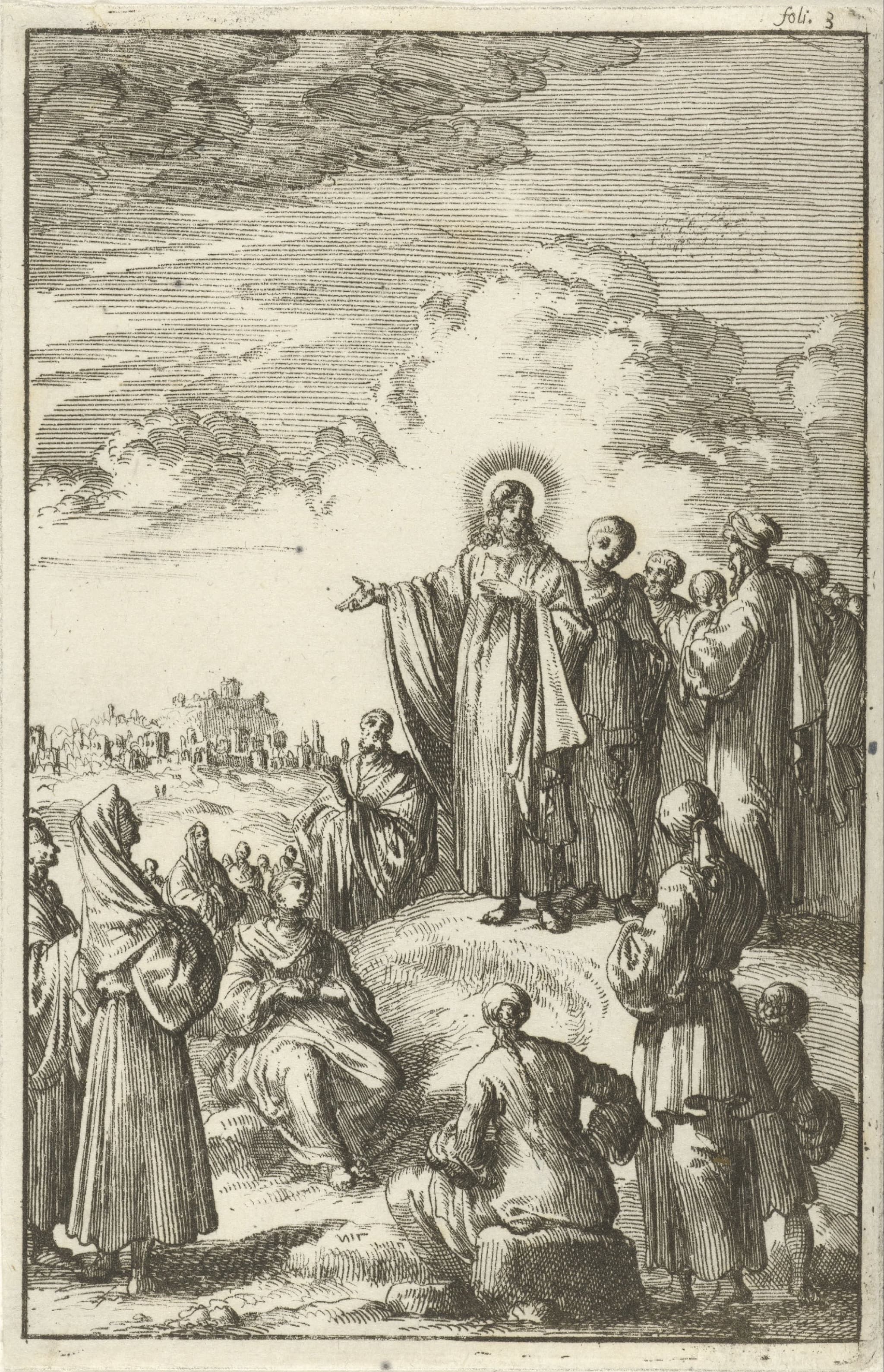
De Bergrede (The Sermon on the Mount), etched by Jan Luyken around 1684 in his Amsterdam workshop and one of the small religious illustrations he produced for the Mennonite-publisher Jacobus van der Deyster, depicts the moment in Matthew 5 in which Christ delivers the Sermon on the Mount to the assembled crowd on a hillside above the Sea of Galilee. Luyken stages the scene as a quiet pastoral encounter — Christ seated on a low rock at the upper register of the composition, the assembled disciples and listeners gathered in a loose semicircle around him in postures of attentive listening, the Mediterranean landscape stretching behind under a soft midday sky. The composition demonstrates Luyken's characteristic restraint and his Mennonite-pietist preference for the legible, calm Gospel encounter over the dramatic Baroque action scene. The print circulated through Dutch Anabaptist devotional publishing throughout the late seventeenth and eighteenth centuries.
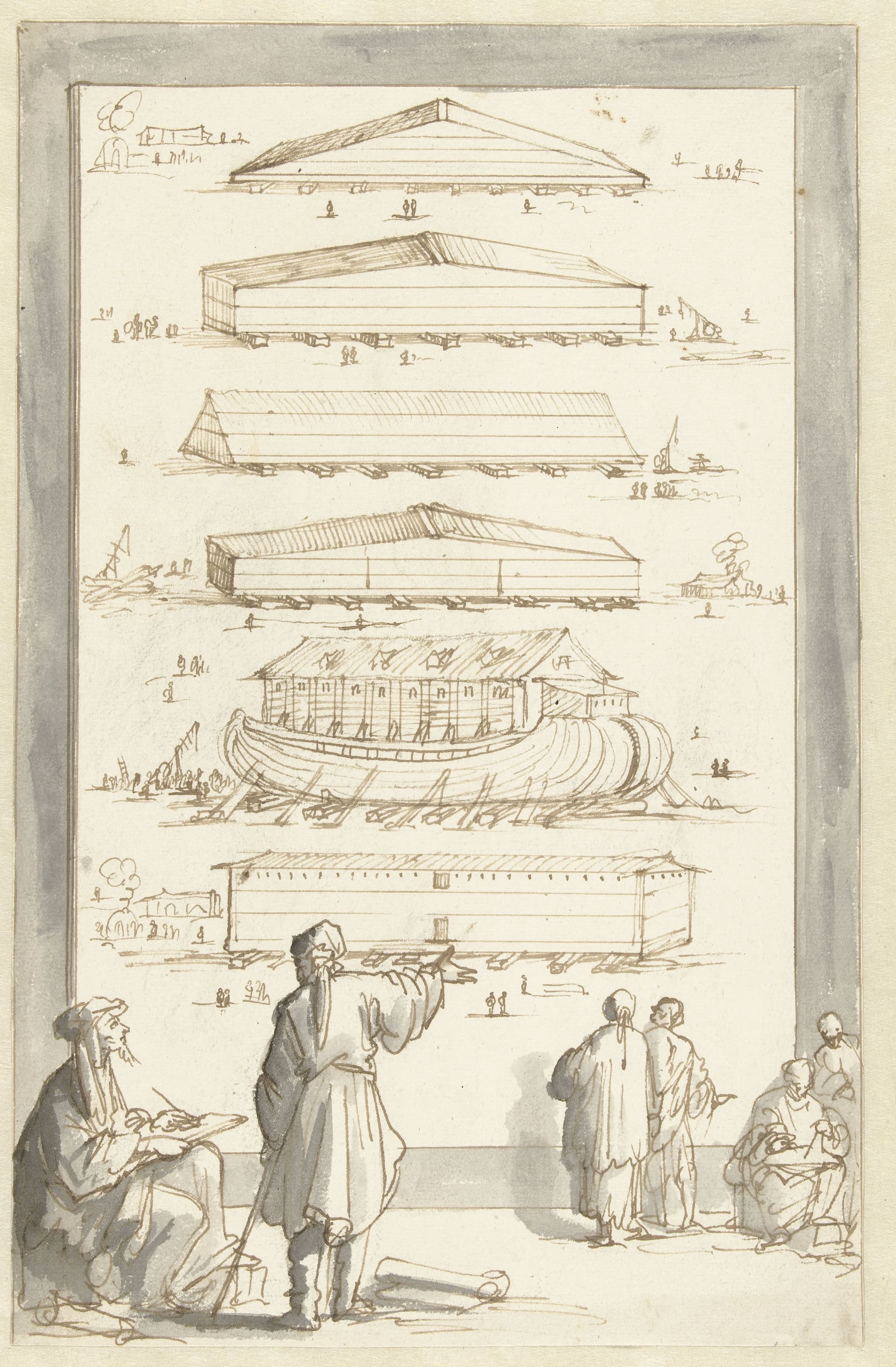
Bouw van de ark van Noach (The Building of Noah's Ark), etched by Jan Luyken around 1688 in his Amsterdam workshop, illustrates the great pre-Flood project from Genesis 6 in which Noah and his sons construct the wooden ark to the divine specifications. Luyken stages the scene as a busy outdoor construction yard: the half-built ark rising in the upper register with workers crawling over its scaffolds, the timber being prepared and shaped in the lower foreground, Noah directing the work from the left foreground in patriarchal robes, his three sons with their hammers and adzes scattered across the working surfaces. The print was one of the standard plates in Luyken's prolific output of Old Testament illustrations and circulated through Dutch Mennonite and broader Protestant devotional publishing for several generations after its first appearance.
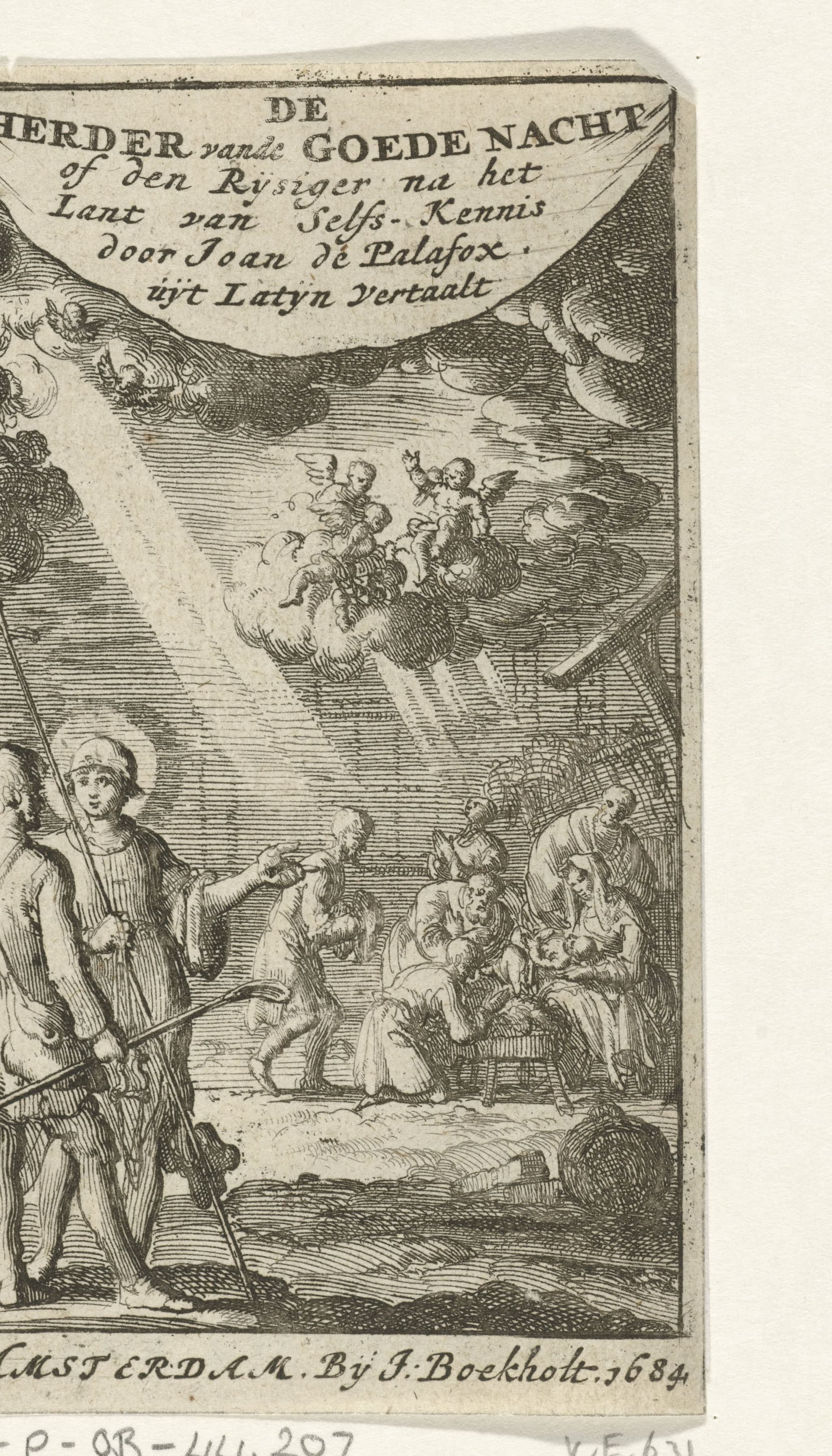
Aanbidding door de herders (Adoration of the Shepherds), etched by Jan Luyken around 1684 in his Amsterdam workshop, depicts the moment from Luke 2 in which the shepherds, having heard the angels' announcement of the birth of Christ, arrive at the small dwelling at Bethlehem to find the newborn child laid in the manger. Luyken stages the scene as a quiet nocturnal encounter inside the small thatched stable: the seated Virgin holding the swaddled Christ Child on her lap; Joseph waiting behind her with a small lantern; the three shepherds gathered in the foreground in postures of recognition and tender adoration. The composition demonstrates Luyken's characteristic Mennonite-pietist preference for the calm, almost domestic Gospel encounter. The print circulated through Dutch and broader Protestant illustrated-Bible publishing for over a century.
jan-luyken-de-zondvloed
De zondvloed (The Flood), etched by Jan Luyken around 1710 in his Amsterdam workshop in the late phase of his career, depicts the moment from Genesis 7 in which the waters of the Flood overwhelm the unrighteous and the Ark floats away across the rising sea. Luyken stages the scene with characteristic late-pietist restraint — the Ark visible as a small dark silhouette in the upper distance riding the storm waves, while the foreground shows the doomed pre-Flood humans clinging to small rocky outcrops with their families and animals as the water rises around them. The composition is among the most reproduced Luyken Old Testament illustrations and a defining statement of the late seventeenth and early eighteenth-century Dutch Mennonite preoccupation with the typological reading of the Old Testament narratives of judgment and salvation.
Bible scenes Jan Luyken painted
Matthew
Genesis
Exodus
Luke
John
Acts