Exodus 25
People in this chapter
Exodus 25 is God saying, "I will live with you." He has just freed Israel from Egypt and brought them to the mountain. They stand at Sinai, trembling at the voice of God. The law is given. The covenant is made. And now God says: Build me a house. Not a house in heaven. Not a house somewhere far away. A house here, in the middle of your camp. Wherever you go, I go with you. Wherever you dwell, I will dwell.
Tap any highlighted phrase to jump to the commentary that unpacks it.
Exodus 25:1-9The Voluntary Gift
1And the LORD spake unto Moses, saying, 2Speak unto the children of Israel, that they bring me an offering: of every man that giveth it willingly with his heart ye shall take my offering. 3And this is the offering which ye shall take of them; gold, and silver, and brass, 4And blue, and purple, and scarlet, and fine linen, and goats’ hair,
Gold, silver, brass, blue, purple, scarlet - the materials for the tabernacle come from a willing heart. Worship begins with what the people gladly give1.
5And rams’ skins dyed red, and badgers’ skins, and shittim wood, 6Oil for the light, spices for anointing oil, and for sweet incense, 7Onyx stones, and stones to be set in the ephod, and in the breastplate. 8And let them make me a sanctuary; that I may dwell among them. 9According to all that I shew thee, after the pattern of the tabernacle, and the pattern of all the instruments thereof, even so shall ye make it.
The phrase "willingly with his heart" appears three times in these verses. God builds His house through the generosity of His people. After the devastation of slavery, after the terror of the plagues, after the sea splitting open - now the people bring gifts. Freely. With joy. The tabernacle is made of the people's love made tangible2.
Exodus 25:10-12Wood and Gold for the Ark
10And they shall make an ark of shittim wood: two cubits and a half shall be the length thereof, and a cubit and a half the breadth thereof, and a cubit and a half the height thereof. 11And thou shalt overlay it with pure gold, within and without shalt thou overlay it, and shalt make upon it a crown of gold round about. 12And thou shalt cast four rings of gold for it, and put them in the four corners thereof; and two rings shall be in the one side of it, and two rings in the other side of it.
God commands an ark made of acacia wood, two and a half cubits long and a cubit and a half wide and high, overlaid with pure gold inside and out and finished with a gold molding around its top. Four gold rings are cast for its corners, ready to receive the poles by which it will be carried.
Exodus 25:13-16The Poles and the Testimony Within
13And thou shalt make staves of shittim wood, and overlay them with gold. 14And thou shalt put the staves into the rings by the sides of the ark, that the ark may be borne with them. 15The staves shall be in the rings of the ark: they shall not be taken from it. 16And thou shalt put into the ark the testimony which I shall give thee.
The ark is complete - a wooden chest overlaid with gold, carried by staves, holding the covenant within. Now comes the crown upon it, the mercy covering, the place where God will meet His people. The structure holds the law; the mercy seat holds the relationship.
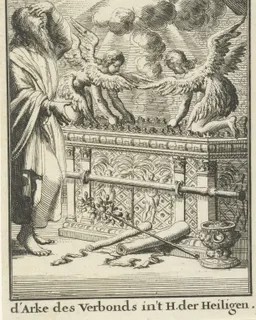
The "testimony" refers to the two stone tablets - the Ten Commandments. They go inside the ark. Above them sits the mercy seat. The image is profound: the broken law rests beneath the place of mercy. The judgment is underneath. The mercy covers it. This is the pattern Christ fulfills: the law condemns, but Christ covers the condemnation with His own blood3.
Exodus 25:17-19The Mercy Seat and the Cherubim
17And thou shalt make a mercy seat of pure gold: two cubits and a half shall be the length thereof, and a cubit and a half the breadth thereof. 18And thou shalt make two cherubims of gold, of beaten work shalt thou make them, in the two ends of the mercy seat. 19And make one cherub on the one end, and the other cherub on the other end: even of the mercy seat shall ye make the cherubims on the two ends thereof.
Exodus 25:20-22Where God Will Meet You
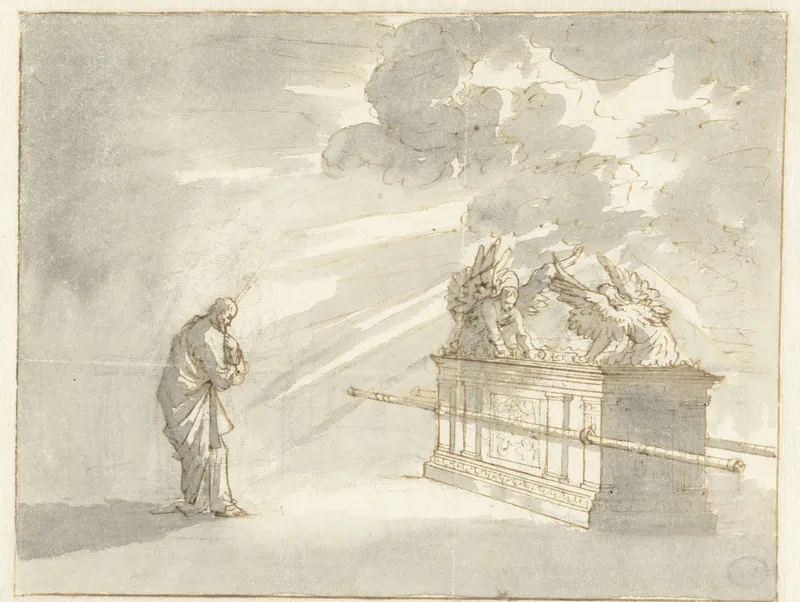
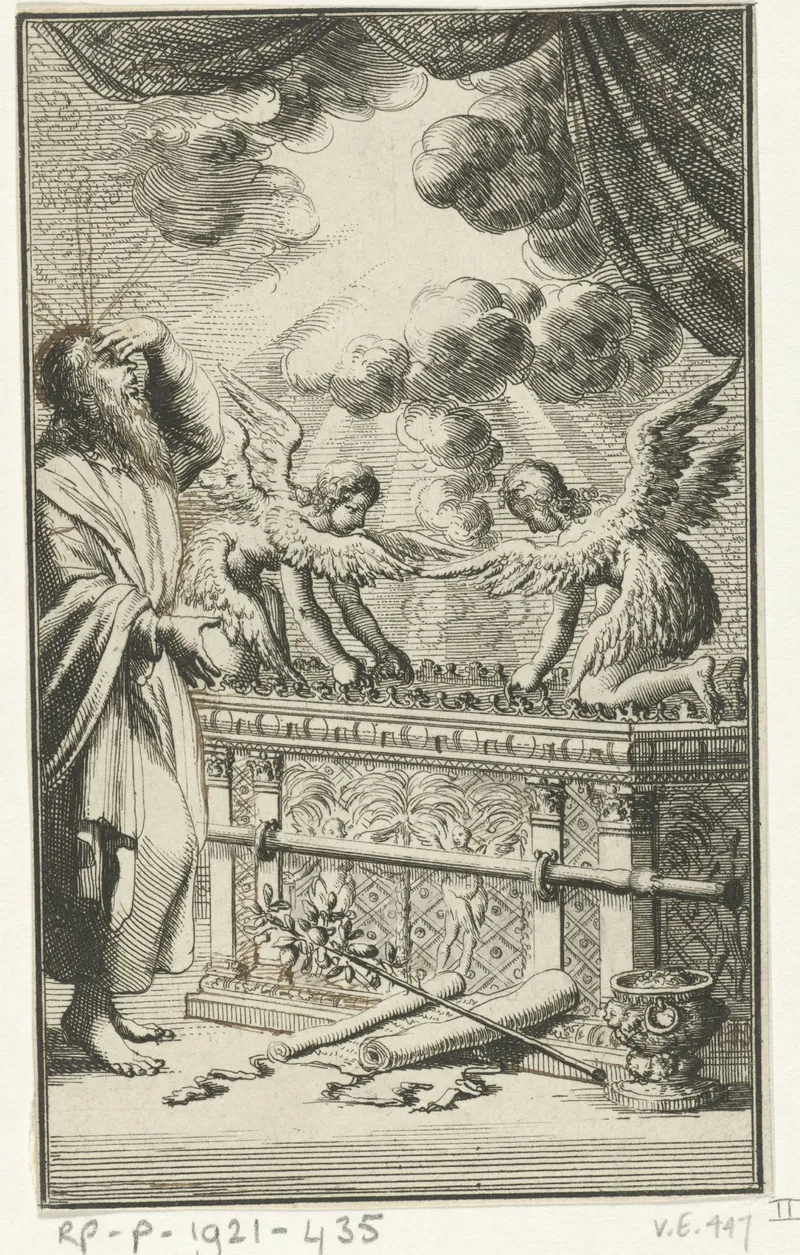
20And the cherubims shall stretch forth their wings on high, covering the mercy seat with their wings, and their faces shall look one to another; toward the mercy seat shall the faces of the cherubims be. 21And thou shalt put the mercy seat above upon the ark; and in the ark thou shalt put the testimony that I shall give thee. 22And there I will meet with thee, and I will commune with thee from above the mercy seat, from between the two cherubims which are upon the ark of the testimony, of all things which I will give thee in commandment unto the children of Israel.
God says, "There I will meet with thee." Not everywhere in the sanctuary. Not in the courtyard. At the mercy seat. Between the two cherubim. The meeting place is the place of atonement. You cannot meet God without the mercy seat. You cannot draw near without blood covering the law. This is where communion happens - at the boundary between judgment and grace.
Exodus 25:23-30The Table of Showbread
23Thou shalt also make a table of shittim wood: two cubits shall be the length thereof, and a cubit the breadth thereof, and a cubit and a half the height thereof. 24And thou shalt overlay it with pure gold, and make thereto a crown of gold round about. 25And thou shalt make unto it a border of an hand breadth round about, and thou shalt make a golden crown to the border thereof round about. 26And thou shalt make for it four rings of gold, and put the rings in the four corners that are on the four feet thereof.
God commands a table of acacia wood, two cubits long, a cubit wide, and a cubit and a half high, overlaid with pure gold and finished with a gold molding. A rim a handbreadth wide runs around it with its own gold molding, and four gold rings are set at its corners by the legs to hold the poles that carry it.
27Over against the border shall the rings be for places of the staves to bear the table. 28And thou shalt make the staves of shittim wood, and overlay them with gold, that the table may be borne with them. 29And thou shalt make the dishes thereof, and spoons thereof, and covers thereof, and bowls thereof, to cover withal: of pure gold shalt thou make them. 30And thou shalt set upon the table shewbread before me alway.
The table is on the north side of the sanctuary. It is not as central as the ark of the covenant, but it is not hidden either. It stands in the holy place, a table set with bread. The priests who serve in the sanctuary will eat that bread as a sign of their covenant with God. They sustain themselves on the presence of God made tangible.
Every vessel is made of gold. The dishes for the bread, the spoons for the drink offering, the cups and bowls. Nothing is common. Everything is set apart. The meal is made of holy things. The sustenance is sacred because it is shared in the presence of God.
Exodus 25:31-40The Seven-Branched Lampstand
31And thou shalt make a candlestick of pure gold: of beaten work shall the candlestick be made: his shaft, and his branches, his bowls, his knops, and his flowers, shall be of the same. 32And six branches shall come out of the sides of it; three branches of the candlestick out of the one side, and three branches of the candlestick out of the other side: 33Three bowls made like unto almonds, with a knop and a flower in one branch; and three bowls made like almonds in the other branch, with a knop and a flower: so in the six branches that come out of the candlestick. 34And in the candlestick shall be four bowls made like unto almonds, with their knops and their flowers. 35And there shall be a knop under two branches of the same, and a knop under two branches of the same, and a knop under two branches of the same, according to the six branches that proceed out of the candlestick.
The lampstand is hammered from one piece of pure gold - branches, knops, flowers, all of one substance. Light in the holy place will not be assembled; it will be one work.
36Their knops and their branches shall be of the same: all it shall be one beaten work of pure gold. 37And thou shalt make the seven lamps thereof: and they shall light the lamps thereof, that they may give light over against it. 38And the tongs thereof, and the snuffdishes thereof, shall be of pure gold. 39Of a talent of pure gold shall he make it, with all these vessels. 40And look that thou make them after their pattern, which was shewed thee in the mount.
The lamps are not for decoration. They are for giving light. In the holy place of the tabernacle, there are no windows. All the light comes from the seven lamps of the menorah. The priest cannot see his work unless the lamps are burning. The light is not incidental to the sanctuary - it is necessary. It is how the priest reads the law, prepares the offerings, performs the work of God.
The lampstand is made of beaten gold - one talent of pure gold worked by a craftsman's hammer into an intricate shape. Not poured into a mold. Not cast. Beaten. Shaped. Each curve and branch formed under the blow of the hammer. The detail is remarkable: almond blossoms, buds, flowers - all made in gold, all beaten by hand. The most expensive thing in the sanctuary is also the most beautiful thing in it.
The phrase "after the pattern" recurs through Exodus. A pattern was shown to Moses on the mount - a vision, a blueprint, a picture of reality as God intended it to be. The sanctuary is not to be invented or decorated according to the builder's taste. It is to be built precisely as God showed it. The pattern is from God. The execution is the people's. But the vision belongs to God alone.
Exodus 25 · The Pattern from the MountThe Sanctuary Made Visible
Three pieces of furniture stand in the holy place: the ark of the covenant (the holiest), the table of showbread (on the north), and the lampstand (on the south). Together they tell a story. The ark is the place where God meets His people - mercy covering judgment. The table is the place where God feeds His people - sustenance for covenant-keeping. The lamp is the place where God illuminates His people - truth lighting the way.
A sanctuary is complete when judgment, mercy, sustenance, and light are all present. A sanctuary is complete when God dwells in the middle of it all.
Moses is told to build everything "according to the pattern" shown on the mount. The word is used carefully in Scripture. When God says there is a pattern, He means something invisible is being made visible. The tabernacle is the visible form of invisible realities. The mercy seat is visible grace. The table is visible sustenance. The lampstand is visible truth. The boards and curtains and curtain rods are a real dwelling place, holding the invisible world in place so Israel can see it, touch it, remember it, and know God is real.
Research trail
Sources & further study
These references support the historical, linguistic, manuscript, and contextual notes in this chapter. Scripture remains the primary text; external sources are provided so readers can inspect the research directly.