Acts 8
People in this chapter
They killed Stephen, and the storm broke. A great persecution drove the believers out of Jerusalem, and the church scattered abroad through Judaea and Samaria. It looks like the end of everything. It is the beginning. Scattering is sowing. Disciples who run are disciples who tell, and the word goes wherever they go 1. The apostles stay put. The ordinary, hunted believers are the ones who carry the gospel out.
Tap any highlighted phrase to jump to the commentary that unpacks it.
Acts 8:1-3Saul Makes Havoc
1And Saul was consenting unto his death. And at that time there was a great persecution against the church which was at Jerusalem; and they were all scattered abroad throughout the regions of Judaea and Samaria, except the apostles. 2And devout men carried Stephen to his burial, and made great lamentation over him. 3As for Saul, he made havock of the church, entering into every house, and haling men and women committed them to prison.
Saul stands at the edge of the text, approving Stephen's execution. He is not a minor player - he is a young, zealous Pharisee burning to defend the law against what he sees as apostasy. Within verses, he will become the chief persecutor.
Saul enters every house - dragging men and women from their homes. His zeal is not passive disapproval; it is violent action. The church is hunted. Yet notice: the apostles stay in Jerusalem. The scattered ones - the ordinary disciples - are the ones who carry the gospel outward 1.
The verb “haling” is brutal. To drag, to haul. This persecution is not theoretical. It is physical, systematic, household by household. Yet it will become the very engine that spreads the gospel across Judaea and into Samaria.
Acts 8:4-8The Scattered Ones Preach the Word
4Therefore they that were scattered abroad went every where preaching the word. 5Then Philip went down to the city of Samaria, and preached Christ unto them. 6And the people with one accord gave heed unto those things which Philip spake, hearing and seeing the miracles which he did. 7For unclean spirits, crying with loud voice, came out of many that were possessed with them: and many taken with palsies, and that were lame, were healed. 8And there was great joy in that city.
The church is hunted, and the result is preaching everywhere. Every believer became a messenger. The ordinary scattered ones carried the gospel outward. This is how the gospel moves: by the faith of people who have nothing to lose but their lives, and have already given those to Christ.
Philip appears here as a deacon (Acts 6), not an apostle. Yet he goes to Samaria - enemy territory. The Jews did not eat with Samaritans, did not speak with them, did not go near them. Philip preaches Christ to them without hesitation. The barriers that centuries of history built, the Spirit begins to dismantle. Samaria itself - the city Philip enters - was excavated by the Israel Antiquities Authority and is now known as Sebaste, revealing the architecture and religion of first-century Samaria2.
The possession and deliverance are real. Unclean spirits cry out and leave. The lame walk. The text does not spiritualize or soften these acts. Philip's preaching is accompanied by genuine power over darkness.
Joy marks the city. This is the first harvest outside Jerusalem. And it begins with someone - Philip - willing to cross a line everyone else thought was fixed forever.
Acts 8:9-13Simon the Sorcerer Believes
9But there was a certain man, called Simon, which beforetime in the same city used sorcery, and bewitched the people of Samaria, giving out that himself was some great one: 10To whom they all gave heed, from the least to the greatest, saying, This man is the great power of God. 11And to him they had regard, because that of long time he had bewitched them with sorceries. 12But when they believed Philip preaching the things concerning the kingdom of God, and the name of Jesus Christ, they were baptized, both men and women. 13Then Simon himself believed also: and when he was baptized, he continued with Philip, and wondered, beholding the miracles and signs which were done.
Simon sees the real thing and believes. He hears the kingdom of God and the name of Jesus Christ preached, and even he turns - a man who built his whole identity on false power, recognizing truth the moment he meets it. He is baptized with the rest. The early church remembered him for a long time afterward, both for this belief and for the grasping that comes next.
Simon follows Philip. He watches. He is astonished. The Greek word suggests he is amazed, even beside himself with wonder. He has seen sorcery work for years, but he has never seen anything like this.
Acts 8:14-17Peter and John Lay Hands; The Spirit Falls
14Now when the apostles which were at Jerusalem heard that Samaria had received the word of God, they sent unto them Peter and John: 15Who, when they were come down, prayed for them, that they might receive the Holy Ghost: 16(For as yet he was fallen upon none of them: only they were baptized in the name of the Lord Jesus.) 17Then laid they their hands on them, and they received the Holy Ghost.
The apostles in Jerusalem hear the news and send Peter and John. Notice the humility here - the apostles recognize that the Spirit is working in Samaria through Philip, and they do not see it as a threat. They come to strengthen and confirm what God has already begun.
The Samaritans believed and were baptized, but had not yet received the Holy Ghost. They had the outward form of faith but not yet the inward gift of the Spirit. The apostles' presence and prayer complete what Philip had begun.
The laying on of hands is the apostolic act. Through it, the Holy Ghost is given. It is the means the apostles used to bring new believers into full communion with the Spirit that raised Jesus from the dead.
Acts 8:18-20Thy Money Perish With Thee
18And when Simon saw that through laying on of the apostles’ hands the Holy Ghost was given, he offered them money, 19Saying, Give me also this power, that on whomsoever I lay hands, he may receive the Holy Ghost. 20But Peter said unto him, Thy money perish with thee, because thou hast thought that the gift of God may be purchased with money.
Reach for your wallet - that is the instinct of a man who has spent his life buying power and influence. Simon has just watched the Spirit fall under the apostles' hands, and his first thought is the price. Everything has had a price for him. He cannot yet imagine a gift that money does not touch.
Peter does not soften it. He ties the silver to the soul and lets both fall together - if the gift of God can be bought, then the money and the man who thinks so can perish as one 3. The church gave this sin its own name afterward, simony, after Simon himself. Grace is not merchandise. It never goes on the market.
Acts 8:21-24Repent of Thy Wickedness
21Thou hast neither part nor lot in this matter: for thy heart is not right in the sight of God. 22Repent therefore of this thy wickedness, and pray God, if perhaps the thought of thine heart may be forgiven thee. 23For I perceive that thou art in the gall of bitterness, and in the bond of iniquity. 24Then answered Simon, and said, Pray ye to the LORD for me, that none of these things which ye have spoken come upon me.
Peter holds out hope: if Simon will repent and pray, perhaps the thought of his heart may be forgiven. The transaction mentality is the sin. But repentance is possible. Simon must turn from trying to buy and learn to receive.
Acts 8:25-26The Spirit Sends Philip South
25And they, when they had testified and preached the word of the Lord, returned to Jerusalem, and preached the gospel in many villages of the Samaritans. 26And the angel of the Lord spake unto Philip, saying, Arise, and go toward the south unto the way that goeth down from Jerusalem unto Gaza, which is desert.
Philip is in the middle of success. Samaria is responding. He has the apostles' affirmation. And the Spirit calls him to leave it all and walk a desert road. Philip obeys immediately. No negotiation. No "but I'm useful here." Just obedience to the Spirit's call.
Acts 8:27-29The Ethiopian Official Reads Isaiah
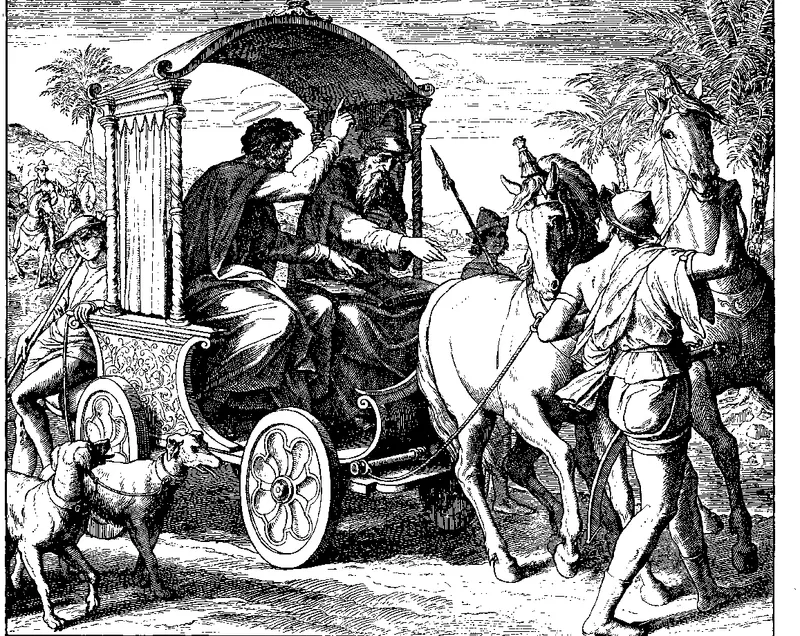
27And he arose and went: and, behold, a man of Ethiopia, an eunuch of great authority under Candace queen of the Ethiopians, who had the charge of all her treasure, and had come to Jerusalem for to worship, 28Was returning, and sitting in his chariot read Esaias the prophet. 29Then the Spirit said unto Philip, Go near, and join thyself to this chariot.
Here is a man of real power - he manages the entire treasury of a queen, the “Candace” whose title marked the rulers of ancient Nubia and Kush. He had traveled hundreds of miles to worship in Jerusalem. And he was kept out. By the law, no eunuch could enter the assembly of the LORD. He came all that way to seek God, found the door barred, and was heading home with a scroll of Isaiah and no one to explain it.
Acts 8:30-32Understandest Thou What Thou Readest?
30And Philip ran thither to him, and heard him read the prophet Esaias, and said, Understandest thou what thou readest? 31And he said, How can I, except some man should guide me? And he desired Philip that he would come up and sit with him. 32The place of the scripture which he read was this, He was led as a sheep to the slaughter; and like a lamb dumb before his shearer, so opened he not his mouth:
Acts 8:33-35Philip Preaches Jesus from the Scripture
33In his humiliation his judgment was taken away: and who shall declare his generation? for his life is taken from the earth. 34And the eunuch answered Philip, and said, I pray thee, of whom speaketh the prophet this? of himself, or of some other man? 35Then Philip opened his mouth, and began at the same scripture, and preached unto him Jesus.
Of all the scrolls in the world, he is reading this one - the Servant led like a lamb to slaughter, silent before the shearer, his life taken from the earth. These lines were written some seven hundred years before the cross, and a copy of them survives in the Dead Sea Scrolls almost exactly as he would have read it 4. He cannot make sense of it. So he asks the only honest question: who is this about - the prophet, or someone else? It is the perfect question, and Philip has the answer.
Acts 8:36-40Baptized on the Way
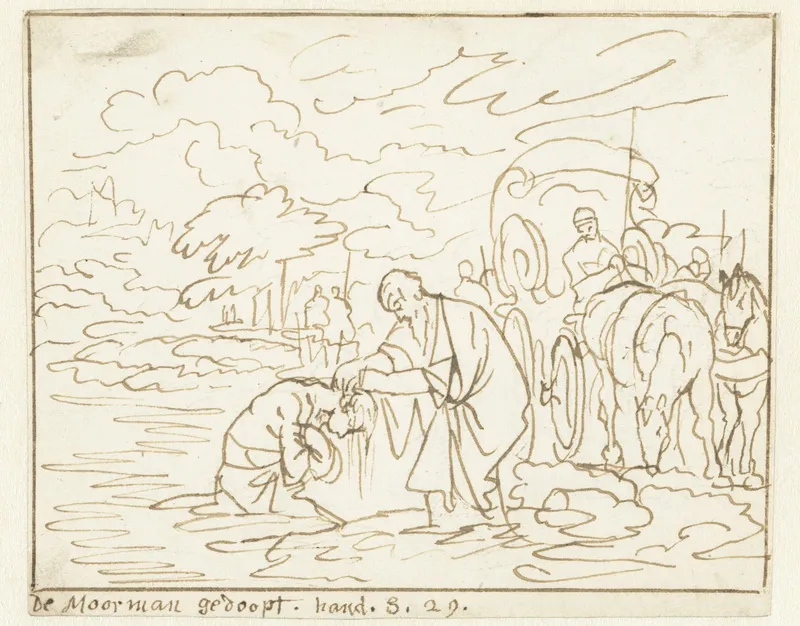
36And as they went on their way, they came unto a certain water: and the eunuch said, See, here is water; what doth hinder me to be baptized? 37And Philip said, If thou believest with all thine heart, thou mayest. And he answered and said, I believe that Jesus Christ is the Son of God. 38And he commanded the chariot to stand still: and they went down both into the water, both Philip and the eunuch; and he baptized him. 39And when they were come up out of the water, the Spirit of the Lord caught away Philip, that the eunuch saw him no more: and he went on his way rejoicing. 40But Philip was found at Azotus: and passing through he preached in all the cities, till he came to Caesarea.
There is no waiting. No committee to approve. No ceremony to prepare. The eunuch says, "Here is water. What hinders me?" and Philip baptizes him on the spot. Faith that sees and acts immediately. The only requirement: belief in Jesus Christ as the Son of God.
The moment the work is finished, the Spirit takes Philip - no goodbye, no exchange of names, no instructions for the road. Jesus has been preached, believed, and sealed in baptism, and that is enough. The eunuch never learns where his teacher went. He only knows he is not the man who climbed into that chariot.
Research trail
Sources & further study
These references support the historical, linguistic, manuscript, and contextual notes in this chapter. Scripture remains the primary text; external sources are provided so readers can inspect the research directly.
- Persecution and Gospel DispersionHistorical analysis of how Christian persecution triggered diaspora and the gospel's expansion beyond Jerusalem.
- Sebaste Excavations (Samaria)Archaeological excavations of ancient Samaria (Sebaste), revealing the urban context of Philip's mission in Acts 8.
- Simony and the Commodification of the SpiritScholarly examination of the concept of simony - attempting to buy spiritual power - from Simon Magus through church history.
- Great Isaiah Scroll (1QIsaa)Digital collection of the Great Isaiah Scroll, including Isaiah 53 in ancient Hebrew, preserved from the first century BCE.
- Isaiah 53 and the Suffering ServantIntertextual links between Isaiah 53's Servant passages and their fulfillment in Christ's passion and redemption.
Where this echoes in Scripture
Simon the Sorcerer Believes
- Luke 10:19Behold, I give unto you power to tread on serpents and scorpions, and over all the power of the enemy.The authority over unclean spirits that works through Philip in verse 7 is the authority Christ handed His followers.
- Acts 13:8-11But Elymas the sorcerer ... withstood them, seeking to turn away the deputy from the faith.Another sorcerer set against the gospel, like Simon in verse 9 - the counterfeit power exposed when the real arrives.
- Exodus 7:11-12They also did in like manner with their enchantments ... but Aaron's rod swallowed up their rods.Egypt's magicians could mimic the signs up to a point, then the true power overwhelmed them - the pattern Samaria sees again.
- 1 John 4:4Greater is he that is in you, than he that is in the world.Why the false power held no ground once Christ was preached in verse 12.
Peter and John Lay Hands; The Spirit Falls
- Acts 1:8Ye shall receive power, after that the Holy Ghost is come upon you ... and in Samaria.The promise being kept in verses 15-17, naming Samaria by name long before Philip arrived.
- Acts 2:1-4They were all filled with the Holy Ghost, and began to speak with other tongues.Pentecost in Jerusalem - the same gift now extended to Samaria through the same apostles.
- Acts 10:44-45On the Gentiles also was poured out the gift of the Holy Ghost.The next boundary to fall - the same Spirit reaching the Gentiles as He here reaches the Samaritans.
- John 4:21-23Ye shall neither in this mountain, nor yet at Jerusalem, worship the Father ... in spirit and in truth.Jesus told a Samaritan woman this; here her people receive the Spirit He promised.
Philip Preaches Jesus from the Scripture
- Isaiah 56:3-5Neither let the eunuch say, Behold, I am a dry tree ... I will give them ... a name better than of sons and of daughters.A few chapters past the one he is reading, the LORD vows the eunuch a place - the answer to his exclusion, in his own scroll.
- Isaiah 53:10-12He shall see his seed ... he shall see of the travail of his soul, and shall be satisfied.The vindication that follows the suffering of verses 32-33 - the Servant rejected, then exalted.
- 1 Peter 2:24Who his own self bare our sins in his own body on the tree.The apostle reading Isaiah 53 the way Philip read it to the eunuch - the Servant's wounds as our healing.
- Luke 24:27Beginning at Moses and all the prophets, he expounded ... the things concerning himself.The risen Jesus opening the Scriptures to point at Himself, exactly as Philip does here from verse 35.
Baptized on the Way
- John 14:6I am the way, the truth, and the life: no man cometh unto the Father, but by me.The eunuch could not reach God through the temple gate; in verse 39 he goes home having found the Way Himself.
- Acts 2:41They that gladly received his word were baptized.The same immediate baptism on belief that the eunuch asks for in verses 36-38.
- Romans 10:14-15How shall they hear without a preacher? ... How beautiful are the feet of them that preach the gospel.Why the Spirit set Philip on that desert road - belief comes by hearing, and someone had to be sent.
- Zephaniah 3:10From beyond the rivers of Ethiopia my suppliants ... shall bring mine offering.A prophet's glimpse of worshippers coming from the very land the rejoicing eunuch is carrying the gospel home to.