Genesis 10
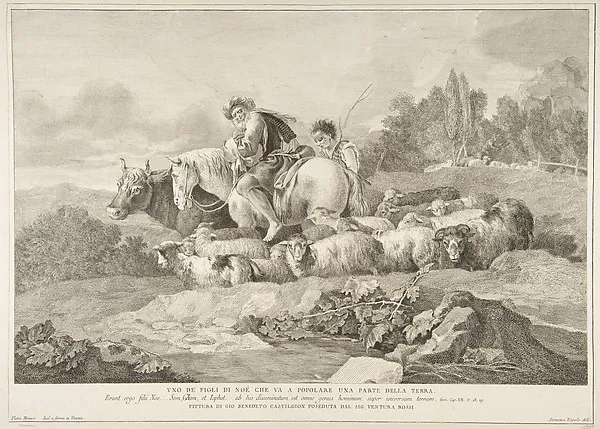
After the Flood has washed the earth clean and the waters have gone down, Genesis turns to a question every reader of the ancient world would have asked: where did all the nations come from? Chapter 10 answers it. Now these are the generations of the sons of Noah, Shem, Ham, and Japheth: and unto them were sons born after the flood (v. 1). What follows is the Table of Nations - seventy peoples charted as they branch out of one household into the lands, languages, and borders of the known world. It reads like a list, but it is making an argument. Three times the same refrain falls like a drumbeat - after their families, after their tongues, in their lands, in their nations - and the chapter closes on the line that names its whole theme: by these were the nations divided in the earth after the flood (v. 32).3
In a world where genealogies were instruments of power - a king listing his conquests, a priest his line, a temple its treasures - this one does something unheard of. It lists nations, and it grants no people a higher birth than any other. Japheth's sons spread to the coastlands and the sea; Ham's to Egypt, Cush, and Canaan; Shem's eastward toward the line that will narrow, in time, to Abraham. Every one of them is traced to the same Flood-survivor, every one named and held in the same divine account. Before Israel ever meets these peoples as neighbors or as obstacles, Genesis introduces them as kin - cousins descended from one father, bearers of the same human likeness. Before judgment comes knowledge; before conflict, kinship.
The chapter also pauses, twice, to let a shadow fall across the map. It slows for one man, Nimrod, who began to be a mighty one in the earth and whose first kingdom rose at Babel in the land of Shinar - the place that becomes, one chapter later, the tower built to make a name for itself. And it slows for one name, Peleg, for in his days was the earth divided. Held together, these are the two stories Genesis is telling at once: one humanity spreading out under the hand of God toward a promised blessing, and the rise of the proud kingdom that builds for its own glory. The list of names turns out to be a map of the whole human race - and of the choice set before it.2
Tap any highlighted phrase to jump to the commentary that unpacks it.
Genesis 10:1-5By These Were the Isles of the Gentiles Divided
1Now these are the generations of the sons of Noah, Shem, Ham, and Japheth: and unto them were sons born after the flood. 2The sons of Japheth; Gomer, and Magog, and Madai, and Javan, and Tubal, and Meshech, and Tiras. 3And the sons of Gomer; Ashkenaz, and Riphath, and Togarmah. 4And the sons of Javan; Elishah, and Tarshish, Kittim, and Dodanim. 5By these were the isles of the Gentiles divided in their lands; every one after his tongue, after their families, in their nations.
The chapter opens with the word that organizes the whole book: Now these are the generations of the sons of Noah (v. 1). Genesis is built out of these headings - the generations of the heavens and the earth, of Adam, of Noah, and now of his sons - each one turning the camera to a new branch of the family and asking what became of it. Here the question is the largest yet. The Flood has ended; the ark has emptied; the earth lies open and unpeopled. From the three men who walked off that ark - Shem, Ham, and Japheth - the whole human race is about to be rebuilt. And the very first thing the text insists on is that what follows is real history, not myth: unto them were sons born after the flood. Ordinary children, born in the ordinary way, in the years after the waters went down. The grand sweep of the nations begins not with gods descending or heroes springing from the soil, as the surrounding cultures told it, but with a family having children. Every people on the map about to be drawn is, at root, somebody's grandchild.
The list begins with Japheth, and his sons spread out toward the rim of the known world. Gomer… Magog… Madai… Javan… Tubal… Meshech… Tiras (v. 2) carry the line northward and westward - Javan toward the Greeks of the coastlands, Madai toward the Medes, the others toward the far northern peoples whom the prophets would later name. Then comes the refrain that will govern the chapter: By these were the isles of the Gentiles divided in their lands; every one after his tongue, after their families, in their nations (v. 5). The isles are the seacoasts and far places, the maritime fringe of the world. Notice how much the verse holds in one breath: each people has its own tongue, its own families, its own land, its own place among the nations. This is not chaos and it is not accident. The peoples are divided - distributed, given their portions - and the dividing is described as something that happened to them, under a hand greater than their own. Distinct languages, distinct lands, distinct nations: the variety of the human family is presented here not as a problem but as a fact woven into how the earth was repeopled.3
It is worth pausing over what is not in these verses. There is no ranking. Japheth's sons are listed first, but nothing marks them as superior; Shem, through whom the promised line will run, comes last of the three and is given no privilege of birth in the telling. There is no conquest here, no people subjugating another, no boundary drawn in blood - only names, tongues, and lands set peacefully side by side. In a world that told its origin stories to explain why our people deserve to rule and their people deserve to serve, Genesis tells a flatter, stranger story: all of them came from the same three brothers, who came from the same father, who walked off the same ark. The cultures that would later meet Israel - the seafaring Greeks descended from Javan, the northern powers, and in the next section Egypt and Canaan - are introduced first as kin. Before they are ever enemies or rivals, they are cousins. The map being drawn is a family tree, and the family is one.1
Genesis 10:6-20A Mighty Hunter Before the LORD
6And the sons of Ham; Cush, and Mizraim, and Phut, and Canaan. 7And the sons of Cush; Seba, and Havilah, and Sabtah, and Raamah, and Sabtechah: and the sons of Raamah; Sheba, and Dedan. 8And Cush begat Nimrod: he began to be a mighty one in the earth. 9He was a mighty hunter before the LORD: wherefore it is said, Even as Nimrod the mighty hunter before the LORD. 10And the beginning of his kingdom was Babel, and Erech, and Accad, and Calneh, in the land of Shinar. 11Out of that land went forth Asshur, and builded Nineveh, and the city Rehoboth, and Calah, 12And Resen between Nineveh and Calah: the same is a great city.
The second branch is Ham, and his sons settle the lands that will loom largest in Israel's story. Cush, and Mizraim, and Phut, and Canaan (v. 6) map onto the world as it stood: Cush to the south, toward Nubia and Ethiopia; Mizraim, which is simply the Hebrew word for Egypt; Phut toward the north of Africa; and Canaan, the land that will one day be promised to Abraham's seed. The line of Cush spreads further still, into Arabia - Seba… Havilah… Raamah… Sheba, and Dedan (v. 7) - names that will surface again as distant trading peoples, and Sheba from whom a queen will come to test Solomon's wisdom. These are the nations Israel will know most intimately: Egypt as both refuge and house of bondage, Canaan as the land it will be sent to possess. But Genesis does not introduce them as enemies. It introduces them as Ham's children, born after the Flood like everyone else, named in the same account as the rest of the human family. The peoples Israel will later struggle with are first set down here as relatives.
Then the steady rhythm of the list breaks, and the text slows for a single man. And Cush begat Nimrod: he began to be a mighty one in the earth (v. 8). Everywhere else the chapter simply names sons and moves on; here it stops and tells a story. Nimrod is the first person in the Bible called a mighty one - the Hebrew gibbor, the word for a warrior, a champion, a man of overwhelming strength. And the verb is telling: he began to be a mighty one. Something new enters the human story with him. Up to this point the nations have spread out quietly, each to its land; with Nimrod, the will to dominate appears - the drive not merely to settle a place but to master it, to gather power and bend others to it. He is remembered as a mighty hunter before the LORD (v. 9), a phrase repeated so it cannot be missed, until Even as Nimrod the mighty hunter before the LORD becomes a proverb in the land. The text does not pause to praise or condemn him outright; it lets the shape of the man speak. The first individual lifted out of the Table of Nations is not a patriarch or a worshipper but an empire-builder - the strong man whose hunting and whose kingdom go together.
Where Nimrod's might leads is named without comment but with great weight: And the beginning of his kingdom was Babel, and Erech, and Accad, and Calneh, in the land of Shinar (v. 10). This is the first time the word kingdom appears in the Bible, and the first city named in it is Babel. The reader who knows what comes next feels the ground shift. The land of Shinar is the very plain where, one chapter later, humanity will gather to build a tower whose top may reach unto heaven and to make us a name (Gen. 11:4). Here Genesis only lays the foundation stones - Babel, Erech, Accad, Calneh - and from Shinar the building does not stop: Out of that land went forth Asshur, and builded Nineveh… and Calah… the same is a great city (vv. 11-12). Babel and Nineveh: the two cities whose names will become bywords for the proud kingdoms that set themselves against God's people and against God Himself. The text does not yet condemn them. It simply notes, with a kind of restraint that is its own warning, where the first kingdom of the mighty hunter began - and how, once begun, it kept building outward, city after city, reaching for greatness.3
13And Mizraim begat Ludim, and Anamim, and Lehabim, and Naphtuhim, 14And Pathrusim, and Casluhim, (out of whom came Philistim,) and Caphtorim. 15And Canaan begat Sidon his firstborn, and Heth, 16And the Jebusite, and the Amorite, and the Girgasite, 17And the Hivite, and the Arkite, and the Sinite, 18And the Arvadite, and the Zemarite, and the Hamathite: and afterward were the families of the Canaanites spread abroad. 19And the border of the Canaanites was from Sidon, as thou comest to Gerar, unto Gaza; as thou goest, unto Sodom, and Gomorrah, and Admah, and Zeboim, even unto Lasha. 20These are the sons of Ham, after their families, after their tongues, in their countries, and in their nations.
From the cities of the east the eye turns west and south, and the list grows dense with names a later reader of Israel's story will recognize at once. Mizraim's line runs through the peoples of Egypt and includes a parenthesis worth marking - (out of whom came Philistim) (v. 14), the Philistines, who will press on Israel for centuries. Then comes Canaan's line, and it reads almost like a roll of the nations Israel will meet in the land of promise: Sidon his firstborn, and Heth - the Hittites - and the Jebusite, and the Amorite, and the Girgasite… the Hivite (vv. 15-17). These are the peoples whose names recur whenever God speaks of the land Abraham's children will enter. And yet here, in Genesis 10, not one of them is marked for judgment. They are listed exactly as the others are - after their families, after their tongues, in their countries (v. 20) - sons of Ham, cousins of Shem, named in the same breath as every other nation. Genesis knows them as family before it ever knows them as obstacles. The reader is meant to carry that forward: the peoples of the land are not faceless foes but kindred, descended from the same Flood, bearing the same human likeness.
The borders of Canaan are traced with unusual care - from Sidon… unto Gaza; as thou goest, unto Sodom, and Gomorrah, and Admah, and Zeboim, even unto Lasha (v. 19) - and the naming is not idle. Among the cities marking Canaan's frontier stand Sodom and Gomorrah, set down here, calmly, as ordinary points on a map. The reader who travels on with Genesis will arrive at these same cities again in fire (Gen. 19). It is the chapter's quiet method once more: the places that will later become signs of judgment are introduced first simply as part of the inhabited world, full of people, holding their place among the nations. There is something sobering in seeing Sodom on the map before it is a ruin - a living city, a name among names, its end not yet written. The Table of Nations does not rush to verdicts. It lets the peoples and their cities stand in their lands, known and counted, before any of their stories have run their course. Judgment, where it comes, will come later; here there is only the patient naming of a world still whole.
Genesis 10:21-32Shem, the Father of All the Children of Eber
21Unto Shem also, the father of all the children of Eber, the brother of Japheth the elder, even to him were children born. 22The children of Shem; Elam, and Asshur, and Arphaxad, and Lud, and Aram. 23And the children of Aram; Uz, and Hul, and Gether, and Mash. 24And Arphaxad begat Salah; and Salah begat Eber. 25And unto Eber were born two sons: the name of one was Peleg; for in his days was the earth divided; and his brother's name was Joktan.
The list comes at last to Shem, and the way he is introduced quietly signals that something different is happening here. Unto Shem also, the father of all the children of Eber (v. 21). The other branches were headed simply by their ancestor's name; Shem is identified by a descendant still several generations off - Eber, the man from whom the word “Hebrew” will come. The genealogy is already leaning forward, past the present generation toward a line that matters. His sons are named - Elam, and Asshur, and Arphaxad, and Lud, and Aram (v. 22) - and they too become nations: Elam to the east, Asshur toward Assyria, Aram the Arameans of Syria, whose tongue Israel will one day speak. But the camera does not linger on the breadth of Shem's line the way it lingered on the others. It hurries down a single strand: Arphaxad begat Salah; and Salah begat Eber (v. 24). Three names in a row, no detours - the text is following a thread. Among all the nations spreading across the earth, one line is being quietly traced, and the reader who knows where Genesis is going can feel the narrowing. This is how the promise always moves: hidden inside an ordinary genealogy, one name leading to the next, until it arrives where God intends.
At Eber the line reaches a name freighted with meaning. Unto Eber were born two sons: the name of one was Peleg; for in his days was the earth divided; and his brother's name was Joktan (v. 25). Peleg means “division,” and the text pauses to explain why: in his days was the earth divided. What exactly that dividing was, Scripture does not spell out here. Many readers hear in it an echo of what comes next - the scattering of the peoples and the confusing of tongues at Babel (ch. 11), which would indeed divide the earth's families across its face. The text itself leaves the manner open and simply marks the fact: in Peleg's generation, the one human family became many, parted and spread abroad. And notice what the verse does with its two sons. Peleg's line will narrow on toward Abraham and the promise; Joktan's will fan out into the peoples of Arabia, named in the verses that follow. The text does not yet exalt one brother over the other. It simply names them both - the chosen line and the wider family side by side - the way it has done all along. The promised seed is not announced with trumpets; it is tucked into a list, one name among many, waiting to be followed.3
26And Joktan begat Almodad, and Sheleph, and Hazarmaveth, and Jerah, 27And Hadoram, and Uzal, and Diklah, 28And Obal, and Abimael, and Sheba, 29And Ophir, and Havilah, and Jobab: all these were the sons of Joktan. 30And their dwelling was from Mesha, as thou goest unto Sephar a mount of the east. 31These are the sons of Shem, after their families, after their tongues, in their lands, after their nations. 32These are the families of the sons of Noah, after their generations, in their nations: and by these were the nations divided in the earth after the flood.
Joktan's sons are named in a long run - Almodad… Hazarmaveth… Sheba… Ophir… Havilah (vv. 26-29) - peoples of the Arabian south and east, some of them remembered later for their gold and spice, their dwelling… from Mesha… unto Sephar a mount of the east (v. 30). It is worth noticing that the chosen line through Peleg gets no such roll of descendants here; the text follows the other brother out to the edges and lets the promised strand wait. That is characteristic of Genesis. It refuses to flatten the wider family into a mere backdrop for the elect line; the sons of Joktan are real nations, given their place and their lands and their honor in the account, exactly as the chosen line will be. Then the whole Table is sealed with the formula that has tolled through all three branches: These are the sons of Shem, after their families, after their tongues, in their lands, after their nations (v. 31). Japheth, Ham, Shem - each section closing on the same words, families and tongues and lands and nations. The chapter is built like a refrain precisely so the reader cannot miss its claim: this is the whole human race, all of it, every people in its place, all sprung from one.
The final verse gathers everything into one line and names the chapter's theme outright: These are the families of the sons of Noah, after their generations, in their nations: and by these were the nations divided in the earth after the flood (v. 32). The whole long catalogue resolves into that single statement - the nations divided in the earth after the flood. The same verb that opened the list now closes it: the peoples were divided, parted out across the world, each to its land and tongue. And the closing words anchor it in time - after the flood. This is the world rebuilt; this is what became of the three who walked off the ark. Yet the very word that ends the chapter, divided, leaves a question hanging in the air. A family parted is a family that might be gathered again. The dividing of the nations is the great fact of Genesis 10 - but it is not the last word Scripture will speak over the nations. The list of the scattered is, read in the light of all that follows, also a list of the invited: every family named here is a family God means to reach.
Further study
- The Hebrew text of Genesis 10 with Rashi, Ibn Ezra, and other classical commentators side by side - useful for the verbs of dividing (parad in v. 5 and palag behind the name Peleg in v. 25), for gibbor (vv. 8-9, the “mighty one” and “mighty hunter”), and for the recurring formula after their families, after their tongues, in their lands, in their nations.
- Genesis 10 ↔ Acts 17 · Genesis 12 · Acts 2 · Revelation 7Intertextual BibleTraces the threads tying the Table of Nations to the rest of Scripture - the seventy nations of one family (vv. 1-32) read alongside of one blood all nations of men (Acts 17:26), the families divided read beside the promise that in Abraham all families of the earth would be blessed (Gen. 12:3), and the scattering at Babel answered by every tongue hearing at Pentecost (Acts 2) and the multitude of all nations before the throne (Rev. 7:9).
- Genesis 10 - Translators' NotesNET BibleThe NET Bible's detailed footnotes on Genesis 10 - the structure of the Table of Nations and its symbolic count of seventy peoples, the difficult description of Nimrod in verses 8-10, the cities of Shinar and Assyria, and the note in verse 25 that in Peleg's days was the earth divided.
Where this echoes in Scripture
By These Were the Isles of the Gentiles Divided
- Acts 17:26And hath made of one blood all nations of men for to dwell on all the face of the earth, and hath determined the times before appointed, and the bounds of their habitation.The apostle’s reading of this whole chapter - the nations divided into their lands (v. 5) are one blood from one father.
- Genesis 9:19These are the three sons of Noah: and of them was the whole earth overspread.The verse just before this chapter, naming its premise - the whole earth peopled from the three sons of verse 1.
- Deuteronomy 32:8When the most High divided to the nations their inheritance, when he separated the sons of Adam, he set the bounds of the people.The dividing of verse 5 named as God’s own act - the nations given their bounds by the Most High.
- Ezekiel 38:2-3Son of man, set thy face against Gog, the land of Magog, the chief prince of Meshech and Tubal.Japheth’s sons of verse 2 - Magog, Meshech, Tubal - named again as nations in Israel’s prophetic future.
- Psalm 86:9All nations whom thou hast made shall come and worship before thee, O Lord; and shall glorify thy name.The nations of this chapter gathered to their purpose - made by God, and at last come to worship Him.
A Mighty Hunter Before the LORD
- Genesis 11:4Let us build us a city and a tower, whose top may reach unto heaven; and let us make us a name.Where the kingdom begun at Babel (v. 10) is going - the city of man built to make its own name.
- Micah 5:6And they shall waste the land of Assyria with the sword, and the land of Nimrod in the entrances thereof.Nimrod’s name (vv. 8-9) become a byword for the proud kingdom of the east, set under judgment.
- Revelation 18:2Babylon the great is fallen, is fallen, and is become the habitation of devils.The end of the city whose first stones are laid in verse 10 - Babel grown into Babylon, and fallen.
- Hebrews 11:10For he looked for a city which hath foundations, whose builder and maker is God.The other city - not built by a mighty hunter to make a name, but founded by God Himself.
- Genesis 13:13But the men of Sodom were wicked and sinners before the LORD exceedingly.Sodom, set quietly on Canaan’s border in verse 19, before its story of judgment is told.
Shem, the Father of All the Children of Eber
- Genesis 12:3And in thee shall all families of the earth be blessed.God’s answer to the divided families of verse 32 - the very nations of this chapter, promised blessing in Abraham’s line.
- Galatians 3:8Preached before the gospel unto Abraham, saying, In thee shall all nations be blessed.The apostle names the promise to Eber’s line (v. 21) as the gospel itself, spoken in advance to the nations.
- Acts 2:5-6There were dwelling at Jerusalem Jews, devout men, out of every nation under heaven... every man heard them speak in his own language.The dividing of tongues (v. 32) reversed at Pentecost - every nation hearing the works of God in its own speech.
- Revelation 7:9A great multitude, which no man could number, of all nations, and kindreds, and people, and tongues, stood before the throne.The destination of the nations divided in verse 32 - every people gathered at last before the Lamb.
- Luke 3:35-36Which was the son of Saruch, which was the son of Ragau, which was the son of Phalec, which was the son of Heber, which was the son of Sala.Eber and Peleg of verses 24-25 (Heber and Phalec) standing in the line traced all the way to Christ.