Genesis 13
Genesis 13 is a chapter about two ways of seeing. Abram comes up out of Egypt very rich in cattle, in silver, and in gold, and the first thing he does is go back - back to the altar he had built at Bethel before the famine ever drove him south, and there he called on the name of the LORD. The wealth he gained becomes the very thing that strains his household: the land cannot bear both his herds and his nephew Lot's, and their herdmen begin to quarrel. In any ordinary telling, the older man and the promise-bearer would claim the best ground for himself. Abram does the reverse. He refuses to let strife grow between kinsmen and hands Lot the first choice with both hands open: Is not the whole land before thee?… if thou wilt take the left hand, then I will go to the right.3
The chapter turns on a single Hebrew gesture, repeated twice - nasa einayim, to lift up the eyes. Lot lifts his eyes and beholds the plain of Jordan, well watered everywhere, beautiful even as the garden of the LORD; he chooses it and pitches his tent toward Sodom. The narrator adds a quiet warning the reader can hear but Lot cannot: the men of Sodom were wicked and sinners before the LORD exceedingly. Lot chose by what his eyes could see. Abram stayed in Canaan, holding a promise he could not yet hold in his hands.
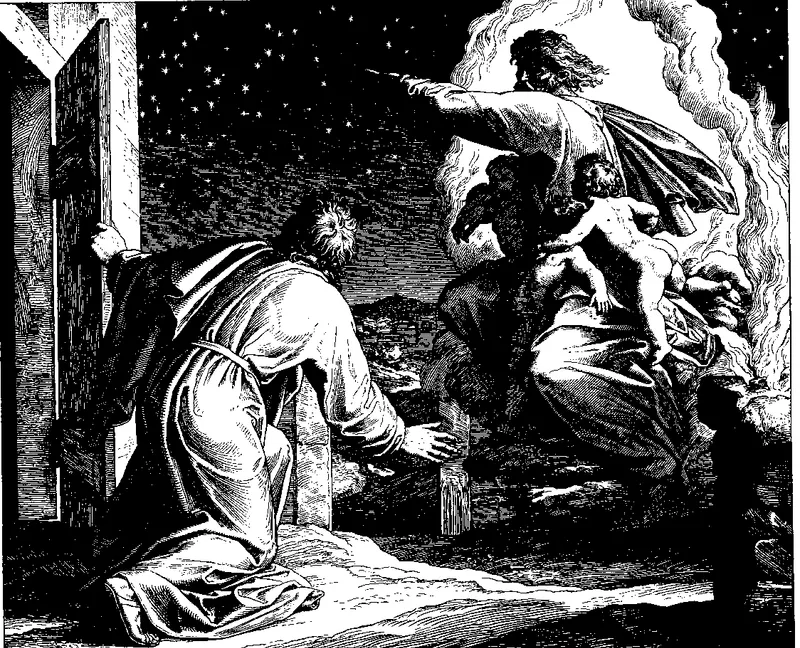
Then, after Lot has gone, the LORD gives Abram a sight of his own. Lift up now thine eyes, He says, using the same words - and where Lot looked toward a doomed city, Abram is told to look in every direction over a land that will be given: all the land which thou seest, to thee will I give it, and to thy seed for ever… and I will make thy seed as the dust of the earth. The chapter closes the way it opened, with Abram building an altar - this time at Mamre in Hebron - the life that keeps answering the promise with worship.2
Tap any highlighted phrase to jump to the commentary that unpacks it.
Genesis 13:1-4Back to the Altar at Bethel
1And Abram went up out of Egypt, he, and his wife, and all that he had, and Lot with him, into the south. 2And Abram was very rich in cattle, in silver, and in gold. 3And he went on his journeys from the south even to Bethel, unto the place where his tent had been at the beginning, between Bethel and Hai; 4Unto the place of the altar, which he had made there at the first: and there Abram called on the name of the LORD.
Abram comes up out of Egypt the same way Israel will one day come up out of Egypt - laden with wealth. And Abram was very rich in cattle, in silver, and in gold (v. 2). The riches are real, and the narrator names them plainly, but he leaves their meaning hanging. Was this prosperity a blessing or a snare? The chapter that follows will answer the question, because it is precisely Abram's wealth, set beside Lot's, that the land cannot hold. Prosperity rarely arrives without complication. The same abundance that looks like favour can crowd a household, breed rivalry, and force decisions that comfort would never have demanded. Scripture is honest about this everywhere: riches are not condemned, but they are never simply safe. What matters is not whether Abram has cattle, silver, and gold, but what he does with his heart now that he has them - and the very next verses show him going not to spend or to settle, but to worship.3
The first thing Abram does on his return is retrace his own steps. He travels from the south even to Bethel, unto the place where his tent had been at the beginning… Unto the place of the altar, which he had made there at the first (vv. 3-4). The repetition is deliberate - at the beginning, at the first. Abram goes back to a particular spot, the ground he had marked for God before the famine ever sent him down into Egypt. Egypt had been a tangle: half-truths about his wife, Sarai taken into Pharaoh's house, deliverance that came in spite of him rather than because of him. Now, out of all that, Abram does not strike out for somewhere new. He returns to the altar he had already built. There is a quiet wisdom in it. After a season of drift and compromise, faithfulness often looks less like a fresh start and more like a homecoming - going back to the place where you last met God, and standing there again.
At that altar, Abram does one thing: there Abram called on the name of the LORD (v. 4). He does not ask for more cattle or more land; he has just been told he is very rich, and he comes empty-handed anyway, with nothing on his lips but the name of God. Notice the order the verse keeps. The altar comes first - built long before, at the beginning - and the prayer comes after. The place set apart for God becomes the place Abram finds his way back to worship. Calling on the name of the LORD is the thread that ties Abram's whole life together; it is what he did when he first entered the land, and it is what he does again now. Worship is not the reward at the end of a settled life. It is the first act of a returning one. Before Abram resolves a single problem in this chapter - before the strife, before the parting, before the promise is renewed - he stands at his altar and speaks the name of God.
Genesis 13:5-13Is Not the Whole Land Before Thee?
5And Lot also, which went with Abram, had flocks, and herds, and tents. 6And the land was not able to bear them, that they might dwell together: for their substance was great, so that they could not dwell together. 7And there was a strife between the herdmen of Abram's cattle and the herdmen of Lot's cattle: and the Canaanite and the Perizzite dwelled then in the land. 8And Abram said unto Lot, Let there be no strife, I pray thee, between me and thee, and between my herdmen and thy herdmen; for we be brethren. 9Is not the whole land before thee? separate thyself, I pray thee, from me: if thou wilt take the left hand, then I will go to the right; or if thou depart to the right hand, then I will go to the left. 10And Lot lifted up his eyes, and beheld all the plain of Jordan, that it was well watered every where, before the LORD destroyed Sodom and Gomorrah, even as the garden of the LORD, like the land of Egypt, as thou comest unto Zoar. 11Then Lot chose him all the plain of Jordan; and Lot journeyed east: and they separated themselves the one from the other. 12Abram dwelled in the land of Canaan, and Lot dwelled in the cities of the plain, and pitched his tent toward Sodom. 13But the men of Sodom were wicked and sinners before the LORD exceedingly.
The trouble grows straight out of the blessing. And Lot also, which went with Abram, had flocks, and herds, and tents (v. 5) - Lot too is prospering, and now there are simply too many animals for the ground to feed. And the land was not able to bear them, that they might dwell together: for their substance was great (v. 6). The phrase could not dwell together falls twice in a single verse, like a door closing. It is a quietly painful thing the narrator is describing: not a sin, not a betrayal, but the ordinary friction of two flourishing households pressed into the same space. Abundance has its own weight. The very thing they had both been given - great substance - is what now makes nearness impossible. And the timing is sharpened by a half-line of background: the Canaanite and the Perizzite dwelled then in the land (v. 7). They are not alone out there. Others are watching, and quarrelling kinsmen would be a poor witness among them. The pressure on Abram is real, and it is the kind of pressure that tests what a person is made of.
The flashpoint is precise: there was a strife between the herdmen of Abram's cattle and the herdmen of Lot's cattle (v. 7). It is the servants who clash first, over water and grazing - not the two men themselves. Abram could easily have let it stay at that level, treated it as a problem beneath him, and waited for it to fester into something between him and his nephew. He does the opposite. He steps in before the strife can climb from the herdmen to the household, and he takes the matter on himself. There is a kind of leadership here that is easy to miss because it is so undramatic: the willingness to address conflict early, while it is still small, rather than let it harden. Abram does not assign blame, does not demand his servants be vindicated, does not stand on his dignity. He moves toward the trouble while it can still be solved cleanly - and the words he chooses next reveal exactly what he refuses to let this become.
Hear how Abram frames it: Let there be no strife, I pray thee, between me and thee, and between my herdmen and thy herdmen; for we be brethren (v. 8). Three things stand out. First, the gentleness - I pray thee, the language of entreaty, not command, though Abram is the elder and could have commanded. Second, the order: he names between me and thee first, before the herdmen, because he sees clearly that a quarrel among servants is really a threat to the bond between kinsmen, and that bond is what he means to protect. Third, the word that carries it all - brethren. Abram and Lot are in fact uncle and nephew, not brothers; calling Lot his brother is a deliberate act of grace, an insistence on family over rivalry. The same tie that binds them is exactly what makes the coming separation bearable. They are not competitors fighting over the same inheritance; they are kin, and Abram will not let a dispute over pasture turn them into enemies. He would rather give up land than give up a brother.
Then comes the offer, and it is astonishing in its openness: Is not the whole land before thee? separate thyself, I pray thee, from me: if thou wilt take the left hand, then I will go to the right; or if thou depart to the right hand, then I will go to the left (v. 9). Abram holds every advantage. He is the elder. He is the one to whom God appeared and made the promise of this very land. By every custom of the age the first choice is his by right. He gives it away. He does not so much as name which direction he would prefer; he simply lays the whole land open before Lot and says, in effect, you choose, and I will take whatever is left. This is not indecision or weakness. It is the freedom of a man who is certain of his portion in God and therefore does not need to grasp at it with his hands. Because Abram knows the land is promised to him by the One who cannot lie, he can afford to let his nephew pick first. Faith in the promise is precisely what makes such generosity possible. The one who is sure of God can open his hands.
Now the camera turns to Lot, and to his eyes. And Lot lifted up his eyes, and beheld all the plain of Jordan, that it was well watered every where… even as the garden of the LORD, like the land of Egypt (v. 10). The narrator does not say Lot was wrong about what he saw; the plain really was lush, green, watered everywhere - genuinely beautiful, fit to be compared to Eden itself and to the fertile valley of the Nile. The problem is not that Lot saw badly but that he saw only what was visible. He read the land with his eyes, and his eyes told him the truth as far as they could reach - and no farther. For tucked into the very sentence is a fact Lot's eyes could not deliver: this is the plain before the LORD destroyed Sodom and Gomorrah. The reader is told the end from the beginning. What looks like the garden of the LORD is standing under a sentence of judgment that no amount of looking could detect. The comparison to the land of Egypt is a second quiet flag: Egypt was beautiful too, and Egypt had nearly cost Abram his wife. Beauty that the eye can measure is not the same thing as safety the soul can trust.
Lot makes his choice and acts on it: Then Lot chose him all the plain of Jordan; and Lot journeyed east… Abram dwelled in the land of Canaan, and Lot dwelled in the cities of the plain, and pitched his tent toward Sodom (vv. 11-12). Watch the small, fateful word: toward. Lot does not move into Sodom yet. He merely orients himself that way, pitches his tent in its direction, settles his life on a heading. But small choices about what we face have a way of becoming the large shape of a life. A tent pitched toward Sodom is a decision repeated every morning, until the day comes - and in Genesis it does come - when Lot is found dwelling inside its gates. No single step looked like ruin. He chose the well-watered plain; he drifted to the cities of the plain; he faced his tent toward the city; and the direction did the rest. The text is not moralizing over Lot here, nor calling him wicked. It is showing, with great restraint, how a life gets aimed - one reasonable-looking choice at a time - and trusting the reader to feel the weight of where this heading leads.
The section ends on a single, sober line, and it lands like a held breath: But the men of Sodom were wicked and sinners before the LORD exceedingly (v. 13). It is the narrator's comment, not Lot's knowledge - an aside spoken over Lot's head to us. The little word but sets the whole thing in tension: Lot pitched toward Sodom, but the men of Sodom were exceedingly wicked. The beauty of the plain and the character of its people are two different things, and Lot weighed only the first. The verse does not pronounce sentence on Lot - his story is still unfolding, and Scripture will later call him a righteous man vexed by what surrounded him (2 Pet. 2:7-8). What the verse does is name what the eyes could not see. Lot looked at the land; he did not reckon with the people. He measured the water and the green; he did not measure the wickedness. And the narrator, by placing this line exactly here, lets the reader understand the cost of a choice made by sight alone - without ever needing to say it aloud.
Genesis 13:14-18All the Land Which Thou Seest
14And the LORD said unto Abram, after that Lot was separated from him, Lift up now thine eyes, and look from the place where thou art northward, and southward, and eastward, and westward: 15For all the land which thou seest, to thee will I give it, and to thy seed for ever. 16And I will make thy seed as the dust of the earth: so that if a man can number the dust of the earth, then shall thy seed also be numbered. 17Arise, walk through the land in the length of it and in the breadth of it; for I will give it unto thee. 18Then Abram removed his tent, and came and dwelt in the plain of Mamre, which is in Hebron, and built there an altar unto the LORD.
The timing is everything: And the LORD said unto Abram, after that Lot was separated from him (v. 14). It is precisely after Abram has given away the choice - after he has let the well-watered plain go to his nephew and kept only what was left - that the LORD speaks. Abram opened his hands, and now God fills them. And He fills them with the very gift Abram declined to seize: Lift up now thine eyes, and look from the place where thou art northward, and southward, and eastward, and westward. The same words used of Lot - lift up… thine eyes - are now spoken to Abram, but with a difference that changes everything. Lot lifted his eyes and chose. Abram lifts his eyes at God's command and receives. Lot looked at one direction, the plain; Abram is told to look in every direction, the whole compass of the land. The man who refused to grasp is shown a horizon no grasping could have reached. There is a pattern here that runs through all of Scripture: what is surrendered to God is not lost but enlarged, and the open hand is the one God chooses to fill.3
The promise itself is sweeping and sure: For all the land which thou seest, to thee will I give it, and to thy seed for ever (v. 15). Two things make it remarkable. First, it is given by the word of God alone - Abram does not buy this land, does not conquer it, does not even pick it; it is simply granted, I will give it. The whole basis of Abram's claim is a promise, not a possession. Second, it reaches past Abram's own lifetime: to thee… and to thy seed for ever. The gift outruns the man. Abram will live and die in tents and never hold the land as his own - yet the promise stands, looking far down the generations to a seed not yet born. Then God commands a strange and beautiful act: Arise, walk through the land in the length of it and in the breadth of it; for I will give it unto thee (v. 17). Abram is to walk the ground he does not yet own, the length and the breadth of it, as one already takes possession by faith of what is promised but not yet held. He paces out a gift that is real because God has spoken it, long before a single field is his.
The chapter ends where it began - at an altar. Then Abram removed his tent, and came and dwelt in the plain of Mamre, which is in Hebron, and built there an altar unto the LORD (v. 18). He does not build a city, a fortress, or a monument to himself; he builds an altar, and he goes on dwelling in a tent. The two facts belong together. The tent says he holds the land loosely, as a sojourner, not yet owning what is promised; the altar says he holds God firmly, marking the ground with worship wherever he stops. Through this whole chapter Abram's instinct has been the same: out of Egypt, an altar; after the promise renewed, an altar. He answers the word of God not by seizing but by worshipping. The land is not his because he conquered it or because it looked good to his eyes; it is his because God has given it - and the altar is Abram's way of never forgetting that. He builds, at the last, the only thing a man of faith can build on land he has been promised but does not yet possess: a place to call on the name of the LORD.
Further study
- The Hebrew text of Genesis 13 with Rashi, Ibn Ezra, Ramban, and other classical commentators side by side - useful for the idiom nasa einayim (vv. 10, 14, “lifted up his eyes”), for qara beshem-YHWH (v. 4, “called on the name of the LORD”), and for the rabbinic reading of Abram's deference to Lot in verses 8-9.
- Genesis 13 ↔ Hebrews 11 · Philippians 2 · Galatians 3 · 2 Corinthians 5Intertextual BibleTraces the threads tying Genesis 13 to the rest of Scripture - Abram dwelling in tents and looking for the city whose builder and maker is God (Heb. 11:9-10), the seed promised as the dust of the earth read alongside the one seed which is Christ (Gal. 3:16), and Lot's choice by sight set beside we walk by faith, not by sight (2 Cor. 5:7).
- Genesis 13 - Translators' NotesNET BibleThe NET Bible's detailed footnotes on Genesis 13 - the geography of the journey from the Negev back to Bethel (vv. 1-3), the legal and social weight of Abram's offer to divide the land (vv. 8-9), the description of the Jordan plain “like the garden of the LORD” (v. 10), and the renewed land-and-seed promise of verses 14-17.
Where this echoes in Scripture
Back to the Altar at Bethel
- Genesis 12:7-8and there builded he an altar unto the LORD... and called upon the name of the LORD.The altar Abram returns to in verses 3-4 - the one he first built when he entered the land.
- Genesis 4:26then began men to call upon the name of the LORD.The same act as verse 4 - the public invocation of God by name that runs through Genesis.
- Romans 10:13For whosoever shall call upon the name of the Lord shall be saved.What it means to call on the name of the LORD (v. 4), carried forward to all who come to Christ.
- 1 Timothy 6:17Charge them that are rich in this world, that they be not highminded, nor trust in uncertain riches.The question hanging over Abram’s wealth in verse 2 - riches held without being trusted.
- Psalm 116:17I will offer to thee the sacrifice of thanksgiving, and will call upon the name of the LORD.Abram’s response in verse 4 - worship as the first act of a heart returning to God.
Is Not the Whole Land Before Thee?
- Matthew 5:5Blessed are the meek: for they shall inherit the earth.Abram’s temper in verses 8-9 - the meekness that yields its right and inherits by promise.
- Philippians 2:3-7Let nothing be done through strife... Look not every man on his own things... made himself of no reputation.The mind behind Abram’s deference (vv. 8-9) - named by the apostle as the mind of Christ.
- 2 Peter 2:7-8And delivered just Lot, vexed with the filthy conversation of the wicked.The later cost of pitching toward Sodom (vv. 12-13) - and the restraint of judging Lot here.
- 1 John 2:16the lust of the eyes... is not of the Father, but is of the world.The danger in Lot’s way of choosing (vv. 10-11) - a life set by what the eyes desire.
- James 3:16For where envying and strife is, there is confusion and every evil work.What Abram refuses to let grow between kinsmen in verses 7-8 - strife uprooted before it spreads.
All the Land Which Thou Seest
- Hebrews 11:8-10he looked for a city which hath foundations, whose builder and maker is God.The faith behind verses 14-18 - Abram dwelling in tents, holding the land only by promise.
- 2 Corinthians 5:7For we walk by faith, not by sight.The contrast running through the whole chapter - Abram’s way against Lot’s way of choosing.
- Galatians 3:16Now to Abraham and his seed were the promises made... which is Christ.The seed promised as the dust of the earth in verse 16 - read as fulfilled in one Seed.
- Genesis 15:5Look now toward heaven, and tell the stars... So shall thy seed be.The promise of verse 16 restated - the seed as countless as dust and as the stars.
- Genesis 22:17in blessing I will bless thee... as the stars of the heaven, and as the sand which is upon the sea shore.The numberless seed of verse 16 confirmed by oath after Abram’s obedience on Moriah.