Jonah 3
People in this chapter
The chapter opens with two of the most hopeful words in the book: the second time. And the word of the LORD came unto Jonah the second time, saying, Arise, go unto Nineveh, that great city, and preach unto it the preaching that I bid thee (vv. 1-2). The command has not changed since chapter one - the same city, the same errand - but everything about the man has changed. The prophet who once bought a ticket in the opposite direction now rises and goes.
He walks into Nineveh, an exceeding great city, and after only a day's journey in he begins to cry the message: Yet forty days, and Nineveh shall be overthrown (v. 4). It is the shortest recorded sermon in the Bible, and there is not a word of comfort in it - only a number, a name, and a verdict.1
Tap any highlighted phrase to jump to the commentary that unpacks it.
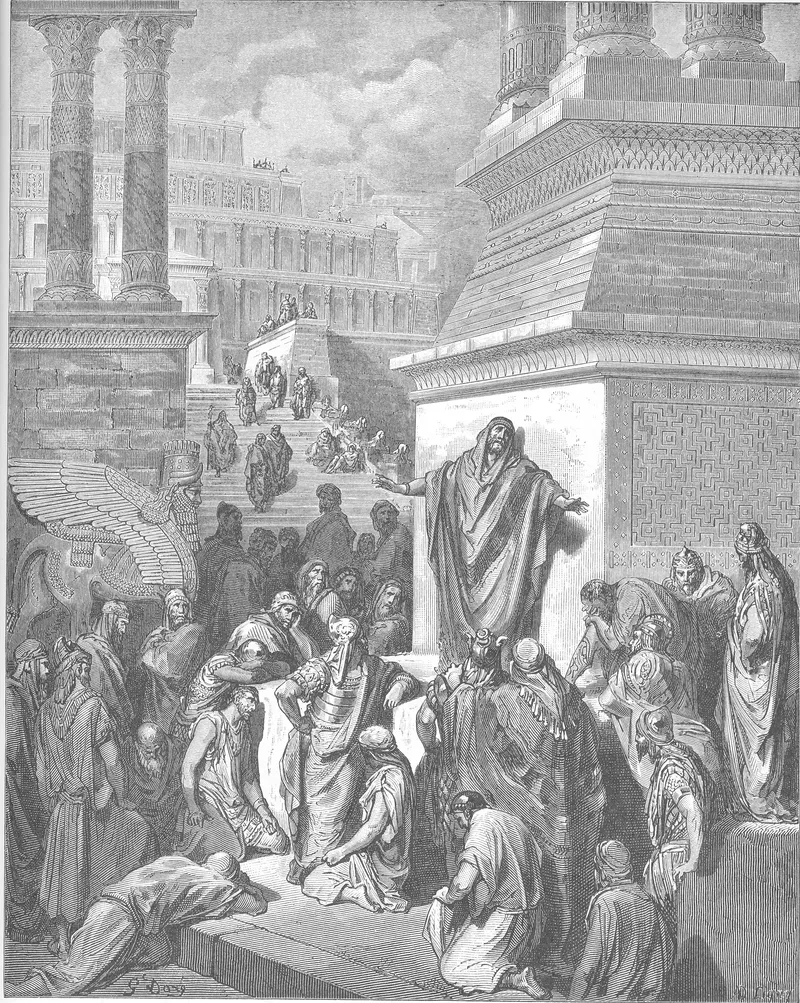
Jonah 3:1-4The Word the Second Time
1And the word of the LORD came unto Jonah the second time, saying, 2Arise, go unto Nineveh, that great city, and preach unto it the preaching that I bid thee. 3So Jonah arose, and went unto Nineveh, according to the word of the LORD. Now Nineveh was an exceeding great city of three days’ journey. 4And Jonah began to enter into the city a day’s journey, and he cried, and said, Yet forty days, and Nineveh shall be overthrown.
The chapter turns on two words: the second time. And the word of the LORD came unto Jonah the second time, saying, Arise, go unto Nineveh, that great city, and preach unto it the preaching that I bid thee (vv. 1-2). The wording deliberately echoes the opening of the book, where the same word came and Jonah fled toward Tarshish. Now the command returns unchanged - the same city, the same task - but it comes to a man who has been through the storm, the sea, and the belly of the fish.
There is mercy in the very repetition. God does not write Jonah off after his flight; He calls him again, with the identical errand, as if the failure had not disqualified him. The phrase that I bid thee keeps the message firmly in God's hands - Jonah is to preach what he is told, not what he prefers. The renewed call is a quiet revelation of how God works: He gives the disobedient a second word, and the door He once opened He opens again.2
This time Jonah does not run. So Jonah arose, and went unto Nineveh, according to the word of the LORD (v. 3). The phrase according to the word of the LORD stands in pointed contrast to chapter one, where he rose up to flee… from the presence of the LORD. The same verb - he arose - now bends the right direction. And the city he enters is no village: Now Nineveh was an exceeding great city of three days' journey. Nineveh was the heart of the Assyrian power, a sprawling capital whose size the text marks with awe.
It was also, by every reputation of the age, a place of cruelty and violence - the last city on earth a Hebrew prophet would expect to find mercy. That is part of the point. The greatness of the city only sharpens the wonder of what is about to happen there. A single man, on foot, walks into the vast and violent capital of a hostile empire with nothing but a word from God.3
The sermon, when it finally comes, is astonishingly short. And Jonah began to enter into the city a day's journey, and he cried, and said, Yet forty days, and Nineveh shall be overthrown (v. 4). In Hebrew it is five words; in English, eight. There is a deadline and a verdict - plain, with no introduction, no appeal, no promise of mercy attached. Jonah announces the coming overthrow plainly and walks on. By every human measure this is the least promising evangelistic strategy imaginable: a foreigner's blunt threat, shouted in the streets, with no good news in sight.
And yet the very starkness of the word is part of its power. It leaves the city no room to argue with the messenger and nowhere to look but up. Everything now hangs on what the hearers will do with the bare, hard truth they have been handed.
Jonah 3:5-10A City Turns · And God Repented
5So the people of Nineveh believed God, and proclaimed a fast, and put on sackcloth, from the greatest of them even to the least of them. 6For word came unto the king of Nineveh, and he arose from his throne, and he laid his robe from him, and covered him with sackcloth, and sat in ashes. 7And he caused it to be proclaimed and published through Nineveh by the decree of the king and his nobles, saying, Let neither man nor beast, herd nor flock, taste any thing: let them not feed, nor drink water: 8But let man and beast be covered with sackcloth, and cry mightily unto God: yea, let them turn every one from his evil way, and from the violence that is in their hands. 9Who can tell if God will turn and repent, and turn away from his fierce anger, that we perish not? 10And God saw their works, that they turned from their evil way; and God repented of the evil, that he had said that he would do unto them; and he did it not.
The response is immediate and total. So the people of Nineveh believed God, and proclaimed a fast, and put on sackcloth, from the greatest of them even to the least of them (v. 5). Notice the order of the words: before any fast, before any sackcloth, they believed God. The outward signs flow from an inward conviction - they took the warning to be true, took it to be from God, and only then acted. And the turning reaches from the greatest of them even to the least - the whole social order, top to bottom, swept into the same response.
There is no faction debating whether the foreign prophet should be believed, no powerful class exempting itself. The sackcloth is the rough cloth of mourning, and the fast is the body's confession that something graver than hunger is at stake. What moves the modern reader is the sheer improbability of it: a hostile pagan city, with no covenant and no prior knowledge of this God, hears eight blunt words and believes. It is a rebuke, written into the story itself, to everyone who has heard far more and turned far less.1
The turning runs all the way to the throne, and there it becomes unforgettable. For word came unto the king of Nineveh, and he arose from his throne, and he laid his robe from him, and covered him with sackcloth, and sat in ashes (v. 6). Every motion in the verse is a stripping away of majesty. He arose from his throne - the seat of his power; he laid his robe from him - the mark of his rank; he covered him with sackcloth - the cloth of the grieving poor; and he sat in ashes - on the ground, in the dust of humiliation.
The most powerful man in the city makes himself the lowest. There is no clinging to dignity, no calculation that a king must keep up appearances before his people. He treats himself as a sinner like any other, under the same sentence and in need of the same mercy. It is the precise opposite of the pride that so often travels with power. And his humbling is public - the people see their king in ashes, which gives the whole city permission, and example, to do the same.
The king's decree shows what real repentance is made of. It begins with the outward and severe - Let neither man nor beast, herd nor flock, taste any thing: let them not feed, nor drink water (v. 7) - a fast so total it sweeps in the animals, a whole creation made to groan together. But the decree does not stop at ritual. Its heart is moral: let them turn every one from his evil way, and from the violence that is in their hands (v. 8).
This is the line that matters most. The king commands a changed life - specifically a turning from violence, the very sin for which Assyria was infamous. True repentance is named here exactly: each person turning from the actual evil his own hands have done. And the decree ends in trembling hope: Who can tell if God will turn and repent, and turn away from his fierce anger, that we perish not? (v. 9). There is no presumption in it.
They do not claim a right to mercy; they cast themselves on the bare possibility of it. Who can tell? - perhaps the God who warns is also a God who relents. They turn, and they hope, and they leave the outcome wholly with Him.
The final verse answers the king's “who can tell?” with mercy. And God saw their works, that they turned from their evil way; and God repented of the evil, that he had said that he would do unto them; and he did it not (v. 10). What God saw was their works, that they turned - the genuine change of direction the outward signs pointed to. Mercy met repentance the moment repentance was real. The line that God repented of the evil - that is, relented from the disaster He had threatened - can trouble a reader, but the chapter itself frames it plainly: the threatened “overthrow” was held back because the people for whom it was intended were no longer the same people.
The God who announces judgment against evil is, in the same breath, the God who withdraws it when the evil is forsaken. This is God being utterly true to His character. He had said the city would be overthrown if it stayed what it was. It did not stay what it was - and so neither did its sentence. The whole book is built to make this single point shine: the LORD is a God who relents toward the penitent, even when the penitent are Nineveh.
Research trail
Sources & further study
These references support the historical, linguistic, manuscript, and contextual notes in this chapter. Scripture remains the primary text; external sources are provided so readers can inspect the research directly.
- Jonah 3 - Translators' NotesThe NET Bible's detailed footnotes on Jonah 3 - the renewed commission in verses 1-2, the size of the city and the “three days' journey” (v. 3), the wording of the eight-word oracle in verse 4, and the much-discussed statement in verse 10 that God “repented of the evil” He had threatened.
- Jonah 3 ↔ Matthew 12 · Luke 11 · Jeremiah 18Traces the threads tying Jonah 3 to the rest of Scripture - Nineveh's repentance (vv. 5-10) read beside Jesus' words that the men of Nineveh shall rise in judgment because they repented at the preaching of Jonas (Matt. 12:41; Luke 11:32), and God's relenting (v. 10) read alongside the principle of Jeremiah 18:7-8, that when a nation turns from evil God turns from the threatened judgment.
- Jonah 3 · Hebrew + classical Jewish commentaryThe Hebrew text of Jonah 3 with Rashi, Ibn Ezra, and other classical commentators side by side - useful for the bounded arba'im yom (v. 4, the “forty days” given to repent) and for vayinachem (v. 10, “God repented,” the verb for relenting from a threatened harm).
Where this echoes in Scripture
The Word the Second Time
- Jonah 1:1-3Now the word of the LORD came unto Jonah... saying, Arise, go to Nineveh... But Jonah rose up to flee... from the presence of the LORD.The first time the same word came - and was fled from. Verses 1-3 are its merciful echo, now obeyed.
- Matthew 12:41The men of Nineveh shall rise in judgment with this generation, and shall condemn it: because they repented at the preaching of Jonas; and, behold, a greater than Jonas is here.Jesus points to Nineveh's turning at verse 4 as a rebuke to a more privileged generation that would not turn at Him.
- Mark 1:15The time is fulfilled, and the kingdom of God is at hand: repent ye, and believe the gospel.The greater Prophet opens His ministry as Jonah opened his sermon - with a call to repent before the appointed time.
- Genesis 19:24-25the LORD rained upon Sodom and upon Gomorrah brimstone and fire... and he overthrew those cities.The same word “overthrew” behind verse 4 - the fate Nineveh was warned of, and the one it escaped by turning.
- 2 Corinthians 6:2behold, now is the accepted time; behold, now is the day of salvation.The “forty days” of verse 4 as a window of grace - an interval given precisely so that it may be used to turn.
A City Turns · And God Repented
- Jeremiah 18:7-8If that nation, against whom I have pronounced, turn from their evil, I will repent of the evil that I thought to do unto them.The principle behind verse 10 stated outright - when a nation turns, God turns from the threatened judgment.
- Ezekiel 33:11I have no pleasure in the death of the wicked; but that the wicked turn from his way and live.The heart of God that verse 10 reveals - His desire for the turning that leads to life.
- 2 Peter 3:9The Lord is... longsuffering to us-ward, not willing that any should perish, but that all should come to repentance.The mercy that reached Nineveh (vv. 5, 10) named as God's settled will toward all.
- Micah 7:18Who is a God like unto thee, that pardoneth iniquity... he retaineth not his anger for ever, because he delighteth in mercy.Why God relented in verse 10 - the character of a God who delights in mercy.
- Luke 15:7joy shall be in heaven over one sinner that repenteth, more than over ninety and nine just persons, which need no repentance.The gladness behind the mercy of verse 10 - heaven's joy over a turning sinner, here a whole turning city.