Matthew 19
People in this chapter
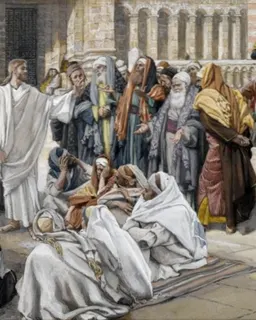
Jesus has finished teaching in Galilee, and now He turns south, into the coasts of Judaea beyond Jordan (v. 1), with great multitudes following and being healed. The first thing that happens there is a test. The Pharisees also came unto him, tempting him… Is it lawful for a man to put away his wife for every cause? (v. 3). It is a question with a hook in it, framed by a live controversy of the day over the grounds for divorce.
Jesus answers neither school of the debate directly; He reaches behind the whole argument, back to the opening pages of Scripture: he which made them at the beginning made them male and female… and they twain shall be one flesh. What therefore God hath joined together, let not man put asunder (vv. 4-6). When pressed about Moses, He draws the line plainly - Moses permitted divorce because of the hardness of your hearts; but from the beginning it was not so (v. 8).1
Tap any highlighted phrase to jump to the commentary that unpacks it.
Matthew 19:1-12What God Hath Joined Together
1And it came to pass, that when Jesus had finished these sayings, he departed from Galilee, and came into the coasts of Judaea beyond Jordan; 2And great multitudes followed him; and he healed them there. 3The Pharisees also came unto him, tempting him, and saying unto him, Is it lawful for a man to put away his wife for every cause? 4And he answered and said unto them, Have ye not read, that he which made them at the beginning made them male and female, 5And said, For this cause shall a man leave father and mother, and shall cleave to his wife: and they twain shall be one flesh? 6Wherefore they are no more twain, but one flesh. What therefore God hath joined together, let not man put asunder.
The setting is marked from the first word the Pharisees speak: they came tempting him (v. 3). This is not an honest seeker bringing an honest doubt; it is a trap, baited to catch Jesus on the horns of a live and bitter controversy.
The question - Is it lawful for a man to put away his wife for every cause? - turns on the phrase for every cause. The rabbis of the day were split over how to read the divorce provision of Moses: one school held that a man could divorce his wife only for grave moral cause, another that he could send her away for almost anything that displeased him. To answer either way was to make enemies.
But there is something deeper than a legal puzzle in the question, and Jesus goes for it. Notice what the question assumes - that marriage is fundamentally about the husband's freedom to dissolve it, a contract he may end for every cause. Jesus will not argue inside that frame. He answers a question they did not ask, by going back to a beginning they had stopped reading.1
Twice Jesus appeals not to the debate but to the page beneath it: Have ye not read, that he which made them at the beginning made them male and female (v. 4), and For this cause shall a man leave father and mother, and shall cleave to his wife: and they twain shall be one flesh (v. 5). He is quoting the opening of the Bible - the creation of male and female, and the word spoken over the first marriage2.
The argument is quietly devastating to the Pharisees' framing. They wanted to talk about the grounds for ending a marriage; Jesus talks about the design and purpose of one. Marriage, He says, is not a human invention to be revised at will, a private arrangement two people enter and leave as they please. It is rooted in how humanity was made at the beginning and in a joining God Himself performs.
The man cleaves - a strong word for being bound fast, glued, welded - so that two distinct lives become, in God's reckoning, one flesh. Whatever the legal codes allowed, this is the older and deeper truth, and it sets the terms for everything Jesus says next.
From the design Jesus draws the conclusion: Wherefore they are no more twain, but one flesh. What therefore God hath joined together, let not man put asunder (v. 6). The little word God is the hinge. A marriage is not merely two people choosing each other; it is two people joined by God - a divine act, not only a human one. And what God has done, a human being should not presume to undo.
The verb put asunder means to separate what belongs together, to tear apart a single thing into pieces. Jesus is not laying a crushing burden on the wounded or pronouncing on every painful case the world will ever bring; He is naming, plainly and tenderly, what marriage is at its root - a covenant bond God forms and means to last.
The dignity of it and the weight of it both come from the same source: it is His joining, not ours. That is why it is not a thing to be dissolved for every cause. The seriousness Jesus gives marriage is not severity; it is the honor due to something God Himself makes.
7They say unto him, Why did Moses then command to give a writing of divorcement, and to put her away? 8He saith unto them, Moses because of the hardness of your hearts suffered you to put away your wives: but from the beginning it was not so. 9And I say unto you, Whosoever shall put away his wife, except it be for fornication, and shall marry another, committeth adultery: and whoso marrieth her which is put away doth commit adultery. 10His disciples say unto him, If the case of the man be so with his wife, it is not good to marry. 11But he said unto them, All men cannot receive this saying, save they to whom it is given. 12For there are some eunuchs, which were so born from their mother’s womb: and there are some eunuchs, which were made eunuchs of men: and there be eunuchs, which have made themselves eunuchs for the kingdom of heaven’s sake. He that is able to receive it, let him receive it.
The Pharisees think they have caught Him: if marriage is so binding, Why did Moses then command to give a writing of divorcement? (v. 7). Jesus draws a distinction that goes to the root of how to read the law. Moses, He says, because of the hardness of your hearts suffered you to put away your wives: but from the beginning it was not so (v. 8).
The word suffered means permitted, tolerated - not commanded, not endorsed, but allowed as a concession. The provision Moses gave was a regulation of human failure, a guardrail set around hard hearts to limit the damage they would otherwise do. It described what God would bear with in a fallen people; it did not describe what God desired. Jesus sets the two side by side without flinching: there is what was permitted for the hardness of hearts, and there is the way it was from the beginning.
The exception He names in verse 9 - except it be for fornication - stands within that same realism: Jesus speaks honestly about the breaking of the one-flesh bond in a broken world. But His aim is never to widen the door to divorce; it is to lift the eyes of His hearers back over the wall of their own hard-heartedness to the original design, and to call them to it.3
The disciples are staggered. If marriage is this binding, this serious, it is not good to marry (v. 10) - better, they reason, never to take on so weighty a bond at all. Their reaction shows how high Jesus has just raised the stakes. He answers with a strange and gentle word: All men cannot receive this saying, save they to whom it is given (v. 11).
Then He speaks of eunuchs - some born unable to marry, some made so by others, and some who have made themselves eunuchs for the kingdom of heaven's sake (v. 12). Jesus is not commending self-mutilation; He is describing those who freely set aside marriage in order to give themselves wholly to the work of the kingdom. It is a calling, not a command - given to some, not laid on all. And He closes with the same open hand: He that is able to receive it, let him receive it.
The point is not that marriage is bad and singleness better, nor the reverse. It is that both marriage, with its binding covenant, and a life freely devoted to the kingdom are weighty callings to be received from God - not careers a person drifts into or out of for every cause.
Matthew 19:13-15Of Such Is the Kingdom of Heaven
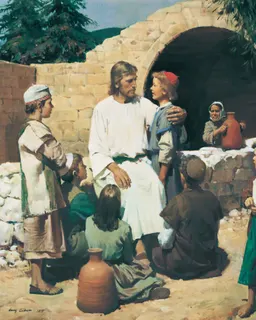
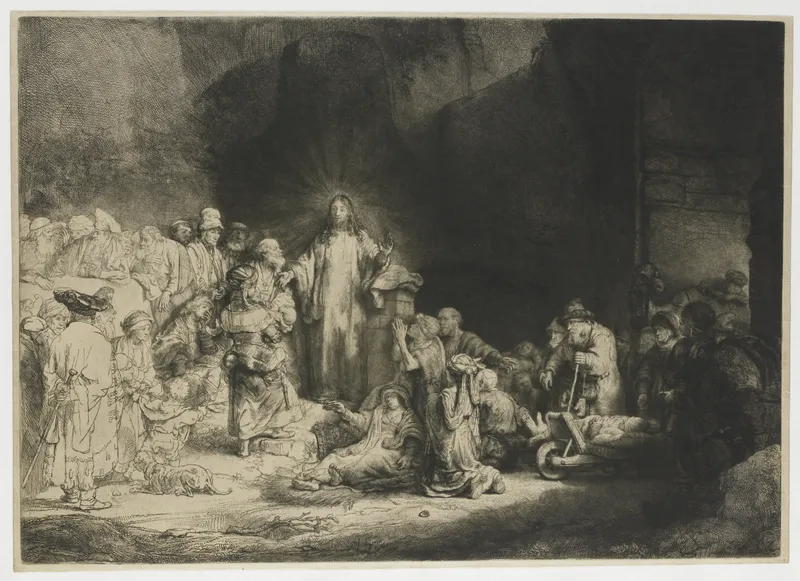
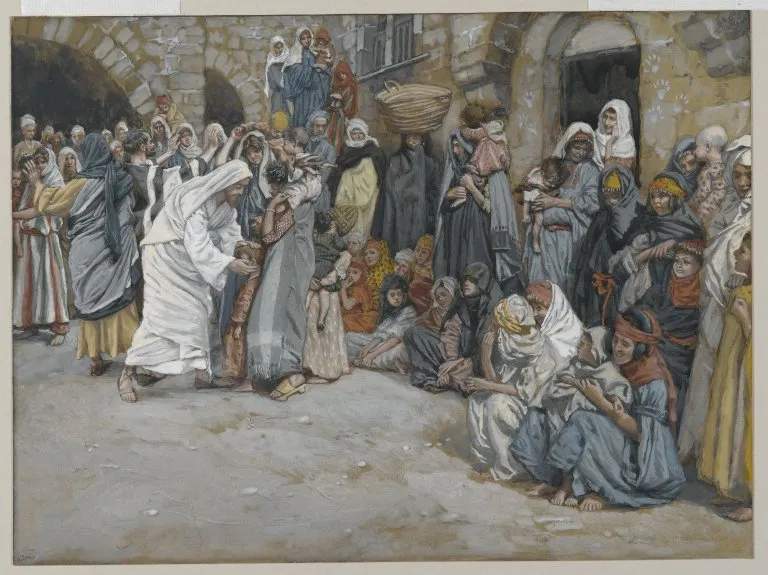
13Then were there brought unto him little children, that he should put his hands on them, and pray: and the disciples rebuked them. 14But Jesus said, Suffer little children, and forbid them not, to come unto me: for of such is the kingdom of heaven. 15And he laid his hands on them, and departed thence.
The scene shifts from a tense legal sparring match to something altogether quieter: Then were there brought unto him little children, that he should put his hands on them, and pray (v. 13). Parents are bringing their little ones to Jesus, hoping He will lay His hands on them and bless them - an ordinary, tender thing. And the disciples rebuke them. We are not told exactly why; perhaps they thought the children too unimportant to take up the Master's time, perhaps they were guarding His dignity, perhaps they were simply tired and the children were a bother.
The instinct is painfully human. We rank people by their usefulness, their status, their ability to contribute - and small children rank low by every such measure. They cannot argue theology, cannot follow on a hard road, cannot give anything back. So the disciples wave them off as a distraction from the serious work. It is exactly the same mistake the chapter keeps circling: assuming the kingdom is for the capable and the impressive. Jesus is about to overturn it.
Jesus reverses the rebuke without hesitation: Suffer little children, and forbid them not, to come unto me: for of such is the kingdom of heaven (v. 14). The old word suffer here means allow - let them come, do not get in their way. And the reason He gives is the stunning part: for of such is the kingdom of heaven. The kingdom does not merely make room for children alongside the real members; it actually belongs to such as these.
Why? Because of what a little child is before someone who loves them. A small child does not negotiate for a parent's embrace or arrive with credentials. The child simply comes, with open hands, and receives. That is the posture of everyone who enters the kingdom. The same Gospel records Jesus saying it even more sharply elsewhere: whosoever shall not receive the kingdom of God as a little child, he shall not enter therein. Set this beside the rich young man who comes next, and the contrast is the whole lesson.
The child with empty hands goes in; the rich man with full hands walks away.2
Matthew 19:16-26With God All Things Are Possible
16And, behold, one came and said unto him, Good Master, what good thing shall I do, that I may have eternal life? 17And he said unto him, Why callest thou me good? there is none good but one, that is, God: but if thou wilt enter into life, keep the commandments. 18He saith unto him, Which? Jesus said, Thou shalt do no murder, Thou shalt not commit adultery, Thou shalt not steal, Thou shalt not bear false witness, 19Honour thy father and thy mother: and, Thou shalt love thy neighbour as thyself. 20The young man saith unto him, All these things have I kept from my youth up: what lack I yet?
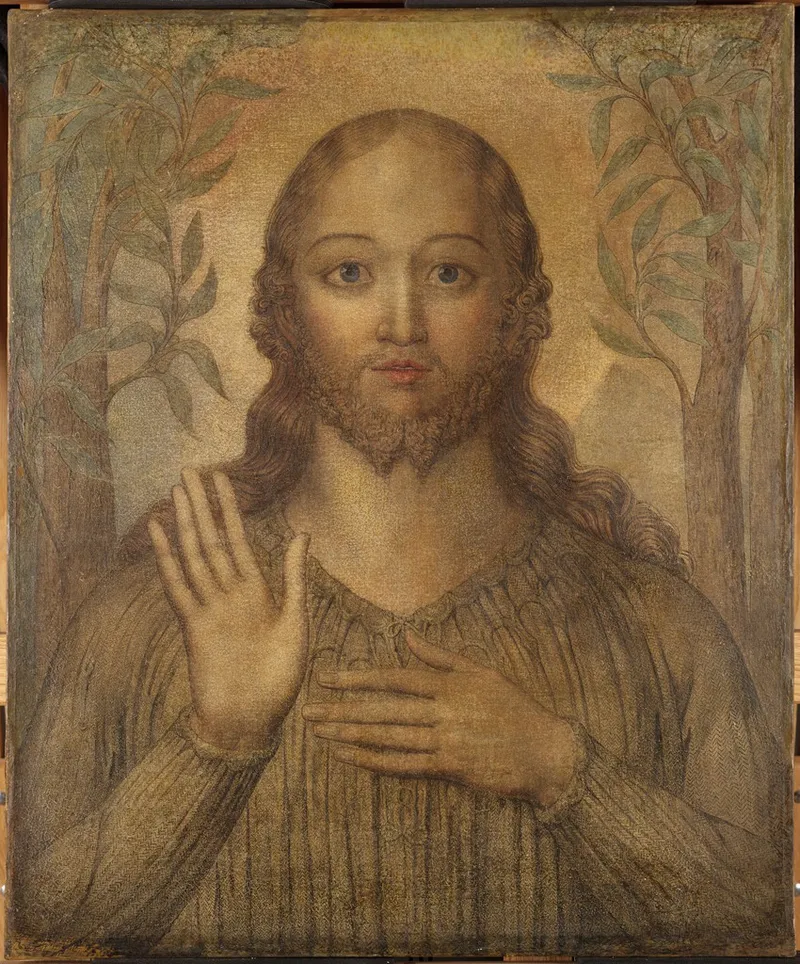
A young man comes to Jesus with an earnest question and a revealing assumption: Good Master, what good thing shall I do, that I may have eternal life? (v. 16). He is sincere, even eager. But listen to how he frames it - what good thing shall I do. He assumes eternal life is a transaction, a prize to be secured by the right deed added to his ledger; he only wants to know which deed.
Jesus answers first by probing the word good: Why callest thou me good? there is none good but one, that is, God (v. 17). He is not denying His own goodness; He is holding up a mirror. The young man is throwing around the word good - good Master, good thing - without reckoning with how high the bar of true goodness is, or who alone clears it.
Then Jesus meets the man on his own terms: if thou wilt enter into life, keep the commandments. This is the law doing its proper work. The man wants to know what he must do - very well, here is the standard. Jesus lets the commandments speak, knowing where they will lead a heart honest enough to follow them down.2
The young man asks Which?, and Jesus lists the commandments that govern how we treat one another - do not murder, do not commit adultery, do not steal, do not bear false witness, honor your father and mother - capping them with the great summary: Thou shalt love thy neighbour as thyself (vv. 18-19). And the young man answers, with what seems like genuine confidence: All these things have I kept from my youth up: what lack I yet? (v. 20).
There is no reason to think he is lying. By the outward measure of the commandments, he may well have lived a clean and upright life from boyhood. And yet his very question betrays him - what lack I yet? For all his keeping, he knows something is still missing. He has done the deeds and still does not have the life.
That ache is the most honest thing about him, and it is the doorway Jesus will use. The law has brought him exactly where the law is meant to bring a person: to the edge of his own righteousness, looking over it, sensing it is not enough, not yet knowing why.
21Jesus said unto him, If thou wilt be perfect, go and sell that thou hast, and give to the poor, and thou shalt have treasure in heaven: and come and follow me. 22But when the young man heard that saying, he went away sorrowful: for he had great possessions. 23Then said Jesus unto his disciples, Verily I say unto you, That a rich man shall hardly enter into the kingdom of heaven. 24And again I say unto you, It is easier for a camel to go through the eye of a needle, than for a rich man to enter into the kingdom of God. 25When his disciples heard it, they were exceedingly amazed, saying, Who then can be saved? 26But Jesus beheld them, and said unto them, With men this is impossible; but with God all things are possible.
Jesus answers the man's what lack I yet? with a word aimed straight at the one thing he had not surrendered: If thou wilt be perfect, go and sell that thou hast, and give to the poor, and thou shalt have treasure in heaven: and come and follow me (v. 21). This is not a general rule that everyone who follows Jesus must sell everything; the Gospels show many disciples who kept homes and means. It is a diagnosis tailored to this man.
Jesus, who knows the heart, has put His finger on the precise place where this man's true allegiance lay. The young man called Jesus good Master and asked about eternal life - but his real master, the thing he trusted and would not let go of, was his wealth. So Jesus offers him an exchange that exposes everything: trade the treasure you are clinging to for treasure in heaven, and come and follow me.
The command is not cruelty; it is the most loving thing Jesus could say, because it names the idol the man could not see. The other Gospel adds the detail that makes it unbearable to read: Jesus beholding him loved him, and only then spoke the hard word. Love is what said it. Love always tells the truth about what holds us.3
The result is one of the saddest sentences in the Gospels: But when the young man heard that saying, he went away sorrowful: for he had great possessions (v. 22). Notice the exact shape of his sorrow. He does not leave angry, or scoffing, or unmoved; he leaves sorrowful - grieved, because he glimpsed what was offered and could not bring himself to take it. He wanted eternal life genuinely. He simply wanted his possessions more.
And the closing clause delivers the verdict with quiet devastation: for he had great possessions. We tend to say a man like this has great wealth; the verse hints at the truth that the wealth had him. This is the danger Jesus is about to spell out - not that money is evil in itself, but that it makes a quiet and powerful claim on the heart, offering a security and an identity that compete directly with God.
The young man stands as a warning precisely because he was so close. He came running, knelt, kept the commandments, felt the lack, heard the answer - and still walked away, because one thing held him that he would not let go.
Watching the man leave, Jesus turns to the disciples with a sober word and then a startling image: a rich man shall hardly enter into the kingdom of heaven - and It is easier for a camel to go through the eye of a needle, than for a rich man to enter into the kingdom of God (vv. 23-24). The picture is deliberately impossible. The camel was the largest animal anyone in that land regularly handled; the eye of a needle, the smallest opening they knew.
Set the two together and the meaning is plain - this is not difficult, it is humanly impossible.
And the disciples grasp exactly that. They are exceedingly amazed, and they ask the question the whole scene has been driving toward: Who then can be saved? (v. 25). Their alarm makes sense in a world that often read wealth as a sign of God's favor: if the rich, the blessed, the visibly successful cannot get in, what hope is there for anyone? Jesus does not soften the image to relieve them. He lets the impossibility stand - because the impossibility is the point, and the answer He is about to give does not lower the bar but lifts the source.1
Matthew 19:27-30The Last Shall Be First
27Then answered Peter and said unto him, Behold, we have forsaken all, and followed thee; what shall we have therefore? 28And Jesus said unto them, Verily I say unto you, That ye which have followed me, in the regeneration when the Son of man shall sit in the throne of his glory, ye also shall sit upon twelve thrones, judging the twelve tribes of Israel. 29And every one that hath forsaken houses, or brethren, or sisters, or father, or mother, or wife, or children, or lands, for my name’s sake, shall receive an hundredfold, and shall inherit everlasting life. 30But many that are first shall be last; and the last shall be first.
Peter, watching the rich man walk away unwilling to give up his possessions, speaks for the Twelve who did: Behold, we have forsaken all, and followed thee; what shall we have therefore? (v. 27). It is a very human moment, and a mixed one. On the one hand it is simply true - they really had left their nets, their boats, their trades to follow Him, doing the very thing the rich young man could not. On the other hand the question has a calculating edge: what shall we have therefore? - what is in this for us?
Jesus does not rebuke the question. Remarkably, He answers it with extravagant generosity, while the closing verse will gently correct the spirit behind it. There is something tender in this. The disciples' following was real but imperfect, their motives tangled with self-interest, as ours always are. And Jesus meets even that mixed devotion with a promise far larger than the question deserved. He is not stingy with those who follow Him, even when their following is not yet pure.
Jesus answers with a sweeping promise that reaches to the renewal of all things: ye which have followed me, in the regeneration when the Son of man shall sit in the throne of his glory, ye also shall sit upon twelve thrones, judging the twelve tribes of Israel (v. 28). The word regeneration here points to the great renewal - the world made new, when the Son of man comes in glory and all things are set right. In that day, Jesus says, those who followed Him will share in His reign, seated on thrones.
The picture is staggering: the fishermen and tax collectors who left everything will be lifted to honor in the world to come. Set this against the scene just past, and the kingdom's economy comes clear - what is grasped in this age, like the great possessions the young man could not release, is lost, while what is let go for Christ's sake is repaid beyond all measure in the age to come.
The promise widens beyond the Twelve to every one: every one that hath forsaken houses, or brethren, or sisters, or father, or mother, or wife, or children, or lands, for my name's sake, shall receive an hundredfold, and shall inherit everlasting life (v. 29). Two things steady this verse so it is not misread. First, the forsaking is for my name's sake - not loss for its own sake, not asceticism for show, but whatever is let go in order to follow Christ. Second, the return is an hundredfold, a hundred times over.
This does not promise that the one who follows will get rich, or recover the very things surrendered in kind. It promises a return so far beyond the cost that the arithmetic of sacrifice is overturned. Whatever is given up for His sake is repaid a hundred times - in the family of faith that becomes brothers and sisters and mothers, in the deep joys of a life spent following Him, and above all in the crowning gift named last: shall inherit everlasting life. That is the very thing the rich young man went away without.
Those who release their hold receive the life and find everything else given back transformed. No one, in the end, out-gives God.2
Research trail
Sources & further study
These references support the historical, linguistic, manuscript, and contextual notes in this chapter. Scripture remains the primary text; external sources are provided so readers can inspect the research directly.
- Matthew 19 - Translators' NotesThe NET Bible's detailed footnotes on Matthew 19 - the contested divorce question of verse 3, the exception clause in verse 9, the saying on eunuchs in verse 12, and the much-discussed image of the camel and the needle's eye in verse 24.
- Matthew 19 ↔ Genesis 1-2 · Deuteronomy 24 · Mark 10 · Luke 18Traces the threads tying Matthew 19 to the rest of Scripture - Jesus' appeal to male and female and one flesh (vv. 4-5) reaching back to Genesis 1:27 and 2:24, Moses' writing of divorcement (v. 7) pointing to Deuteronomy 24, and the rich young man and the camel saying read alongside the parallel scenes in Mark 10 and Luke 18.
- Matthew 19 · Greek interlinear + lexiconThe Greek text of Matthew 19 word by word, with parsing and lexical entries - useful for sarka mian (v. 5, “one flesh”), for the verb behind put asunder (v. 6), and for dunatos (v. 26, “possible”) in the saying that what is impossible with men is possible with God.
Where this echoes in Scripture
What God Hath Joined Together
- Genesis 2:24Therefore shall a man leave his father and his mother, and shall cleave unto his wife: and they shall be one flesh.The word over the first marriage that Jesus quotes in verse 5 - the origin of the one-flesh union.
- Genesis 1:27So God created man in his own image... male and female created he them.The making of male and female at the beginning Jesus appeals to in verse 4.
- Deuteronomy 24:1then let him write her a bill of divorcement, and give it in her hand, and send her out of his house.The writing of divorcement the Pharisees cite in verse 7 - the concession Moses permitted.
- Malachi 2:16For the LORD, the God of Israel, saith that he hateth putting away.The heart behind verse 8 - God's own stance toward the tearing apart of what He has joined.
- Ephesians 5:31-32they two shall be one flesh. This is a great mystery: but I speak concerning Christ and the church.The one flesh of verse 5 reaching its deepest meaning - the bond between Christ and His people.
Of Such Is the Kingdom of Heaven
- Mark 10:15Whosoever shall not receive the kingdom of God as a little child, he shall not enter therein.The lesson of verse 14 stated as a rule - the kingdom is entered only as a child receives a gift.
- Matthew 18:3-4Except ye be converted, and become as little children, ye shall not enter into the kingdom of heaven.The same teaching just a chapter before - the humility of a child as the way in.
- Psalm 131:2Surely I have behaved and quieted myself, as a child that is weaned of his mother: my soul is even as a weaned child.The childlike posture of verse 14 - the quiet trust of a child resting on the one who holds it.
- 1 Peter 2:2As newborn babes, desire the sincere milk of the word, that ye may grow thereby.The dependence of the child Jesus blesses in verse 14 - receiving, not achieving, as the way of growth.
- Ephesians 2:8-9For by grace are ye saved through faith; and that not of yourselves: it is the gift of God: not of works.Why the kingdom is of such (v. 14) - salvation received as a gift, never earned.
With God All Things Are Possible
- Luke 18:22-27sell all that thou hast... The things which are impossible with men are possible with God.The same scene in another Gospel - the rich ruler, the camel, and the impossible made possible with God.
- Ephesians 2:8-9For by grace are ye saved through faith; and that not of yourselves: it is the gift of God: not of works.The meaning of verse 26 stated plainly - salvation is God's gift, not a human achievement.
- Luke 1:37For with God nothing shall be impossible.The angel's word at the Gospel's opening - the same truth Jesus speaks over salvation in verse 26.
- 1 Timothy 6:9-10they that will be rich fall into temptation and a snare... the love of money is the root of all evil.The danger embodied in the rich young man (vv. 22-24) - wealth's quiet claim on the heart.
- Luke 19:10For the Son of man is come to seek and to save that which was lost.The other half of verse 26 in person - the One through whom God does what no man can.
The Last Shall Be First
- Matthew 20:16So the last shall be first, and the first last: for many be called, but few chosen.The reversal of verse 30 repeated at the close of the very next parable - grace overturning the order.
- Philippians 2:7-9made himself of no reputation... wherefore God also hath highly exalted him.The great reversal of verse 30 lived out by Christ - the lowest place becoming the highest.
- Mark 10:29-30shall receive an hundredfold now in this time... and in the world to come eternal life.The hundredfold promise of verse 29 in its fuller form - repaid now and in the age to come.
- Luke 22:28-30I appoint unto you a kingdom... that ye may sit on thrones judging the twelve tribes of Israel.The promise of the thrones in verse 28 spoken again - the followers raised to reign with Him.
- Matthew 6:33But seek ye first the kingdom of God, and his righteousness; and all these things shall be added unto you.The economy of verses 29-30 in a single command - what is sought first is repaid in full.