Painter of the Bible
William Blake
William Blake was an English poet, printmaker, and visionary religious artist whose body of biblical illustration is unlike anything else in the Western canon.

Their faith
Why William Blake painted Christ
William Blake's faith was deeply interwoven with his artistic vision, reflecting a unique blend of Christianity and personal mysticism. He was influenced by the biblical texts from a young age, which shaped his understanding of the divine and the human experience. Blake's religious beliefs were not confined to traditional interpretations; instead, he sought to explore the spiritual realms through his art and poetry. His works often reflect a passionate engagement with scripture, as he believed that the Bible contained profound truths meant to be interpreted and reimagined. This commitment to his faith was evident in his devotional practices and the way he approached his creative endeavors, often seeing himself as a prophet tasked with revealing deeper spiritual insights.
Blake's artistic output is a testament to his spiritual vision, particularly evident in his series of biblical watercolors created for his patron Thomas Butts. These works, such as the scenes depicting the Creation and the Fall, showcase his ability to convey complex theological concepts through vivid imagery and innovative techniques. His masterpiece, the Job series, illustrates the Book of Job with a depth of emotion and understanding that resonates with the struggles of faith and suffering. Blake's unique perspective on biblical narratives invites viewers to engage with the text in new and transformative ways, emphasizing the enduring relevance of scripture. Through his art, Blake's devotion continues to inspire and uplift, inviting us to explore the divine mysteries that lie within the pages of the Bible.
Life & work
William Blake was an English poet, printmaker, and visionary religious artist whose body of biblical illustration is unlike anything else in the Western canon. Born in London in 1757, apprenticed at fourteen to the engraver James Basire (whose work copying medieval tomb sculpture in Westminster Abbey gave Blake his lifelong taste for slim Gothic figures), and trained briefly at the Royal Academy under Joshua Reynolds — whose academic neoclassicism Blake spent the rest of his life arguing against — he made his living as a journeyman engraver while producing, in his own publications and in commissions for a small circle of patrons, an entirely original body of religious art. He died in London in 1827.
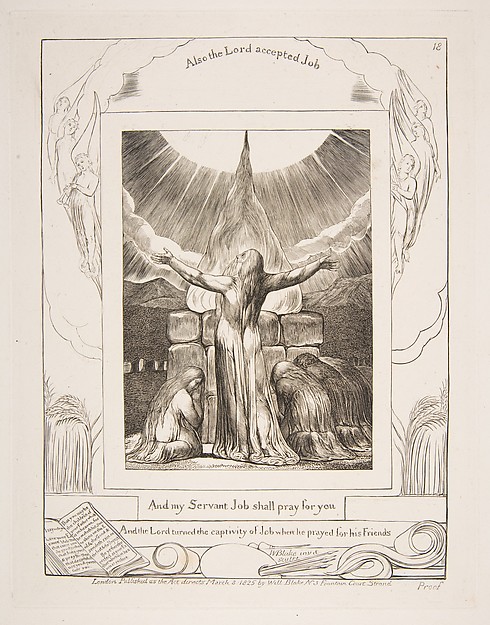
Blake's central religious works are the great series of biblical watercolors, mostly executed for his patron Thomas Butts between roughly 1799 and 1809: scenes of the Creation, the Fall, the Plagues of Egypt, the lives of the Patriarchs and the Prophets, the Gospels and Revelation, painted in a small, jewel-like format with translucent washes laid over fine ink outlines. The Job series — twenty-one engraved plates published in 1826, the year before his death, illustrating the Book of Job — is the most concentrated and complete project of his biblical career and is widely held to be his masterpiece in the print medium. The Dante illustrations he was working on at the same moment were left unfinished.
His own prophetic books — printed by his idiosyncratic relief-etching process and hand-colored, often in tiny editions of a few copies — interleave Blake's own mythological cycles (Urizen, Los, Albion) with scriptural and apocalyptic imagery. The Marriage of Heaven and Hell, Jerusalem, and Milton are not Christian art in the conventional sense, but they read the Bible obsessively and rewrite it for an English Romantic age.
Blake worked outside the academy, was largely ignored in his own lifetime by the London art world, and lived poor. The Pre-Raphaelites, the Symbolists, W. B. Yeats, and the twentieth-century rediscovery of his prophetic books eventually made him a major modern figure. His grave in Bunhill Fields was relocated and memorialized in 2018.
Notable works in detail
blake-ancient-of-days
The Ancient of Days, designed by William Blake in 1794 as the frontispiece for his prophetic book Europe: A Prophecy and produced in his idiosyncratic relief-etched and hand-colored format, depicts the moment from Proverbs 8 (and from Blake's own mythological cycles) in which the divine figure leans down from a luminous celestial sphere with a great brass compass to measure out the boundaries of the created world. The figure — Blake's own visionary character Urizen, identified in his mythology with the moral law-giver and with the divine architect of the material universe — is shown crouched inside a fiery solar disc reaching down with the compass into the formless darkness below. The composition is among the most reproduced of Blake's prophetic illustrations and was the print he was reportedly working on as he died in 1827. Blake himself colored the surviving impressions of the design by hand in editions of a few copies; the principal surviving versions are in the Whitworth Art Gallery in Manchester, the British Museum, and the Yale Center for British Art.
blake-elohim-creating-adam
Elohim Creating Adam, painted by William Blake in 1795 (or 1805 — the dating of the Large Color Prints series is contested) in color print finished in pen and watercolor on paper and now in the Tate in London, depicts the moment from Genesis 2 in which the Lord forms Adam from the dust of the ground. Blake stages the scene as a fierce spiritual struggle: the great winged figure of Elohim hovers above the half-formed body of Adam, who lies on the ground with a serpent already wrapped around his thigh — the iconographic signal that Blake reads the act of creation as already entangled with the Fall and the suffering that will follow. The painting is one of the twelve large color prints Blake produced in the mid-1790s, and one of the supreme statements of his lifelong commitment to a visionary, unconventional, almost dissenting reading of the biblical narrative.
blake-nebuchadnezzar
Nebuchadnezzar, painted by William Blake in 1795 (or 1805 — the dating is contested) in color print finished in pen and watercolor on paper and now in the Tate in London, depicts the Babylonian king of Daniel 4 after God has driven him from human society and reduced him to crawling on all fours in the wilderness, his hair grown like eagles' feathers, his nails like birds' claws. Blake shows the king in the moment of his abasement: a heavily muscled bearded figure on hands and knees, his eyes wide with terror, his mouth open in a half-howl, in a craggy rocky landscape. The painting is one of the twelve large color prints Blake produced in the mid-1790s and a supreme statement of his interest in the Old Testament as a record of human spiritual catastrophe. Blake's Nebuchadnezzar shaped the iconographic treatment of the subject for the next two centuries; almost every subsequent depiction of the mad king refers back to it.

Christ in the Sepulchre, Guarded by Angels
Christ in the Sepulchre, Guarded by Angels, painted by William Blake around 1805 in pen and watercolor on paper and now in the Victoria and Albert Museum in London, depicts the body of Christ laid in the rock-cut tomb between the moment of his death and the moment of his Resurrection — the day and a half between Good Friday and Easter Sunday on which medieval and early modern Christian tradition meditated as the Sabbath of the Lord's rest. Blake shows the body of Christ stretched out on a low stone slab; two enormous winged angels kneel facing each other at the head and the foot, their wings extended and meeting overhead to form a kind of canopy of feathered protection. The composition is among the most original and most affecting of Blake's biblical watercolors and a defining statement of his ability to visualize the silent, almost unspoken moments of the Christian narrative that the more conventional Renaissance and Baroque traditions had largely passed over.

When the Morning Stars Sang Together
When the Morning Stars Sang Together, plate 14 of Blake's Illustrations of the Book of Job (London, 1826), is among the supreme statements of his late style and one of the most reproduced single images from the entire Job series. The plate illustrates the moment from Job 38 in which God speaks to Job out of the whirlwind: Where wast thou when I laid the foundations of the earth, when the morning stars sang together and all the sons of God shouted for joy? Blake stages the moment as a vast cosmic theatre — Job and his wife and friends in the foreground recoiling in awe, the great figure of God in the upper register with arms outstretched, four angelic figures behind him representing the personified powers of creation, and a long horizontal band of small singing angels along the upper edge of the plate. The Job engravings, published in 1826 the year before Blake's death and dedicated to his patron John Linnell, are widely held to be the masterpiece of his entire engraved career.

Job and His Family, plate 1 of Blake's Illustrations of the Book of Job (London, 1826), is the opening image of the twenty-one-engraving cycle that traces the entire Job narrative from the patriarch's pre-affliction prosperity through his sufferings, his dialogue with his three friends, the divine speech from the whirlwind, and his final restoration. The opening plate shows Job and his wife seated on either side of their large family under the spreading branches of a great tree at sunset, the household animals at their feet, the musical instruments hung silent in the tree above — Blake's small visual signal that something is wrong, that the music has stopped before the trial begins. The text border around the engraving carries scriptural quotations laid out in Blake's own characteristic typographic format. The plate sets the visual and theological tone for the entire cycle and is one of the most reproduced individual engravings from Blake's late career.
Bible scenes William Blake painted
Matthew
Luke
Genesis
Mark
Job

%20-%20The%20Entombment%20-%20PC.91%20-%20Pollok%20House.jpg?width=800)