Job 11
People in this chapter
Job 11 is the third friend's opening speech in the first cycle of the great debate. Eliphaz spoke first (chs. 4-5) appealing to a mystical night-vision he had received. Bildad spoke second (ch. 8) appealing to the wisdom of the ancestors. Zophar - almost certainly the youngest of the three, since he speaks third in each cycle - appeals to neither vision nor tradition. He appeals to his own certainty. He is the friend whose speech contains no qualifier, no acknowledgment of mystery, no allowance that Job's experience might be revealing something Zophar has not yet considered.
He simply tells Job that Job is wrong, that Job is lying, that Job needs to repent, and that if Job will only do so, restoration will follow.
Tap any highlighted phrase to jump to the commentary that unpacks it.

Job 11:1-6Should Thy Lies Make Men Hold Their Peace?
1Then answered Zophar the Naamathite, and said, 2Should not the multitude of words be answered? and should a man full of talk be justified? 3Should thy lies make men hold their peace? and when thou mockest, shall no man make thee ashamed? 4For thou hast said, My doctrine is pure, and I am clean in thine eyes. 5But oh that God would speak, and open his lips against thee; 6And that he would shew thee the secrets of wisdom, that they are double to that which is! Know therefore that God exacteth of thee less than thine iniquity deserveth.
Zophar opens by escalating12. Eliphaz had been grandfatherly. Bildad had been formal. Zophar is angry. Should not the multitude of words be answered? - i.e., somebody needs to shut Job up. Should a man full of talk be justified? - i.e., Job's suffering does not earn him the right to keep speaking. Should thy lies make men hold their peace? - i.e., your grief is so embarrassing the rest of us have been polite long enough.
The chapter is recording the exact moment a friend group's patience with a sufferer runs out and turns into accusation.
Zophar misquotes Job in v. 4. Job has never said “my doctrine is pure, and I am clean in thine eyes.” Job has said things much subtler: that he does not know what he is being punished for, that he is willing to be examined, that he longs for a hearing in God's court. Zophar reduces Job's nuanced grief to a flat claim of perfection - which is the easiest claim to refute. The Bible is documenting a familiar pattern: when you can't answer what someone actually said, restate their position more simplistically and attack the simpler version.
The book of Job is the canonical warning against the move.
Verse 6 is the chapter's most chilling sentence. Know therefore that God exacteth of thee less than thine iniquity deserveth. The statement is true in the abstract - every fallen person could rightly say of themselves, “the LORD has not dealt with me after my sins, nor rewarded me according to my iniquities” (Ps. 103:10). But Zophar is saying it to a specific man God Himself has called blameless (Job 1:8) and whose suffering God has specifically permitted as a test of integrity, not as retribution (Job 1:11-12; 2:5-6).
Zophar does not know what the reader knows from chapters 1-2. He is applying a true general principle to a specific innocent case where it is exactly wrong. The Bible is asking us to feel how much damage a true sentence can do in the wrong mouth.
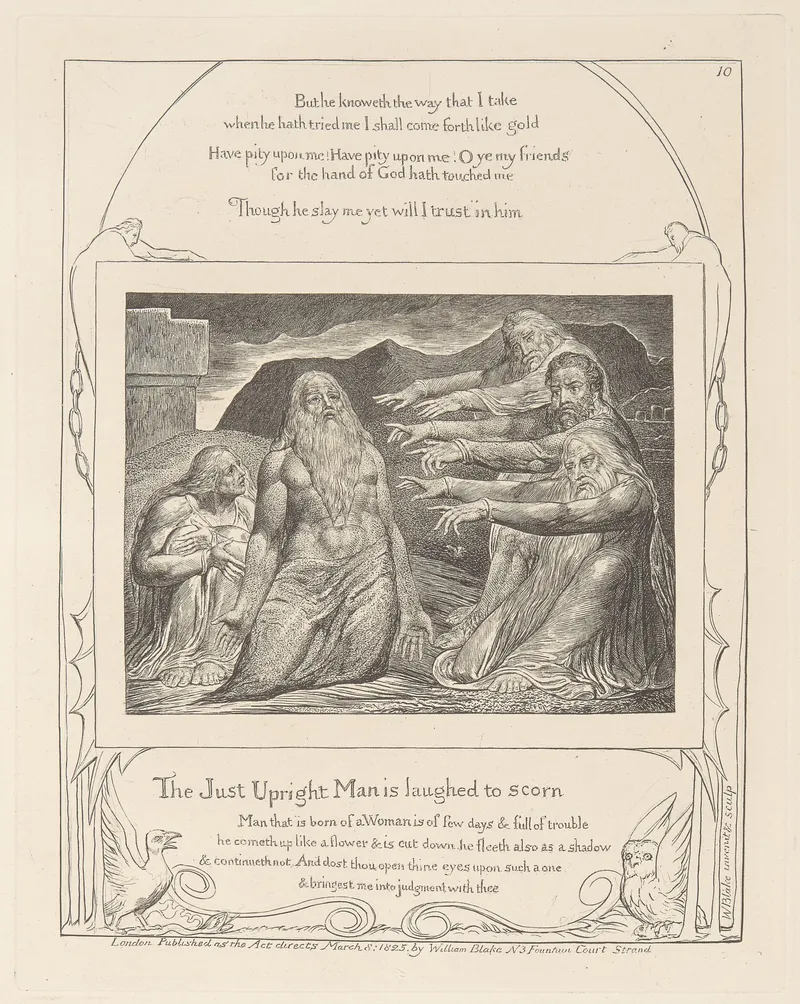
Job 11:7-12The Unsearchable Depths
7Canst thou by searching find out God? canst thou find out the Almighty unto perfection? 8It is as high as heaven; what canst thou do? deeper than hell; what canst thou know? 9The measure thereof is longer than the earth, and broader than the sea. 10If he cut off, and shut up, or gather together, then who can hinder him? 11For he knoweth vain men: he seeth wickedness also; will he not then consider it? 12For vain man would be wise, though man be born like a wild ass’s colt.
Verses 7-9 are stunning in themselves. Higher than heaven; deeper than Sheol; longer than the earth; broader than the sea. The chapter at this point is genuinely beautiful - and the beauty is part of its danger. Real theological depth in the mouth of an unsympathetic friend can sound so much like the truth that the sufferer in the room cannot push back. The chapter is teaching, by displaying it in real-time, how a friend with a real theology of transcendence can use it to silence the actual pain of the person in front of him.
The cure is not to abandon the theology of God's unsearchableness. The cure is to use it the way Paul uses it.
Job 11:13-20The Promise on Zophar's Terms
13If thou prepare thine heart, and stretch out thine hands toward him; 14If iniquity be in thine hand, put it far away, and let not wickedness dwell in thy tabernacles. 15For then shalt thou lift up thy face without spot; yea, thou shalt be stedfast, and shalt not fear: 16Because thou shalt forget thy misery, and remember it as waters that pass away: 17And thine age shall be clearer than the noonday: thou shalt shine forth, thou shalt be as the morning. 18And thou shalt be secure, because there is hope; yea, thou shalt dig about thee, and thou shalt take thy rest in safety. 19Also thou shalt lie down, and none shall make thee afraid; yea, many shall make suit unto thee. 20But the eyes of the wicked shall fail, and they shall not escape, and their hope shall be as the giving up of the ghost.
Zophar's offer is built on a quiet, devastating assumption. The conditional if iniquity be in thine hand, put it far away assumes that there is iniquity in Job's hand - that's the whole reason for the suffering. Zophar is offering the verse as a diagnosis. The book's reader knows the diagnosis is false. The Lord has already named Job in chapters 1-2 as having no such iniquity, and the suffering is not retributive - it is a contested trial of Job's integrity against an Accuser the friends do not know exists.
Zophar is, in effect, telling a wrongly-accused defendant to confess to the crime so the judge will go easier on him. It is the cruelest variation of well-meaning counsel.
Verse 16's promise is one of the chapter's most pastorally dangerous. Thou shalt forget thy misery, and remember it as waters that pass away. It sounds beautiful. It is also, in Job's case, false. Job's ten children will not return. The years he spent waiting on the ash heap will not be erased. The friends who failed him cannot un-fail him. The book of Job will record an unusual closing scene in which Job is restored - but the restoration explicitly does not erase what was lost (cf. Job 42:11, where his brothers and sisters come and console him over “all the evil that the LORD had brought upon him”).
The Bible refuses to pretend, even in a redemption ending, that the misery was nothing. Zophar's promise is the kind of theology that has nothing to say to a parent who has buried a child.
Verse 19's closing image - many shall make suit unto thee - is the chapter's subtlest cruelty. Zophar is promising Job that if he repents, the same kind of friends who are currently looking down on him will once again come to him for counsel. The implication is that Job's loss of social standing is the actual problem at the center of his suffering. The book of Job spends thirty more chapters undoing this assumption. Job's suffering is the silence of God under unjust pain - a weight Zophar reduces to a social problem he cannot even name accurately.
Research trail
Sources & further study
These references support the historical, linguistic, manuscript, and contextual notes in this chapter. Scripture remains the primary text; external sources are provided so readers can inspect the research directly.
- Job 11 · Hebrew + Jewish commentaryHebrew text with Rashi, Ibn Ezra, Ramban, and Saadia Gaon on Zophar's first speech - including the long Jewish tradition of reading Zophar as the harshest and least sympathetic of the three friends.
- Ludlul Bēl Nēmeqi (“I Will Praise the Lord of Wisdom”)The Akkadian wisdom poem from Babylon often called “the Babylonian Job” - a sufferer wrestling with the same questions Zophar dismisses. Useful comparative background for the ancient Near Eastern wisdom traditions Job is in conversation with and against.
- Job 11:7 ↔ Romans 11:33Paul's “O the depth of the riches both of the wisdom and knowledge of God! how unsearchable are his judgments” (Rom 11:33) lifts Zophar's rhetorical question and reframes it as the doxology of the gospel.
Where this echoes in Scripture
Should Thy Lies Make Men Hold Their Peace?
- Job 1:8There is none like him in the earth, a perfect and an upright man, one that feareth God, and escheweth evil.God Himself naming Job as blameless - the verdict Zophar overrides in 11:6.
- Job 42:7Ye have not spoken of me the thing that is right, as my servant Job hath.God's closing verdict on the three friends, including Zophar.
- Isaiah 53:6The LORD hath laid on him the iniquity of us all.The cross-shaped reversal of Zophar's math.
The Unsearchable Depths
- Isaiah 40:28The everlasting God, the LORD, the Creator of the ends of the earth, fainteth not, neither is weary? there is no searching of his understanding.The same vocabulary, used as Isaiah uses it - as comfort to the exhausted, not as a club to the suffering.
- Romans 11:33-34O the depth of the riches both of the wisdom and knowledge of God! how unsearchable are his judgments, and his ways past finding out!Paul reframing Zophar's line into the gospel's doxology.
- Colossians 2:3In whom are hid all the treasures of wisdom and knowledge.Where the unsearchable depths Zophar gestured at have actually become searchable - in Christ.
The Promise on Zophar's Terms
- Job 42:7-8My wrath is kindled against thee, and against thy two friends: for ye have not spoken of me the thing that is right, as my servant Job hath.God's closing verdict - Zophar's well-articulated theology is rebuked, not commended.
- 1 John 1:9If we confess our sins, he is faithful and just to forgive us our sins, and to cleanse us from all unrighteousness.The genuine gospel offer Zophar's false offer is parodying.
- Revelation 21:4And God shall wipe away all tears from their eyes; and there shall be no more death.The real restoration - wipes the tears that were really cried; does not pretend they weren't.