Job 1
People in this chapter
The book of Job begins on earth - in the land of Uz, a place both real and symbolic, where a man named Job dwells. He is described in terms that seem almost superhuman: perfect, upright, fearing God, eschewing evil. He is blessed beyond measure - thousands of sheep and camels, great herds of oxen and asses, a household of servants, and ten children who feast and celebrate. By every measure of the ancient world, Job is the greatest of all the men of the East. He is, it seems, a man who has earned God's favor.
Tap any highlighted phrase to jump to the commentary that unpacks it.
Job 1:1-3The Perfect Man, Blessed
1There was a man in the land of Uz, whose name was Job; and that man was perfect and upright, and one that feared God, and eschewed evil. 2And there were born unto him seven sons and three daughters. 3His substance also was seven thousand sheep, and three thousand camels, and five hundred yoke of oxen, and five hundred she asses, and a very great household; so that this man was the greatest of all the men of the east.
Job is introduced with language usually reserved for God Himself - "perfect and upright." In Hebrew, these words suggest completeness, integrity, absence of hidden corruption. Job's character is entirely aligned with righteousness, with no hidden self beneath the surface. What you see is what you get: a man of wholeness. 1
To fear God is to stand in reverent awe before the holy. To eschew evil is to turn away from it deliberately, to make a practice of rightness. Job actively, habitually avoids evil and pursues the fear of the Lord. This is a chosen way of life, sustained by discipline and love23.
Job 1:4-5A Household in Celebration
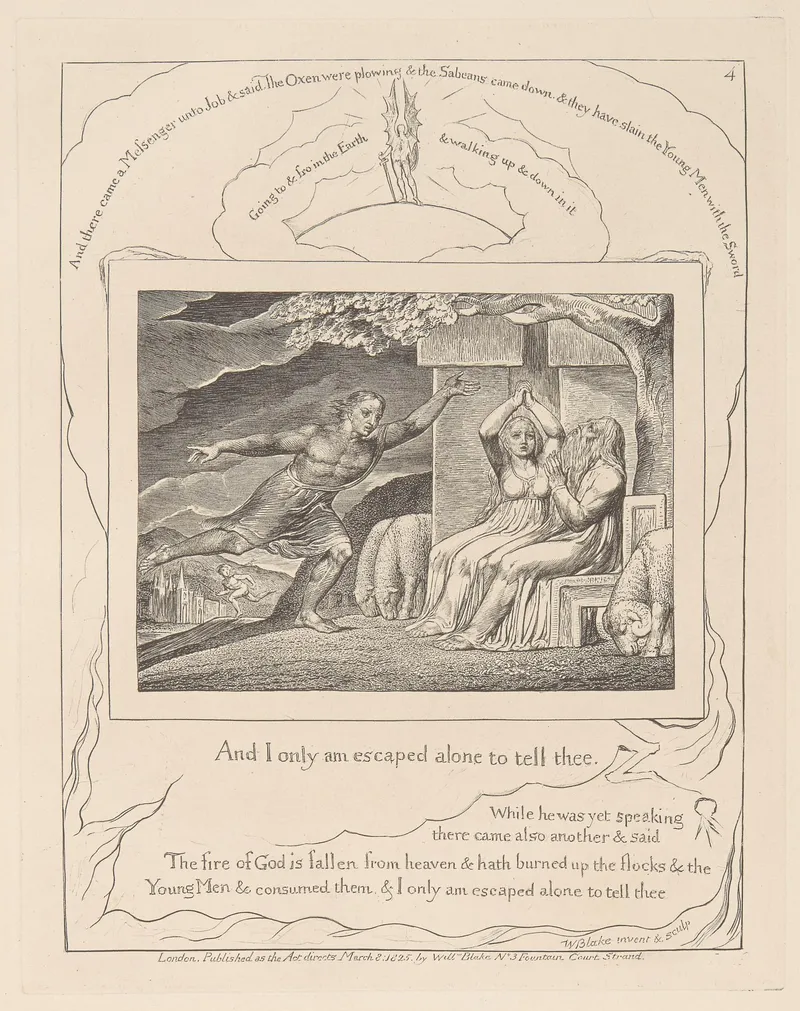
4And his sons went and feasted in their houses, every one his day; and sent and called for their three sisters to eat and to drink with them. 5And it was so, when the days of their feasting were gone about, that Job sent and sanctified them, and rose up early in the morning, and offered burnt offerings according to the number of them all: for Job said, It may be that my sons have sinned, and cursed God in their hearts. Thus did Job continually.
Job's children are not merely alive - they are feasting, celebrating, rotating through houses of celebration. This is abundance, security, joy. Yet notice the subtle note: each child feasts in his or her own house, one day at a time. There is wealth here, but also separation. And into this scene of celebration comes a father's vigilance.
After the feasting ends, Job rises early and offers burnt offerings for each of his children. The possibility of hidden sin troubles him, even where he has no proof of it. "It may be that my sons have sinned, and cursed God in their hearts" - the heart, the hidden place. Job's concern reaches past outward propriety to the secret thoughts of his children. He is a man of such deep piety that he stands guard even over the internal lives of those he loves, offering intercession on their behalf. This is love at its most vigilant.
Job 1:6-11The Accuser in Heaven
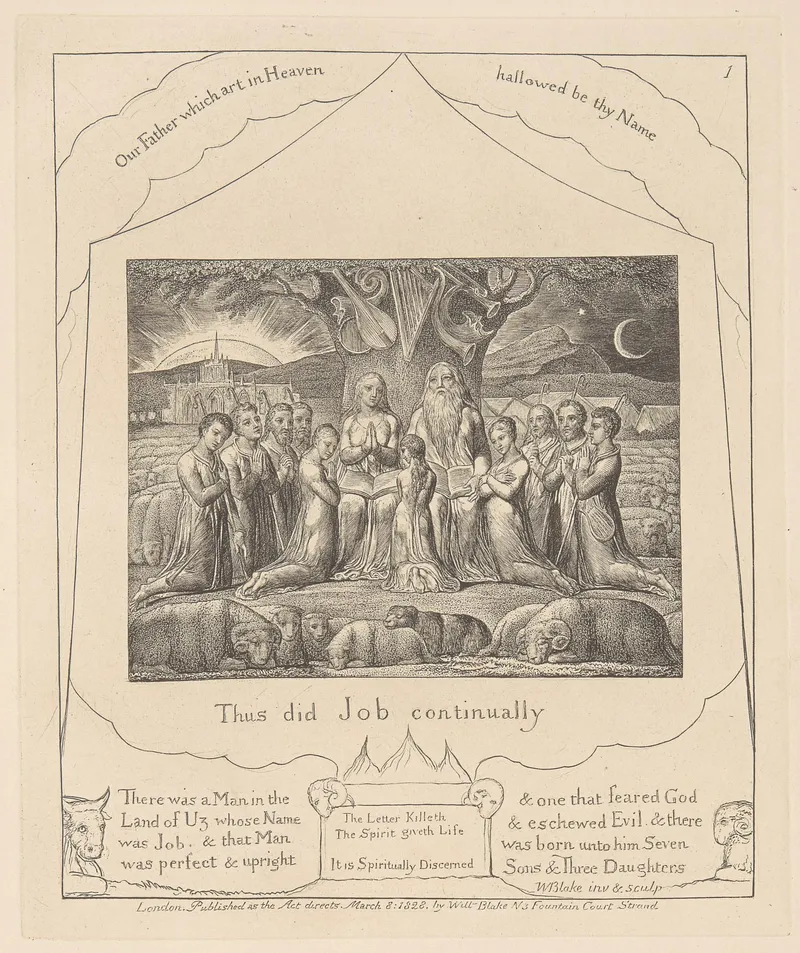
6Now there was a day when the sons of God came to present themselves before the LORD, and Satan came also among them. 7And the LORD said unto Satan, Whence comest thou? Then Satan answered the LORD, and said, From going to and fro in the earth, and from walking up and down in it. 8And the LORD said unto Satan, Hast thou considered my servant Job, that there is none like him in the earth, a perfect and an upright man, one that feareth God, and escheweth evil? 9Then Satan answered the LORD, and said, Doth Job fear God for nought? 10Hast not thou made an hedge about him, and about his house, and about all that he hath on every side? thou hast blessed the work of his hands, and his substance is increased in the land. 11But put forth thine hand now, and touch all that he hath, and he will curse thee to thy face.
The "sons of God" are mysterious figures - angelic beings, members of the heavenly court, the witnesses to God's throne. In this moment, they gather to present themselves before the Lord, as if for a divine assembly or judgment day. The scene is cosmic, witnessed by the heavenly order.
The Lord Himself praises Job: "There is none like him in the earth." This is the assessment of one who sees all hearts, spoken without flattery and without reservation. The Lord is putting Job forward as an exemplar of righteousness, as proof that there exists at least one human being whose faith is not mercenary, whose love of God is not conditional on reward.
Again the same language: perfect and upright. The Lord echoes the narrator's description of Job, affirming it. And now we see that God Himself knows Job, takes notice of him, speaks of him with pride. His righteousness is confirmed in the sight of the Most High.
Satan's question cuts to the heart of all religious doubt: "Doth Job fear God for nought?" Does he worship out of love, or out of calculation? Is his faith rooted in genuine devotion, or merely in the wages he has received? This is the fundamental question of religion: why do we believe? What sustains faith when belief no longer brings benefit?
Satan proposes an experiment: take away everything Job has - his flocks, his lands, his wealth - and his faith will evaporate. "Touch all that he hath" - let there be loss, dispossession, the stripping away of everything that makes life secure. Then, Satan suggests, Job will curse God to His face. The wager is this: will Job's faith survive deprivation?
Job 1:12-19All in a Single Day
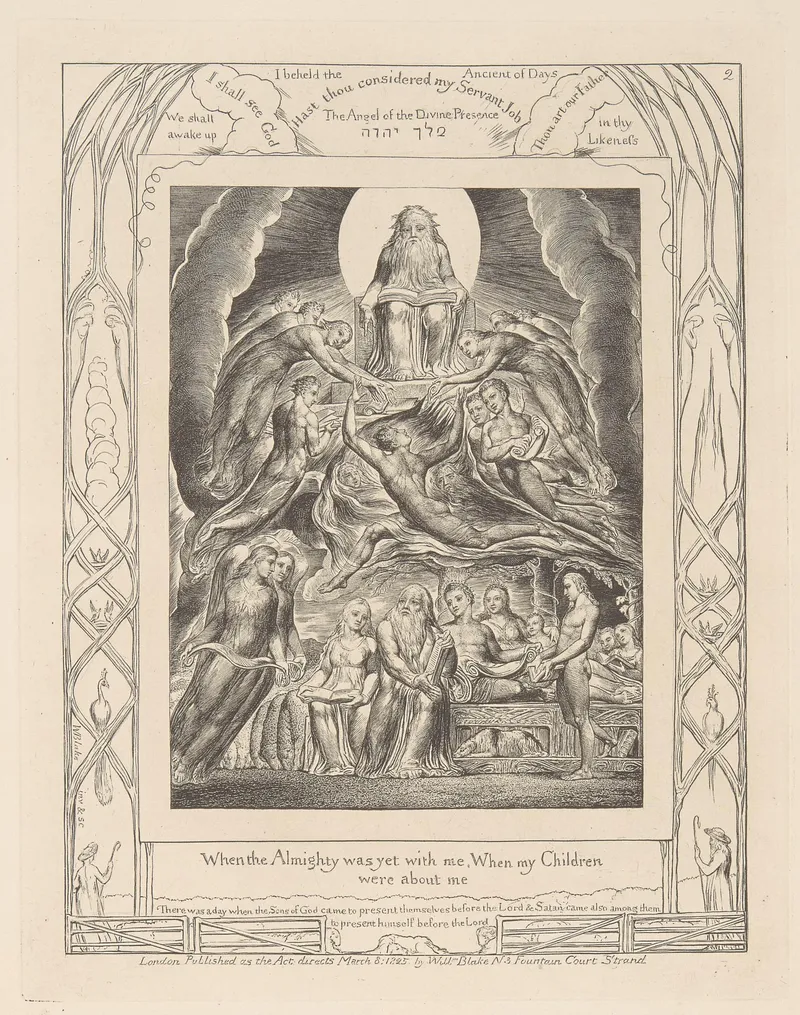
12And the LORD said unto Satan, Behold, all that he hath is in thy power; only upon himself put not forth thine hand. So Satan went forth from the presence of the LORD. 13And there was a day when his sons and his daughters were eating and drinking wine in their eldest brother’s house: 14And there came a messenger unto Job, and said, The oxen were plowing, and the asses feeding beside them: 15And the Sabeans fell upon them, and took them away; yea, they have slain the servants with the edge of the sword; and I only am escaped alone to tell thee.
Calamity strips everything; faith asks: can you praise when silence is easier?
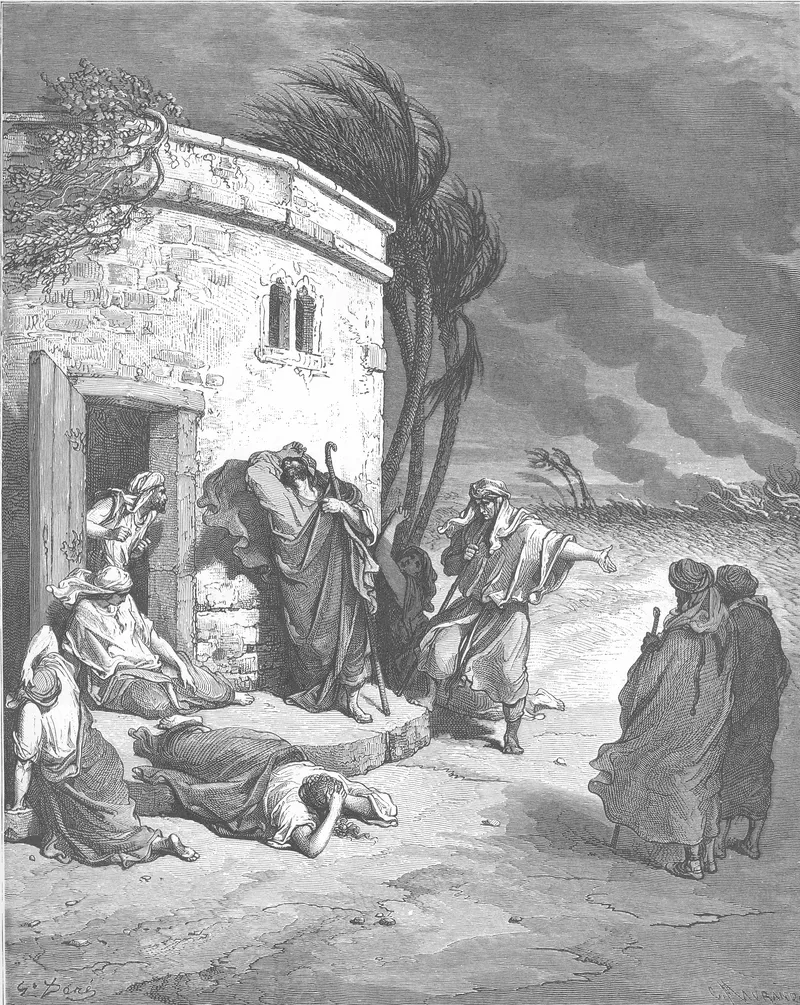
16While he was yet speaking, there came also another, and said, The fire of God is fallen from heaven, and hath burned up the sheep, and the servants, and consumed them; and I only am escaped alone to tell thee. 17While he was yet speaking, there came also another, and said, The Chaldeans made out three bands, and fell upon the camels, and have carried them away, yea, and slain the servants with the edge of the sword; and I only am escaped alone to tell thee. 18While he was yet speaking, there came also another, and said, Thy sons and thy daughters were eating and drinking wine in their eldest brother’s house: 19And, behold, there came a great wind from the wilderness, and smote the four corners of the house, and it fell upon the young men, and they are dead; and I only am escaped alone to tell thee.
The Lord consents to the wager. Everything Job possesses will be placed into Satan's hands - his flocks, his herds, his servants, his land. Only Job himself is off limits. "Put not forth thine hand upon him" - Job's life is protected, but everything that makes life worth living is at stake. The experiment is set in motion.
The first messenger brings news of the first catastrophe. Raiders - the Sabeans, a known people of Arabia - have attacked Job's oxen and asses while they were in the field. The servants have been slaughtered. All the livestock taken. And the messenger, the sole survivor, arrives to tell Job what has been lost.
Notice the rhythm. While the first messenger is still speaking, a second arrives. Then a third. Then a fourth. The catastrophes do not arrive separately, allowing time for grief or recovery. They arrive in rapid succession, piling upon one another, overwhelming the mind. This is how total devastation works: an avalanche, each wave carrying another loss, another death, another shock. The pattern itself is part of the torture: one messenger has not even finished before the next arrives.
Job 1:20-22"The Lord Gave, and the Lord Hath Taken Away"
20Then Job arose, and rent his mantle, and shaved his head, and fell down upon the ground, and worshipped, 21And said, Naked came I out of my mother’s womb, and naked shall I return thither: the LORD gave, and the LORD hath taken away; blessed be the name of the LORD. 22In all this Job sinned not, nor charged God foolishly.
Job's first response to the news is not to bargain, not to rage, not to flee. He tears his mantle - the sign of mourning in the ancient world - and shaves his head. These are the physical expressions of grief, the body's way of crying out what words cannot say. Job is undone. He does not hide his sorrow. But he also does not curse.
And then comes the astonishing word: he worshipped. While still on the ground, stripped of everything, Job falls down before God. The very posture of his body - prostrate, vulnerable, empty - becomes an act of faith. He falls in worship rather than rising in accusation. This is the answer to Satan's wager: Yes, Job fears God for nought, out of piety, sustained by love for its own sake.
Job's meditation moves backward and forward in time. He remembers the moment of his birth - naked, defenseless, carrying nothing into life. Birth is a dispossession, and we arrive in the world with empty hands.
And death will mirror birth. Job will return "thither" - to that same nakedness, that same state of empty-handedness. Between the two nakedness - birth and death - lies the brief season of life, where we gather things, accumulate, possess. But it is all temporary. We return to earth with nothing, exactly as we came.
"The Lord gave, and the Lord hath taken away." This is the bedrock theology of stewardship. Job does not say "I had" or "I owned." He says "The Lord gave." Everything he possessed was, in the deepest sense, a gift. It belonged to God. And if God has chosen to withdraw the gift, that is God's prerogative. Job is expressing a profound truth: the only thing that is finally ours is our relationship with God. Everything else - property, children, health, life itself - is on loan.
"Blessed be the name of the Lord." Even in loss, Job blesses God. He does not curse. He does not demand explanation. He does not rage at the unfairness. Instead, he speaks a blessing over the name of the one who has allowed this suffering. This is faith stretched to its absolute limit. This is the human soul saying to God: You are holy. Your name is worthy of blessing. Even this - even this loss - does not change that truth.
The narrator adds a crucial word: "In all this Job sinned not, nor charged God foolishly." Job has not accused God of injustice. He has not demanded an explanation. He has not questioned God's goodness. This is what fidelity looks like when all evidence is stripped away. Job has answered Satan's wager. He fears God because God is God.
Research trail
Sources & further study
These references support the historical, linguistic, manuscript, and contextual notes in this chapter. Scripture remains the primary text; external sources are provided so readers can inspect the research directly.
- The Book of JobSBL entry on Job: composition, wisdom tradition, theodicy, textual history.
- Job 1 - Hebrew + classical Jewish commentaryThe Hebrew text of Job 1 alongside Rashi, Ibn Ezra, and other classical commentators.
- Job - SBL OverviewOpen-access SBL essay on the historical and literary setting of Job.