Job 2
People in this chapter
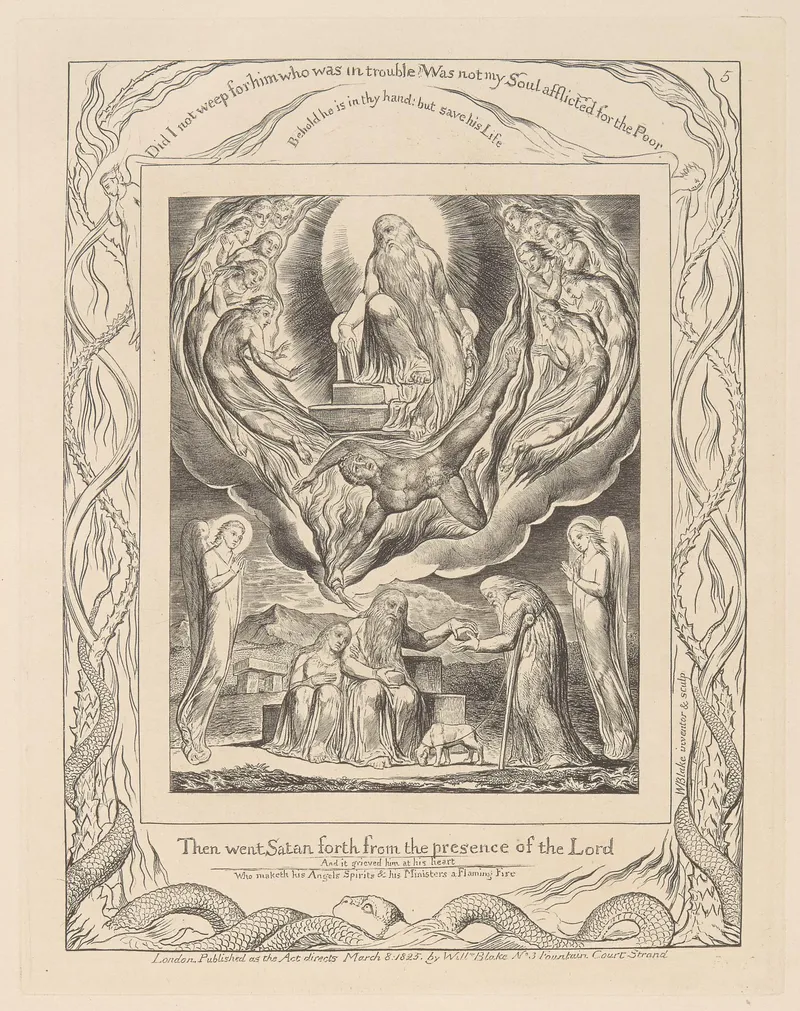
The curtain lifts on heaven a second time, almost word for word like the first: Again there was a day when the sons of God came to present themselves before the LORD, and Satan came also among them. And again the LORD points to His servant - only now with a line that was not there before: still he holdeth fast his integrity, although thou movedst me against him, to destroy him without cause (v. 3).
The first round of loss has not broken Job, and the LORD says so. But Satan has a new wager, colder than the last: Skin for skin, yea, all that a man hath will he give for his life. But put forth thine hand now, and touch his bone and his flesh, and he will curse thee to thy face (vv. 4-5). Strip away a man's possessions, the accuser argues, and he endures; strike his own body and he will break.
The LORD permits the trial within one boundary: Behold, he is in thine hand; but save his life (v. 6).1
Tap any highlighted phrase to jump to the commentary that unpacks it.
Job 2:1-6Skin for Skin · Still He Holdeth Fast His Integrity
1Again there was a day when the sons of God came to present themselves before the LORD, and Satan came also among them to present himself before the LORD. 2And the LORD said unto Satan, From whence comest thou? And Satan answered the LORD, and said, From going to and fro in the earth, and from walking up and down in it. 3And the LORD said unto Satan, Hast thou considered my servant Job, that there is none like him in the earth, a perfect and an upright man, one that feareth God, and escheweth evil? and still he holdeth fast his integrity, although thou movedst me against him, to destroy him without cause. 4And Satan answered the LORD, and said, Skin for skin, yea, all that a man hath will he give for his life. 5But put forth thine hand now, and touch his bone and his flesh, and he will curse thee to thy face. 6And the LORD said unto Satan, Behold, he is in thine hand; but save his life.
The chapter opens by repeating the first scene almost exactly: Again there was a day when the sons of God came to present themselves before the LORD, and Satan came also among them (v. 1). The book is in no hurry to explain this assembly, and we should resist the urge to explain it for it. What the text gives us is plain enough: there is a court, the LORD presides over it, and the accuser is present and accountable, answering when questioned and moving only within what he is granted.
He has been going to and fro in the earth (v. 2), restless and roaming, exactly as before. The repetition itself is part of the point. Job, down in his ruined life, knows nothing of this scene; he will live the whole book without it. We, the readers, are shown it once at the start and then left to carry what Job cannot see - that his ordeal is not random cruelty and not the silence of an absent God, even though to Job it will feel like both.
The narrative simply opens the door to heaven, lets us look, and closes it again. It does not hand us a theory of why the righteous suffer; it shows us a throne, and a servant about to be tested under it.1
The LORD's words about Job are the same praise as before, with one stunning addition: still he holdeth fast his integrity, although thou movedst me against him, to destroy him without cause (v. 3). Two things in that line must not be softened. First, Job's standing has not slipped an inch; after losing children, wealth, and servants he still holds fast, and the LORD says so aloud. Second - and this is the hinge of the whole book - the affliction is without cause. It is not the wage of some hidden sin.
It is not discipline for a fault. The LORD Himself certifies that Job has done nothing to deserve what has come and what is coming. Hold that firmly, because every voice in the chapters ahead, including Job's well-meaning friends, will press the opposite assumption: that suffering this severe must mean Job did something to earn it. The narrator has already told us, from the throne room, that this is false. Whatever Job 2 is about, it is not about a man getting what he had coming.
The text refuses that reading before the friends can ever propose it.
Satan answers with a proverb, blunt and cold: Skin for skin, yea, all that a man hath will he give for his life (v. 4). The exact origin of the saying is debated, but its drift is clear enough as the accuser uses it: a man will surrender anything - possessions, livestock, even his children - to keep his own skin, his own life. So the first round, the accuser implies, did not really touch Job where he lives; it only stripped away the outer things a man would trade away anyway.
But put forth thine hand now, and touch his bone and his flesh, and he will curse thee to thy face (v. 5). Strike the body itself, the self in its own flesh, and the piety will crack. Notice what Satan's wager assumes about human beings: that self-preservation is the deepest thing in us, that under enough bodily pain everyone's faith is finally for sale. It is a low view of the creature and, behind it, a low view of God - as though no one could love and trust the LORD for His own sake once it stopped paying.
The whole rest of the book is, in one sense, the testing of that cynical claim.
The LORD grants the trial within a fixed limit: Behold, he is in thine hand; but save his life (v. 6). Two truths sit side by side here, and the chapter holds them together without flinching. The affliction is real and severe - Job is handed over to genuine suffering. And yet the accuser is on a leash; he reaches no further than he is permitted, and the boundary is drawn precisely where the LORD says, not where Satan wishes.
Save his life. Job may be struck, but he may not be killed. This constraint will shape everything that follows. When the agony deepens and Job longs for death as a release, death will not come; he must live through it. When his wife says curse God, and die, the dying she imagines is not on offer. The book will not let Job escape downward into the grave any more than it lets Satan strike without limit.
He is held, painfully, in the narrow place between - alive, suffering, and not abandoned, though he cannot feel the hand that holds the line.
Job 2:7-8From the Sole of His Foot unto His Crown
7So went Satan forth from the presence of the LORD, and smote Job with sore boils from the sole of his foot unto his crown. 8And he took him a potsherd to scrape himself withal; and he sat down among the ashes.
The permission given, the blow falls at once: So went Satan forth from the presence of the LORD, and smote Job with sore boils from the sole of his foot unto his crown (v. 7). The detail to feel is the reach of it - from the sole of his foot unto his crown. There is no inch of him the affliction does not cover. The affliction is total, head to foot, with no clean place left to rest.
And these are sore boils - inflamed, oozing, painful eruptions over the whole body, the kind of disfigurement that is both agonizing and shameful, written plainly on the skin for anyone to see. Job cannot hide it, cannot keep his dignity behind a calm face; the ruin is on the surface of him. We met him in the first chapter as the greatest of all the men of the east; now he is a man no one would look at twice except to recoil.
The accuser has done exactly what he asked to do - touched the bone and the flesh - and the question of verse 5 now hangs in the air over a body in torment: will he curse God to His face? The chapter makes us wait inside the suffering before it lets us hear the answer.
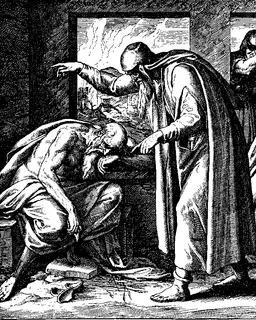
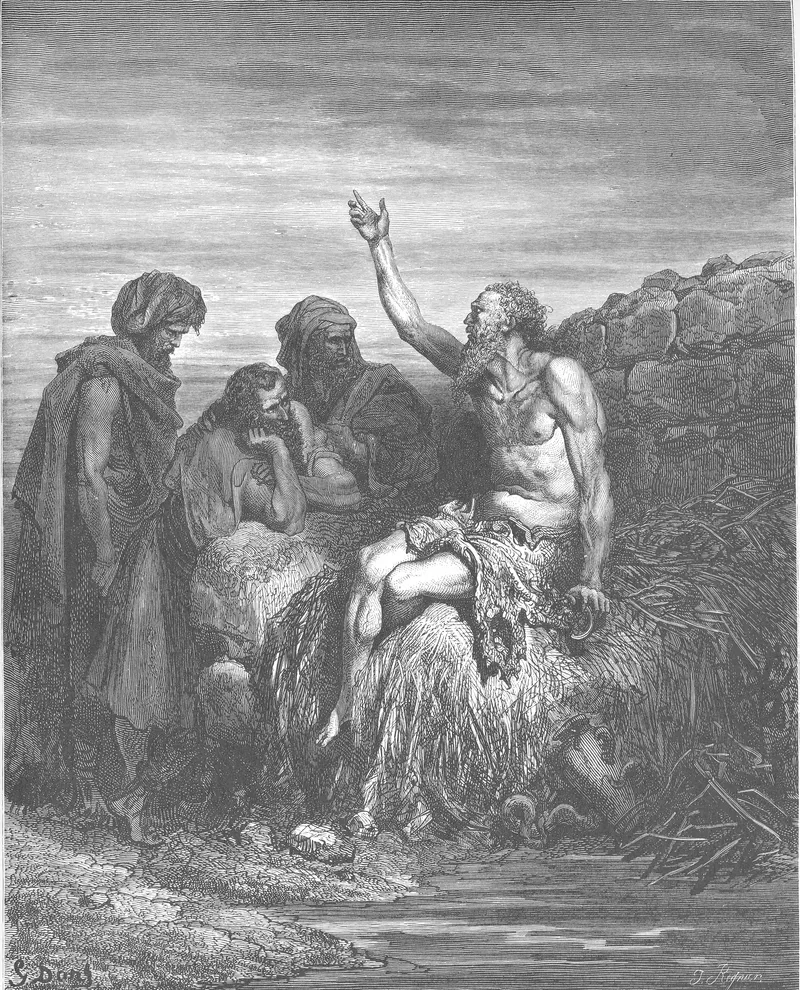
The next image is one of the most haunting in Scripture, and it is told without a wasted word: And he took him a potsherd to scrape himself withal; and he sat down among the ashes (v. 8). A potsherd is a broken piece of pottery - a shard, refuse, the discarded fragment of a shattered jar. Job has no balm, no oil, no soft cloth; he has a jagged splinter of garbage, and with it he scrapes at his own skin, trying to get some relief from the maddening torment of the boils.
The same shattered uselessness that the potsherd is, Job has become - the once-great man now sitting in the trash and the ash, working a broken shard against his own flesh. There is no self-pity in how the verse tells it and no flourish; it simply lays the picture down and lets it do its work. This is what the suffering of Job looks like from the outside: a man at the end of every resource, reduced to the crudest possible comfort.
The Bible does not clean this up. It wants us to see exactly how far down a righteous man can be brought - and to remember, from verse 3, that he has done nothing to deserve the descent.
Where Job sits matters: he sat down among the ashes (v. 8). The ash-heap was the place of mourning and of ruin - the refuse mound outside a town, where the burned remains and the waste were thrown, and where the grieving and the outcast sat in the dust. To sit in ashes was, across the ancient world, the body's own language of desolation: kings did it when their cities fell, mourners did it when they tore their robes, the broken did it when there was nothing left to do.
Job goes there and stays. The man who once sat in honor at the city gate now sits in the place of the discarded, marked by disease, scraping himself with a shard. And yet - this is the quiet wonder of the verse - he sits. He does not flee, does not rage off into the dark, does not (yet) lift his hand against heaven. He takes the lowest seat there is and simply remains there with his grief, in the open, before God and everyone.
The whole drama of the chapter is about to come and find him in that place: first his wife, then three friends, all drawn to the man in the ashes. It is from this seat of ruin, not from any height, that Job will speak his great word of faith.
Job 2:9-13Shall We Receive Good, and Not Evil? · Seven Days of Silence
9Then said his wife unto him, Dost thou still retain thine integrity? curse God, and die. 10But he said unto her, Thou speakest as one of the foolish women speaketh. What? shall we receive good at the hand of God, and shall we not receive evil? In all this did not Job sin with his lips. 11Now when Job’s three friends heard of all this evil that was come upon him, they came every one from his own place; Eliphaz the Temanite, and Bildad the Shuhite, and Zophar the Naamathite: for they had made an appointment together to come to mourn with him and to comfort him. 12And when they lifted up their eyes afar off, and knew him not, they lifted up their voice, and wept; and they rent every one his mantle, and sprinkled dust upon their heads toward heaven. 13So they sat down with him upon the ground seven days and seven nights, and none spake a word unto him: for they saw that his grief was very great.
Into the ash-heap the first voice that comes is the nearest one: Then said his wife unto him, Dost thou still retain thine integrity? curse God, and die (v. 9). It would be easy, and unfair, to make her a villain. Remember what she has lost - the same ten children were hers, the same wealth and household, the same world swept away - and now she watches the man she loves rotting in sores, scraping himself with a shard, refusing to be moved.
Her words are bitter, but they are the bitterness of someone past the end of her endurance. Still, the chapter does not soften what she says. Curse God, and die is precisely the outcome the accuser predicted in verse 5 - that under enough pain Job would curse God to His face - and so her counsel, whatever her heartbreak, voices the very temptation the trial was designed to provoke. It is a dark mercy she offers: let go of this God who has let go of you, speak the curse, and be done - let death end it.
That the temptation comes from the one closest to him, sharing his bed and his grief, makes it heavier, not lighter. Some of the hardest pressure to abandon faith comes not from enemies but from those we love most, who cannot bear to watch us suffer and reach, in their anguish, for the one exit they can see.
Job's reply is firm but not cruel: Thou speakest as one of the foolish women speaketh (v. 10). He does not call her a fool; he says she is speaking like one - that this counsel is folly, beneath who she is and beneath the truth they have both known. The fool in the wisdom books is not the unintelligent person but the one who lives as though God can be dismissed; to curse God and die is exactly that folly spoken aloud, and Job names it.
Then comes the answer that has steadied sufferers ever since: What? shall we receive good at the hand of God, and shall we not receive evil? Weigh how much he concedes and how much he holds. He names it plainly as evil and refuses to take only the pleasant from God's hand while rejecting the bitter from that same hand. The years of blessing came from God; will he now curse God for the years of loss?
If the good was received as gift, the evil must be received as from the same giver - not approved, not enjoyed, but received, without letting go of the One who gives. This is not grim resignation; it is the refusal to make his faith a transaction that pays out only in good weather.
The narrator steps in with the verdict the whole scene was driving toward: In all this did not Job sin with his lips (v. 10). It is a careful sentence, and the care is deliberate. With his lips - Job did not speak the curse Satan was certain he would speak; he did not, with his mouth, turn on God. The wager of verse 5 is, at this stage, decisively lost: the accuser said the body's pain would make Job curse God to His face, and it has not.
But the phrasing leaves a door honest. It says Job did not sin with his lips - it does not flatten him into a man without struggle or pretend the road ahead will be all serene acceptance. In the chapters to come Job will pour out raw, anguished, almost reckless speech; he will argue with God, demand answers, wish he had never been born. The narrator is not yet ruling on all of that. What this verse certifies is precise and real: in the hour of the second blow, faced with the temptation to curse and quit, Job kept his integrity whole - he held fast (v. 3) and did not let go.
That is the victory of the chapter, and it is enough. Integrity is not the absence of agony or even of hard words; it is the refusal, under the worst, to curse the God you cannot understand.
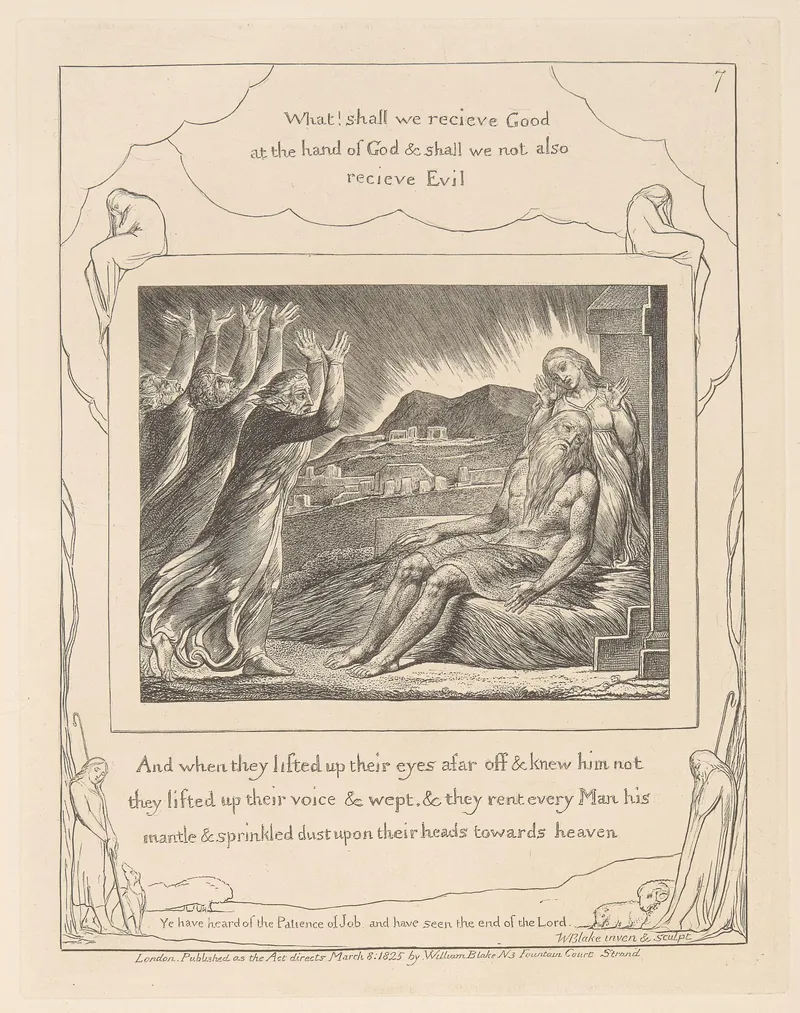
Now the scene widens, and the rest of the book begins to gather: Now when Job's three friends heard of all this evil that was come upon him, they came every one from his own place; Eliphaz the Temanite, and Bildad the Shuhite, and Zophar the Naamathite: for they had made an appointment together to come to mourn with him and to comfort him (v. 11). Whatever harm these three will later do with their words, begin by giving them their due, because the text does.
They heard - they did not look away from a friend's catastrophe. They came - each leaving his own land, traveling a real distance, at real cost. They made an appointment together - this was deliberate, coordinated, intentional, not a passing courtesy. And their stated purpose is exactly right: to mourn with him and to comfort him. When they catch sight of him from far off and cannot even recognize the ruined figure as Job, they do not recoil and leave; they lifted up their voice, and wept; and they rent every one his mantle, and sprinkled dust upon their heads (v. 12).
They enter his grief with their own bodies - weeping, tearing their robes, throwing dust toward heaven - refusing the distance that would have been easier. This is friendship doing the costly, right thing. Hold it in mind through the speeches that follow; the men who will wound Job began by genuinely loving him.
And then they do the wisest thing they will do in the entire book: So they sat down with him upon the ground seven days and seven nights, and none spake a word unto him: for they saw that his grief was very great (v. 13). Take in what they did. They came down to where he was - onto the ground, into the ash and dust beside him, refusing the comfort of standing over the sufferer.
They stayed a long time - seven days and seven nights, the very length of formal mourning for the dead, as though they were grieving a death while Job still lived. And they were silent - none spake a word. Because they saw that his grief was very great, and grief that great does not want explaining. It wants company. This is the friends at their finest, and it is worth marking precisely why they were right here and wrong later: here they let his suffering be what it was and simply stayed beside it; later they will try to account for it, to fit it into a system, to fix him with words.
The seven silent days are a small picture of the truest comfort there is - not answers, not advice, not the rushing in to make the pain make sense, but the steady, costly refusal to leave someone alone in the worst of it. They lost it the moment they opened their mouths. While they kept silent, they kept it.
Research trail
Sources & further study
These references support the historical, linguistic, manuscript, and contextual notes in this chapter. Scripture remains the primary text; external sources are provided so readers can inspect the research directly.
- Job 2 - Translators' NotesThe NET Bible's detailed footnotes on Job 2 - the repeated heavenly-court scene of verses 1-6, the proverb skin for skin in verse 4, the nature of the affliction in verse 7, and the much-discussed force of the wife's words and Job's answer in verses 9-10.
- Job 2 · Hebrew + classical Jewish commentaryThe Hebrew text of Job 2 with Rashi, Ibn Ezra, and other classical commentators side by side - useful for tummah (vv. 3, 9, the “integrity” Job holds fast), for shechin (v. 7, the “sore boils” that also fell on Egypt), and for the weight of Job's question in verse 10 about receiving good and evil alike from God's hand.
- Job 2 ↔ Isaiah 53 · 1 Peter 2 · Romans 12Traces the threads tying Job 2 to the rest of Scripture - the righteous man afflicted without cause (v. 3) read alongside the man of sorrows who did no sin (Isa. 53:3; 1 Pet. 2:22), and the friends' seven days of silent presence (v. 13) read beside the call to weep with them that weep (Rom. 12:15).
Where this echoes in Scripture
Skin for Skin · Still He Holdeth Fast His Integrity
- Job 1:21Naked came I out of my mother’s womb, and naked shall I return thither: the LORD gave, and the LORD hath taken away; blessed be the name of the LORD.Job’s answer to the first round of loss - the same faith now tested in the body (vv. 3-6).
- Isaiah 53:9he had done no violence, neither was any deceit in his mouth.The innocence Job has only in part (v. 3) seen whole in the Servant who suffered without cause.
- Luke 22:31-32Satan hath desired to have you, that he may sift you as wheat: but I have prayed for thee, that thy faith fail not.The accuser asking leave to test a servant of God, as in verses 4-6 - and the limit set against him.
- 1 Corinthians 10:13God is faithful, who will not suffer you to be tempted above that ye are able.The boundary of verse 6 as a settled mercy - the trial permitted, but only within a limit God fixes.
- James 1:12Blessed is the man that endureth temptation: for when he is tried, he shall receive the crown of life.The trial of verses 4-6 named as the testing that, endured, is blessed.
From the Sole of His Foot unto His Crown
- Exodus 9:9-11it shall become small dust... and shall be a boil breaking forth with blains upon man, and upon beast.The same word for boils (v. 7) - there a plague of judgment, here laid on a man called blameless.
- Isaiah 52:14his visage was so marred more than any man, and his form more than the sons of men.A sufferer disfigured in body as Job is (vv. 7, 12) - marred beyond recognition.
- Lamentations 3:16He hath also broken my teeth with gravel stones, he hath covered me with ashes.The ash-heap of mourning where Job sits (v. 8) - the body’s language of desolation.
- Psalm 38:3There is no soundness in my flesh because of thine anger; neither is there any rest in my bones because of my sin.The cry of one afflicted sole to crown (v. 7) - though Job, unlike the psalmist, is struck without cause.
- Job 7:5My flesh is clothed with worms and clods of dust; my skin is broken, and become loathsome.Job’s own later description of the boils of verse 7 - the affliction in his own words.
Shall We Receive Good, and Not Evil? · Seven Days of Silence
- Matthew 26:39O my Father, if it be possible, let this cup pass from me: nevertheless not as I will, but as thou wilt.The faith of verse 10 carried to its furthest point - receiving the cup from the Father’s hand.
- Romans 12:15Rejoice with them that do rejoice, and weep with them that weep.The friends’ one wise act (v. 13) named as a mark of love - presence with the grieving.
- John 11:35Jesus wept.The Lord weeping with mourners as the friends weep with Job (v. 12) - comfort that simply stays.
- James 5:11Ye have heard of the patience of Job, and have seen the end of the Lord; that the Lord is very pitiful, and of tender mercy.The New Testament’s own verdict on Job’s endurance (v. 10) - held up as the pattern of patient faith.
- 1 Thessalonians 5:18In every thing give thanks: for this is the will of God in Christ Jesus concerning you.The posture of verse 10 - receiving from God’s hand in every season, not only the pleasant ones.