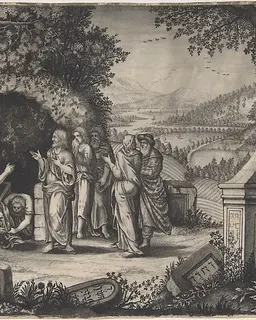
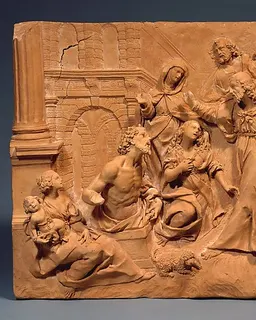
John 11
People in this chapter
John has been building, sign by sign, toward this chapter - water made wine, a boy healed from a distance, a paralytic raised from his bed, five thousand fed, a man born blind given sight - and now he sets down the last and greatest sign before the cross. It opens with sickness and an appeal: Now a certain man was sick, named Lazarus, of Bethany (v. 1), and his sisters Mary and Martha send to Jesus the simplest of pleas, Lord, behold, he whom thou lovest is sick (v. 3).
What follows is meant to unsettle us: When he had heard therefore that he was sick, he abode two days still in the same place where he was (v. 6). The delay is deliberate, and Jesus has already named its reason - This sickness is not unto death, but for the glory of God, that the Son of God might be glorified thereby (v. 4).1
Tap any highlighted phrase to jump to the commentary that unpacks it.
John 11:1-16This Sickness Is for the Glory of God
1Now a certain man was sick, named Lazarus, of Bethany, the town of Mary and her sister Martha. 2(It was that Mary which anointed the Lord with ointment, and wiped his feet with her hair, whose brother Lazarus was sick.) 3Therefore his sisters sent unto him, saying, Lord, behold, he whom thou lovest is sick. 4When Jesus heard that, he said, This sickness is not unto death, but for the glory of God, that the Son of God might be glorified thereby. 5Now Jesus loved Martha, and her sister, and Lazarus. 6When he had heard therefore that he was sick, he abode two days still in the same place where he was. 7Then after that saith he to his disciples, Let us go into Judaea again. 8His disciples say unto him, Master, the Jews of late sought to stone thee; and goest thou thither again? 9Jesus answered, Are there not twelve hours in the day? If any man walk in the day, he stumbleth not, because he seeth the light of this world. 10But if a man walk in the night, he stumbleth, because there is no light in him. 11These things said he: and after that he saith unto them, Our friend Lazarus sleepeth; but I go, that I may awake him out of sleep. 12Then said his disciples, Lord, if he sleep, he shall do well. 13Howbeit Jesus spake of his death: but they thought that he had spoken of taking of rest in sleep. 14Then said Jesus unto them plainly, Lazarus is dead. 15And I am glad for your sakes that I was not there, to the intent ye may believe; nevertheless let us go unto him. 16Then said Thomas, which is called Didymus, unto his fellowdisciples, Let us also go, that we may die with him.
The chapter opens by naming a household John clearly expects his readers to know - Lazarus, of Bethany, the town of Mary and her sister Martha (v. 1) - and he pauses to identify Mary by the act of love she is famous for: that Mary which anointed the Lord with ointment, and wiped his feet with her hair (v. 2). These are not strangers to Jesus; they are friends He loves. So the message the sisters send is striking in its brevity and its confidence: Lord, behold, he whom thou lovest is sick (v. 3).
They do not tell Jesus what to do. They do not ask Him to come, or to heal, or to hurry. They simply lay the situation before Him and lean on one thing - His love. He whom thou lovest is sick; surely that is enough said. It is one of the purest prayers in Scripture: not a demand, not a strategy, just the need named and placed in the hands of the One who loves.
And it sets up the tension that drives the whole chapter, because the love they appeal to is about to do something they never expected love to do.1
What Jesus does next is meant to trouble us, and John makes sure we feel it. First the verdict: This sickness is not unto death, but for the glory of God, that the Son of God might be glorified thereby (v. 4). Then, with deliberate emphasis, the response: Now Jesus loved Martha, and her sister, and Lazarus. When he had heard therefore that he was sick, he abode two days still in the same place where he was (vv. 5-6).
Read those two verses together and the grammar almost jars - Jesus loved them… therefore he stayed away. Not but He stayed; therefore. The delay flows out of His love and His purpose. We naturally assume that love always rushes to relieve the pain at once, and when relief is slow in coming we are tempted to conclude that we have been forgotten. This chapter quietly refuses that conclusion. Jesus loves Lazarus, and Jesus waits - because He is moving toward a greater good than the sisters have asked for, a glory that the swift, expected mercy would have left unseen.
The hardest thing about the delay is that it looks, from inside it, exactly like neglect.
When at last Jesus says, Let us go into Judaea again (v. 7), the disciples are alarmed, for Judaea is where the threat to His life is sharpest: Master, the Jews of late sought to stone thee; and goest thou thither again? (v. 8). His answer reaches past their fear: Are there not twelve hours in the day? If any man walk in the day, he stumbleth not, because he seeth the light of this world (vv. 9-10).
There is an appointed span to His work - a “day” in which it must be done - and while that day lasts, no plot of men can cut it short; He walks in the light of the Father's purpose and does not stumble. He moves by the Father's timing, steady against the threats of others. The same calm governs everything in this chapter - the two days' delay, the careful words, the slow approach to the tomb.
Jesus is never hurried by panic and never frozen by danger. He walks in the day He has been given, and He means to finish the work the Father set in it, whatever it costs Him in Judaea.
Then Jesus speaks of Lazarus in words that wrap death in a gentler garment: Our friend Lazarus sleepeth; but I go, that I may awake him out of sleep (v. 11). The disciples take Him at the surface - Lord, if he sleep, he shall do well (v. 12) - missing that He spake of his death (v. 13). So He tells them plainly: Lazarus is dead (v. 14). But the first word was no mere euphemism.
When Jesus calls death sleep, He is saying something true about what death has become in His presence: not the final, irreversible end it seems, but a state from which He can awake the sleeper as easily as a parent rouses a child. To everyone else Lazarus is dead and gone; to Jesus he is asleep and wake-able. Then comes a line that startles - I am glad for your sakes that I was not there, to the intent ye may believe (v. 15).
He is not glad Lazarus died; He is glad of what His disciples are about to see and believe through it. Their faith is worth more than the few days of grief, because what is coming will anchor them for everything ahead. And brave, sorrowful Thomas speaks for them all: Let us also go, that we may die with him (v. 16) - loyal to the death, even while expecting the worst.
John 11:17-27I Am the Resurrection, and the Life
17Then when Jesus came, he found that he had lain in the grave four days already. 18Now Bethany was nigh unto Jerusalem, about fifteen furlongs off: 19And many of the Jews came to Martha and Mary, to comfort them concerning their brother. 20Then Martha, as soon as she heard that Jesus was coming, went and met him: but Mary sat still in the house. 21Then said Martha unto Jesus, Lord, if thou hadst been here, my brother had not died. 22But I know, that even now, whatsoever thou wilt ask of God, God will give it thee. 23Jesus saith unto her, Thy brother shall rise again. 24Martha saith unto him, I know that he shall rise again in the resurrection at the last day. 25Jesus said unto her, I am the resurrection, and the life: he that believeth in me, though he were dead, yet shall he live: 26And whosoever liveth and believeth in me shall never die. Believest thou this? 27She saith unto him, Yea, Lord: I believe that thou art the Christ, the Son of God, which should come into the world.
John records a detail that matters more than it first appears: when Jesus came, he found that he had lain in the grave four days already (v. 17). The four days are deliberate. In the thinking of that time and place, the soul was sometimes held to linger near the body for three days; by the fourth, death was beyond all question, final and complete. Lazarus is not freshly dead, not in some borderland between living and gone where a mistake might be possible.
He is four days dead, sealed in the tomb, his body already given over to decay - as Martha will say bluntly at the stone. John is closing every escape hatch from the plain meaning of what is about to happen. No one will be able to say Lazarus merely swooned, or that Jesus arrived in some narrow window of revival. The man is thoroughly, undeniably dead. And it is into that - not a near-death but a long-settled death, with mourners already gathered from nearby Jerusalem (vv. 18-19) - that the Lord of life is walking.
The deeper the death, the greater the sign; the four days are there so that the glory of God will have nothing left to be doubted against.1
The two sisters meet grief differently - Martha… went and met him: but Mary sat still in the house (v. 20) - and Martha's words to Jesus carry faith and reproach braided together: Lord, if thou hadst been here, my brother had not died. But I know, that even now, whatsoever thou wilt ask of God, God will give it thee (vv. 21-22). There is an ache in the first half - if thou hadst been here - the honest sorrow of someone who believes Jesus could have helped and is wounded that He did not come.
But she does not stop there. But I know… even now - her grief does not extinguish her trust; it reaches, half-formed, toward a hope she cannot yet name. When Jesus answers, Thy brother shall rise again (v. 23), Martha hears it as standard comfort and gives the standard reply: I know that he shall rise again in the resurrection at the last day (v. 24). She believes the doctrine. She holds the future hope firmly - there will be a resurrection, far off, at the end of all things.
What she does not yet grasp is that the resurrection she has filed away as a distant event is standing in front of her as a Person, and that “the last day” has, in one sense, just walked into Bethany.
Then Jesus speaks the words that stand at the very heart of the Gospel: I am the resurrection, and the life: he that believeth in me, though he were dead, yet shall he live: and whosoever liveth and believeth in me shall never die (vv. 25-26). Notice what He does with Martha's careful, distant hope. She had said resurrection is an event - something that happens, later, at the last day. Jesus answers that resurrection is not first an event but a Person: I am it.
He does not say merely that He brings about resurrection, or grants life, as a gift handed over from a distance - though He does that too. He says He is resurrection and life, the source and the substance of it, so that to be joined to Him by faith is already to have entered into a life that death cannot finally touch. He says two things, and they answer the two faces of death. To the one who has died trusting Him - though he were dead, yet shall he live: physical death is not the end; the believer who dies will live again.
And to the one living and trusting Him - shall never die: there is a death, the deep severing from God, that never falls on him at all; for him bodily death becomes a passage, not a destruction. Resurrection and life are not commodities Jesus distributes; they are what He is, and He gives them by giving Himself. And then He turns it directly on the grieving woman in front of Him: Believest thou this?
Everything narrows to a single question put to one heartbroken woman: Believest thou this? (v. 26). Jesus asks her to believe before she sees anything, with her brother still in the tomb and her grief still raw. The claim He has just made is enormous - that He Himself is the answer to death - and He will not let it hang in the air as an abstraction. He presses it home: do you believe this? And Martha rises to it.
Her answer does not even mention Lazarus or the resurrection she has just been promised; it goes higher, to the Person making the promise: Yea, Lord: I believe that thou art the Christ, the Son of God, which should come into the world (v. 27). It is one of the great confessions of the Gospels - the same in substance as Peter's, Thou art the Christ, the Son of the living God (Matt. 16:16) - and here it is spoken not on a mountain of vision but in the valley of fresh grief, by a woman whose brother lies dead.
That is the remarkable thing. She confesses who He is before He has done the thing that would make believing easy. Faith, John is showing us, lays hold of the Person of Christ in the dark, ahead of the sign - and finds that the One it trusts is exactly who He said.
John 11:28-37Jesus Wept
28And when she had so said, she went her way, and called Mary her sister secretly, saying, The Master is come, and calleth for thee. 29As soon as she heard that, she arose quickly, and came unto him. 30Now Jesus was not yet come into the town, but was in that place where Martha met him. 31The Jews then which were with her in the house, and comforted her, when they saw Mary, that she rose up hastily and went out, followed her, saying, She goeth unto the grave to weep there. 32Then when Mary was come where Jesus was, and saw him, she fell down at his feet, saying unto him, Lord, if thou hadst been here, my brother had not died. 33When Jesus therefore saw her weeping, and the Jews also weeping which came with her, he groaned in the spirit, and was troubled, 34And said, Where have ye laid him? They said unto him, Lord, come and see. 35Jesus wept. 36Then said the Jews, Behold how he loved him! 37And some of them said, Could not this man, which opened the eyes of the blind, have caused that even this man should not have died?
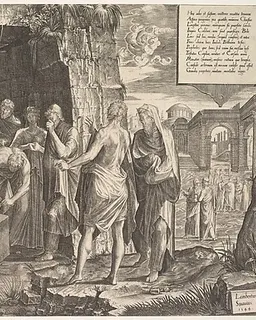
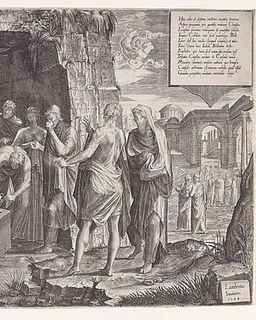
Martha goes back and calls her sister quietly: The Master is come, and calleth for thee (v. 28). It is a tender detail - Jesus has asked for Mary by name - and Mary does not hesitate: As soon as she heard that, she arose quickly, and came unto him (v. 29). When she reaches Him she does what Martha did not; she fell down at his feet (v. 32), the posture of one undone by grief, and speaks the very words her sister had spoken: Lord, if thou hadst been here, my brother had not died. The two sisters, so different in temperament - Martha meeting Him on the road with theology and questions, Mary collapsing at His feet in tears - arrive at the same ache and the same sentence.
If thou hadst been here. It is the cry of every griever who believed help was possible and came too late: where were you? And it is worth noticing that Jesus does not rebuke either of them for it. The complaint is folded inside their faith - they say it to Him, still trusting, still at His feet. Sometimes the most faithful thing a sorrowing heart can do is bring its where were you? straight to the Lord rather than away from Him.
What happens next tells us who this Jesus is at the deepest level. Confronted with Mary's weeping and the wailing of the mourners, he groaned in the spirit, and was troubled (v. 33). These are strong words. This is a deep, churning movement in His inmost being - the Greek behind groaned carries a sense of being powerfully stirred, even shaken. The Lord who knows He is about to call Lazarus out of the grave goes down into the grief.
He is troubled - the same word John uses elsewhere for the agitation of Jesus' own soul as the cross drew near. And then the most human question in the chapter: Where have ye laid him? (v. 34). The One who will in a moment command the dead asks, like any mourner, where the body lies, and lets Himself be led to the tomb - Lord, come and see. Everything in this moment refuses the idea of a God who is distant from human sorrow.
The power that is about to raise the dead is wrapped in a heart that is genuinely moved by death's wreckage. He enters it.
Then comes the verse the whole world remembers: Jesus wept (v. 35). Two words - the shortest verse in the Bible - and they carry an ocean. He is moments from the greatest demonstration of His power, and He stands at the tomb and lets the tears come. The watching mourners read it rightly: Behold how he loved him! (v. 36). His tears are the visible shape of His love. These are tears of genuine grief, the tears of One who knows exactly what He is about to do and weeps anyway.
Which makes the weeping all the more astonishing: He weeps even though He will raise Lazarus in a matter of minutes. He cries with her first. The Lord honours the grief before He undoes its cause. And then John records the doubting murmur of others in the crowd: Could not this man, which opened the eyes of the blind, have caused that even this man should not have died? (v. 37). It is half-faith, half-accusation - they have heard of His power and cannot square it with this death.
They are asking, in their own way, Martha's and Mary's question: if He could, why didn't He? The answer is already on its way to the tomb.
John 11:38-44Lazarus, Come Forth
38Jesus therefore again groaning in himself cometh to the grave. It was a cave, and a stone lay upon it. 39Jesus said, Take ye away the stone. Martha, the sister of him that was dead, saith unto him, Lord, by this time he stinketh: for he hath been dead four days. 40Jesus saith unto her, Said I not unto thee, that, if thou wouldest believe, thou shouldest see the glory of God? 41Then they took away the stone from the place where the dead was laid. And Jesus lifted up his eyes, and said, Father, I thank thee that thou hast heard me. 42And I knew that thou hearest me always: but because of the people which stand by I said it, that they may believe that thou hast sent me. 43And when he thus had spoken, he cried with a loud voice, Lazarus, come forth. 44And he that was dead came forth, bound hand and foot with graveclothes: and his face was bound about with a napkin. Jesus saith unto them, Loose him, and let him go.
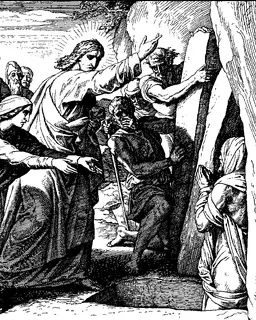
Jesus comes to the grave still groaning in himself (v. 38) - the same deep stirring that took hold of Him before; He approaches the tomb not as a magician approaches a trick but as One bearing the full weight of what death is. The grave is a cave with a stone laid over its mouth, and His first command is to the people: Take ye away the stone (v. 39). It is worth pausing on.
He who is about to raise the dead by a word could surely have rolled the stone away by a word too - yet He gives the people something to do. There is human work set right alongside the divine work: hands must move the stone before the voice calls the dead. Martha, so recently lifted to that great confession, recoils at the practical horror of it: Lord, by this time he stinketh: for he hath been dead four days (v. 39).
It is an utterly human objection, and an honest one. The faith she voiced on the road meets the reek of the tomb, and falters. She is not faithless; she is realistic - the body has begun to rot; what good can come of opening the grave now? Her words also serve John's purpose one last time, hammering home that Lazarus is truly, fully, four-days dead. Whatever is about to happen, no one will be able to call it anything less than a raising of the dead.
Jesus answers Martha's recoil by calling her back to His own promise: Said I not unto thee, that, if thou wouldest believe, thou shouldest see the glory of God? (v. 40). The order of the words is everything: believe, and then see. Faith comes first; the seeing of God's glory follows. Martha must let go of the stench and the four days and the impossibility, and trust the One who told her He is the resurrection.
Then the stone is rolled back, and Jesus does something He does nowhere else before a miracle - He prays aloud, openly, for the crowd to hear: Father, I thank thee that thou hast heard me. And I knew that thou hearest me always (vv. 41-42). He thanks the Father before Lazarus comes out, so sure of being heard that the thanks comes first. And He tells us plainly why He prayed it out loud: because of the people which stand by I said it, that they may believe that thou hast sent me. The prayer is for the crowd's sake.
The whole sign is being done in the open, before witnesses, so that what they see will lead them to believe that Jesus comes from the Father - that this power over the grave is the Father's power, working in the Son the Father sent.
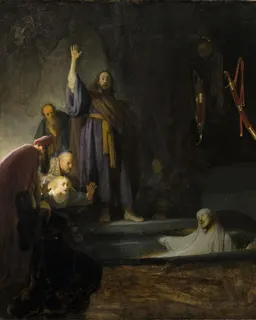
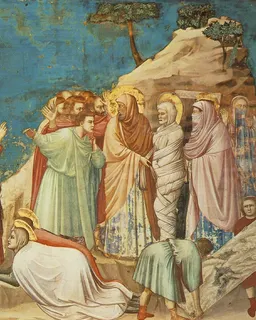
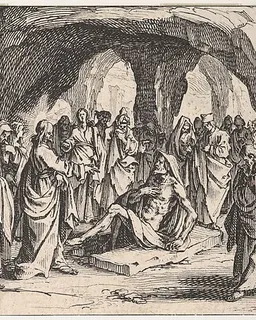
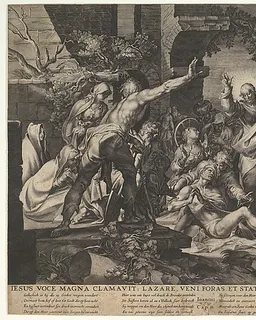
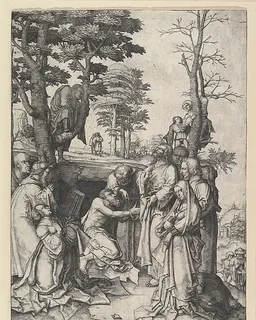
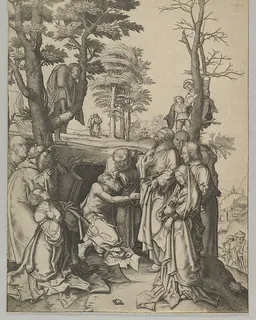
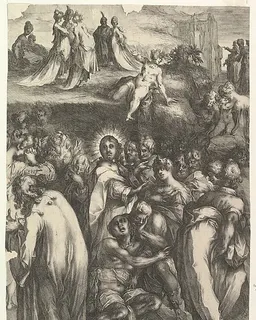
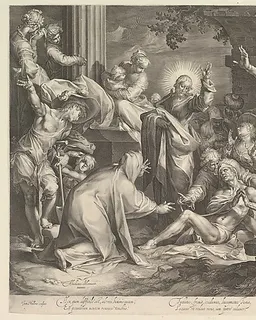
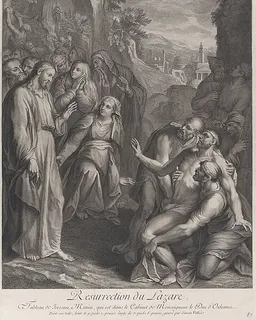
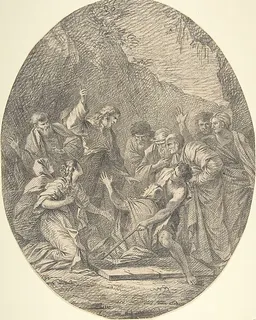
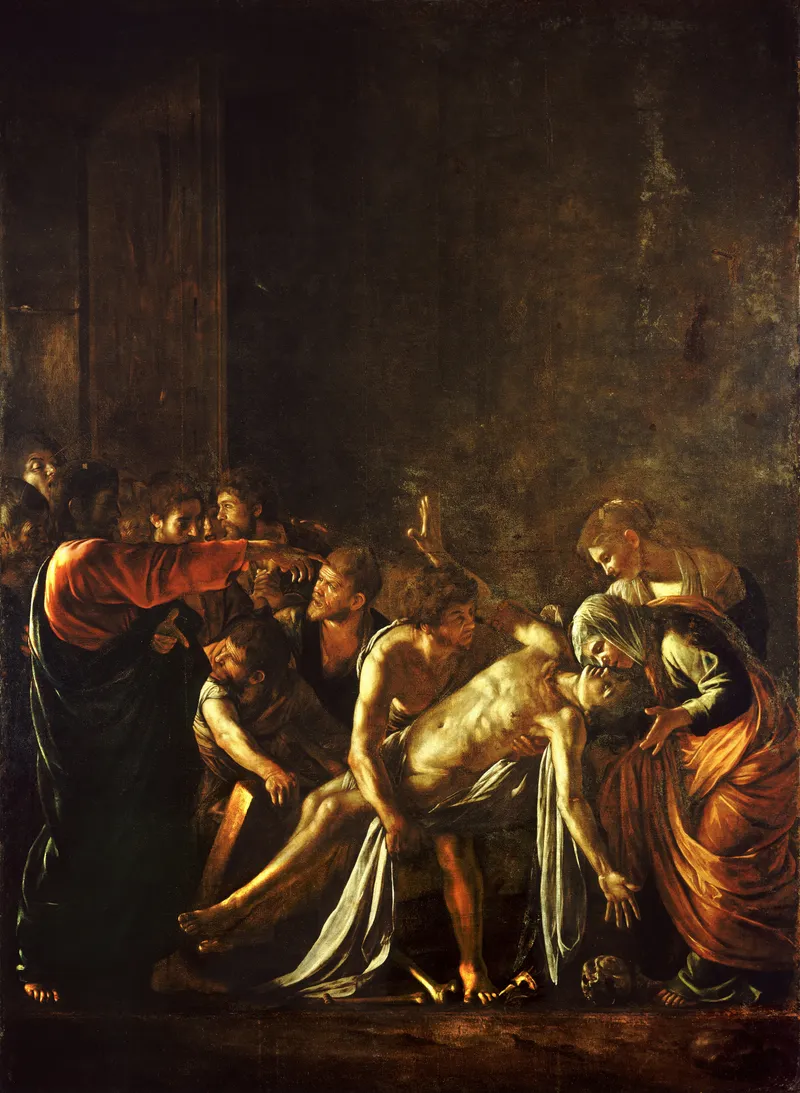
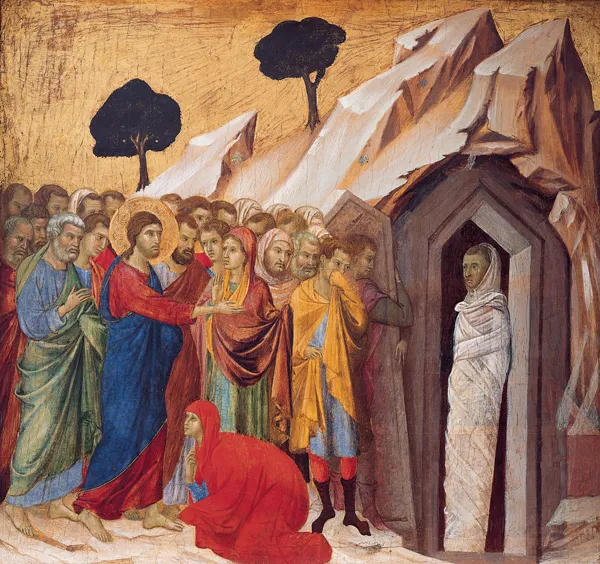
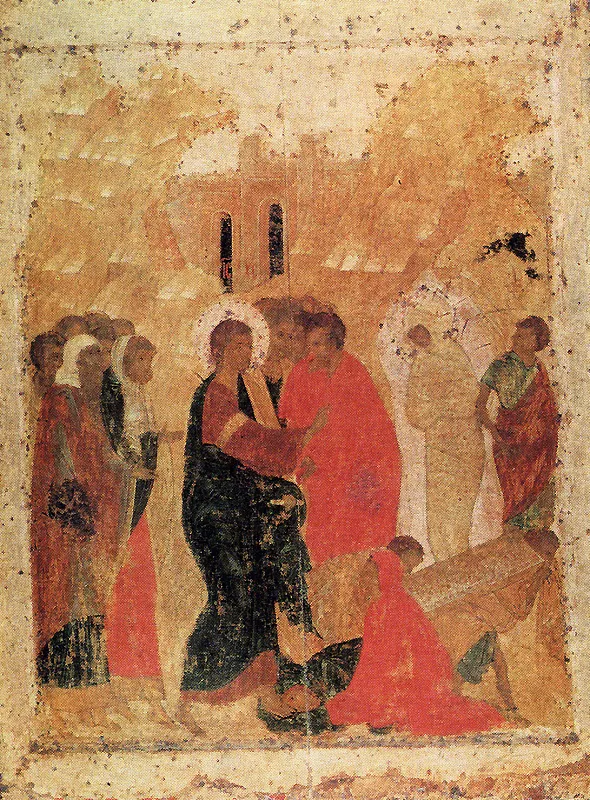
Then the moment toward which the whole chapter has strained: he cried with a loud voice, Lazarus, come forth (v. 43). A single shout, three words, addressed by name to a dead man. And the dead man obeys. And he that was dead came forth, bound hand and foot with graveclothes: and his face was bound about with a napkin (v. 44). The picture is almost startling in its homely detail - Lazarus comes shuffling out still wrapped in his burial bands, his face still covered, the very clothes of death clinging to a man now alive.
Four days in the tomb, and at the sound of that voice his heart beats, his lungs draw breath, his limbs move. It has often been observed that Jesus called Lazarus by name - for had He simply cried come forth, the whole valley of the dead might have answered. He summons one man, and one man rises. And then a last command, again giving the bystanders a part: Loose him, and let him go. Jesus raises the dead; the living are told to unwind the graveclothes.
The One who gives life calls others to free the man from what still binds him - the divine work and the human work side by side to the very end.
John 11:45-57One Man Should Die for the People
45Then many of the Jews which came to Mary, and had seen the things which Jesus did, believed on him. 46But some of them went their ways to the Pharisees, and told them what things Jesus had done. 47Then gathered the chief priests and the Pharisees a council, and said, What do we? for this man doeth many miracles. 48If we let him thus alone, all men will believe on him: and the Romans shall come and take away both our place and nation. 49And one of them, named Caiaphas, being the high priest that same year, said unto them, Ye know nothing at all, 50Nor consider that it is expedient for us, that one man should die for the people, and that the whole nation perish not. 51And this spake he not of himself: but being high priest that year, he prophesied that Jesus should die for that nation; 52And not for that nation only, but that also he should gather together in one the children of God that were scattered abroad. 53Then from that day forth they took counsel together for to put him to death. 54Jesus therefore walked no more openly among the Jews; but went thence unto a country near to the wilderness, into a city called Ephraim, and there continued with his disciples. 55And the Jews’ passover was nigh at hand: and many went out of the country up to Jerusalem before the passover, to purify themselves. 56Then sought they for Jesus, and spake among themselves, as they stood in the temple, What think ye, that he will not come to the feast? 57Now both the chief priests and the Pharisees had given a commandment, that, if any man knew where he were, he should shew it, that they might take him.
The greatest sign yet done divides those who witness it, exactly as the works of Jesus always do. Many of the Jews… believed on him (v. 45); but others went their ways to the Pharisees, and told them what things Jesus had done (v. 46). The raising of a dead man leaves no one neutral - it drives some to faith and others to the authorities. And the council that gathers reveals a strange, telling thing: they do not for a moment dispute the miracle.
What do we? for this man doeth many miracles (v. 47). They grant that the signs are real; their problem is not whether He does them but what His growing influence will cost them. Their reasoning is entirely political: If we let him thus alone, all men will believe on him: and the Romans shall come and take away both our place and nation (v. 48). There is a bitter irony folded into the words.
They fear losing their place - the temple, their authority - and their nation; and in moving to destroy Jesus to keep these, they set their feet on the very road that will lead, a generation later, to the loss of both. They look straight at undeniable evidence that God is at work and conclude only that this man is a threat to be removed. The clearer the sign of life, the harder their resolve toward death.
Into the council's anxious debate the high priest cuts with cold contempt: Ye know nothing at all, nor consider that it is expedient for us, that one man should die for the people, and that the whole nation perish not (vv. 49-50). Caiaphas means it as ruthless statecraft - better to sacrifice one troublesome man than to risk Roman reprisal against the whole people. It is the cynical math of power: one life spent to save the institution.
He has no idea that he has just spoken the truest sentence in the chapter. For John steps in to tell us what is really happening: And this spake he not of himself: but being high priest that year, he prophesied that Jesus should die for that nation; and not for that nation only, but that also he should gather together in one the children of God that were scattered abroad (vv. 51-52). The words leave Caiaphas' mouth meaning one thing and land in John's telling meaning another, infinitely greater.
One man should die for the people - yes, but not as Caiaphas imagines, a political casualty to appease Rome; rather the willing death of the One who would lay down His life for the people, and not for one nation only but to gather God's scattered children into one. The high priest, whose office it was to speak for God, prophesies the very meaning of the cross while plotting to bring it about. Even the conspiracy against Jesus is made, unwilling and unknowing, to announce the gospel.
From that council the die is cast: Then from that day forth they took counsel together for to put him to death (v. 53). The decision is made; what remains is only the timing. And so Jesus, whose hour has not yet fully come, withdraws - walked no more openly among the Jews; but went thence… into a city called Ephraim, and there continued with his disciples (v. 54). This is His sovereign command of the timing; He will go to the cross at the Passover the Father has appointed.
John then lifts our eyes to the gathering crowds: the Jews' passover was nigh at hand (v. 55), and pilgrims are streaming up to Jerusalem to purify themselves for the feast. The mention is heavy with meaning, for it is at this Passover that Jesus will die - the true Passover Lamb, slain as the lambs are slain. The chapter ends with the net drawing tight: the people wonder whether Jesus will dare come to the feast (v. 56), while the chief priests and the Pharisees had given a commandment, that, if any man knew where he were, he should shew it, that they might take him (v. 57).
The stage is fully set. The sign that displayed His power over death has set in motion the events of His own death - and that death, the chapter has quietly told us through the lips of His enemy, will be the gathering of God's children into one.
Research trail
Sources & further study
These references support the historical, linguistic, manuscript, and contextual notes in this chapter. Scripture remains the primary text; external sources are provided so readers can inspect the research directly.
- John 11 - Translators' NotesThe NET Bible's detailed footnotes on John 11 - the purpose of the two-day delay (vv. 4-6), the force of Jesus being “deeply moved” and weeping (vv. 33-35), the four days in the tomb (vv. 17, 39), and the unwitting prophecy of Caiaphas (vv. 49-52).
- John 11 · Greek interlinear + lexiconThe Greek text of John 11 word by word, with parsing and lexical entries - useful for he anastasis kai he zoe (v. 25, “the resurrection, and the life”), for edakrusen (v. 35, “Jesus wept” - He shed tears), and for enebrimesato (vv. 33, 38, the deep groaning of His spirit).
- John 11 ↔ 1 Corinthians 15 · John 5 · Revelation 1Traces the threads tying John 11 to the rest of Scripture - I am the resurrection, and the life (v. 25) read beside all that are in the graves shall hear his voice (John 5:28-29), the firstfruits hope of 1 Corinthians 15, and the risen Christ who holds the keys of hell and of death (Rev. 1:18).
Where this echoes in Scripture
This Sickness Is for the Glory of God
- Isaiah 55:8-9For my thoughts are not your thoughts, neither are your ways my ways, saith the LORD.The delay that looks like neglect (vv. 5-6) - a love whose timing runs higher than our own.
- John 9:3that the works of God should be made manifest in him.The same redirection as verse 4 - suffering turned into the place where God's work is shown.
- 1 Thessalonians 4:13-14I would not have you to be ignorant, brethren, concerning them which are asleep, that ye sorrow not, even as others which have no hope.The “sleep” of verse 11 made the church's word for death - a rest with a waking to come.
- John 12:23The hour is come, that the Son of man should be glorified.The “glorified” of verse 4 - the glory of the Son reaching its height at the cross this sign sets in motion.
- Daniel 12:2And many of them that sleep in the dust of the earth shall awake.The sleep from which the dead are roused - the language Jesus takes up in verses 11-14.
I Am the Resurrection, and the Life
- John 5:28-29all that are in the graves shall hear his voice, and shall come forth.The hour the raising of Lazarus foreshadows - the voice that calls every grave open (vv. 25, 43).
- 1 Corinthians 15:20-22now is Christ risen from the dead, and become the firstfruits of them that slept... in Christ shall all be made alive.The harvest of which this single raising is the firstfruit - the answer to death in verses 25-26.
- Revelation 1:18I am he that liveth, and was dead; and, behold, I am alive for evermore... and have the keys of hell and of death.The One who is the resurrection and the life (v. 25) - holding the keys to the grave He passed through.
- Matthew 16:16Thou art the Christ, the Son of the living God.Martha's confession in verse 27 - the same as Peter's, spoken here in the valley of grief.
- John 6:35I am the bread of life: he that cometh to me shall never hunger.Another of the great “I am” sayings - Christ naming Himself the reality, as in verse 25.
Jesus Wept
- Isaiah 53:3He is despised and rejected of men; a man of sorrows, and acquainted with grief.The grieving Christ of verse 35 - the Saviour who is no stranger to sorrow.
- Hebrews 4:15we have not an high priest which cannot be touched with the feeling of our infirmities.Why the tears of verse 35 matter - a Lord who genuinely feels what we feel.
- Romans 12:15Rejoice with them that do rejoice, and weep with them that weep.The compassion Jesus shows at the tomb (v. 35) - weeping with those who weep.
- Psalm 56:8thou tellest my wanderings: put thou my tears into thy bottle: are they not in thy book?The God who treasures human tears - and who sheds them Himself in verse 35.
- John 13:21When Jesus had thus said, he was troubled in spirit, and testified.The same word for Jesus' inward agitation as in verse 33 - His soul deeply moved.
Lazarus, Come Forth
- John 5:28-29the hour is coming, in the which all that are in the graves shall hear his voice, and shall come forth.The promise the raising of Lazarus rehearses (v. 43) - the voice that will empty every grave.
- John 20:6-7the napkin, that was about his head, not lying with the linen clothes, but wrapped together in a place by itself.Lazarus came out still bound; Christ left the graveclothes behind - the sign pointing past itself (v. 44).
- Ezekiel 37:12-13O my people, I will open your graves, and cause you to come up out of your graves.God opening graves and calling out the dead - the promise enacted at Bethany (vv. 43-44).
- Genesis 1:3And God said, Let there be light: and there was light.The word that creates by speaking - the same authority in the command of verse 43.
- Romans 4:17God, who quickeneth the dead, and calleth those things which be not as though they were.The God who calls the dead to life - doing it by name at the tomb in verse 43.
One Man Should Die for the People
- John 10:16other sheep I have, which are not of this fold... and there shall be one fold, and one shepherd.The gathering of the scattered into one (v. 52) - the reach of the death Caiaphas unwittingly foretold.
- John 12:32And I, if I be lifted up from the earth, will draw all men unto me.The death that gathers (vv. 51-52) - lifted up to draw in God's scattered children.
- Isaiah 53:8for the transgression of my people was he stricken.The One dying for the people (v. 50) - smitten in their place, as the prophet foretold.
- 1 Corinthians 5:7For even Christ our passover is sacrificed for us.Why John notes the Passover drawing near (v. 55) - the true Lamb about to be slain.
- Genesis 50:20ye thought evil against me; but God meant it unto good.Evil intent bent to God's saving purpose - as in Caiaphas' words turned to prophecy (vv. 50-52).