Job 42
People in this chapter
Every voice in the book has now spoken - Job's anguish, the friends' arguments, young Elihu's correction, and finally the LORD Himself out of the whirlwind, two chapters of questions about the sea and the stars, the wild ox and the war-horse, Behemoth and Leviathan. Job had longed for his day in court; he had wanted to order his cause before God and be answered. The answer came as an encounter, and chapter 42 is what a man says when the trial he demanded actually convenes and he finds himself standing before the living God.
He does not get the one thing he asked for, the why. He gets something he had not known to ask for: he sees.
Tap any highlighted phrase to jump to the commentary that unpacks it.
Job 42:1-6Now Mine Eye Seeth Thee
1Then Job answered the LORD, and said, 2I know that thou canst do every thing, and that no thought can be withholden from thee. 3Who is he that hideth counsel without knowledge? therefore have I uttered that I understood not; things too wonderful for me, which I knew not. 4Hear, I beseech thee, and I will speak: I will demand of thee, and declare thou unto me. 5I have heard of thee by the hearing of the ear: but now mine eye seeth thee. 6Wherefore I abhor myself, and repent in dust and ashes.
Job's last speech is the shortest he gives in the whole book, and it begins with surrender: I know that thou canst do every thing, and that no thought can be withholden from thee (v. 2). He is not stating a doctrine he has just learned; the friends could have said as much in chapter 4. What has changed is that Job now knows it the way a man knows the sea after nearly drowning in it.
Then he quotes God back to Himself - Who is he that hideth counsel without knowledge? (v. 3) was the LORD's own opening question (Job 38:2), and Job takes it up as a verdict against his own mouth: therefore have I uttered that I understood not; things too wonderful for me, which I knew not. This is Job confessing to scale - admitting he had been speaking about a government of the universe he could not begin to comprehend, weighing matters too large for any human hand to hold.
The man who demanded a hearing discovers that the deepest thing he can say, now that the hearing has come, is that he had been speaking past the edge of his knowledge all along.
Everything in the chapter turns on the contrast Job draws in verse 5: I have heard of thee by the hearing of the ear: but now mine eye seeth thee. All his life Job had known God by report - by what the fathers handed down, by the tradition he had been taught, by the true but secondhand knowledge that had made him the most upright man of the east. None of it was false. But it was hearing, and hearing is not seeing.
Now, out of the whirlwind, the report has become an encounter; the God Job knew about has stepped into the room. And the moment he sees, his whole posture collapses into something humbler and freer than the careful righteousness he had guarded so long. It is a strange grace that it took the loss of everything to move Job from the ear to the eye - but the book insists the sight was worth the cost, that to behold God, even from an ash heap, is the one thing that finally answers a grief no explanation could touch.
Job 42:7-11My Servant Job Shall Pray for You
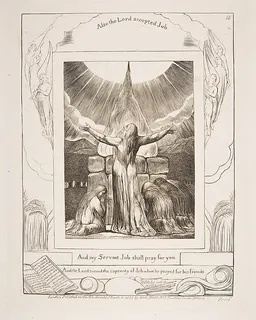
7And it was so, that after the LORD had spoken these words unto Job, the LORD said to Eliphaz the Temanite, My wrath is kindled against thee, and against thy two friends: for ye have not spoken of me the thing that is right, as my servant Job hath. 8Therefore take unto you now seven bullocks and seven rams, and go to my servant Job, and offer up for yourselves a burnt offering; and my servant Job shall pray for you: for him will I accept: lest I deal with you after your folly, in that ye have not spoken of me the thing which is right, like my servant Job. 9So Eliphaz the Temanite and Bildad the Shuhite and Zophar the Naamathite went, and did according as the LORD commanded them: the LORD also accepted Job.
The verdict, when it comes, overturns the table. For thirty-odd chapters the three friends had defended God's justice with confident speeches, insisting that suffering is the wage of sin and that Job must therefore be a hidden sinner; Job had refused their logic, sometimes wildly, sometimes blasphemously by their lights, holding that his agony was not the verdict of a guilty conscience. Now God renders His own judgment, and it falls on the defenders, not the questioner: ye have not spoken of me the thing that is right, as my servant Job hath (v. 7).
It is worth weighing how strange this is. Job had said things in his pain that sounded far closer to accusation than the friends ever dared. Yet God calls Job the one who spoke rightly - because Job spoke to God and about his real anguish honestly, while the friends spoke for a God they had shrunk to fit their formula. The book quietly dismantles the whole machinery of tidy religious explanation. Better the honest wrestling that keeps hold of God than the correct-sounding theology that lets go of the truth to protect a system.1
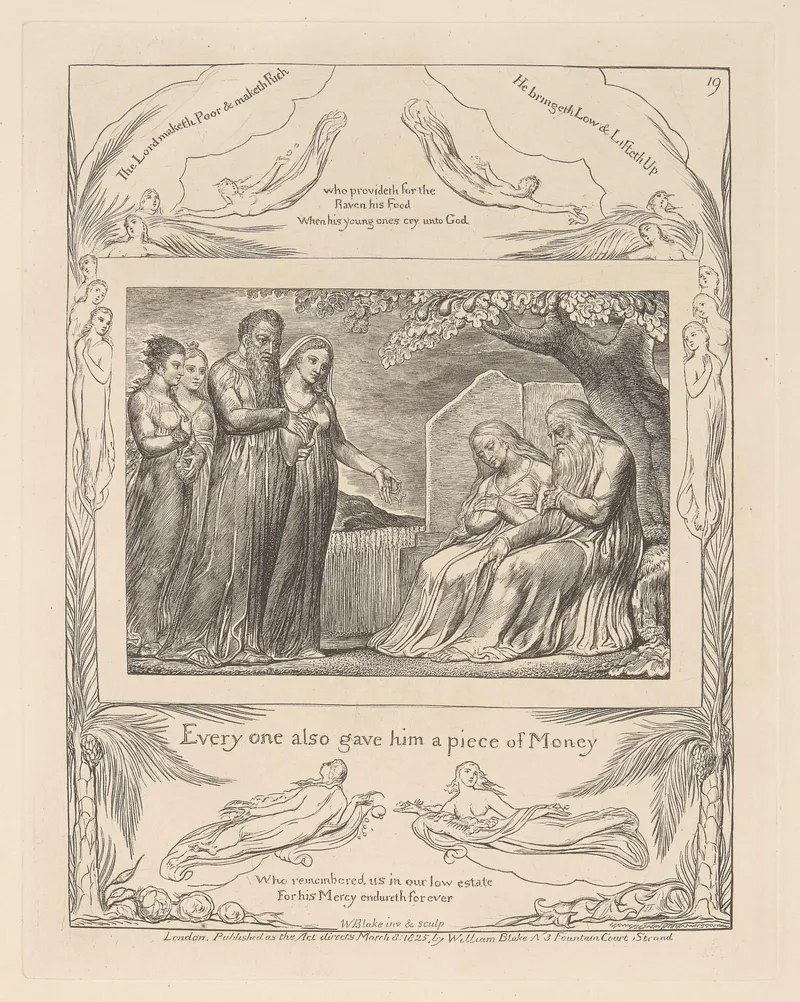
10And the LORD turned the captivity of Job, when he prayed for his friends: also the LORD gave Job twice as much as he had before. 11Then came there unto him all his brethren, and all his sisters, and all they that had been of his acquaintance before, and did eat bread with him in his house: and they bemoaned him, and comforted him over all the evil that the LORD had brought upon him: every man also gave him a piece of money, and every one an earring of gold.
The hinge of Job's restoration is set down with great care: the LORD turned the captivity of Job, when he prayed for his friends (v. 10). The turning does not come when Job repents in verse 6, nor when God vindicates him in verse 7. It comes as he prays for the men who had tormented him - the moment he stops nursing his grievance and steps into the gap for them. Forgiveness is the doorway through which his own healing walks.
And the first sign of the turn is achingly human: the family and old friends who had vanished during his suffering come back, sit at his table, eat bread with him, weep with him, press small gifts into his hands (v. 11). It is not yet the doubled herds; it is something more immediate and more needed - the end of his isolation. The man who sat alone on the ash heap, scraping his sores, abandoned even by those who should have stayed, is surrounded again by people who love him.
Restoration, in the Bible, very often begins with the return of communion - a table, shared bread, and tears that are finally wept with a man instead of at him.
Job 42:12-17The Latter End, More Than His Beginning
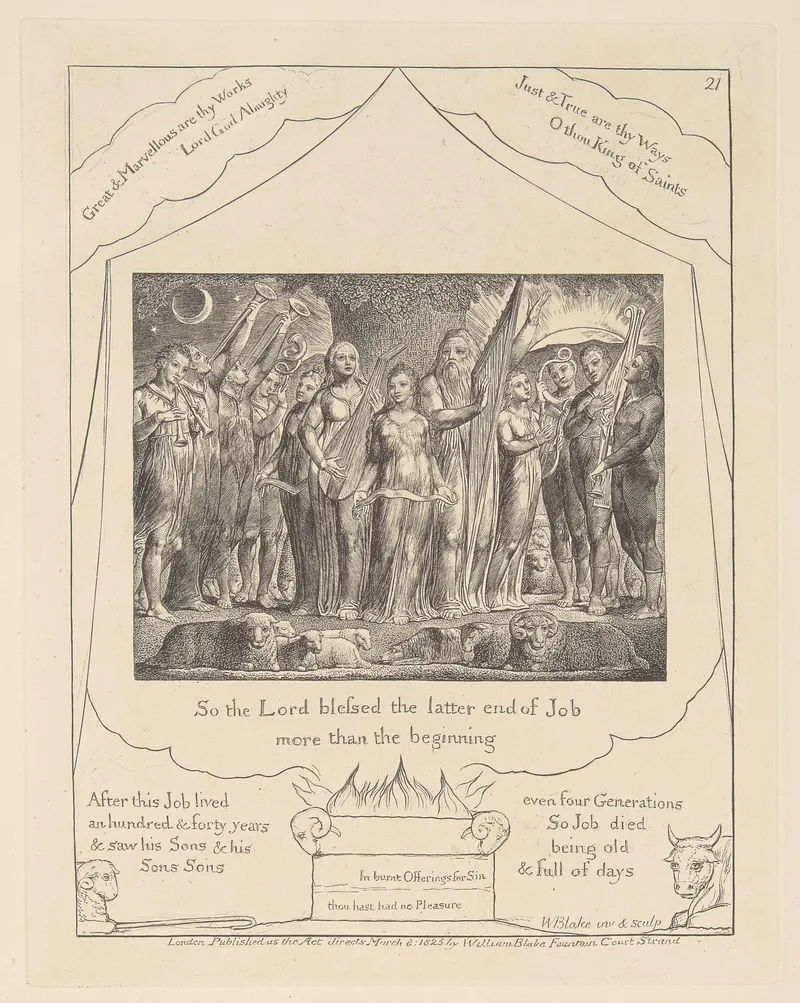
12So the LORD blessed the latter end of Job more than his beginning: for he had fourteen thousand sheep, and six thousand camels, and a thousand yoke of oxen, and a thousand she asses. 13He had also seven sons and three daughters. 14And he called the name of the first, Jemima; and the name of the second, Kezia; and the name of the third, Kerenhappuch. 15And in all the land were no women found so fair as the daughters of Job: and their father gave them inheritance among their brethren. 16After this lived Job an hundred and forty years, and saw his sons, and his sons’ sons, even four generations. 17So Job died, being old and full of days.
God restores Job's fortunes, and the restoration is deliberately lavish: fourteen thousand sheep where he had owned seven, six thousand camels for the former three, the herds and flocks all doubled (v. 12). But the count of the children is the detail that stops the careful reader. Job had lost seven sons and three daughters; he is now given seven sons and three daughters - not twenty, but ten again, the same number as before.
The herds are doubled; the children are not. And readers across the centuries have heard in that arithmetic a quiet, breathtaking hope: the first ten are not replaced, because they are not finally lost. A man's sheep, once dead, are gone; but his children, the book seems to whisper, are only ahead of him. To give Job ten more and call it double would only make sense if the first ten are somehow still his - held, as Job himself had dared to hope from the depths, by a Redeemer who lives, in a flesh that will yet see God (Job 19:25-26).
The restoration does not undo the grave. It points past it. The new children are pure gift, and the old ones are kept.
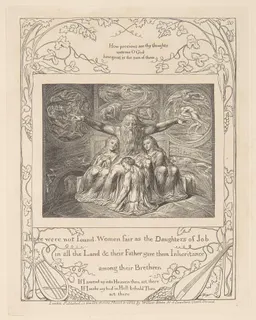
The narrator lingers, unusually, over the daughters - and tells us their names, while the seven sons go unnamed. Jemima means “dove”; Kezia is the fragrant cinnamon-bark, cassia; Keren-happuch is “horn of eye-paint,” the little flask of dark cosmetic that made the eyes shine. They are names of beauty, gentleness, and fragrance - the vocabulary of a world being made lovely again after it had gone to ash. And then a startling line: their father gave them inheritance among their brethren (v. 15).
In a time when sons normally inherited and daughters did not, Job hands his daughters a share of the estate alongside their brothers. The man whom suffering might have curdled into bitterness emerges instead more generous, more just, more tender than the prosperous patriarch of chapter 1. The fire refined him. His latter blessing is not only larger than his former one - it has made him kinder, and that may be the truer doubling.
Research trail
Sources & further study
These references support the historical, linguistic, manuscript, and contextual notes in this chapter. Scripture remains the primary text; external sources are provided so readers can inspect the research directly.
- Job - SBL OverviewOpen-access essay from the Society of Biblical Literature on the historical and literary setting of Job - including how the prose frame that opens and closes the book brackets the poetry of the speeches, and why the ending withholds the explanation the sufferer sought.
- Job 42 · Hebrew + classical Jewish commentaryThe Hebrew text of Job 42 with Rashi, Ibn Ezra, and other classical commentators side by side - useful for the doubled sense of nacham (v. 6, “to repent” and “to be comforted”), the intercessory verb palal (v. 8, “to pray, to interpose”), and the wordplay of shav et-shevut (v. 10, “turned the captivity”).
- Job 42 ↔ Isaiah 53 · Hebrews 7 · James 5Traces the verbal threads tying Job 42's accepted intercessor and blessed “latter end” to the Servant who made intercession for the transgressors (Isa. 53:12), the One who ever liveth to make intercession (Heb. 7:25), and James's backward glance at the end of the Lord in the story of Job (James 5:11).
Where this echoes in Scripture
Now Mine Eye Seeth Thee
- Job 19:26-27Yet in my flesh shall I see God: whom I shall see for myself, and mine eyes shall behold.Job's earlier cry - answered in the moment his eye at last sees God (v. 5).
- Job 38:2Who is this that darkeneth counsel by words without knowledge?God's opening question, which Job takes up against himself in v. 3.
- John 14:9He that hath seen me hath seen the Father.The seeing Job longed for (v. 5), made flesh and visible.
- 1 John 3:2We shall see him as he is.The hearing-turned-to-seeing held out to every sufferer.
My Servant Job Shall Pray for You
- Isaiah 53:12He bare the sin of many, and made intercession for the transgressors.The pattern of v. 8 - the wronged one who prays for the wrongdoers - given its fullest form.
- Luke 23:34Father, forgive them; for they know not what they do.The innocent sufferer interceding for those who wrong him (cf. v. 8, 10).
- Hebrews 7:25He ever liveth to make intercession for them.Job prays once for his friends; the great Intercessor prays always.
- Psalm 126:1, 5When the LORD turned again the captivity of Zion... they that sow in tears shall reap in joy.The same idiom and the same hope as “turned the captivity of Job” (v. 10).
The Latter End, More Than His Beginning
- James 5:11Ye have heard of the patience of Job, and have seen the end of the Lord; that the Lord is very pitiful, and of tender mercy.The New Testament's own reading of Job's “latter end” (v. 12).
- Job 19:25-26I know that my redeemer liveth... yet in my flesh shall I see God.Why the children are given again but not doubled (v. 13) - the first ten are not finally lost.
- Psalm 30:5Weeping may endure for a night, but joy cometh in the morning.The shape of Job's story: the long night ending in a latter morning (v. 12).
- Revelation 21:4-5God shall wipe away all tears from their eyes... Behold, I make all things new.The doubled blessing (v. 12) as an early flicker of the final restoration of all things.