Job 41
People in this chapter
God is not finished, and He saves the most terrible thing for last. Behemoth filled the end of chapter 40; now the whirlwind turns to the sea and to leviathan, the one creature in the book that no human hand can touch. The whole of chapter 41 is given to this single animal - its hook-proof hide, its furnace breath, its stone heart, its contempt for every weapon ever forged. It is the longest portrait of any creature in the speeches, and the first thing to see is that the portrait is the closing move in God's long answer to a suffering man who wanted to put the Almighty on trial.
Tap any highlighted phrase to jump to the commentary that unpacks it.
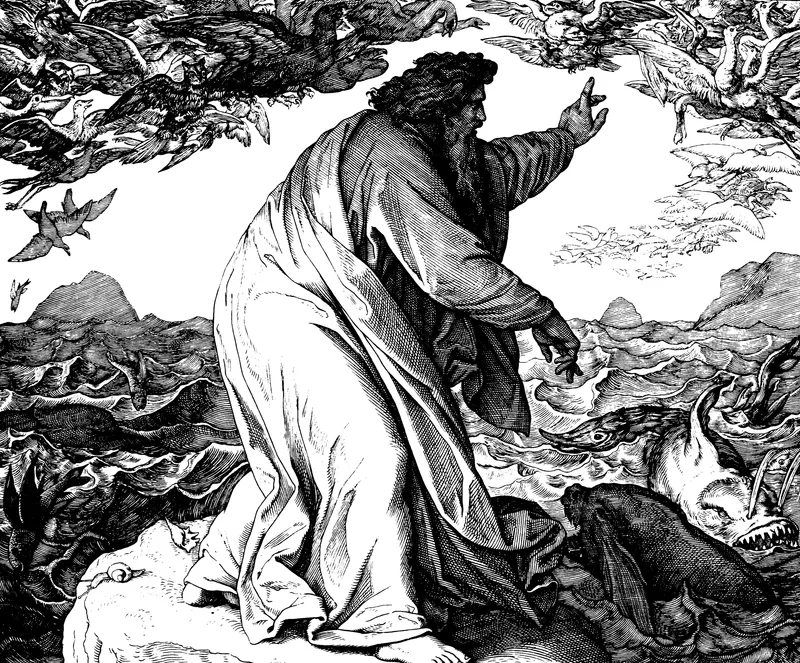
Job 41:1-11Who Then Is Able to Stand Before Me?
1Canst thou draw out leviathan with an hook? or his tongue with a cord which thou lettest down? 2Canst thou put an hook into his nose? or bore his jaw through with a thorn? 3Will he make many supplications unto thee? will he speak soft words unto thee? 4Will he make a covenant with thee? wilt thou take him for a servant for ever? 5Wilt thou play with him as with a bird? or wilt thou bind him for thy maidens?
The chapter opens with a torrent of questions, and every one of them is a closed door. Can you fish Leviathan out with a hook and line the way a boy lands a carp? Can you put a ring through his nose and lead him home, the way a herdsman leads an ox? Will he plead with you for mercy, speak soft words, sign a treaty, hire on as your servant for life? Will you tie a string to his leg and let him hop about for your daughters' amusement, the way one keeps a pet sparrow?
The humor is deliberate and withering. Each image takes some ordinary way humans master an animal - hook it, harness it, tame it, trade it, play with it - and sets it against a creature who answers to none of them. The point is that he is ungovernable, utterly outside the reach of human dominion. And the man being asked these questions is the same man who wanted to summon God to court and cross-examine Him.
God begins by showing Job he cannot so much as put a leash on one of God's creatures.
6Shall the companions make a banquet of him? shall they part him among the merchants? 7Canst thou fill his skin with barbed irons? or his head with fish spears? 8Lay thine hand upon him, remember the battle, do no more. 9Behold, the hope of him is in vain: shall not one be cast down even at the sight of him?
The questions keep closing doors. Can a fishing crew carve him up and auction the cuts in the market? Can you riddle his hide with harpoons, his head with fish-spears? Then comes a line of grim, almost gentle counsel: Lay thine hand upon him, remember the battle, do no more. The meaning is that one encounter would be enough to cure a man of ever trying again - touch him once, recall how that went, and you will not reach out a second time.
The hope of him is in vain (v. 9): even the expectation of subduing Leviathan is a delusion, and the merest sight of the creature is enough to lay a man flat. God is dismantling Job's confidence - the quiet assumption that he could, if only granted the hearing, hold his own before the Almighty. If the sight of a sea-creature flattens a man, what would the sight of its Maker do?
10None is so fierce that dare stir him up: who then is able to stand before me? 11Who hath prevented me, that I should repay him? whatsoever is under the whole heaven is mine.
Here the whole speech turns on its hinge. For ten verses God has been talking about Leviathan; now, in a single stroke, He swings the argument up to Himself: None is so fierce that dare stir him up: who then is able to stand before me? The logic is a ladder with one rung. No one dares provoke the creature - so who would dare provoke the Creator? If the handiwork is untouchable, the hand is beyond all reckoning.
And v. 11 widens the claim past the sea to the whole cosmos: Who hath prevented me, that I should repay him? whatsoever is under the whole heaven is mine. No one has given God anything first, putting Him in their debt; everything under heaven already belongs to Him. It is the quiet, total answer to Job's lawsuit. Job had imagined a courtroom where claims could be pressed and God might owe a reply.
God answers that there is no creditor in the universe, because there is nothing that was not already His. The God who cannot be put in anyone's debt is precisely the God who can be wholly trusted: a debtor protects himself, but One who owes nothing is free to give everything.1
Job 41:12-24His Scales Are His Pride
12I will not conceal his parts, nor his power, nor his comely proportion. 13Who can discover the face of his garment? or who can come to him with his double bridle? 14Who can open the doors of his face? his teeth are terrible round about. 15His scales are his pride, shut up together as with a close seal.
God now slows the camera and moves it lovingly over the creature, and the surprising thing is the tone: something close to a craftsman's pride in his own work. I will not conceal his parts, nor his power, nor his comely proportion (v. 12) - the word is almost tender, a Maker pointing out the symmetry of the thing He has fashioned. Who could strip off his outer hide, the face of his garment, or get a bridle near that double jaw?
Who could pry open the doors of his face, ringed with terrible teeth? Then the detail that defines him: his scales are his pride, shut up together as with a close seal. The overlapping plates are sealed so tight that nothing can pass between them - a living suit of armor, joined like a stamped document no one can break open. There is a quiet irony the chapter will return to at its very end: the creature's glory is his impenetrability, his refusal to be opened, his pride - and he is, in the last verse, named the king of all such proud, unbowed things.
16One is so near to another, that no air can come between them. 17They are joined one to another, they stick together, that they cannot be sundered. 18By his neesings a light doth shine, and his eyes are like the eyelids of the morning. 19Out of his mouth go burning lamps, and sparks of fire leap out.
20Out of his nostrils goeth smoke, as out of a seething pot or caldron. 21His breath kindleth coals, and a flame goeth out of his mouth. 22In his neck remaineth strength, and sorrow is turned into joy before him. 23The flakes of his flesh are joined together: they are firm in themselves; they cannot be moved. 24His heart is as firm as a stone; yea, as hard as a piece of the nether millstone.
The description rises to a furnace pitch. Smoke pours from his nostrils like steam off a boiling cauldron; his breath sets coals alight; flame goes out of his mouth (vv. 20-21). Strength is lodged in his very neck, and before him sorrow is turned into joy - terror dances ahead of him; despair runs before him as if rejoicing. His flesh hangs in folds that are firm in themselves, immovable; and at the core of him, his heart is as firm as a stone, as hard as a piece of the nether millstone - the lower grinding-stone of a mill, the hardest, most unyielding object in the ancient household.
The poem is building an image of total immovability, a creature without a single soft place, armored without and granite within. And yet - this is the thing Job is meant to feel - even this stone-hearted, fire-breathing terror is one item in the inventory of what God has made and named and described from the inside, as easily as a man might describe his own ox. What is past all human power to move is, to its Maker, simply a creature He can talk about.
Job 41:25-34A King Over All the Children of Pride
25When he raiseth up himself, the mighty are afraid: by reason of breakings they purify themselves. 26The sword of him that layeth at him cannot hold: the spear, the dart, nor the habergeon. 27He esteemeth iron as straw, and brass as rotten wood. 28The arrow cannot make him flee: slingstones are turned with him into stubble. 29Darts are counted as stubble: he laugheth at the shaking of a spear.
Now the chapter measures Leviathan against the whole armory of human power, and the armory loses. When he so much as rises up, the mighty are afraid - even heroes lose their nerve and stumble back in panic (v. 25). No weapon answers: sword, spear, dart, javelin, the woven coat of mail - none can hold against him. He esteemeth iron as straw, and brass as rotten wood: the hardest metals men can forge are to him as flimsy as dried grass and crumbling timber.
Arrows cannot make him flee; slingstones become chaff; he laugheth at the shaking of a spear. That last image is the sharpest - the creature is not merely invulnerable but contemptuous, amused by the very weapons that terrify everyone else. Every tool by which humans assert mastery over the world is, against Leviathan, a joke. And the reader is meant to remember who is speaking, and why. This is God's closing argument to a man who wanted to contend with Him.
If the creature laughs at the spear, what folly to take up a case against the Creator.
30Sharp stones are under him: he spreadeth sharp pointed things upon the mire. 31He maketh the deep to boil like a pot: he maketh the sea like a pot of ointment. 32He maketh a path to shine after him; one would think the deep to be hoary.
33Upon earth there is not his like, who is made without fear. 34He beholdeth all high things: he is a king over all the children of pride.
The speech ends on a verdict that doubles back on the whole book. Upon earth there is not his like, who is made without fear - there is nothing else like him in all the world, a creature fashioned with no capacity for dread, who looks every height in the eye. He beholdeth all high things: he is a king over all the children of pride. Leviathan is enthroned over everything that lifts itself up, every proud and unbowed thing; he is fearlessness incarnate, the king of all that will not stoop.
And then God simply stops. He has held up before Job a portrait of unconquerable, fearless, kingly pride - and the unspoken question hangs in the air: if even this king of the proud is only a creature God describes at leisure, what becomes of the smaller prides of men? Job had stood on his record, pressed his case, demanded his hearing. The next words in the book are his answer to all of this: surrender.
I have heard of thee by the hearing of the ear: but now mine eye seeth thee. Wherefore I abhor myself, and repent in dust and ashes (Job 42:5-6). The king of the children of pride met the King of kings, and laid his pride down.
Research trail
Sources & further study
These references support the historical, linguistic, manuscript, and contextual notes in this chapter. Scripture remains the primary text; external sources are provided so readers can inspect the research directly.
- Job - SBL OverviewOpen-access essay from the Society of Biblical Literature on the historical and literary setting of Job - including how the divine speeches answer the suffering man with a tour of a creation that dwarfs him.
- Job 41 · Hebrew + Jewish commentaryThe Hebrew text of Job 41 with Rashi, Ibn Ezra, and Ramban side by side - useful for the name livyathan (the “twisting” creature of v. 1), the tehom (“the deep”) he sets boiling in v. 31, and the bnei shachatz (“children of pride”) he is crowned over in v. 34.
- Job 41 ↔ Romans 11 · Colossians 1 · Revelation 21Traces the verbal threads tying Job 41's “whatsoever is under the whole heaven is mine” (v. 11) to Paul's “who hath first given to him?” (Rom. 11:35), the all-things-created-by-him of Colossians 1:16, and the subdued sea of Revelation 21:1.
Where this echoes in Scripture
Who Then Is Able to Stand Before Me?
- Psalm 104:26There go the ships: there is that leviathan, whom thou hast made to play therein.The same creature (v. 1) - named as a thing God made for His sea to play in.
- Romans 11:35-36Or who hath first given to him?... For of him, and through him, and to him, are all things.Paul lifts Job 41:11 and sets it under the Son, in whom all things hold.
- Colossians 1:16By him were all things created... all things were created by him, and for him.“Whatsoever is under the whole heaven is mine” (v. 11), traced to the Son.
- Job 40:9Hast thou an arm like God? or canst thou thunder with a voice like him?The whole speech's logic: the creature dwarfs Job, the Creator dwarfs the creature.
His Scales Are His Pride
- Psalm 139:9If I take the wings of the morning, and dwell in the uttermost parts of the sea...The dawn (shachar) of v. 18 - the light at the edge of the dark, here a sign of hope.
- Ezekiel 36:26I will take away the stony heart out of your flesh, and I will give you an heart of flesh.Leviathan's heart is “firm as a stone” (v. 24); its Maker remakes stone hearts.
- Hebrews 1:3Upholding all things by the word of his power.The unmovable creature (v. 23) hangs on the word of the One who made it.
- Psalm 148:7Praise the LORD from the earth, ye dragons, and all deeps.Even the creatures of the deep are summoned to praise the One who made them.
A King Over All the Children of Pride
- Genesis 1:2And darkness was upon the face of the deep. And the Spirit of God moved upon the face of the waters.The tehom (“the deep,” v. 31) - His from the beginning, never a rival to His rule.
- Job 42:5-6Now mine eye seeth thee. Wherefore I abhor myself, and repent in dust and ashes.Shown the king of pride (v. 34), Job does the one thing Leviathan cannot: he bows.
- Philippians 2:9-10God also hath highly exalted him, and given him a name which is above every name.Over the king of the proud (v. 34) stands the King who stooped lowest and was raised highest.
- Revelation 21:1And I saw a new heaven and a new earth... and there was no more sea.The untamable deep (v. 31) finally stilled in the new creation.