Job 40
People in this chapter
The whirlwind has been speaking since chapter 38, marching Job past the foundations of the earth, the storehouses of the snow, the wild goats and the war-horse and the hawk - and now it pauses to ask Job directly what he will do with it all: Shall he that contendeth with the Almighty instruct him? he that reproveth God, let him answer it (v. 2). For the first time in the book, Job answers not with a fresh complaint but with a hand over his lips: Behold, I am vile; what shall I answer thee? I will lay mine hand upon my mouth (v. 4).
It is the most eloquent silence in Scripture - a man who has said everything he knows how to say, and has discovered there is nothing left worth adding.
Tap any highlighted phrase to jump to the commentary that unpacks it.
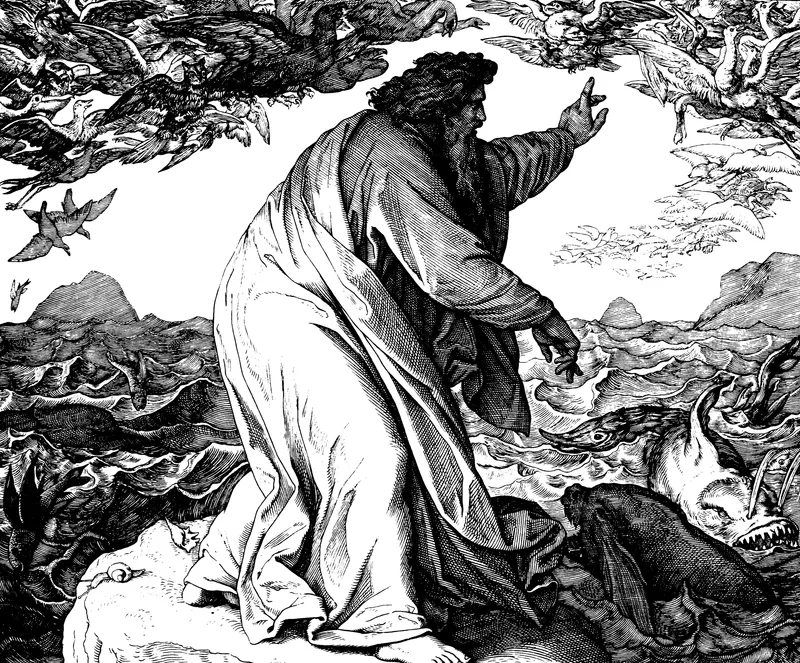
Job 40:1-9I Will Lay Mine Hand Upon My Mouth
1Moreover the LORD answered Job, and said, 2Shall he that contendeth with the Almighty instruct him? he that reproveth God, let him answer it. 3Then Job answered the LORD, and said,
After two chapters of questions about the sea and the stars, the wild ass and the eagle, God pauses to put the matter to Job plainly: Shall he that contendeth with the Almighty instruct him? (v. 2). The verb is the language of the courtroom - Job had wanted a lawsuit with God, had longed to come even to his seat and order my cause before him (Job 23:3-4). Now the trial has convened, but not as Job imagined.
He came as the plaintiff with a brief against heaven; he finds himself the one being questioned, and the questions are about a universe he did not make and cannot manage. The man who would correct the Almighty must first be able to do what the Almighty does - and Job, for all his integrity, cannot.
4Behold, I am vile; what shall I answer thee? I will lay mine hand upon my mouth. 5Once have I spoken; but I will not answer: yea, twice; but I will proceed no further.
This is Job's first surrender, and it is breathtaking in its restraint. For most of the book Job has had an answer for everything - for the friends, for the silence of heaven, for the apparent injustice of his ruin. Now, asked whether he will instruct the Almighty, he says only: I am vile; what shall I answer thee? I will lay mine hand upon my mouth (v. 4). The hand over the lips is the ancient gesture of the man who yields the floor - the princes of Job's own better days had done it in deference to him (the princes refrained talking, and laid their hand on their mouth, Job 29:9).
Now Job does it before God. And notice the careful arithmetic of v. 5: once... yea, twice; but I will proceed no further. He is not confessing crimes; he is declining to add another word to a case he now sees was too large for him from the start. The silence is the first true peace he has known since the disasters fell.
6Then answered the LORD unto Job out of the whirlwind, and said, 7Gird up thy loins now like a man: I will demand of thee, and declare thou unto me. 8Wilt thou also disannul my judgment? wilt thou condemn me, that thou mayest be righteous? 9Hast thou an arm like God? or canst thou thunder with a voice like him?
God is not finished, and His next words are gentler than they sound: Gird up thy loins now like a man (v. 7). This is the same summons that opened chapter 38, and it is a strange honor - God treats Job as a man able to stand and be addressed. Then comes the question at the center of the whole book's argument: Wilt thou condemn me, that thou mayest be righteous? (v. 8). Here is the hidden cost of Job's case that even Job had not seen.
To insist on his own innocence in the way he had been doing, Job had been forced, almost without meaning to, to put God in the wrong - as if the only way for Job to be right was for God to be unjust. God names it plainly. And then He asks the question that measures the distance between them: Hast thou an arm like God? (v. 9). Can you do what only God can do?
Because the right to run the moral universe belongs only to the One who has the strength to save it.
Job 40:10-19Then Will I Also Confess Unto Thee
10Deck thyself now with majesty and excellency; and array thyself with glory and beauty. 11Cast abroad the rage of thy wrath: and behold every one that is proud, and abase him. 12Look on every one that is proud, and bring him low; and tread down the wicked in their place. 13Hide them in the dust together; and bind their faces in secret.
Now God makes Job an astonishing offer, heavy with irony: if you think the world is being run unjustly, here - take the throne. Deck thyself now with majesty and excellency... array thyself with glory and beauty (v. 10). Put on the robes of God. Then do the work: behold every one that is proud, and abase him... tread down the wicked in their place... hide them in the dust (vv. 11-13). Job had complained, with real anguish, that the wicked seem to prosper and the innocent to suffer (Job 21:7).
Very well, God says: govern it yourself. Humble every proud man on earth with a glance; bury injustice in the dust where it belongs. It is the challenge no human being can meet, and God knows it. To run a moral universe, you must be able to see every proud heart, weigh every hidden deed, and have the power to set it all right - and you must be able to do it without becoming a tyrant yourself.
The offer is clarifying. It shows Job, more gently than any rebuke, why the government of the world was never his to carry.
14Then will I also confess unto thee that thine own right hand can save thee.
The whole challenge funnels down to a single, devastating sentence: Then will I also confess unto thee that thine own right hand can save thee (v. 14). It is the standard for anyone who would judge God's management of the world - show that your own right hand can save you, that you can rescue yourself, that you hold within your own strength the power to make things right. Of course Job cannot. He cannot save himself from the ash heap, let alone save the world from its proud and its wicked.
And the verse is doing something more than humbling Job; it is quietly drawing the boundary of all human capacity. No man can save himself by his own right hand. This is the bedrock the rest of Scripture builds on - that salvation is a thing the Creator does, not something the creature can work up out of his own arm. God's irony here becomes, two Testaments later, the deepest comfort in the Bible: the right hand that no human being possesses, God would stretch out Himself.
15Behold now behemoth, which I made with thee; he eateth grass as an ox. 16Lo now, his strength is in his loins, and his force is in the navel of his belly. 17He moveth his tail like a cedar: the sinews of his stones are wrapped together. 18His bones are as strong pieces of brass; his bones are like bars of iron. 19He is the chief of the ways of God: he that made him can make his sword to approach unto him.
Then God turns from the throne-room challenge to a living illustration of it: Behold now behemoth, which I made with thee (v. 15). The name is simply the plural of the ordinary Hebrew word for “beast” - a beast of beasts, the creature raised to its highest power. God lingers over its sheer physical magnificence: strength packed into its loins, a tail that sways like a cedar, bones like bars of iron and pieces of brass (vv. 16-18).
And yet - this is the quiet marvel - for all its terrible strength, he eateth grass as an ox. The mightiest thing in the field is a peaceable grazer, harming no one, simply being what God made it to be. God adds the phrase that crowns the description: it is the chief of the ways of God (v. 19), the masterwork at the head of His creatures. The lesson for Job is unmistakable. If Job cannot tame, capture, or command even this one beast that grazes in the marsh, what business had he correcting the One who made it - and made the sea, and the stars, and the boundaries of the dawn?
The creature he cannot govern is a parable of the Creator he cannot instruct.1
Job 40:20-24He Drinketh Up a River, and Hasteth Not
20Surely the mountains bring him forth food, where all the beasts of the field play. 21He lieth under the shady trees, in the covert of the reed, and fens. 22The shady trees cover him with their shadow; the willows of the brook compass him about.
Having shown the beast's terrible strength, God now shows its astonishing calm. The mountains bring it food; the other animals play nearby, unafraid; it lies down in the shade of the lotus and the reeds, the willows of the brook ringing it round (vv. 20-22). Here is a creature that could crush, and chooses to rest. The picture is almost pastoral - the mightiest thing in the landscape stretched out peaceably in the cool of the marsh while the lesser creatures frolic at its side.
And there is something here for Job to feel as well as understand. The God who designed Behemoth gave it not only its iron bones but its green pastures and its shade; the same hand that armed it also feeds it and shelters it. A world this carefully provided for, down to the lotus-cover of a marsh beast, is a world held. The God Job feared had abandoned the moral order turns out to be tending it down to the willows of a single riverbank.
23Behold, he drinketh up a river, and hasteth not: he trusteth that he can draw up Jordan into his mouth. 24He taketh it with his eyes: his nose pierceth through snares.
The portrait ends on the beast's unshakable composure. A river rises against it and it does not flinch: he drinketh up a river, and hasteth not: he trusteth that he can draw up Jordan into his mouth (v. 23). The flood that would terrify a man only quenches Behemoth's thirst. And the last line lifts an eyebrow at human cleverness: he taketh it with his eyes: his nose pierceth through snares (v. 24) - the traps men set to capture wild things are nothing to it; it sees them coming and walks through.
The point for Job is complete. Here is a creature that cannot be flooded out, cannot be trapped, cannot be mastered by force or by cunning - and it is only one of God's works, a grass-eater in a marsh. If Job cannot capture the beast, he certainly cannot capture the questions he has been hurling at its Maker. The wisest thing in his hands is the gesture he has already made: the hand laid on the mouth, and the trust that lays it there.
Research trail
Sources & further study
These references support the historical, linguistic, manuscript, and contextual notes in this chapter. Scripture remains the primary text; external sources are provided so readers can inspect the research directly.
- Job - SBL OverviewOpen-access essay from the Society of Biblical Literature on the historical and literary setting of Job - including the speeches from the whirlwind and the great creatures (Behemoth and Leviathan) that crown God's answer to the sufferer.
- Job 40 · Hebrew + Jewish commentaryThe Hebrew text of Job 40 with Rashi, Ibn Ezra, and other classical commentators side by side - useful for the verb behind I am vile (v. 4, qalothi, “I have become light, of small account”), the zeroaʿ (“arm,” v. 9) Job is asked whether he possesses, and the phrase reishith darkei-el (“the chief of the ways of God,” v. 19).
- Job 40 ↔ Isaiah 53 · Isaiah 59 · Philippians 2Traces the verbal threads tying Job 40's “arm” and “right hand that can save” to the arm of the LORD that brought salvation (Isa. 59:16; 63:5), the arm revealed in the suffering Servant (Isa. 53:1), and the One who humbled himself and was silent before His accusers (Phil. 2:8; Isa. 53:7).
Where this echoes in Scripture
I Will Lay Mine Hand Upon My Mouth
- Job 29:9The princes refrained talking, and laid their hand on their mouth.The same gesture (v. 4) - once offered to Job in honor, now offered by Job to God.
- Isaiah 59:16He saw that there was no man... therefore his arm brought salvation unto him.The arm Job lacks (v. 9) - the arm God bares to save when no one else can.
- Isaiah 53:1Who hath believed our report? and to whom is the arm of the LORD revealed?The saving arm of God, revealed at last in the suffering Servant.
- Philippians 2:8Being found in fashion as a man, he humbled himself, and became obedient unto death.The hand laid on the mouth (v. 4) deepened into the self-emptying of the Son.
Then Will I Also Confess Unto Thee
- Psalm 49:7None of them can by any means redeem his brother, nor give to God a ransom for him.The right hand that cannot save itself (v. 14) - the limit of all human rescue.
- Psalm 98:1His right hand, and his holy arm, hath gotten him the victory.The saving right hand Job is asked for (v. 14) belongs to God alone.
- Colossians 1:16-17By him were all things created... and by him all things consist.Behemoth is chief of the creatures God made (v. 19); the Son upholds them all.
- Job 21:7Wherefore do the wicked live, become old, yea, are mighty in power?Job's old complaint - answered by the offer to govern the proud himself (vv. 11-13).
He Drinketh Up a River, and Hasteth Not
- Job 38:4Where wast thou when I laid the foundations of the earth? declare, if thou hast understanding.The tour of what Job cannot do, of which Behemoth (vv. 15-24) is the living crown.
- Psalm 104:24-25O LORD, how manifold are thy works!... So is this great and wide sea, wherein are things creeping innumerable.The same wonder: a creation too vast and well-tended to be running out of control.
- Job 42:7Ye have not spoken of me the thing that is right, as my servant Job hath.Why Job's silence (v. 4) is humbled trust: a creature who has finally seen how large God is.
- Matthew 11:28Come unto me, all ye that labour and are heavy laden, and I will give you rest.The burden Job lays down - taken up by the One whose right hand can save.