Job 39
People in this chapter
The voice has not stopped. Out of the whirlwind God has already walked Job through the foundations of the earth, the doors of the sea, the storehouses of the snow, and the courses of the stars - and now, without pausing for breath, He turns from the inanimate world to the living one. Chapter 39 is a procession of wild animals: the goats of the rock and the hind in labour, the wild ass and the wild ox, the strange self-forgetting ostrich, the thundering war-horse, the hawk and the eagle riding the high air.
The method is unchanged from chapter 38. God does not explain Job's suffering; He asks questions Job cannot answer, and the questions are about creatures Job has never fed, never tamed, and never understood.
Tap any highlighted phrase to jump to the commentary that unpacks it.
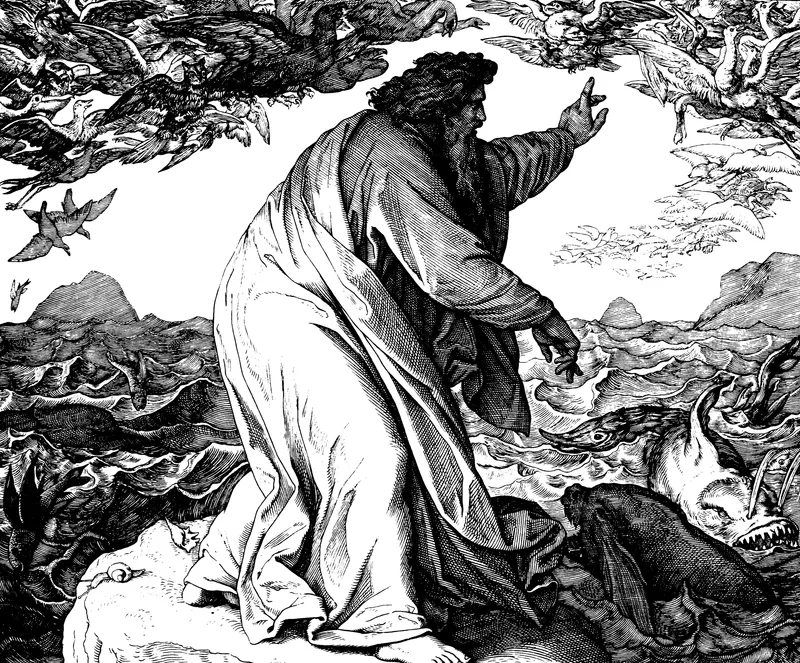
Job 39:1-12Who Hath Sent Out the Wild Ass Free?
1Knowest thou the time when the wild goats of the rock bring forth? or canst thou mark when the hinds do calve? 2Canst thou number the months that they fulfil? or knowest thou the time when they bring forth? 3They bow themselves, they bring forth their young ones, they cast out their sorrows. 4Their young ones are in good liking, they grow up with corn; they go forth, and return not unto them.
The new movement opens, like the last, with a question about a thing Job cannot do: Knowest thou the time when the wild goats of the rock bring forth? (v. 1). It is a strange place for God to begin a defense of His justice - with the obstetrics of mountain goats. But that is exactly the point. The ibex births her young on cliff-ledges no shepherd will ever climb; the hind drops her fawn in the deep forest where no human midwife attends.
The whole event - the months counted, the labour, the casting out of the birth-pangs, the fawn growing strong and then leaving for good - happens entirely off-stage from human life, unwatched and uncounted by anyone but God. Job runs a great household; he has never once been present at the birth that matters most to a wild doe. There is a God who keeps that appointment, who numbers the months of a creature no person tends.
The first lesson of the chapter is quiet and enormous: God's care reaches into places human care has never been.
5Who hath sent out the wild ass free? or who hath loosed the bands of the wild ass? 6Whose house I have made the wilderness, and the barren land his dwellings. 7He scorneth the multitude of the city, neither regardeth he the crying of the driver. 8The range of the mountains is his pasture, and he searcheth after every green thing.
From the hidden birth God turns to a creature defined by its freedom: Who hath sent out the wild ass free? or who hath loosed the bands of the wild ass? (v. 5). The domestic donkey is the very emblem of patient servitude - harnessed, driven, beaten. But its wild cousin, the pere, has been turned loose by God Himself, and it answers to no one. Whose house I have made the wilderness (v. 6) - God claims the desolate land not as a curse on the animal but as its God-given home, the open country where it belongs.
And so it scorneth the multitude of the city; the shouting of the donkey-driver, which a tame beast must obey, means nothing to it (v. 7). Here is the deliberate provocation in the speech: Job has spent the book longing to drag God into court and put questions to Him, to bind the Almighty to an account. God answers by pointing at an animal even Job cannot bind. If the wild ass will not come when Job calls, on what grounds does Job summon its Maker?
9Will the unicorn be willing to serve thee, or abide by thy crib? 10Canst thou bind the unicorn with his band in the furrow? or will he harrow the valleys after thee? 11Wilt thou trust him, because his strength is great? or wilt thou leave thy labour to him? 12Wilt thou believe him, that he will bring home thy seed, and gather it into thy barn?
If the wild ass is freedom Job cannot hold, the unicorn - the great wild ox, the re'em of the old translations - is strength Job cannot use. The questions turn faintly ironic: Will the unicorn be willing to serve thee, or abide by thy crib? (v. 9). Picture trying to yoke this animal to a plough. Its strength is enormous, exactly the strength a farmer dreams of - and exactly the strength no farmer can ever bend to the furrow.
Wilt thou trust him, because his strength is great? or wilt thou leave thy labour to him? (v. 11). The tame ox brings the harvest home and gathers the seed into the barn; this one never will. The point sharpens what came before. The wild ox is the most powerful animal in the catalogue, and its power was never meant to serve us. Job had quietly assumed that strength exists to be harnessed and that a well-run world is one bent to human good.
God shows him a strength He delights in precisely because it runs free of the harness.
Job 39:13-25He Saith Among the Trumpets, Ha, Ha
13Gavest thou the goodly wings unto the peacocks? or wings and feathers unto the ostrich? 14Which leaveth her eggs in the earth, and warmeth them in dust, 15And forgetteth that the foot may crush them, or that the wild beast may break them. 16She is hardened against her young ones, as though they were not hers: her labour is in vain without fear; 17Because God hath deprived her of wisdom, neither hath he imparted to her understanding. 18What time she lifteth up herself on high, she scorneth the horse and his rider.
Then comes the oddest creature in the whole speech, and the most surprising one for God to claim. The ostrich is a study in apparent failure. She has goodly wings but cannot fly. She leaveth her eggs in the earth, abandons them to the warming dust, and forgetteth that the foot may crush them (vv. 14-15). She is hardened against her young ones, as though they were not hers (v. 16). And the text says, with startling directness, that this is by design: God hath deprived her of wisdom, neither hath he imparted to her understanding (v. 17).
Here is a creature God made without the prudence we prize - and He puts her in His gallery anyway, unembarrassed. We would have edited her out; she does not seem to work. But then the verse turns on a hinge: What time she lifteth up herself on high, she scorneth the horse and his rider (v. 18). The same foolish bird, when she runs, outpaces a war-horse at full gallop and leaves its rider in the dust.
God's creatures need not be wise, or careful, or even competent by our measures, to be exactly what He delights to have made. The lesson cuts straight at Job's friends, who had insisted the world runs on a tidy logic of merit. God displays a bird that breaks every rule of sense and is glorious all the same.
19Hast thou given the horse strength? hast thou clothed his neck with thunder? 20Canst thou make him afraid as a grasshopper? the glory of his nostrils is terrible. 21He paweth in the valley, and rejoiceth in his strength: he goeth on to meet the armed men. 22He mocketh at fear, and is not affrighted; neither turneth he back from the sword.
And now the centerpiece. Of all the creatures in the chapter, God lingers longest over the war-horse, and the poetry rises to meet it - this is one of the great descriptions of an animal in all of literature. Hast thou given the horse strength? hast thou clothed his neck with thunder? (v. 19). The image is of the great muscled neck and flying mane as a kind of rolling thunder made flesh. The horse paweth in the valley, and rejoiceth in his strength (v. 21) - note the word rejoiceth; the animal takes joy in its own power.
It mocketh at fear, and is not affrighted; neither turneth he back from the sword (v. 22). What God admires here is a kind of magnificent courage that has no thought of reward. The horse does not weigh the odds; it does not calculate survival. It simply pours out its whole strength toward the danger because that is the glory God built into it. Job, crushed and afraid on his ash heap, is being shown a creature that rejoices as it runs toward the very thing men flee.
23The quiver rattleth against him, the glittering spear and the shield. 24He swalloweth the ground with fierceness and rage: neither believeth he that it is the sound of the trumpet. 25He saith among the trumpets, Ha, ha; and he smelleth the battle afar off, the thunder of the captains, and the shouting.
The war-horse passage ends on a line no one forgets. The animal swalloweth the ground with fierceness and rage - it seems to devour the distance as it charges (v. 24) - and then: He saith among the trumpets, Ha, ha; and he smelleth the battle afar off (v. 25). The horse laughs. Amid the blaring trumpets and the clash of armies it gives a sound the poet can only render as a laugh of sheer exultation, and it scents the coming battle on the wind from far away, eager for it.
This is the high point of the whole divine speech's argument-by-delight. God is not cataloguing facts about zoology; He is sharing His own pleasure in what He has made. And the implied question lands on Job with great weight: you did not give this animal its fearless joy - so are you sure you understand the world well enough to put its Maker on trial? The God who built laughter into a horse running toward swords is running the universe by a wisdom larger and gladder than Job's arithmetic of suffering can hold.
Job 39:26-30Doth the Eagle Mount Up at Thy Command?
26Doth the hawk fly by thy wisdom, and stretch her wings toward the south? 27Doth the eagle mount up at thy command, and make her nest on high? 28She dwelleth and abideth on the rock, upon the crag of the rock, and the strong place.
The procession lifts off the ground for its final image. Doth the hawk fly by thy wisdom, and stretch her wings toward the south? (v. 26). The hawk's migration - that mysterious seasonal pull that turns the wings southward at exactly the right time - owes nothing to Job's instruction. He did not teach the bird its routes; he cannot even explain them. Doth the eagle mount up at thy command, and make her nest on high? (v. 27).
The eagle climbs to heights no human can follow and builds where no human can reach, upon the crag of the rock, and the strong place (v. 28). The chapter has been steadily moving outward and upward - from births in the cliffs, to the open wilderness, to the battlefield, and now into the high air itself - and at every stage the message is the same: there is a wisdom at work in the world that is not Job's, governing creatures Job can neither reach nor command.
The instinct that wheels the hawk toward the south is a fragment of the wisdom by which God governs everything, including the suffering Job cannot understand.
29From thence she seeketh the prey, and her eyes behold afar off. 30Her young ones also suck up blood: and where the slain are, there is she.
The last picture is fierce, and the speech does not soften it. From her crag the eagle seeketh the prey, and her eyes behold afar off (v. 29) - a vision so keen it sees what no human eye could; and her young ones also suck up blood: and where the slain are, there is she (v. 30). God ends the catalogue not with something pretty but with a predator feeding her chicks on the kill.
This is honest about the world He made: it is wild, and it has blood in it, and God does not flinch from showing Job a creation that includes the talon and the carcass. Yet even here the note is care: the eagle's terrible eyes and her bloodied nest are how her young ones are fed; the fierceness serves a family. And the phrase her eyes behold afar off hangs in the air as the chapter closes, almost as a sign of the whole.
The eagle sees what Job cannot see from where he sits. So does God. The God who gave the eagle eyes to spot the prey at impossible distances sees the whole landscape of Job's life - the parts behind him and the parts still over the horizon - from a height Job will never climb to. Job has been judging the picture from one small corner of it. He is being asked to trust the eyes that behold afar off.
Research trail
Sources & further study
These references support the historical, linguistic, manuscript, and contextual notes in this chapter. Scripture remains the primary text; external sources are provided so readers can inspect the research directly.
- Job 39 · Hebrew + Jewish commentaryThe Hebrew text of Job 39 with Rashi, Ibn Ezra, and other classical commentators side by side - useful for the pere (the “wild ass,” v. 5), the disputed re'em rendered “unicorn” (v. 9), and the ra'am (“thunder”) that clothes the war-horse's neck in v. 19.
- Job 39 ↔ Matthew 6 · Luke 12 · Psalm 104Traces the verbal threads tying Job 39's catalogue of fed and wild creatures to the providence Jesus preaches - the birds the Father feeds (Matt. 6:26), the ravens and sparrows not forgotten (Luke 12:6, 24) - and to the great creation hymn of Psalm 104.
- Job - SBL OverviewOpen-access essay from the Society of Biblical Literature on the historical and literary setting of Job - including how the divine speeches answer the friends' courtroom theology by overwhelming it with the sheer scale and wildness of creation.
Where this echoes in Scripture
Who Hath Sent Out the Wild Ass Free?
- Matthew 6:26Behold the fowls of the air... yet your heavenly Father feedeth them. Are ye not much better than they?The providence Job is shown (vv. 5-8) - turned by the Son into a promise.
- Psalm 104:10-14He sendeth the springs into the valleys... the wild asses quench their thirst.The same wild ass (v. 5), watered by the God who feeds all His creatures.
- Genesis 16:12And he will be a wild man; his hand will be against every man...The pere (“wild ass,” v. 5) as the Bible's emblem of untamed freedom.
- Colossians 1:16-17By him were all things created... and by him all things consist.The hand that holds together the wild creatures Job cannot govern.
He Saith Among the Trumpets, Ha, Ha
- Luke 12:6-7Are not five sparrows sold for two farthings, and not one of them is forgotten before God?God's eye on the creatures no one counts (vv. 13-18) - carried to its tenderest end.
- Job 26:14The thunder of his power who can understand?The ra'am (“thunder,” v. 19) God pours into the war-horse's neck.
- Psalm 147:10-11He delighteth not in the strength of the horse... the LORD taketh pleasure in them that fear him.The horse's glory (vv. 19-25) is real, yet not where God's deepest delight rests.
- Proverbs 21:31The horse is prepared against the day of battle: but safety is of the LORD.The war-horse's might (v. 25) belongs, in the end, to the One who made it.
Doth the Eagle Mount Up at Thy Command?
- Luke 19:41And when he was come near, he beheld the city, and wept over it.The far-seeing eye (v. 29) joined, in Christ, to a weeping heart.
- John 13:7What I do thou knowest not now; but thou shalt know hereafter.Job's lesson - trusting eyes that see farther than ours - from the lips of Christ himself.
- Isaiah 40:31They shall mount up with wings as eagles; they shall run, and not be weary.The eagle's ascent (v. 27) as a figure of strength renewed in the Lord.
- Job 38:41Who provideth for the raven his food? when his young ones cry unto God...The companion image: God feeds the predator's young (cf. v. 30), as He feeds all.