Job 38
People in this chapter
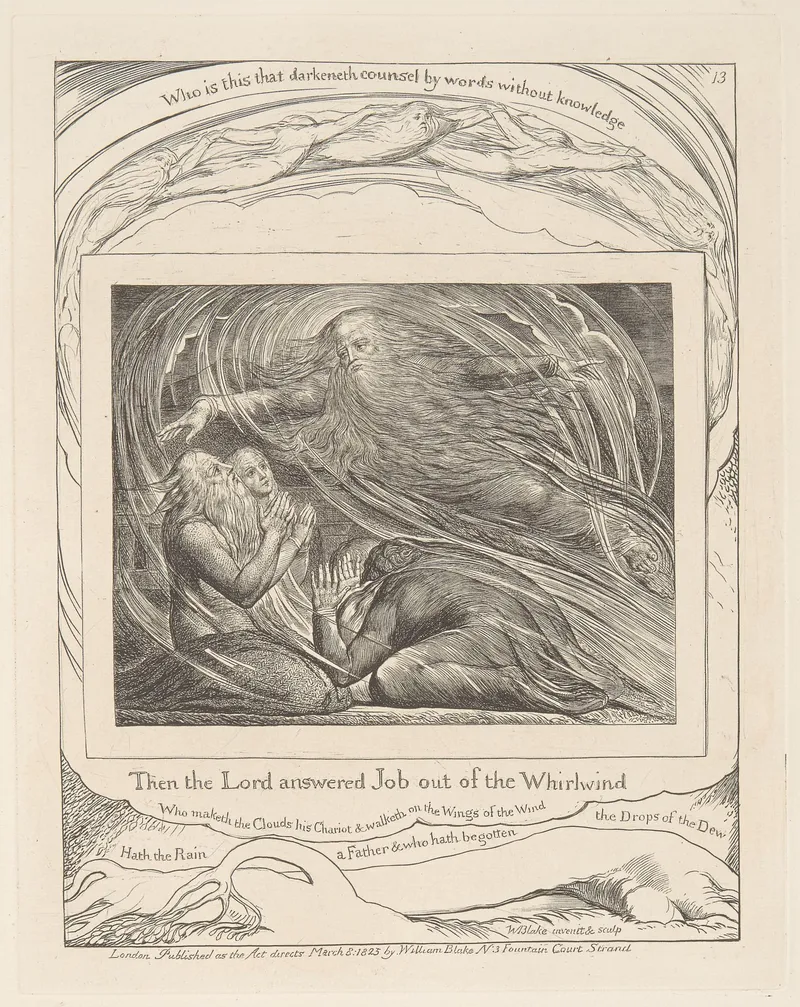
For thirty-seven chapters, the air has been thick with human speech. Job has poured out his complaint, the three friends have argued their case, young Elihu has added his long reply - and through all of it the one voice that could settle everything has been silent. Now, at last, that silence breaks. Then the LORD answered Job out of the whirlwind, and said. The God who has seemed absent through all Job's anguish speaks - and He speaks from the storm itself, the whirlwind that is Scripture's own emblem of the overwhelming nearness of God.1
Tap any highlighted phrase to jump to the commentary that unpacks it.
Job 38:1-11Where Wast Thou When I Laid the Foundations?
1Then the LORD answered Job out of the whirlwind, and said, 2Who is this that darkeneth counsel by words without knowledge? 3Gird up now thy loins like a man; for I will demand of thee, and answer thou me. 4Where wast thou when I laid the foundations of the earth? declare, if thou hast understanding. 5Who hath laid the measures thereof, if thou knowest? or who hath stretched the line upon it? 6Whereupon are the foundations thereof fastened? or who laid the corner stone thereof; 7When the morning stars sang together, and all the sons of God shouted for joy? 8Or who shut up the sea with doors, when it brake forth, as if it had issued out of the womb? 9When I made the cloud the garment thereof, and thick darkness a swaddlingband for it, 10And brake up for it my decreed place, and set bars and doors, 11And said, Hitherto shalt thou come, but no further: and here shall thy proud waves be stayed?
The first thing to feel is the sheer fact of it: God speaks. After the long silence in which Job has cried into the dark and heard nothing, the LORD answered Job out of the whirlwind. The whirlwind is no incidental detail. All through Scripture the storm is the signature of God's overwhelming approach - the cloud and tempest of Sinai, the wind in which Elijah strained to hear Him. God comes as the storm that surrounds and dwarfs the one He addresses.
And His first words are a question that names Job's whole problem: Who is this that darkeneth counsel by words without knowledge? Job has spoken much - not falsely about his own innocence, but beyond his depth about the governance of the world, as though he could see the whole design and find it wanting. To darken counsel is to make the wise plan look murky and confused by speaking of what one does not understand.
God is saying that Job has been talking about a canvas far larger than he can see.1
And then a summons that is bracing rather than cruel: Gird up now thy loins like a man; for I will demand of thee, and answer thou me. To gird up the loins was to gather the long robe and bind it at the waist so a man could run, or work, or stand his ground - the ancient gesture of readiness. God is calling him to his feet. Stand up. Brace yourself. I am going to ask, and you are going to answer. There is a strange dignity in it: God treats Job as one worth questioning, summons him to engage rather than collapse.
What follows will indeed demand everything Job has - and it comes as a challenge issued to a man God means to address face to face. The questioning that fills the rest of the chapter is, in its own severe way, an act of nearness. God has come close enough to ask.
The questioning begins where everything begins - at the founding of the world - and God reaches for the language of building. Who hath laid the measures thereof… or who hath stretched the line upon it? Whereupon are the foundations thereof fastened? or who laid the corner stone thereof? The images are an architect's and a master builder's: the measures marked out, the measuring line stretched across the ground, the foundations sunk and fastened, the corner stone set in place from which the whole structure takes its squareness.2 The earth, God is saying, is not an accident; it is a built thing, laid out with intention by One who knew its dimensions before there was anything to measure.
And every question carries the same unspoken edge: you were not the one who did this. Job arrived in a finished world. He never saw the line stretched or the corner stone laid. He is a guest in a house whose construction he cannot remember, presuming to tell the Builder how the house should be run.
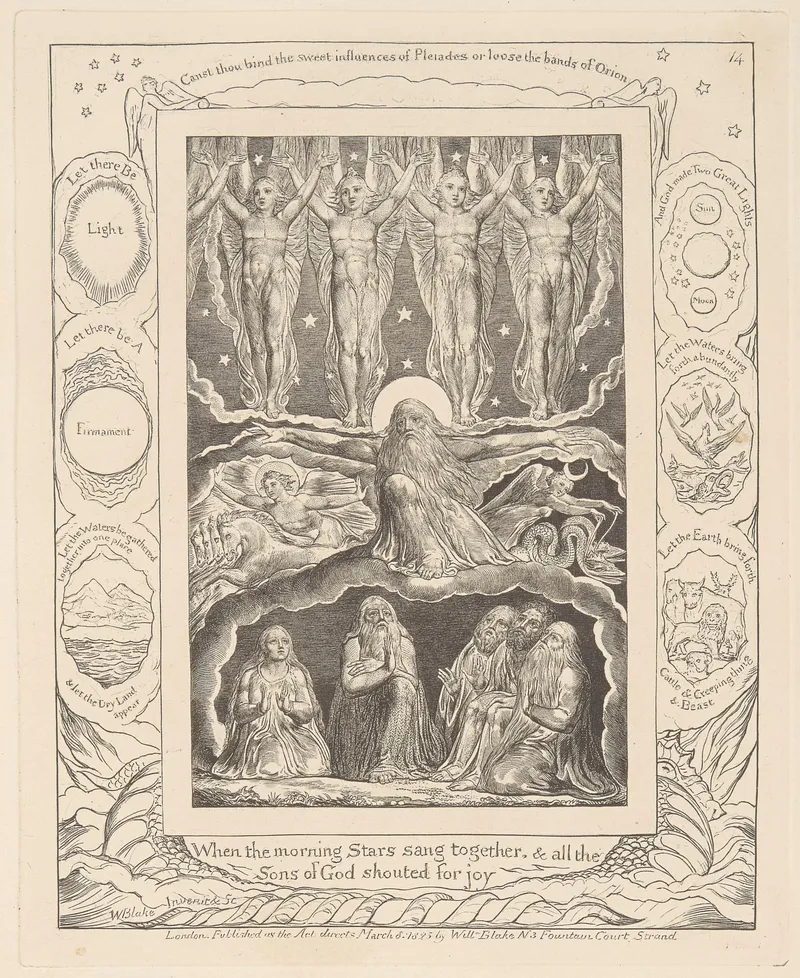
Then the building scene fills with sound and joy: When the morning stars sang together, and all the sons of God shouted for joy? At the laying of earth's foundation there was music - the morning stars singing, the heavenly host shouting for gladness over the work of God. It is one of the most beautiful pictures in all of Scripture: creation greeted with a chorus of praise, the dawn of the world attended by celebration.
And the point for Job is gentle and devastating at once. This singing happened before Job drew breath, before there was a single human eye to see it. The world was founded amid a joy Job was not present to share and a wisdom he was not consulted to approve. The God he is questioning was being praised by the heavens while Job did not yet exist. The very antiquity of the creation - older than the questioner, sung over by stars - sets the whole dispute in proportion.
From the founding of the earth God turns to the taming of the sea, and the imagery shifts from architecture to birth. Or who shut up the sea with doors, when it brake forth, as if it had issued out of the womb? The sea is pictured as a newborn bursting forth, wild and surging - and God is the one who receives it, who made the cloud the garment thereof, and thick darkness a swaddlingband for it, wrapping the infant deep as a mother swaddles a child.
In the imagination of the ancient world the sea was the very face of chaos, the untamable power that swallowed ships and threatened the order of the world. And Job hears that this raging deep was, from its first moment, an infant in God's hands - clothed, swaddled, and bounded. And brake up for it my decreed place, and set bars and doors. The chaos has a nursery and a door with a bar across it.
What terrifies sailors is, to God, a child He has put to bed.
Job 38:12-21Hast Thou Commanded the Morning?
12Hast thou commanded the morning since thy days; and caused the dayspring to know his place; 13That it might take hold of the ends of the earth, that the wicked might be shaken out of it? 14It is turned as clay to the seal; and they stand as a garment. 15And from the wicked their light is withholden, and the high arm shall be broken. 16Hast thou entered into the springs of the sea? or hast thou walked in the search of the depth? 17Have the gates of death been opened unto thee? or hast thou seen the doors of the shadow of death? 18Hast thou perceived the breadth of the earth? declare if thou knowest it all. 19Where is the way where light dwelleth? and as for darkness, where is the place thereof, 20That thou shouldest take it to the bound thereof, and that thou shouldest know the paths to the house thereof? 21Knowest thou it, because thou wast then born? or because the number of thy days is great?
God turns from the founding of the world to its daily renewal, and asks whether Job has any hand in the most ordinary miracle of all: the sunrise. Hast thou commanded the morning since thy days; and caused the dayspring to know his place? Every dawn the light returns and finds its appointed station - and not once has Job ordered it to do so. The morning comes at a command that is not his. Then the image turns vivid and strange: as the light spreads, the earth is turned as clay to the seal, the way a cylinder seal rolled across soft clay presses the formless surface into shape and detail.
In the dark the world is a featureless blur; with the dawn its hills and forms emerge as if stamped into being, and they stand as a garment, the landscape clothed in light. And the morning has a moral edge: it take[s] hold of the ends of the earth, that the wicked might be shaken out of it, for evil loves the cover of night and is scattered when day breaks. The God who commands the morning is governing not only the light but the order of things the light reveals.
The questions now probe the hidden places of the world - the regions no human foot has reached. Hast thou entered into the springs of the sea? or hast thou walked in the search of the depth? The springs of the sea are the deep sources beneath the waters, the bottom of the abyss where the sea is born; and God asks whether Job has ever walked there, gone down and searched out the floor of the deep.
The answer is plain: no one has. These are places sealed against human sight, known only to the One who made them.1 And the form of the question matters as much as its content. God is not merely listing wonders; He is mapping the edges of Job's knowledge, one frontier after another, showing how quickly a man reaches the boundary of what he can know. Job has walked the surface of the world.
He has never walked its depths. There is a whole creation beneath the one he sees, and he has no access to it at all.
Then the questions reach the most solemn frontier of all: Have the gates of death been opened unto thee? or hast thou seen the doors of the shadow of death? Death is pictured as a realm with gates and doors - a place into which all the living pass and from which none return to report. And God asks whether Job has seen behind those doors, whether the secrets of that realm have been opened to him.
They have not. Here is the deepest edge of human ignorance: the one experience every person will undergo, and the one no living person can see into. For a man who has been demanding to understand the governance of life and death - who has cried out under the weight of his own losses - it is a piercing question. Job presumes to judge how God orders the boundary between life and death, and he has never once seen past the gate.
The realm he speaks of so freely is sealed even to the wisest of the living. Only the Maker holds its keys.
The movement comes to rest on light and darkness themselves - not as abstractions but as things with a dwelling place. Where is the way where light dwelleth? and as for darkness, where is the place thereof, that thou shouldest take it to the bound thereof, and that thou shouldest know the paths to the house thereof? Light and darkness are imagined as travelers who each have a home and a road they walk between work and rest; and God asks whether Job knows the way to either house, whether he could lead them to their borders.
He cannot. And then the question turns gently, almost wryly, to Job himself: Knowest thou it, because thou wast then born? or because the number of thy days is great? The irony is unmistakable and kind. Does Job know these ancient secrets because he was alive when light first took its road? Because his years stretch back to the beginning? Of course not. His life is a brief thing, lately begun; the paths of light and darkness were laid long before his first morning.
The whole section has been measuring the span of Job's knowledge against the span of God's - and the contrast is meant to settle him into the truth of his own creatureliness.
Job 38:22-41The Treasures of the Snow and the Bands of Orion
22Hast thou entered into the treasures of the snow? or hast thou seen the treasures of the hail, 23Which I have reserved against the time of trouble, against the day of battle and war? 24By what way is the light parted, which scattereth the east wind upon the earth? 25Who hath divided a watercourse for the overflowing of waters, or a way for the lightning of thunder; 26To cause it to rain on the earth, where no man is; on the wilderness, wherein there is no man; 27To satisfy the desolate and waste ground; and to cause the bud of the tender herb to spring forth? 28Hath the rain a father? or who hath begotten the drops of dew? 29Out of whose womb came the ice? and the hoary frost of heaven, who hath gendered it? 30The waters are hid as with a stone, and the face of the deep is frozen.
God moves to the weather - the snow, the hail, the rain, the frost - and pictures it as a kept treasure. Hast thou entered into the treasures of the snow? or hast thou seen the treasures of the hail, which I have reserved against the time of trouble, against the day of battle and war? The image is of vast storehouses, divine treasuries from which God draws out the snow and hail as a king draws weapons from an armory.2 And these stores are not merely meteorological; they are reserved for God's purposes - held against the day of battle, as when hailstones once fell on Israel's fleeing enemies.
The weather Job watches with no idea where it comes from is, to God, a marshaled resource kept ready in a storehouse Job has never seen. Then the questions multiply through the whole sky: By what way is the light parted… Who hath divided a watercourse for the overflowing of waters, or a way for the lightning of thunder? Even the lightning has a way, a channel cut for it; even the cloudburst follows a course God has carved.
Nothing in the storm is random. It all moves along paths laid by a hand Job cannot see.
And then comes one of the most quietly profound lines in the chapter - a line that reaches past Job's situation into the whole question of why God orders the world as He does. God sends the rain to cause it to rain on the earth, where no man is; on the wilderness, wherein there is no man; to satisfy the desolate and waste ground; and to cause the bud of the tender herb to spring forth. Consider what this says.
God waters the empty wilderness - ground where no person lives, where no one will see the green herb spring up or benefit from it. The rain falls there anyway, and the desolate places are satisfied, and the tender bud opens to no human eye. The creation, in other words, does not exist solely for human use or human understanding. God delights in the flourishing of a wilderness no man will ever walk. And the implication for Job is liberating: if God lavishes such care on the unseen and the useless-to-man, ordering the world for purposes that exceed human benefit entirely, then perhaps the governance of Job's life also runs by a wisdom larger than “what serves Job's comfort.” The God who waters the empty desert is not a God who can be measured by whether His ways are convenient to us.
The questions about the weather turn tender and almost playful, reaching for the language of family and birth. Hath the rain a father? or who hath begotten the drops of dew? Out of whose womb came the ice? and the hoary frost of heaven, who hath gendered it? Where does the rain come from - does it have a father who begets it? From what womb is the ice born? God speaks of the dew and the frost as His own offspring, things He brings forth as a parent brings forth a child.
The waters are hid as with a stone, and the face of the deep is frozen - the lake locked under ice as hard as stone, sealed at a word. There is wonder in this, and intimacy: the God who founded the earth and bounds the sea is also the One who tends each drop of dew, who gives birth to the morning frost, who lays the ice like a lid over the deep. The same hand that does the vast things does the delicate ones.
And once again Job is the outsider to it all - he cannot father the rain or mother the frost; he can only receive them from a generosity whose source he does not control.
31Canst thou bind the sweet influences of Pleiades, or loose the bands of Orion? 32Canst thou bring forth Mazzaroth in his season? or canst thou guide Arcturus with his sons? 33Knowest thou the ordinances of heaven? canst thou set the dominion thereof in the earth? 34Canst thou lift up thy voice to the clouds, that abundance of waters may cover thee? 35Canst thou send lightnings, that they may go, and say unto thee, Here we are? 36Who hath put wisdom in the inward parts? or who hath given understanding to the heart? 37Who can number the clouds in wisdom? or who can stay the bottles of heaven, 38When the dust groweth into hardness, and the clods cleave fast together?
God lifts Job's eyes from the weather to the stars, and names them one by one. Canst thou bind the sweet influences of Pleiades, or loose the bands of Orion? Canst thou bring forth Mazzaroth in his season? or canst thou guide Arcturus with his sons? These are specific, named constellations - the great star-clusters by which the ancient world told its seasons and steered its ships.3 The sweet influences of Pleiades evoke the cluster rising with the gentle warmth of spring; the bands of Orion are the great winter figure bound in his place; Mazzaroth is brought forth in its season, the constellations wheeling out on schedule; Arcturus with his sons is guided across the sky with its trailing stars like a parent leading children.
And the question to Job is the same each time: can you do this? Can you bind the spring stars or loose the winter ones, summon the constellations in their turn, lead the great star and its little ones along their nightly road? He cannot touch them. They are infinitely beyond his reach, and yet they move with perfect regularity - bound and loosed and guided by Another, season after season, since before Job was born.
Behind the wheeling stars God names the thing that governs them: Knowest thou the ordinances of heaven? canst thou set the dominion thereof in the earth? The heavens are not chaos; they run by ordinances - fixed statutes, laws of order that hold the cosmos to its courses. And God asks two things: does Job even know these laws, and could he set them - could he establish their dominion, their ruling sway, over the earth below?
Job neither knows the ordinances nor could impose them. He cannot summon a rainstorm by shouting at the clouds (Canst thou lift up thy voice to the clouds…?); he cannot dispatch the lightning like a servant that reports back, Here we are. The whole sky obeys a sovereignty that is not Job's. And here is the unspoken turn the whole chapter has been driving toward: if Job does not even know the ordinances of heaven, the laws by which the stars and storms are governed, how can he presume to know the deeper ordinances by which God governs justice and suffering?
The order he cannot trace in the sky is a parable of the order he cannot trace in his own life - both administered, perfectly, by One who knows what Job does not.
In the midst of the storms and stars comes a question that turns suddenly inward, and it is one of the most searching in the chapter: Who hath put wisdom in the inward parts? or who hath given understanding to the heart? God has been asking about the outer world - the sea, the sky, the constellations - and now He asks about the very faculty Job has been using to question Him. The capacity for wisdom, the understanding seated in the heart, the power of thought by which Job weighs and judges and argues - who put it there?
Job did not give himself his own mind. The very reason that has been quarreling with heaven is itself a gift from the One being quarreled with. There is a deep gentleness, and a deep correction, in this. Job's ability to even frame his complaint is on loan from God. The understanding that feels its own limits in this chapter is understanding God Himself bestowed - which means the One who made Job's mind knows its boundaries far better than Job does, and is not threatened by its questions.
Then the questions return to the sky and the soil - Who can number the clouds in wisdom? or who can stay the bottles of heaven…? - the rain held in heaven's jars and poured at God's discretion, the dust hardening into clods as the showers cease. Even the counting of the clouds requires a wisdom Job does not have.
39Wilt thou hunt the prey for the lion? or fill the appetite of the young lions, 40When they couch in their dens, and abide in the covert to lie in wait? 41Who provideth for the raven his food? when his young ones cry unto God, they wander for lack of meat.
The great tour ends not among the stars but among the animals - and tellingly, among the wild creatures no human hand provides for. Wilt thou hunt the prey for the lion? or fill the appetite of the young lions, when they couch in their dens, and abide in the covert to lie in wait? The lion is the very picture of fierce independence, the predator that answers to no shepherd - and yet it is God who hunts the prey for it, who fills the appetite of the cubs crouched in the den.
The care that orders the world reaches even the carnivore in the wild, even the hunt in the thicket. God hunts the prey for the lion. And the point gathers up everything that has come before: God's provision is not limited to the domesticated, the useful, the human. It extends to every creature in the system He has made, sustaining a vast web of life Job neither manages nor comprehends.
And the chapter closes on a small, piercing image: the raven in its hunger. Who provideth for the raven his food? when his young ones cry unto God, they wander for lack of meat. Picture it: the fledgling ravens, abandoned or unable to feed themselves, croaking in their hunger - and the text says they cry unto God. Even the cry of a baby bird is heard in heaven; even that small need draws the provision of the Maker.
It is a deliberately humble note to end such a majestic tour. God has paraded the founding of the earth, the bounding of the sea, the wheeling of the constellations - and He finishes with a hungry young raven and the assurance that its cry does not go unanswered. The God of the whirlwind, who governs galaxies, marks the hunger of a single fledgling. For Job - and for every reader who has felt small and overlooked in their suffering - this is the chapter's tenderest word.
The vastness that should have made Job feel forgotten turns out to belong to a God who feeds the ravens when they cry. If the young raven's cry is heard, so is Job's. So is yours.
Research trail
Sources & further study
These references support the historical, linguistic, manuscript, and contextual notes in this chapter. Scripture remains the primary text; external sources are provided so readers can inspect the research directly.
- Job 38 - Translators' NotesThe NET Bible's detailed footnotes on Job 38 - the force of the rhetorical questions, the architectural imagery of measures and corner stone in verses 5-6, the birth-imagery of the sea in verse 8, and the long-debated identity of the constellations in verses 31-32.
- Job 38 · Hebrew + classical Jewish commentaryThe Hebrew text of Job 38 with Rashi, Ibn Ezra, and other classical commentators side by side - useful for yasad (the founding of the earth in verse 4), for the bounding of the sea in verses 8-11, and for the named constellations of verses 31-32 (Pleiades, Orion, Mazzaroth, Arcturus).
- Astronomy and the Stars in the Ancient Near East · Heilbrunn TimelineThe Met's survey of the ordered night sky of the ancient Near Eastern world Job belongs to - the named constellations and seasonal stars behind the sweet influences of Pleiades… the bands of Orion… Mazzaroth… Arcturus with his sons (vv. 31-32), and the conviction that the heavens themselves moved by an order no man had set.
- Job 38 ↔ John 1 · Colossians 1 · Hebrews 1 · Mark 4Traces the threads tying the Creator who laid the foundations of the earth (v. 4) and bounded the sea (v. 11) to the One by [whom] were all things created… and by him all things consist (Col. 1:16-17; John 1:3; Heb. 1:2-3), and to the One who stilled the sea with a word (Mark 4:39).
Where this echoes in Scripture
Where Wast Thou When I Laid the Foundations?
- Proverbs 3:19The LORD by wisdom hath founded the earth; by understanding hath he established the heavens.The same verb and the same wonder - the earth founded (yasad) in wisdom, the work God sets before Job in verse 4.
- Psalm 104:9Thou hast set a bound that they may not pass over; that they turn not again to cover the earth.The bounded sea of verses 8-11 - the proud waves told how far they may come, and no further.
- Colossians 1:16For by him were all things created… all things were created by him, and for him.Whose founding it was - the Creator of the whirlwind named as the One by whom and for whom all things were made.
- Mark 4:39And he… rebuked the wind, and said unto the sea, Peace, be still. And the wind ceased, and there was a great calm.The God who set the sea its limit (v. 11) stilling that same sea with a word, in the flesh.
Hast Thou Commanded the Morning?
- Psalm 74:16The day is thine, the night also is thine: thou hast prepared the light and the sun.The light and the morning of verses 12-19 - the day and the night alike belonging to the God who prepared them.
- Psalm 139:8If I ascend up into heaven, thou art there: if I make my bed in hell, behold, thou art there.The gates of death of verse 17 - the realm sealed to Job, yet open and present to God.
- Isaiah 40:28There is no searching of his understanding.The span of God's knowledge against the span of man's - the very contrast this section draws around Job.
- Romans 11:33How unsearchable are his judgments, and his ways past finding out!The New Testament's answering wonder - the borders of God's wisdom that Job is led, here, to feel.
The Treasures of the Snow and the Bands of Orion
- Psalm 147:9He giveth to the beast his food, and to the young ravens which cry.The closing image of verse 41 - the God whose provision reaches the crying young raven, sung in the Psalms.
- Luke 12:24Consider the ravens… God feedeth them: how much more are ye better than the fowls?The ravens of verse 41 on the lips of the Lord Jesus - the Creator's provision pressed as comfort against fear.
- Amos 5:8Seek him that maketh the seven stars and Orion… the LORD is his name.The named constellations of verses 31-32 - the maker of Pleiades and Orion, called by name.
- Hebrews 1:2Hath in these last days spoken unto us by his Son… by whom also he made the worlds.The God who answered from the whirlwind, speaking His final word - the Son by whom the worlds were made.