Mark 4
People in this chapter
Mark 4 is the chapter of seed and storm. It opens with so great a crowd pressing on the shore that Jesus pushes out in a boat and teaches from the water, the people ranged along the land like a hillside congregation. And He teaches in parables - the first and longest being the sower. A man scatters seed; some falls on the trodden path and the birds take it, some on stony ground where it springs up fast and burns out, some among thorns that choke it, and some on good ground… and brought forth, some thirty, and some sixty, and some an hundred (v. 8).
To His own disciples, in private, He gives the key: the sower soweth the word (v. 14), and the four soils are four kinds of hearer.1
Tap any highlighted phrase to jump to the commentary that unpacks it.
Mark 4:1-20A Sower Went Out to Sow
1And he began again to teach by the sea side: and there was gathered unto him a great multitude, so that he entered into a ship, and sat in the sea; and the whole multitude was by the sea on the land. 2And he taught them many things by parables, and said unto them in his doctrine, 3Hearken; Behold, there went out a sower to sow: 4And it came to pass, as he sowed, some fell by the way side, and the fowls of the air came and devoured it up. 5And some fell on stony ground, where it had not much earth; and immediately it sprang up, because it had no depth of earth: 6But when the sun was up, it was scorched; and because it had no root, it withered away. 7And some fell among thorns, and the thorns grew up, and choked it, and it yielded no fruit. 8And other fell on good ground, and did yield fruit that sprang up and increased; and brought forth, some thirty, and some sixty, and some an hundred. 9And he said unto them, He that hath ears to hear, let him hear.
The scene is exact and easy to picture: the crowd has grown so large that Jesus pushes a boat a little way out and sits down in it - the teacher's posture - while the people stand along the shore, the water carrying His voice up the slope to them (v. 1). And the first thing He gives them is a story drawn from the very landscape they can see: a farmer walking a field, flinging seed by hand.
In that country a sower scattered broadly across ground that was not yet plowed, so the seed fell wherever it fell - on the hard path beaten through the field, on the thin soil over hidden rock, into the corners where thornroots waited, and on the open good ground. Hearken; Behold (v. 3): the doubled call to attention tells the crowd that this plain farming scene is about to mean more than farming. Three of the four places end in loss - eaten, scorched, choked.
Only the fourth bears. And the parable refuses to interpret itself out loud; it ends with a riddle hung in the air: He that hath ears to hear, let him hear (v. 9).1
Notice where the weight of the parable falls. Most of the picture is failure - the birds, the sun, the thorns - but the story does not end discouraged. It ends in abundance: other fell on good ground, and did yield fruit that sprang up and increased; and brought forth, some thirty, and some sixty, and some an hundred (v. 8). The good ground does not merely survive; it multiplies, and on a scale a farmer of that day would call astonishing.
The losses are real and they are many, yet they are not the point. The point is that the seed, where it is received, produces a harvest out of all proportion to the handful that was sown. And the yields are not uniform - thirty, sixty, a hundred. Even among those who truly receive the word there is more and less fruitfulness, but all of it is genuine harvest. The parable holds two truths together without flinching: much of the sowing seems wasted, and the final crop is overwhelming.
The sower keeps sowing because the good ground makes it worth it.
10And when he was alone, they that were about him with the twelve asked of him the parable. 11And he said unto them, Unto you it is given to know the mystery of the kingdom of God: but unto them that are without, all these things are done in parables: 12That seeing they may see, and not perceive; and hearing they may hear, and not understand; lest at any time they should be converted, and their sins should be forgiven them. 13And he said unto them, Know ye not this parable? and how then will ye know all parables? 14The sower soweth the word. 15And these are they by the way side, where the word is sown; but when they have heard, Satan cometh immediately, and taketh away the word that was sown in their hearts. 16And these are they likewise which are sown on stony ground; who, when they have heard the word, immediately receive it with gladness; 17And have no root in themselves, and so endure but for a time: afterward, when affliction or persecution ariseth for the word’s sake, immediately they are offended. 18And these are they which are sown among thorns; such as hear the word, 19And the cares of this world, and the deceitfulness of riches, and the lusts of other things entering in, choke the word, and it becometh unfruitful. 20And these are they which are sown on good ground; such as hear the word, and receive it, and bring forth fruit, some thirtyfold, some sixty, and some an hundred.
When the crowd disperses and the inner circle is left, they ask Him the parable, and His answer is among the hardest sayings in the Gospel: Unto you it is given to know the mystery of the kingdom of God: but unto them that are without, all these things are done in parables: that seeing they may see, and not perceive (vv. 11-12). The words echo the commission of Isaiah, sent to a people whose hearts had grown dull (Isa. 6:9-10)2.
The point is not that God is hiding the truth from people who long for it; it is that the parable reveals to the one who comes asking - as these disciples have just done - and stays opaque to the one who will not. The very same story is light to the seeker and a closed door to the scoffer, and which it becomes depends on whether a person draws near to ask. The disciples are given the mystery precisely because they came to Him with the question.
The door is not locked from God's side; it opens to those who knock. And lest the disciples grow proud of being insiders, Jesus presses them too: Know ye not this parable? and how then will ye know all parables? (v. 13). Being near Him is not the same as understanding Him; they, too, must still learn to hear.
Then He unlocks the whole thing with one sentence: The sower soweth the word (v. 14). The seed was never grain; it was the word of God, and the four soils are four ways the human heart receives it. The way side is the heart packed hard by traffic, where the word never sinks in and is snatched away before it can (v. 15). The stony ground is the heart of quick enthusiasm and no depth - it receives the word with gladness but has no root, so when affliction or persecution comes for the word's sake, it withers (vv. 16-17).
The thorns are the most sobering, because nothing here is openly evil: the cares of this world, and the deceitfulness of riches, and the lusts of other things crowd in and slowly choke the word until it bears nothing (vv. 18-19). Worry, wealth, and wanting - ordinary, respectable things - can strangle a life as surely as open rebellion. The diagnosis is searching because most of us recognize ourselves not in the hard path or the rock but in the thorns: the word is there, but it is competing for room, and losing.
The fourth soil is described in three plain verbs, and they are worth dwelling on: such as hear the word, and receive it, and bring forth fruit (v. 20). The good ground is not a different kind of person who never struggles; it is the heart that does three things with the word the others fail to do. It hears - really attends, lets the word land. It receives - takes the word in, welcomes it, lets it put down roots rather than holding it at arm's length.
And it brings forth fruit - the word works its way out into a changed life. Hearing, receiving, fruit-bearing: the parable is not sorting humanity into the saved and the doomed by some hidden decree, but describing what genuine reception looks like and calling every listener toward it. The yields again vary - some thirtyfold, some sixty, and some an hundred - so no one need despair of being “only” thirtyfold ground; all of it is fruit, all of it is harvest.
And the verbs are doable. You cannot make yourself a different person, but you can hear, you can receive, you can let the word take root. The whole parable lands as an appeal: be the ground that hears and keeps and bears.
Mark 4:21-25Nothing Hid That Shall Not Be Manifested
21And he said unto them, Is a candle brought to be put under a bushel, or under a bed? and not to be set on a candlestick? 22For there is nothing hid, which shall not be manifested; neither was any thing kept secret, but that it should come abroad. 23If any man have ears to hear, let him hear. 24And he said unto them, Take heed what ye hear: with what measure ye mete, it shall be measured to you: and unto you that hear shall more be given. 25For he that hath, to him shall be given: and he that hath not, from him shall be taken even that which he hath.
After the sower comes a cluster of short sayings that turn on light and proportion. The first is a small joke with a serious edge: Is a candle brought to be put under a bushel, or under a bed? (v. 21). Of course not; you do not light a lamp in order to smother it. A lamp exists to be set up where it gives light to the room. The point lands on the word just sown: the mystery of the kingdom that has been given to the disciples (v. 11) is not given to be hoarded or hidden but to be set on a stand and shine.
And that opens into a promise as bracing as it is comforting: there is nothing hid, which shall not be manifested; neither was any thing kept secret, but that it should come abroad (v. 22). For now the kingdom comes quietly, in parables and small beginnings, easy to miss. But its hiddenness is temporary. What God has planted in obscurity He intends to bring fully to light; the present concealment is the seed underground, not the seed lost.
Everything true will finally be seen for what it is.
The next saying turns from light to measure, and it begins with a command about listening: Take heed what ye hear (v. 24). How you hear is not neutral; it sets in motion a kind of return. With what measure ye mete, it shall be measured to you: and unto you that hear shall more be given. The picture is a market scoop: the openness you bring to the word is the size of the cup you hold out, and you are given back according to it - and then more besides.
This is not a transaction you can game; it is a description of how spiritual hearing works. For he that hath, to him shall be given: and he that hath not, from him shall be taken even that which he hath (v. 25). The saying sounds severe until you see it is simply the law of every living thing: a muscle used grows and a muscle unused wastes; attention given to the word deepens, attention withheld dries up until even the little understanding once held slips away.
The warning and the promise are the same fact seen from two sides. Bring a large, open measure to what you hear, and you will be given more than you brought. Bring nothing, and even what you had leaks out.1
Mark 4:26-34The Earth Bringeth Forth Fruit of Herself
26And he said, So is the kingdom of God, as if a man should cast seed into the ground; 27And should sleep, and rise night and day, and the seed should spring and grow up, he knoweth not how. 28For the earth bringeth forth fruit of herself; first the blade, then the ear, after that the full corn in the ear. 29But when the fruit is brought forth, immediately he putteth in the sickle, because the harvest is come. 30And he said, Whereunto shall we liken the kingdom of God? or with what comparison shall we compare it? 31It is like a grain of mustard seed, which, when it is sown in the earth, is less than all the seeds that be in the earth: 32But when it is sown, it groweth up, and becometh greater than all herbs, and shooteth out great branches; so that the fowls of the air may lodge under the shadow of it. 33And with many such parables spake he the word unto them, as they were able to hear it. 34But without a parable spake he not unto them: and when they were alone, he expounded all things to his disciples.
Mark alone records this short parable, and it is a quiet rebuke to every anxious worker for God. So is the kingdom of God, as if a man should cast seed into the ground; and should sleep, and rise night and day, and the seed should spring and grow up, he knoweth not how (vv. 26-27). The farmer's part is real but small: he scatters the seed, then he goes on with his life - sleeping, waking, day after day - and the growth happens without him, beyond his sight and outside his control.
He knoweth not how. He cannot explain the secret life in the seed, and he certainly cannot force it; he could no more pull the harvest up early than command the dawn. For the earth bringeth forth fruit of herself (v. 28) - the ground has a God-given power to produce that the farmer only cooperates with. And it comes in order, not all at once: first the blade, then the ear, after that the full corn in the ear. The kingdom grows like that.
We sow the word, we tend and wait, but the life is not in us; it is in the seed and in the God who gives the increase. The harvest is sure - the sickle does come (v. 29) - but it ripens on God's timetable and by God's hidden working, and the steadiest thing the sower can do is to trust the growth he cannot see.
Then the mustard seed, the parable of small beginnings: Whereunto shall we liken the kingdom of God?… It is like a grain of mustard seed, which, when it is sown in the earth, is less than all the seeds that be in the earth: but when it is sown, it groweth up, and becometh greater than all herbs (vv. 30-32). The contrast is the whole point. The seed is proverbially tiny - a speck a person could lose between two fingers - and what it becomes is the largest of the garden plants, throwing out great branches wide enough that the fowls of the air may lodge under the shadow of it. The image of birds nesting in the branches echoes the great trees of the prophets, under which the nations find shelter (Ezek. 17:23; Dan. 4:12).
So the kingdom does not arrive with the fanfare an onlooker would expect of God's reign. It begins almost invisibly - a Teacher in a boat, a handful of fishermen, a word sown in a few hearts - and from that smallest of beginnings it grows until it overshadows the earth and the peoples of the world find rest in it. No one watching the seed go into the ground would guess the tree. That is exactly the comfort: the smallness of the beginning is no measure of the greatness of the end.
Mark closes the day of teaching with a note on Jesus' method: with many such parables spake he the word unto them, as they were able to hear it. But without a parable spake he not unto them: and when they were alone, he expounded all things to his disciples (vv. 33-34). Two things stand together here. First, He met people where they were - as they were able to hear it - not overwhelming the crowd but handing them the truth in pictures their lives could hold.
The parable was a mercy, the right-sized portion for each listener. Second, there was always more for those who stayed: when they were alone, he expounded all things. The private explanation was not a reward for being special; it was the fruit of remaining with Him after the crowd went home. The pattern is the same one the chapter has pressed throughout. The word goes out to everyone in a form they can receive; the depths of it open to those who do not drift off but draw near and keep asking.
The crowd got the parable; the ones who stayed got the meaning. Nearness to Jesus, sustained past the public moment, is how the hidden things become plain.
Mark 4:35-41Peace, Be Still
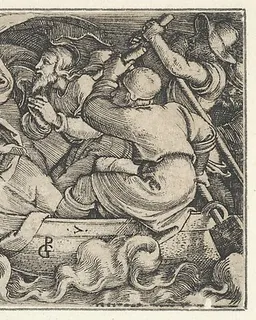
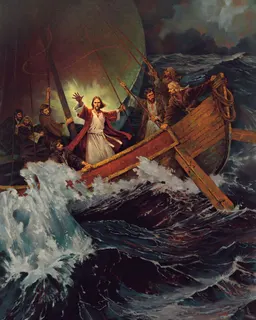
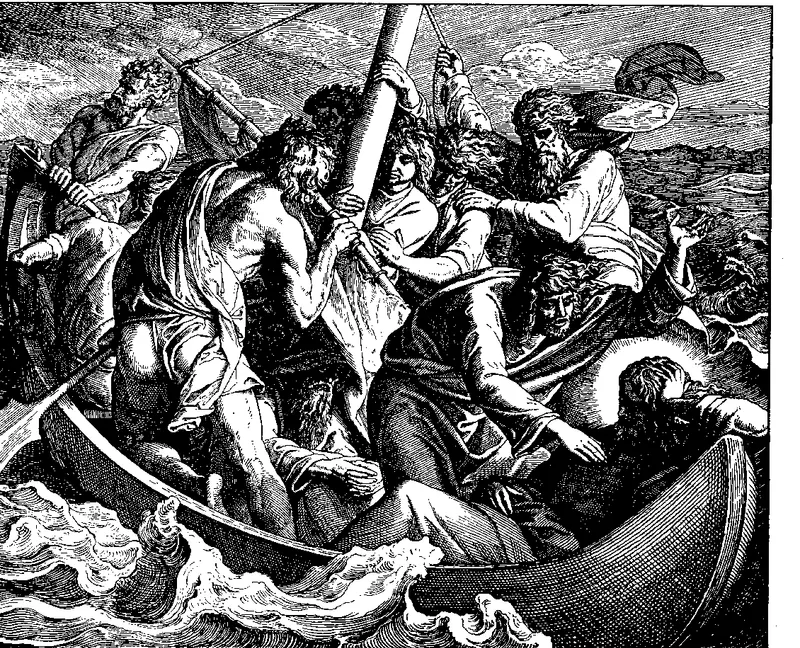
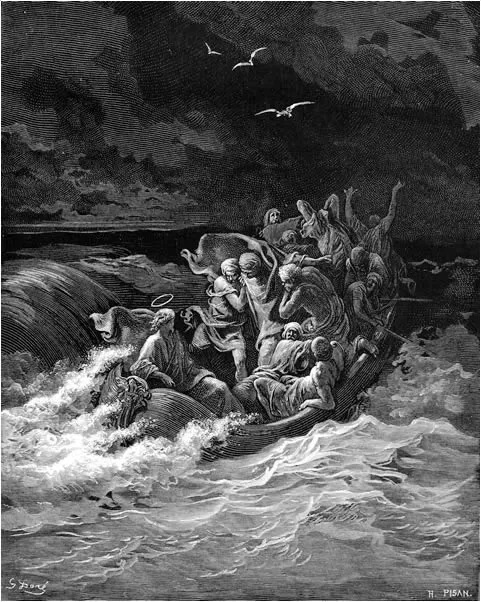
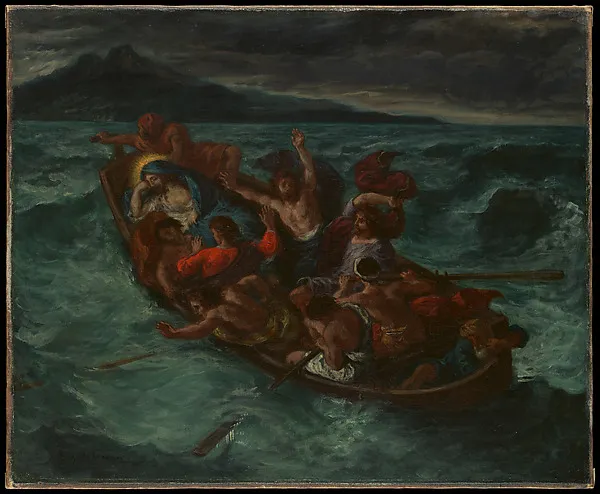
35And the same day, when the even was come, he saith unto them, Let us pass over unto the other side. 36And when they had sent away the multitude, they took him even as he was in the ship. And there were also with him other little ships. 37And there arose a great storm of wind, and the waves beat into the ship, so that it was now full. 38And he was in the hinder part of the ship, asleep on a pillow: and they awake him, and say unto him, Master, carest thou not that we perish? 39And he arose, and rebuked the wind, and said unto the sea, Peace, be still. And the wind ceased, and there was a great calm. 40And he said unto them, Why are ye so fearful? how is it that ye have no faith? 41And they feared exceedingly, and said one to another, What manner of man is this, that even the wind and the sea obey him?
The day that began with crowds on the shore ends with a crisis on the water. When the even was come, Jesus says, Let us pass over unto the other side (v. 35), and they take Him even as he was - weary from a day of teaching - into the boat. Then, with no warning, there arose a great storm of wind, and the waves beat into the ship, so that it was now full (v. 37).
This is not a squall on the edge of things; the boat is swamping, going down, and several of these men know the lake and know real danger when they are in it. And Jesus is asleep - in the hinder part of the ship, asleep on a pillow (v. 38). The detail is almost startling: the deep, untroubled sleep of a man at perfect rest, in the stern, while water pours in around Him. They wake Him with a cry that is half plea, half accusation: Master, carest thou not that we perish? Beneath the fear of drowning is a deeper fear - that He does not care, that He is indifferent to them, asleep while they die.
It is the cry the human heart still makes in the storm: not only save us, but do you even care? Mark lets the question stand, because he means to answer it.
Jesus does not argue with their panic; He stands and addresses the storm itself. And he arose, and rebuked the wind, and said unto the sea, Peace, be still. And the wind ceased, and there was a great calm (v. 39). Two things are remarkable. First, He speaks to the wind and the sea as a master speaks to something under his authority - He rebukes them, the way one rebukes a thing that has overstepped.
Second, the result is instant and total: not a gradual easing as a storm naturally spends itself, but a great calm the moment the words leave His mouth. Wind does not stop like that, and waves do not flatten like that, on their own; the suddenness is the miracle. The disciples had asked whether He cared; His answer is to still the very thing that terrified them, with a word. And the calm is described as great - the same word used of the storm a moment before.
The great tempest meets a greater peace. He does not merely survive the storm with them; He commands it, and it obeys.3
Only after the calm does Jesus turn to the men: Why are ye so fearful? how is it that ye have no faith? (v. 40). The question is not a scolding for being frightened in a sinking boat; it is a probe into where their trust went when the water rose. They had seen Him heal and cast out and teach with authority all day; the One who could do those things was in the boat with them.
Their terror was not unreasonable about the storm - it was unreasonable about Him. Faith, as Jesus uses the word here, is the settled confidence that the One who is present is also in command, even when He seems asleep to your trouble. And the disciples' response is the right one, even though it comes wrapped in a new and deeper fear: they feared exceedingly, and said one to another, What manner of man is this, that even the wind and the sea obey him? (v. 41).
Their first fear was of the storm; this second fear is of Him - the awe that rises when you realize the One in the boat is greater than the sea. That question, left ringing at the chapter's end, is the one Mark wants every reader to carry out with them.
Research trail
Sources & further study
These references support the historical, linguistic, manuscript, and contextual notes in this chapter. Scripture remains the primary text; external sources are provided so readers can inspect the research directly.
- Mark 4 - Translators' NotesThe NET Bible's detailed footnotes on Mark 4 - the agricultural realities behind the four soils (vv. 4-8), the difficult purpose-clause of verse 12, the proverb of the measure in verse 24, and the force of the rebuke addressed to the wind and sea in verse 39.
- Mark 4 ↔ Isaiah 6 · Psalm 107 · Job 38 · John 12Traces the threads tying Mark 4 to the rest of Scripture - the parable-and-hardening language of verse 12 read against Isaiah 6:9-10, the stilling of the storm (v. 39) read beside He maketh the storm a calm (Ps. 107:29) and the sea's appointed bound in Job 38:8-11, and the sown seed that must die to bear fruit (John 12:24).
- Mark 4 · Greek interlinear + lexiconThe Greek text of Mark 4 word by word, with parsing and lexicon links - useful for parabolē (vv. 2, 10, 11, 13, 30, 33, 34, the “parable” that sets one thing beside another), for logos (v. 14, the “word” that is sown), and for the two commands to the sea in verse 39, siōpa (“be silent”) and pephimōso (“be muzzled”).
Where this echoes in Scripture
A Sower Went Out to Sow
- Isaiah 55:10-11so shall my word be that goeth forth out of my mouth: it shall not return unto me void, but it shall accomplish that which I please.The seed of verse 14 - the word of God that does not finally come back empty.
- John 12:24Except a corn of wheat fall into the ground and die, it abideth alone: but if it die, it bringeth forth much fruit.The Sower of verse 14 becomes the seed - buried, and rising to a great harvest.
- Isaiah 6:9-10Hear ye indeed, but understand not; and see ye indeed, but perceive not.The words behind verse 12 - revelation that opens to the seeker and stays closed to the scoffer.
- James 1:21-22receive with meekness the engrafted word... But be ye doers of the word, and not hearers only.The good ground of verse 20 - the word received, rooted, and brought to fruit.
- Luke 8:15they, having heard the word, keep it, and bring forth fruit with patience.Luke's telling of the good ground (v. 20) - the fruit comes with patience, over time.
Nothing Hid That Shall Not Be Manifested
- Matthew 5:14-16Ye are the light of the world... Let your light so shine before men, that they may see your good works.The lamp of verse 21 turned outward - light given is light meant to be set up and seen.
- Luke 12:2-3For there is nothing covered, that shall not be revealed; neither hid, that shall not be known.The promise of verse 22 - what is concealed now will all be brought to light.
- John 8:12I am the light of the world: he that followeth me shall not walk in darkness, but shall have the light of life.The lamp on the stand (v. 21) named in person - the light no darkness overcomes.
- Proverbs 4:18But the path of the just is as the shining light, that shineth more and more unto the perfect day.The growing return of verses 24-25 - light given out grows brighter and brighter.
The Earth Bringeth Forth Fruit of Herself
- 1 Corinthians 3:6-7I have planted, Apollos watered; but God gave the increase... but God that giveth the increase.The lesson of verses 26-28 - the sower's part is real, but the growth belongs to God.
- Ezekiel 17:22-23I will plant it... and it shall bring forth boughs... and under it shall dwell all fowl of every wing.The great tree behind verse 32 - the kingdom in whose branches the nations find shelter.
- Daniel 2:34-35a stone was cut out without hands... and the stone that smote the image became a great mountain, and filled the whole earth.The same arc as the mustard seed (vv. 31-32) - a small beginning that fills the earth.
- Zechariah 4:10For who hath despised the day of small things?The warning behind verses 31-32 - do not scorn the smallness of how the kingdom begins.
- Philippians 1:6he which hath begun a good work in you will perform it until the day of Jesus Christ.The certainty of the harvest (v. 29) - the growth God begins, God completes.
Peace, Be Still
- Psalm 107:28-29Then they cry unto the LORD in their trouble... He maketh the storm a calm, so that the waves thereof are still.The act of verse 39 - the stilling of the sea that Scripture ascribes to the LORD alone.
- Job 38:8-11Hitherto shalt thou come, but no further: and here shall thy proud waves be stayed.The voice that sets the sea its bounds (v. 39) - the One the wind and waves obey.
- Psalm 89:8-9thou rulest the raging of the sea: when the waves thereof arise, thou stillest them.The answer to the disciples' question in verse 41 - who it is that stills the sea.
- Mark 1:25And Jesus rebuked him, saying, Hold thy peace, and come out of him.The same word of command as verse 39 - spoken with authority and instantly obeyed.
- Isaiah 43:2When thou passest through the waters, I will be with thee; and through the rivers, they shall not overflow thee.The promise behind the swamping boat (vv. 37-39) - the LORD present in the deep water, not absent from it.