Mark 3
People in this chapter
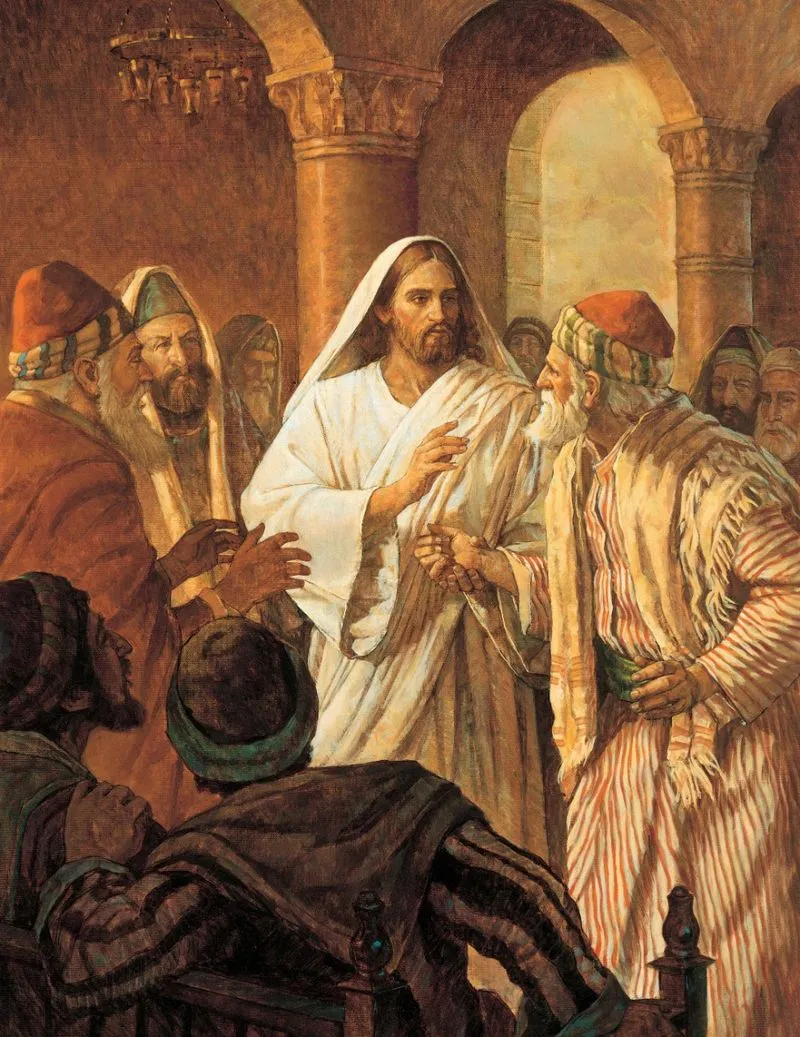
Mark 3 opens on another sabbath, and another collision. And he entered again into the synagogue; and there was a man there which had a withered hand (v. 1). The watchers are already in place: they watched him, whether he would heal him on the sabbath day; that they might accuse him (v. 2). Jesus does not heal quietly off to one side; He calls the man into the middle - Stand forth - and puts the matter to His critics as a question they cannot safely answer: Is it lawful to do good on the sabbath days, or to do evil? to save life, or to kill? But they held their peace (v. 4).
Their silence is its own verdict. He looks round on them with anger, being grieved for the hardness of their hearts (v. 5), and heals the man with a word. And the response to that mercy tells the whole story of the Gospel in advance: the Pharisees went forth, and straightway took counsel with the Herodians against him, how they might destroy him (v. 6).1
Tap any highlighted phrase to jump to the commentary that unpacks it.
Mark 3:1-6Is It Lawful to Do Good on the Sabbath?
1And he entered again into the synagogue; and there was a man there which had a withered hand. 2And they watched him, whether he would heal him on the sabbath day; that they might accuse him. 3And he saith unto the man which had the withered hand, Stand forth. 4And he saith unto them, Is it lawful to do good on the sabbath days, or to do evil? to save life, or to kill? But they held their peace. 5And when he had looked round about on them with anger, being grieved for the hardness of their hearts, he saith unto the man, Stretch forth thine hand. And he stretched it out: and his hand was restored whole as the other. 6And the Pharisees went forth, and straightway took counsel with the Herodians against him, how they might destroy him.
The scene is set with a few spare strokes. And he entered again into the synagogue; and there was a man there which had a withered hand (v. 1). In a world where a man worked with his hands or did not eat, a withered hand was not a small affliction; it was a quiet life sentence of dependence and shame. But the man's need is not what fills the room. The watchers are: they watched him, whether he would heal him on the sabbath day; that they might accuse him (v. 2).
It is a chilling detail. They do not doubt that Jesus can heal; they simply hope He will, so they can charge Him with it. They have come to worship, and they are using the hour to lay a trap. Jesus meets it head on. He will not heal in a corner to avoid the controversy; He calls the man out into the open - Stand forth (v. 3) - setting the need in the middle of the room where no one can look away.
Before He says a word about the law, He has already forced the real question into view: here is a broken man; what will you do with him?2
Then comes the question that splits the room: Is it lawful to do good on the sabbath days, or to do evil? to save life, or to kill? But they held their peace (v. 4). It is brilliantly framed, because it allows no safe answer. The sabbath was given for life - for rest, for mercy, for the flourishing of God's people. To do good on it, to save a life on it, is the very thing the day exists for.
The unspoken alternative is devastating: if it is not lawful to do good, then the only thing left is to do evil; if not to save, then to destroy. And here is the irony Jesus exposes without naming it: while He is poised to do good and save, His watchers are, that very moment, plotting to do evil and to kill. Who is really keeping the sabbath in this room? They held their peace - not out of reverence, but because the question has cornered them.
To agree is to lose their case; to disagree is to say aloud that mercy is unlawful. Their silence is the sound of a conscience that knows the right answer and refuses to give it.
What Jesus feels next is told with rare precision: when he had looked round about on them with anger, being grieved for the hardness of their hearts (v. 5). This is the only place in the Gospels where we are explicitly told the Lord looked on people with anger, and it is worth seeing exactly what kindles it - and what does not. He is not angry at the man's affliction, nor irritated at the interruption to worship.
He is angry, and at the same time grieved, at the hardness of their hearts. The two go together and must not be pulled apart. His anger is grief that men can stand in the presence of a suffering brother and feel nothing but the desire to win an argument. There is a kind of holy displeasure that is the very opposite of indifference - it is love that cannot bear to watch hearts close. Then, with a word and no labour at all, He heals: Stretch forth thine hand… and his hand was restored whole as the other. He breaks no sabbath rest; He merely speaks.
The whole charge against Him collapses into the man's opened, working hand.
The response to that mercy is the hinge of the chapter, and of the Gospel: the Pharisees went forth, and straightway took counsel with the Herodians against him, how they might destroy him (v. 6). Read it slowly. A man has just been made whole - and the reaction of the religious leaders is not wonder, not even argument, but a plot to kill. And to pull it off they reach for the unlikeliest allies imaginable.
The Pharisees were strict separatists who despised Rome's collaborators; the Herodians were partisans of Herod, Rome's client king - the two groups stood at opposite ends of the political and religious world and ordinarily had nothing to do with one another. Yet here they make common cause, because Jesus threatens them both at once. He answers to no system, flatters no power, and exposes hard hearts wherever they sit. From this early in Mark, the shadow of the cross falls across the page: the very goodness of Jesus, the healing that should have melted them, instead hardens them into murderers.
Mercy itself becomes the offence. This is the deadly pattern the rest of the Gospel will trace to its end.1
Mark 3:7-12Thou Art the Son of God
7But Jesus withdrew himself with his disciples to the sea: and a great multitude from Galilee followed him, and from Judaea, 8And from Jerusalem, and from Idumaea, and from beyond Jordan; and they about Tyre and Sidon, a great multitude, when they had heard what great things he did, came unto him. 9And he spake to his disciples, that a small ship should wait on him because of the multitude, lest they should throng him. 10For he had healed many; insomuch that they pressed upon him for to touch him, as many as had plagues. 11And unclean spirits, when they saw him, fell down before him, and cried, saying, Thou art the Son of God. 12And he straitly charged them that they should not make him known.
From the closing room of the plot, Jesus withdraws to the open sea, and the crowds come to Him like a tide: a great multitude from Galilee followed him, and from Judaea, and from Jerusalem, and from Idumaea, and from beyond Jordan; and they about Tyre and Sidon (vv. 7-8). Mark is careful to name the directions, and they matter. The crowds pour in from the north and the south, from across the Jordan to the east and the pagan coastlands of Tyre and Sidon to the northwest - from Jew and Gentile territory alike.
While the leaders in the synagogue close ranks to destroy Him, the ordinary people of the whole region are streaming toward Him from every point of the compass. The pressure is so great that He has a small boat kept ready lest they should throng him (v. 9); the sick pressed upon him for to touch him, as many as had plagues (v. 10). It is a vivid picture of need without limit and mercy without measure - and a quiet foreshadowing that this Galilean healer is for all peoples everywhere.
The hostility of a few cannot stop the coming of the many.3
In the midst of the crush, another kind of voice breaks out: unclean spirits, when they saw him, fell down before him, and cried, saying, Thou art the Son of God (v. 11). It is a startling reversal. The scribes who study the Scriptures cannot see who He is; the demons see it instantly and cannot help saying it aloud. They fell down before him - not in worship, but in dread, knowing exactly whose presence they are in.
Here is a sobering truth the chapter sets quietly alongside the sabbath dispute: to know the right answer about Jesus is not the same as belonging to Him. The unclean spirits had perfect theology - Thou art the Son of God is the truest thing anyone says in the whole chapter - and it saved them nothing. Mere recognition, even correct and trembling recognition, is not faith. What the demons confess in terror, the chapter will close by asking the reader to live: to know who He is, and then to do the will of God.
Jesus' response to the spirits' outcry is firm and deliberate: he straitly charged them that they should not make him known (v. 12). The word straitly means strictly, sternly - this is no gentle request but a sharp command to be silent. It belongs to a pattern that runs all through Mark, often called the messianic secret: again and again Jesus silences demons and tells healed people not to publish what He has done. Why? Partly because a confession forced from a demon is no fit herald for the Son of God - the truth about Him is not to be carried on the lips of the very powers He has come to overthrow.
And partly because the crowds, and even the disciples, were not yet ready to understand what kind of Messiah He was. A title like Son of God shouted over a sea of people hungry for miracles could only feed a false picture - a wonder-worker, a deliverer from Rome - when the path He had chosen led to a cross. He will not be proclaimed on cheap terms. The full meaning of who He is must wait until it can be read in the light of His dying and rising.
Mark 3:13-19He Ordained Twelve, That They Should Be With Him
13And he goeth up into a mountain, and calleth unto him whom he would: and they came unto him. 14And he ordained twelve, that they should be with him, and that he might send them forth to preach, 15And to have power to heal sicknesses, and to cast out devils: 16And Simon he surnamed Peter; 17And James the son of Zebedee, and John the brother of James; and he surnamed them Boanerges, which is, The sons of thunder: 18And Andrew, and Philip, and Bartholomew, and Matthew, and Thomas, and James the son of Alphaeus, and Thaddaeus, and Simon the Canaanite, 19And Judas Iscariot, which also betrayed him: and they went into an house.
After the crush of the crowds, Jesus withdraws upward and acts with quiet sovereignty: he goeth up into a mountain, and calleth unto him whom he would: and they came unto him (v. 13). Every phrase is weighted. The mountain is, throughout Scripture, the place of meeting God and of decisive revelation - the place where Moses received the law and Israel was made a people. Whom he would puts the initiative entirely with Jesus: the Twelve do not volunteer or apply; they are chosen, named by His own will.
And they came unto him - the only fitting response to that call is to come. This is the founding of something. Out of the great undifferentiated multitude that pressed upon Him by the sea, Jesus now sets apart a definite few, calls them by name, and gives them a share in His own mission. The pattern is grace from first to last: He calls whom He will, and those He calls He draws to Himself before He ever sends them out.1
The reason for the calling is stated with deliberate order, and the order is the whole point: he ordained twelve, that they should be with him, and that he might send them forth to preach, and to have power to heal sicknesses, and to cast out devils (vv. 14-15). Notice what comes first. Before any task, before preaching or healing or casting out devils, the first purpose is simply that they should be with him. They are appointed, first of all, to companionship - to live alongside Jesus, to watch Him, to learn His heart by nearness.
Only then, and flowing out of that, are they sent forth. The number itself preaches: twelve, matching the twelve tribes, signals that something new is being founded around Jesus, a people gathered to Him. But the deepest lesson is the sequence. The Lord does not first recruit workers and then, perhaps, allow them some time with Him. He first draws them to Himself, and ministry is the overflow. Everything the apostles would later do - preach, heal, suffer, write - was meant to be the fruit of having first been with him.
Then Mark does something that slows the reader down: he names them, one by one. Simon he surnamed Peter; and James the son of Zebedee, and John the brother of James; and he surnamed them Boanerges, which is, The sons of thunder: and Andrew, and Philip, and Bartholomew, and Matthew, and Thomas, and James the son of Alphaeus, and Thaddaeus, and Simon the Canaanite, and Judas Iscariot (vv. 16-19). They are an unlikely roster - fishermen, a tax-collector in Matthew, a fierce nationalist in Simon the Canaanite (the Zealot), men with no rank or learning between them.
Jesus gives some of them new names: Simon becomes Peter, the rock; the hot-tempered brothers James and John become the sons of thunder. To be called by Christ is to be renamed by Him, given a new identity bound to His purpose. And the list ends with a line that casts a long shadow: Judas Iscariot, which also betrayed him. Even at the founding, the betrayer is named among the chosen. The nearness of the Twelve was a gift, but nearness alone could not save; one who was with him on the mountain would sell Him in a garden.
Privilege is not the same as a faithful heart - a warning standing at the very head of the apostolic list.
Mark 3:20-35Binding the Strong Man · The True Family
20And the multitude cometh together again, so that they could not so much as eat bread. 21And when his friends heard of it, they went out to lay hold on him: for they said, He is beside himself. 22And the scribes which came down from Jerusalem said, He hath Beelzebub, and by the prince of the devils casteth he out devils. 23And he called them unto him, and said unto them in parables, How can Satan cast out Satan? 24And if a kingdom be divided against itself, that kingdom cannot stand. 25And if a house be divided against itself, that house cannot stand. 26And if Satan rise up against himself, and be divided, he cannot stand, but hath an end. 27No man can enter into a strong man’s house, and spoil his goods, except he will first bind the strong man; and then he will spoil his house. 28Verily I say unto you, All sins shall be forgiven unto the sons of men, and blasphemies wherewith soever they shall blaspheme: 29But he that shall blaspheme against the Holy Ghost hath never forgiveness, but is in danger of eternal damnation: 30Because they said, He hath an unclean spirit.
The pressure resumes at once: the multitude cometh together again, so that they could not so much as eat bread (v. 20). Jesus and the Twelve cannot find space even for a meal. And now misunderstanding closes in from two sides. First, those nearest Him fear for His sanity: when his friends heard of it, they went out to lay hold on him: for they said, He is beside himself (v. 21). Those who should have known Him best conclude He has lost His mind, and set out to seize Him and bring Him home.
Then a graver charge arrives from the religious authorities: the scribes which came down from Jerusalem said, He hath Beelzebub, and by the prince of the devils casteth he out devils (v. 22). This is no longer mere doubt; it is a deliberate inversion. They cannot deny that He casts out demons - the deliverances are too plain - so they assign the power behind it to the prince of demons himself. Confronted with the undeniable work of God, they call it the work of the devil.
It is the most dangerous move a soul can make: to look at evident good and name it evil.
Jesus does not brush the charge aside; He reasons with it openly, in parables, and dismantles it with plain logic: How can Satan cast out Satan? And if a kingdom be divided against itself, that kingdom cannot stand. And if a house be divided against itself, that house cannot stand. And if Satan rise up against himself, and be divided, he cannot stand, but hath an end (vv. 23-26). The argument is simple and devastating.
If Jesus were casting out demons by Satan's power, then Satan would be at war with himself, tearing down his own kingdom - which is self-defeating folly that would mean the swift end of his rule. No power preserves itself by destroying itself. So the very thing the scribes admit - that demons are being cast out - proves the opposite of what they claim. The expulsion of evil is the sign of a greater authority breaking in - Someone stronger than Satan, freeing his captives.
Jesus turns their accusation inside out: the deliverances they cannot deny are the announcement that the kingdom of God has come upon them.
Then Jesus lifts the curtain on what is really happening, in one of His most revealing images: No man can enter into a strong man's house, and spoil his goods, except he will first bind the strong man; and then he will spoil his house (v. 27). The picture is a burglary turned inside out - or rather, a liberation told in the language of plunder. There is a strong man, and there is a house full of his goods. The strong man is Satan; the house is his domain over this fallen world; the goods he guards are the human beings held under his power - the demon-oppressed, the sick, the captive.
No one can simply walk in and carry off what the strong man holds; he is too strong for that. First he must be bound. And that is exactly what Jesus says is now taking place. Every deliverance the scribes have witnessed is evidence that the strong man has met his match - that One stronger has entered the house, overpowered its owner, and begun to carry off his prisoners as free men. The casting out of demons is not a sideshow; it is the visible sign of an invasion.
The kingdom of God advances by binding the strong man and emptying his house of the people he has held.
Now comes the chapter's most sobering word, and it must be read exactly as Mark gives it - cause and all. All sins shall be forgiven unto the sons of men, and blasphemies wherewith soever they shall blaspheme: but he that shall blaspheme against the Holy Ghost hath never forgiveness, but is in danger of eternal damnation: because they said, He hath an unclean spirit (vv. 28-30). Hear the breadth of the promise first, for Jesus puts it first and it is staggering: all sins shall be forgiven - all - and blasphemies wherewith soever they shall blaspheme. There is no sin so dark, no word so wicked, that it stands outside the reach of God's pardon.
That is the deliberate frame around the warning. And the one exception Jesus names is defined, by Mark himself, with great care: this blasphemy is what the scribes were doing in that very moment - because they said, He hath an unclean spirit. Standing face to face with the undeniable work of the Holy Spirit - demons cast out, captives freed, a man's withered hand made whole - they looked straight at it and called it the devil's work, and they did so not in confusion or weakness but in hardened, deliberate hostility, having already set their hearts to destroy Him (v. 6).
This is the settled, knowing refusal to receive the Spirit's witness - the deliberate naming of God's light as darkness. And here a word of great tenderness must be said plainly. The very fear of having committed this sin is itself evidence that one has not. The heart Jesus describes is hardened past all desire to repent; it does not grieve, it does not tremble, it does not long to come back. A soul that aches over its sin, that fears it has gone too far, that wants God - that very ache is the Spirit still at work, still drawing, still unspurned.
The Spirit who awakens the longing to return has plainly not been finally rejected. No one who wants Christ has blasphemed away the door to Him; the wanting is the proof the door still stands open.2
31There came then his brethren and his mother, and, standing without, sent unto him, calling him. 32And the multitude sat about him, and they said unto him, Behold, thy mother and thy brethren without seek for thee. 33And he answered them, saying, Who is my mother, or my brethren? 34And he looked round about on them which sat about him, and said, Behold my mother and my brethren! 35For whosoever shall do the will of God, the same is my brother, and my sister, and mother.
The chapter closes by returning to those who had come to lay hold on him (v. 21): There came then his brethren and his mother, and, standing without, sent unto him, calling him (v. 31). They stand without - outside the press of the crowd, outside the circle gathered to hear Him - and send word for Him to come out to them. When the message reaches Him - Behold, thy mother and thy brethren without seek for thee (v. 32) - Jesus does something that must have startled everyone present.
He does not rise and hurry out. He asks a question instead: Who is my mother, or my brethren? (v. 33). It would be easy to hear this as a slight against His family, but that is not its weight. He is redrawing the meaning of kinship for everyone listening. The deepest bond a person can have, He is about to say, is not the one written in blood. The question hangs in the air precisely so that the answer will land - an answer that reaches far beyond His own household to include the strangers sitting on the floor around Him.
Then comes the answer, and it reorders the world: he looked round about on them which sat about him, and said, Behold my mother and my brethren! For whosoever shall do the will of God, the same is my brother, and my sister, and mother (vv. 34-35). The gesture matters as much as the words - he looked round about on the ordinary people seated at His feet, the ones who had come to hear God's word, and called them His family.
In the ancient world, no bond was more fundamental, more defining of a person's identity and loyalty, than blood and household. Jesus relativizes that bond utterly: there is a kinship deeper than birth, and its mark is doing the will of God. Notice how open the door is - whosoever. Not the well-born, not the religiously credentialed, not those of the right lineage, but whosoever shall do the will of God. Anyone may enter this family; the one entrance is a heart turned to do what God wills.
And notice how tender the terms are: brother, and sister, and mother. To do the will of God is to be drawn into the nearest possible relationship with Jesus Himself - not a servant or a follower at a distance, but family. The outsiders on the floor are His true kin; the door stands open to all who will come the same way.
Research trail
Sources & further study
These references support the historical, linguistic, manuscript, and contextual notes in this chapter. Scripture remains the primary text; external sources are provided so readers can inspect the research directly.
- Mark 3 - Translators' NotesThe NET Bible's detailed footnotes on Mark 3 - the sabbath question and Jesus' grief in verses 4-5, the unlikely alliance of Pharisees and Herodians (v. 6), the calling and listing of the Twelve (vv. 13-19), and the much-discussed warning of verses 28-30.
- Mark 3 · Greek interlinear word-by-wordThe Greek text of Mark 3 set word by word beneath the English, with parsing and Strong's numbers - useful for the verb poieo (v. 14, “ordained,” literally made twelve), for deo (v. 27, “bind” the strong man), and for the wording of the warning in verses 28-30.
- Mark 3 ↔ Luke 11 · Colossians 2 · 1 John 3 · John 15Traces the threads tying Mark 3 to the rest of Scripture - the bound strong man (v. 27) read alongside the stronger One who overcomes him (Luke 11:21-22) and disarms the powers (Col. 2:15; 1 John 3:8), and the new family of God's will (v. 35) beside those born not of blood… but of God (John 1:13).
Where this echoes in Scripture
Is It Lawful to Do Good on the Sabbath?
- Mark 2:27-28The sabbath was made for man, and not man for the sabbath: Therefore the Son of man is Lord also of the sabbath.The ground of verse 4 - the day was made for man's good, and its Lord fills it with mercy.
- Luke 19:41-42And when he was come near, he beheld the city, and wept over it... but now they are hid from thine eyes.The same grief over hard hearts as verse 5 - the Lord weeping over those who will not see.
- Hosea 6:6For I desired mercy, and not sacrifice; and the knowledge of God more than burnt offerings.The principle behind the question of verse 4 - God prizes mercy above ceremonial precision.
- Matthew 12:11-12How much then is a man better than a sheep? Wherefore it is lawful to do well on the sabbath days.Jesus' own answer to the question He poses in verse 4 - doing good is always lawful.
- Luke 23:34Then said Jesus, Father, forgive them; for they know not what they do.Where the plot of verse 6 finally leads - and the grieved compassion that meets it even there.
Thou Art the Son of God
- Mark 1:1The beginning of the gospel of Jesus Christ, the Son of God.The title the demons cry in verse 11 is the very confession Mark's whole Gospel is written to draw out.
- Mark 15:39Truly this man was the Son of God.The same words as verse 11, but spoken in faith at the cross - recognition turned to confession.
- James 2:19Thou believest that there is one God; thou doest well: the devils also believe, and tremble.The warning folded into verse 11 - right knowledge of God, by itself, only makes demons tremble.
- Isaiah 49:6I will also give thee for a light to the Gentiles, that thou mayest be my salvation unto the end of the earth.The crowds from Gentile coastlands in verse 8 - a sign that this Messiah is for all peoples.
- Luke 4:41And devils also came out of many, crying out, and saying, Thou art Christ the Son of God. And he... suffered them not to speak.The same scene as verses 11-12 - demons confessing the truth, and Jesus silencing them.
He Ordained Twelve, That They Should Be With Him
- John 15:4-5Abide in me, and I in you... He that abideth in me, and I in him, the same bringeth forth much fruit: for without me ye can do nothing.The principle of verse 14 - being with Him comes first; the fruit grows out of the abiding.
- Acts 4:13they took knowledge of them, that they had been with Jesus.The fruit of the “with him” of verse 14 - the boldness of men who had been in His company.
- Matthew 28:19-20Go ye therefore, and teach all nations... and, lo, I am with you alway, even unto the end of the world.The “sent forth” of verse 14 bracketed by His abiding presence - communion and commission together.
- Luke 6:12-13he continued all night in prayer to God. And... he called unto him his disciples: and of them he chose twelve, whom also he named apostles.The calling of verses 13-19 - chosen by His will after a night of prayer.
- Ephesians 2:20And are built upon the foundation of the apostles and prophets, Jesus Christ himself being the chief corner stone.What the ordaining of the Twelve in verses 14-19 founded - the apostolic foundation of the people of God.
Binding the Strong Man · The True Family
- Luke 11:21-22when a stronger than he shall come upon him, and overcome him, he taketh from him all his armour wherein he trusted, and divideth his spoils.The bound strong man of verse 27 named - Christ the stronger One who overcomes him and frees his captives.
- Colossians 2:15And having spoiled principalities and powers, he made a shew of them openly, triumphing over them in it.Where the binding of verse 27 was decisively done - the powers disarmed at the cross.
- 1 John 3:8For this purpose the Son of God was manifested, that he might destroy the works of the devil.The purpose behind the plundered house of verse 27 - the Son come to undo the devil's works.
- John 1:12-13as many as received him, to them gave he power to become the sons of God... which were born, not of blood... but of God.The new family of verse 35 - kinship to God reckoned not by blood but by being born of God.
- Hebrews 2:11for which cause he is not ashamed to call them brethren.The astonishing terms of verse 35 - that those who do God's will are called Christ's own brethren.