Mark 5
People in this chapter
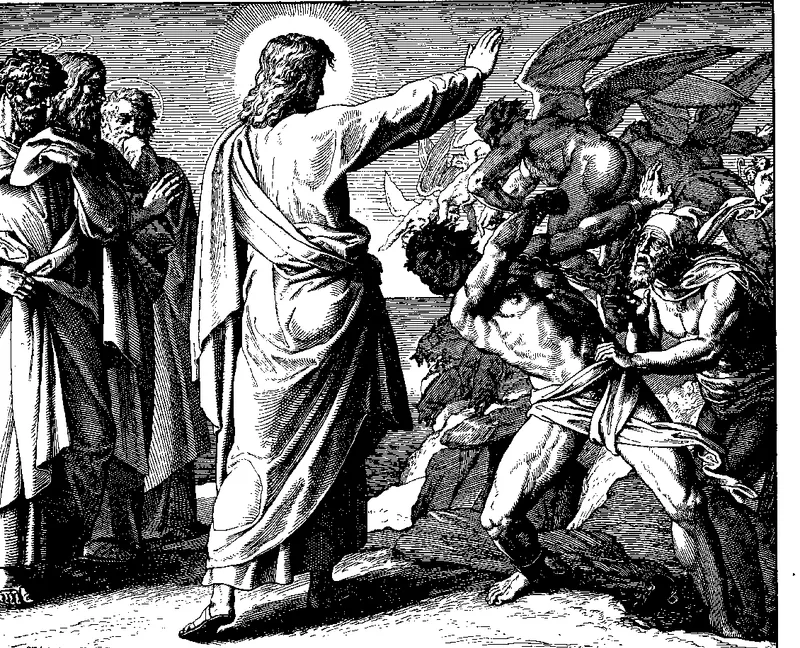
Mark 5 sets three desperate cases side by side, and the point of putting them together is unmistakable: the authority of Jesus runs past every limit a person might think it would hit. He steps off the boat into the country of the Gadarenes and is met at once by a man no one could help - a man who lived among the tombs, and no man could bind him, no, not with chains (v. 3), because he had snapped every chain and shattered every fetter put on him (v. 4).
Night and day he wandered the mountains and the graves, crying, and cutting himself with stones (v. 5). This is the picture Mark hands us first: a human being utterly enslaved, beyond the reach of force, restraint, or community - the hardest case imaginable.1
Tap any highlighted phrase to jump to the commentary that unpacks it.
Mark 5:1-13No Man Could Bind Him
1And they came over unto the other side of the sea, into the country of the Gadarenes. 2And when he was come out of the ship, immediately there met him out of the tombs a man with an unclean spirit, 3Who had his dwelling among the tombs; and no man could bind him, no, not with chains: 4Because that he had been often bound with fetters and chains, and the chains had been plucked asunder by him, and the fetters broken in pieces: neither could any man tame him. 5And always, night and day, he was in the mountains, and in the tombs, crying, and cutting himself with stones. 6But when he saw Jesus afar off, he ran and worshipped him, 7And cried with a loud voice, and said, What have I to do with thee, Jesus, thou Son of the most high God? I adjure thee by God, that thou torment me not. 8For he said unto him, Come out of the man, thou unclean spirit. 9And he asked him, What is thy name? And he answered, saying, My name is Legion: for we are many. 10And he besought him much that he would not send them away out of the country. 11Now there was there nigh unto the mountains a great herd of swine feeding. 12And all the devils besought him, saying, Send us into the swine, that we may enter into them. 13And forthwith Jesus gave them leave. And the unclean spirits went out, and entered into the swine: and the herd ran violently down a steep place into the sea, (they were about two thousand;) and were choked in the sea.
Mark paints the man in the bleakest terms Scripture has for a human life. He has his dwelling among the tombs (v. 3) - living in the graveyard, in the place of the dead, cut off from the houses of the living. And his torment is past all human remedy: no man could bind him, no, not with chains. Because that he had been often bound with fetters and chains, and the chains had been plucked asunder by him, and the fetters broken in pieces: neither could any man tame him (vv. 3-4).
The town had tried. They had reached for the strongest thing they had - iron - and the iron failed. He shattered restraint after restraint, and at last no one could so much as approach him. Then the saddest line of all: always, night and day, he was in the mountains, and in the tombs, crying, and cutting himself with stones (v. 5). No rest, no quiet, no relief, turning his own hands against his own body.
This is the case Mark sets first, on purpose - the most violent, the most isolated, the most hopeless person imaginable, the one everyone had written off. Whatever else this chapter will say about the reach of Jesus, it is saying it about this man first.1
And here the scene turns on a single, startling movement: But when he saw Jesus afar off, he ran and worshipped him (v. 6). The man no one could come near runs - not away, but toward Jesus, and falls down before Him. Then a loud cry breaks out of him: What have I to do with thee, Jesus, thou Son of the most high God? I adjure thee by God, that thou torment me not (v. 7).
The recognition is total and it is unwilling. The unclean spirits know exactly who Jesus is - Son of the most high God - long before the crowds or even the disciples have said as much, and they know themselves to be utterly outmatched, begging Him not to torment them. Mark has already told us the cause behind the cry: For he said unto him, Come out of the man, thou unclean spirit (v. 8). The word of Jesus is already at work; the loud protest is the sound of a power that has met its master.
Demons that broke every chain a town could forge cannot hold their ground against a single command.
Jesus asks the name, and the answer reveals the scale of the bondage: My name is Legion: for we are many (v. 9). It is not one tormentor but a host. A Roman legion numbered in the thousands; the word names a crowd of unclean spirits occupying one man - which is why no chain, no village, no human strength had been able to reclaim him. Yet for all their number they are utterly at His disposal.
They besought him much that he would not send them away out of the country (v. 10), and then begged to be sent into the herd of swine feeding nearby (vv. 11-12). And forthwith Jesus gave them leave (v. 13). The detail that follows is sobering and exact: the herd ran violently down a steep place into the sea, (they were about two thousand;) and were choked in the sea. What the spirits do to the swine is what they had been doing to the man - driving toward destruction.
The contrast is the whole point. Set loose, these spirits ruin and drown; restrained by Christ, they could not so much as keep their hold on one tormented man. The visible wreckage of the swine measures, by contrast, the magnitude of what has just been lifted off the man.2
Mark 5:14-20Go Home, and Tell Them
14And they that fed the swine fled, and told it in the city, and in the country. And they went out to see what it was that was done. 15And they come to Jesus, and see him that was possessed with the devil, and had the legion, sitting, and clothed, and in his right mind: and they were afraid. 16And they that saw it told them how it befell to him that was possessed with the devil, and also concerning the swine. 17And they began to pray him to depart out of their coasts. 18And when he was come into the ship, he that had been possessed with the devil prayed him that he might be with him. 19Howbeit Jesus suffered him not, but saith unto him, Go home to thy friends, and tell them how great things the Lord hath done for thee, and hath had compassion on thee. 20And he departed, and began to publish in Decapolis how great things Jesus had done for him: and all men did marvel.
The herdsmen run to spread the news, and the townspeople come out to see - and what they find is the gospel in a single image: him that was possessed with the devil, and had the legion, sitting, and clothed, and in his right mind (v. 15). Set every word beside what came before. He had been driven, restless, night and day roaming; now he is sitting, at rest. He had been naked, beyond shame; now he is clothed. He had been crying, and cutting himself, his mind a battlefield of a thousand voices; now he is in his right mind - calm, coherent, himself again.
This is what the deliverance of Christ looks like when it is finished: not merely the silencing of the symptoms, but a whole person handed back to himself, restored to rest and dignity and sanity. And then comes one of the strangest reactions in the Gospels: they were afraid. The same townspeople who had endured this man's torment for years are now frightened - not of the demoniac, but of the calm. They had learned to live alongside the bondage; the sudden, undeniable power that broke it unsettles them more than the chaos ever did.
Their fear hardens into a request that is almost unbearable to read: they began to pray him to depart out of their coasts (v. 17). They had watched a man no one could save restored before their eyes, and their response was to ask the Savior to leave. Mark lets the reason stand without softening it - they had also heard concerning the swine (v. 16), the cost of the miracle to the local economy. Faced with a power that healed a man but disrupted their settled arrangements, they chose the arrangements.
It is a quiet, devastating commentary on the human heart: people can witness undeniable mercy and still prefer the world they can manage to the Lord they cannot control. And Jesus does a sobering thing - He grants the request. When he was come into the ship (v. 18), He prepares to go. He does not force Himself on a town that asks Him to leave. The freedom He brings is the freedom He honors; where He is not wanted, He withdraws.
But the chapter does not end in rejection. The healed man, watching Jesus board the boat, prayed him that he might be with him (v. 18) - the most natural longing in the world, to stay near the One who gave him his life back. And here Jesus does something He more often does the opposite of in Mark, where He so frequently commands silence. He sends this man to speak. Howbeit Jesus suffered him not, but saith unto him, Go home to thy friends, and tell them how great things the Lord hath done for thee, and hath had compassion on thee (v. 19).
The man wanted to follow; Jesus gives him a harder and higher calling - to go back to the very people who knew him at his worst, and to be a living witness among them. And he does exactly that: he departed, and began to publish in Decapolis how great things Jesus had done for him: and all men did marvel (v. 20). The first missionary to the Gentile Decapolis is a man who, hours before, could not string two sane words together.
His whole message is his own story - how great things the Lord hath done for thee. Mercy received becomes mercy proclaimed.3
Mark 5:21-34If I May Touch But His Clothes
21And when Jesus was passed over again by ship unto the other side, much people gathered unto him: and he was nigh unto the sea. 22And, behold, there cometh one of the rulers of the synagogue, Jairus by name; and when he saw him, he fell at his feet, 23And besought him greatly, saying, My little daughter lieth at the point of death: I pray thee, come and lay thy hands on her, that she may be healed; and she shall live. 24And Jesus went with him; and much people followed him, and thronged him. 25And a certain woman, which had an issue of blood twelve years, 26And had suffered many things of many physicians, and had spent all that she had, and was nothing bettered, but rather grew worse, 27When she had heard of Jesus, came in the press behind, and touched his garment. 28For she said, If I may touch but his clothes, I shall be whole. 29And straightway the fountain of her blood was dried up; and she felt in her body that she was healed of that plague. 30And Jesus, immediately knowing in himself that virtue had gone out of him, turned him about in the press, and said, Who touched my clothes? 31And his disciples said unto him, Thou seest the multitude thronging thee, and sayest thou, Who touched me? 32And he looked round about to see her that had done this thing. 33But the woman fearing and trembling, knowing what was done in her, came and fell down before him, and told him all the truth. 34And he said unto her, Daughter, thy faith hath made thee whole; go in peace, and be whole of thy plague.
Back across the sea a very different petitioner comes. There cometh one of the rulers of the synagogue, Jairus by name; and when he saw him, he fell at his feet (v. 22). Mark wants us to feel the weight of that. Jairus is a man of standing - a ruler of the synagogue, one of the community's respected officials, the kind of man others fell before, not the kind who fell before a wandering teacher.
Yet here he is on the ground in the dirt, his dignity abandoned, because his world has narrowed to one terrible fact: My little daughter lieth at the point of death (v. 23). Grief has stripped away rank. He does not come with conditions or theological caution; he comes beseeching greatly, begging Jesus to come and lay thy hands on her, that she may be healed; and she shall live. It is the raw, unguarded plea of a parent at the end of his options.
And Jesus answers it the only way He ever answers such a plea - He goes. And Jesus went with him; and much people followed him, and thronged him (v. 24). The crowd presses in on every side, and into that crush of bodies Mark now slips a second story, folding one desperate person inside another.
The interruption is a woman, and Mark tells her history in a single breathless sentence: a certain woman, which had an issue of blood twelve years, and had suffered many things of many physicians, and had spent all that she had, and was nothing bettered, but rather grew worse (vv. 25-26). Twelve years - the very span of the little girl's whole life - of an affliction that under the law left her ritually unclean, which meant twelve years cut off: from full worship, from the touch of others, from the ordinary closeness of community life, for to touch her or what she touched was to be made unclean too.
She has spent everything chasing a cure and is worse, not better; medicine has failed her as completely as chains failed the man among the tombs. So she comes the only way a woman in her condition could come - hidden, from behind, in the anonymity of the crowd: When she had heard of Jesus, came in the press behind, and touched his garment (v. 27). And listen to the reasoning that moves her hand: For she said, If I may touch but his clothes, I shall be whole (v. 28).
It is faith stripped to its barest essential - not a worked-out theology, not a public confession, just a desperate certainty that contact with this man, even the hem of His robe, will be enough. And straightway the fountain of her blood was dried up; and she felt in her body that she was healed of that plague (v. 29). Twelve years undone in an instant, the moment faith touched Him.1
What follows shows that Jesus will not let this healing stay a secret transaction. Jesus, immediately knowing in himself that virtue had gone out of him, turned him about in the press, and said, Who touched my clothes? (v. 30). The disciples think the question absurd - Thou seest the multitude thronging thee, and sayest thou, Who touched me? (v. 31). The whole crowd is pressing against Him; how can He ask who touched Him? But Jesus knows the difference between the jostle of a crowd and the touch of faith.
Many were thronging Him; one had touched Him, and He felt it. He looked round about to see her that had done this thing (v. 32) - not to scold her, but to find her, to draw her out of hiding and into the open. And the woman, who had wanted nothing more than to slip away unseen, comes: fearing and trembling, knowing what was done in her, came and fell down before him, and told him all the truth (v. 33).
She had come to take healing in secret; she ends up giving the whole story face to face. Mark shows us why the question mattered. A cure taken anonymously might have left her thinking the power lived in the cloth, a kind of magic she had stolen. Jesus stops everything - even on the way to a dying child - to give her something better than a quiet healing: He gives her His eyes, His word, and a name.
Mark 5:35-43Be Not Afraid, Only Believe
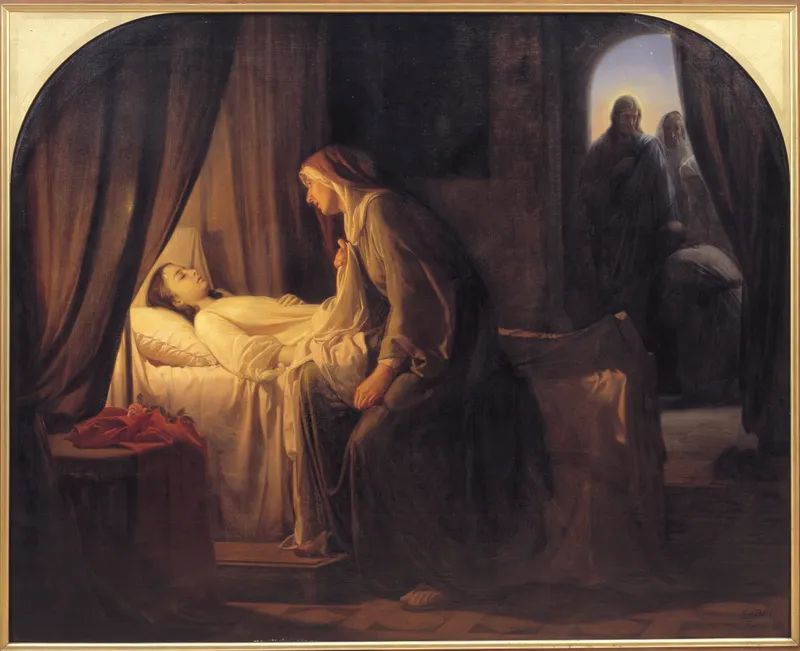
35While he yet spake, there came from the ruler of the synagogue’s house certain which said, Thy daughter is dead: why troublest thou the Master any further? 36As soon as Jesus heard the word that was spoken, he saith unto the ruler of the synagogue, Be not afraid, only believe. 37And he suffered no man to follow him, save Peter, and James, and John the brother of James. 38And he cometh to the house of the ruler of the synagogue, and seeth the tumult, and them that wept and wailed greatly. 39And when he was come in, he saith unto them, Why make ye this ado, and weep? the damsel is not dead, but sleepeth. 40And they laughed him to scorn. But when he had put them all out, he taketh the father and the mother of the damsel, and them that were with him, and entereth in where the damsel was lying. 41And he took the damsel by the hand, and said unto her, Talitha cumi; which is, being interpreted, Damsel, I say unto thee, arise. 42And straightway the damsel arose, and walked; for she was of the age of twelve years. And they were astonished with a great astonishment. 43And he charged them straitly that no man should know it; and commanded that something should be given her to eat.
The delay over the woman has cost what felt like everything. While he yet spake, there came from the ruler of the synagogue's house certain which said, Thy daughter is dead: why troublest thou the Master any further? (v. 35). The message is final and it is hopeless: the girl is gone, and the implication is plain - healing was one thing while she lived, but death has ended all that; do not bother the teacher now.
We can only imagine what those words did to Jairus, who had watched Jesus stop for someone else while his daughter slipped away. And before he can answer, before the grief can settle into despair, Jesus speaks across the messengers' word: As soon as Jesus heard the word that was spoken, he saith unto the ruler of the synagogue, Be not afraid, only believe (v. 36). It is the steadying center of the whole chapter.
The crowd says dead. Jesus says believe. He does not deny the news or minimize the grief; He simply calls Jairus to keep trusting past the point where trust seems pointless - to believe not less now that the worst has come, but still, and only. The faith the woman showed reaching for His hem, Jesus now asks of a father standing at the edge of a grave: only believe.
Jesus takes only the inner circle - Peter, and James, and John (v. 37) - and comes to the house, where the mourning is already in full voice: he… seeth the tumult, and them that wept and wailed greatly (v. 38). The death is real; the grief is real; the professional mourners have begun. And into that noise Jesus says a thing that sounds, to every ear in the room, like denial or madness: Why make ye this ado, and weep? the damsel is not dead, but sleepeth (v. 39).
And they laughed him to scorn (v. 40). The mockery is itself a witness - these people knew death when they saw it; the child was truly dead, and they laughed at the suggestion otherwise. But Jesus is not saying the girl never died. He is renaming death from the far side of it. For the One who is about to raise her, death is no more permanent than sleep is permanent; it is a state from which she can be woken.
What is irreversible to the mourners is, to Him, temporary - a sleep He has come to end. He put them all out, the scoffers with their settled certainty, and takes the parents and the three disciples into the room where the damsel was lying.3
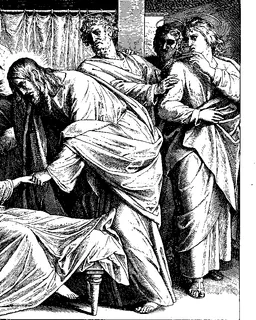
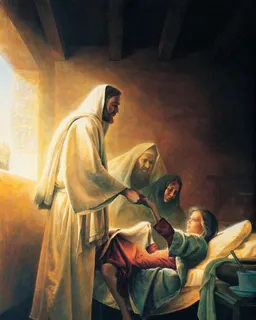
What happens next, Mark records with extraordinary care - he keeps the very sounds Jesus made. He took the damsel by the hand, and said unto her, Talitha cumi; which is, being interpreted, Damsel, I say unto thee, arise (v. 41). First the hand: Jesus takes hold of a dead child, the ultimate uncleanness under the law, and instead of defilement passing to Him, life passes to her. Then the words - Talitha cumi - preserved in the everyday language Jesus actually spoke, a tender phrase a parent might use to wake a sleeping child in the morning: little girl, get up. There is no incantation, no struggle, no long prayer; just a hand and a quiet word, the kind of word that fits His own naming of death as sleep.
And straightway the damsel arose, and walked; for she was of the age of twelve years. And they were astonished with a great astonishment (v. 42). She does not merely stir; she rises and walks, fully alive, fully restored. And then two final touches that are pure Jesus. He charged them straitly that no man should know it (v. 43) - the miracle is not for spectacle. And He commanded that something should be given her to eat: the same authority that conquered death now thinks of a child's hunger.
The God who raises the dead also remembers that a twelve-year-old needs her supper.
Research trail
Sources & further study
These references support the historical, linguistic, manuscript, and contextual notes in this chapter. Scripture remains the primary text; external sources are provided so readers can inspect the research directly.
- Mark 5 - Translators' NotesThe NET Bible's detailed footnotes on Mark 5 - the place names and textual variants in verses 1-2, the size of the herd in verse 13, the “press” or crowd thronging Jesus in verses 24-31, and the Aramaic words preserved in verse 41.
- Mark 5 · Greek interlinear + lexiconThe Greek text of Mark 5 word by word with parsing and lexicon links - useful for legeon (v. 9, the “Legion” that names the many spirits), for the verbs of healing and being “made whole” in verses 28 and 34, and for the report in verse 30 that virtue (Greek dynamis, power) had gone out of Him.
- Mark 5 ↔ Luke 8 · Matthew 8 & 9 · John 11Traces the threads tying Mark 5 to the rest of Scripture - the same three scenes in Luke 8 and Matthew 8-9, the binding of the strong man (Mark 3:27; Luke 11:21-22), and death named as sleep here (v. 39) read beside Our friend Lazarus sleepeth (John 11:11).
Where this echoes in Scripture
No Man Could Bind Him
- Mark 3:27no man can enter into a strong man's house... except he will first bind the strong man; and then he will spoil his house.The binding of the strong man made visible - One stronger empties the house the spirits had ruined (vv. 1-13).
- Luke 11:21-22when a stronger than he shall come upon him, and overcome him, he taketh from him all his armour wherein he trusted.The Stronger One who overcomes the strong man and frees his captives, as Jesus frees the man among the tombs.
- Luke 4:18he hath sent me... to preach deliverance to the captives... to set at liberty them that are bruised.The mission Jesus claimed for Himself, enacted on the most bound man in the region (vv. 1-13).
- Luke 8:26-33they arrived at the country of the Gadarenes... there met him out of the city a certain man, which had devils long time.The same scene told by Luke - the man among the tombs and the legion sent into the swine.
- James 2:19thou believest that there is one God; thou doest well: the devils also believe, and tremble.The unwilling recognition of verse 7 - the spirits know exactly who Jesus is, and tremble.
Go Home, and Tell Them
- Mark 16:15Go ye into all the world, and preach the gospel to every creature.The sending of verse 19 in full - the rescued life turned outward to tell what the Lord has done.
- John 9:25one thing I know, that, whereas I was blind, now I see.The witness Jesus gives the freed man - the plain, unanswerable report of what was done in him (v. 20).
- Psalm 66:16Come and hear, all ye that fear God, and I will declare what he hath done for my soul.The pattern of verse 19 - mercy received becomes mercy proclaimed to all who will hear.
- Luke 8:38-39Return to thine own house, and shew how great things God hath done unto thee.Luke's telling of the same commission - the freed man sent home to publish what God had done.
- Mark 7:31departing from the coasts of Tyre and Sidon, he came unto the sea of Galilee, through the midst of the coasts of Decapolis.Jesus later returns to the Decapolis - the very region the freed man had been publishing in (v. 20).
If I May Touch But His Clothes
- Mark 10:52Go thy way; thy faith hath made thee whole. And immediately he received his sight.The same blessing as verse 34 - faith that lays hold of Christ, and is made whole.
- Matthew 9:20-22touched the hem of his garment... Daughter, be of good comfort; thy faith hath made thee whole.The same scene in Matthew - the reaching touch and the word that credits her faith (vv. 27-34).
- Luke 6:19the whole multitude sought to touch him: for there went virtue out of him, and healed them all.The power that went forth from Jesus in verse 30 - the same word, healing all who reached for Him.
- Leviticus 15:25-27if a woman have an issue of her blood many days... she shall be unclean.The law that left the woman of verse 25 cut off - the twelve-year separation her touch reaches past.
- Hebrews 4:16Let us therefore come boldly unto the throne of grace, that we may obtain mercy.The reaching trust of verses 27-28 - the encouragement to come to Christ in need and find help.
Be Not Afraid, Only Believe
- John 11:11-14Our friend Lazarus sleepeth; but I go, that I may awake him out of sleep... Lazarus is dead.Jesus naming death a sleep again (v. 39) - the One who wakes the dead at His word.
- John 11:25I am the resurrection, and the life: he that believeth in me, though he were dead, yet shall he live.The authority behind Talitha cumi (v. 41) - the Lord who is Himself the resurrection.
- John 5:28-29all that are in the graves shall hear his voice, and shall come forth.The raising of one child (v. 42) as a sign of the morning when His voice will wake every grave.
- Luke 8:49-55Fear not: believe only, and she shall be made whole... and her spirit came again, and she arose straightway.Luke's telling of the same raising - believe only, and the child rises (vv. 35-42).
- 1 Thessalonians 4:14them also which sleep in Jesus will God bring with him.Death as sleep for the believer (v. 39) - the hope grounded in the Lord who raises the dead.