Mark 10
People in this chapter
Mark 10 unfolds on the road up to Jerusalem, in the long shadow of the cross. Jesus has already told His disciples twice that He must suffer and die, and a third telling is coming in this very chapter. Everything here is colored by that destination. He arrives in the region beyond Jordan, the crowds gather as they always do, and as he was wont, he taught them again (v. 1). At once the Pharisees come tempting him with a question designed to trap: Is it lawful for a man to put away his wife? (v. 2).
Jesus will not be drawn into their legal wrangling. He answers by going behind Moses' concession to the first design of the Maker - from the beginning of the creation God made them male and female (v. 6) - and shows marriage to be the joining hand of God, grounded in the act of the Creator Himself.1
Tap any highlighted phrase to jump to the commentary that unpacks it.

Mark 10:1-12What Therefore God Hath Joined Together
1And he arose from thence, and cometh into the coasts of Judaea by the farther side of Jordan: and the people resort unto him again; and, as he was wont, he taught them again. 2And the Pharisees came to him, and asked him, Is it lawful for a man to put away his wife? tempting him. 3And he answered and said unto them, What did Moses command you? 4And they said, Moses suffered to write a bill of divorcement, and to put her away. 5And Jesus answered and said unto them, For the hardness of your heart he wrote you this precept. 6But from the beginning of the creation God made them male and female. 7For this cause shall a man leave his father and mother, and cleave to his wife; 8And they twain shall be one flesh: so then they are no more twain, but one flesh. 9What therefore God hath joined together, let not man put asunder. 10And in the house his disciples asked him again of the same matter. 11And he saith unto them, Whosoever shall put away his wife, and marry another, committeth adultery against her. 12And if a woman shall put away her husband, and be married to another, she committeth adultery.
The Pharisees do not come to learn; they come tempting him (v. 2), hoping to catch Jesus in a controversy that had divided the rabbis of His day. Is it lawful for a man to put away his wife? Jesus answers a question with a question: What did Moses command you? (v. 3). They cite the provision of Deuteronomy - Moses suffered to write a bill of divorcement, and to put her away (v. 4). And here Jesus draws a distinction that matters enormously.
That provision, He says, was not the design but the concession: For the hardness of your heart he wrote you this precept (v. 5). The word translated hardness pictures a heart grown calloused and unyielding. Moses regulated divorce the way a wise physician treats a wound that is already there - not because the wound is good, but because hardened hearts were already breaking covenants, and the vulnerable, especially the woman cast out, needed some protection.
The legal permission was a mercy granted to a fallen situation, never God's first word on marriage. So Jesus refuses to argue at the level of permissions. He moves the whole conversation back to the beginning, to what marriage was made to be before any heart had hardened.1
Jesus grounds marriage not in a statute that can be amended but in the act of the Creator Himself: from the beginning of the creation God made them male and female (v. 6). He is quoting the opening pages of Scripture - the making of humanity as male and female, and the word spoken over the first union: For this cause shall a man leave his father and mother, and cleave to his wife; and they twain shall be one flesh (vv. 7-8).
Notice the weight He puts on that last phrase. The two become one flesh - not merely two people sharing a household, not a contract two parties enter and dissolve at will, but a genuine joining into a single life. So then they are no more twain, but one flesh. Then comes the decisive word, and it names God as the active agent: What therefore God hath joined together, let not man put asunder (v. 9).
Marriage, in Jesus' teaching here, is not finally the work of the couple, the rabbi, or the state; it is something God joins. That is why it carries such weight. To tear apart what God has joined is to set human hands against the design of the One who made man and woman for each other from the beginning. The seriousness Jesus presses is not a heavy rule laid on the wounded; it is reverence for the holy thing marriage is.
Away from the crowd, in the house, the disciples press Jesus privately on the same matter (v. 10), and His answer to them is sobering and plain: Whosoever shall put away his wife, and marry another, committeth adultery against her. And if a woman shall put away her husband, and be married to another, she committeth adultery (vv. 11-12). Two things in these words would have startled His first hearers. First, He treats the marriage bond as so real that breaking it and remarrying is not a clean fresh start but a violation of the first union.
Second - and this was almost unheard of in that world - He speaks of the offense as committed against her, against the wife, and He holds husband and wife to the very same standard. In a culture where a man could discard a wife with relative ease and bore little reckoning for it, Jesus restores the woman's full dignity and binds the man to the same faithfulness he expected of her. This is the protective seriousness of the One who made marriage, guarding the weaker party and honoring the covenant.
The wounds of broken homes are real, and Jesus is never harsh with the brokenhearted; but He will not pretend the covenant is trivial, because He knows what it was made to be.
Mark 10:13-16Suffer the Little Children to Come unto Me
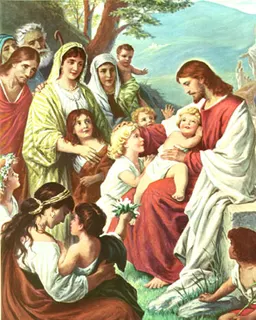
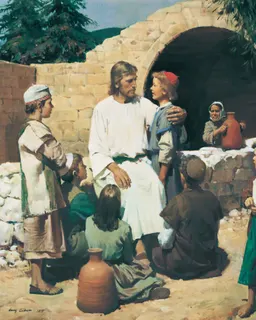
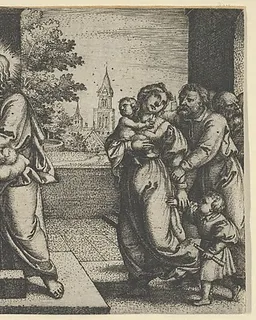
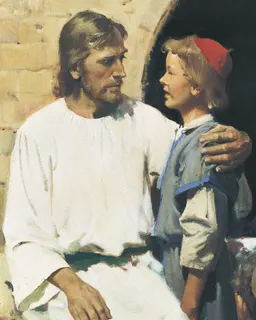
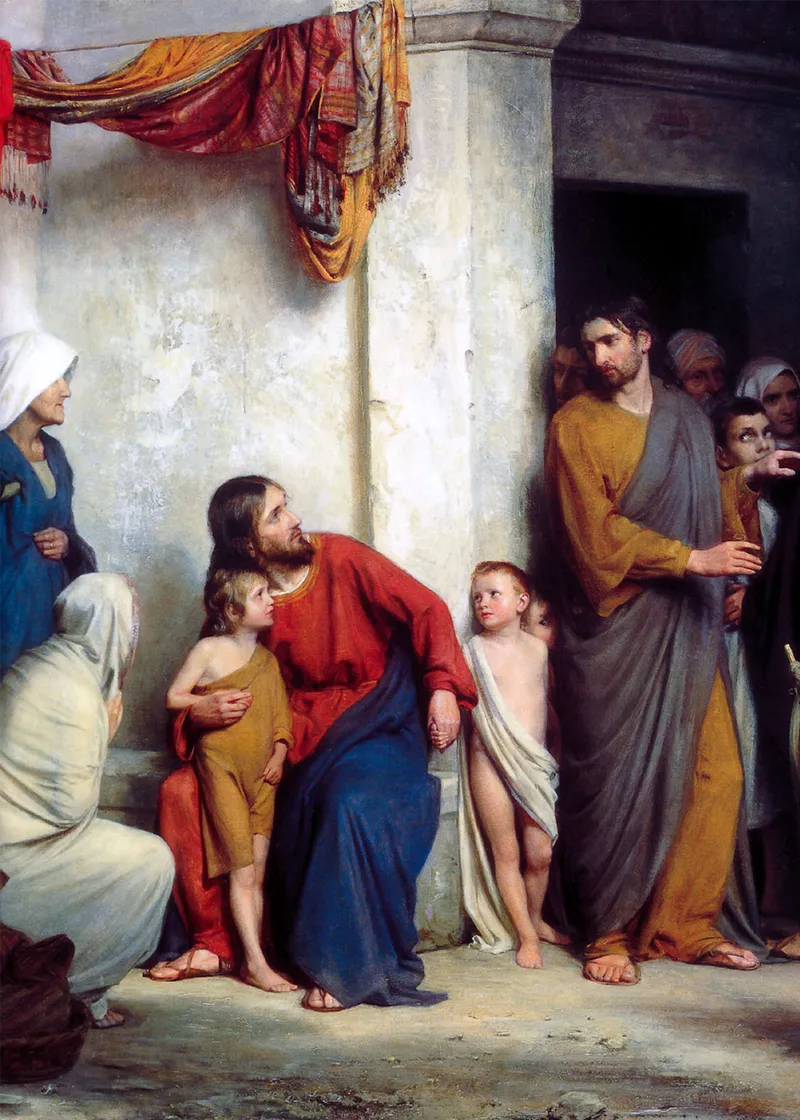
13And they brought young children to him, that he should touch them: and his disciples rebuked those that brought them. 14But when Jesus saw it, he was much displeased, and said unto them, Suffer the little children to come unto me, and forbid them not: for of such is the kingdom of God. 15Verily I say unto you, Whosoever shall not receive the kingdom of God as a little child, he shall not enter therein. 16And he took them up in his arms, put his hands upon them, and blessed them.
Parents bring their young children to Jesus simply that He might touch them (v. 13) - that He might lay a hand on them and bless them. The disciples, no doubt thinking they are protecting their Master's time and dignity, rebuked those that brought them. In their eyes children are an interruption, small and unimportant, not worth the Teacher's attention. Mark records Jesus' reaction with unusual force: when Jesus saw it, he was much displeased (v. 14).
The verb is strong - He was indignant, genuinely upset. Of all the things that provoke Jesus to open displeasure in the Gospels, this is one: His own disciples turning away the little ones who were being brought to Him. His correction is immediate and warm: Suffer the little children to come unto me, and forbid them not. Let them come; do not block the way. The very people the disciples judged too insignificant to bother Him are the people He most wants near.
It is a quiet rebuke of every instinct that measures worth by size, usefulness, or status - and a window into a heart that gathers in exactly those the world waves aside.
Then Jesus turns the children from an interruption into the very lesson: of such is the kingdom of God (v. 14), and Whosoever shall not receive the kingdom of God as a little child, he shall not enter therein (v. 15). This is one of the most piercing things He ever says about how a person comes into the kingdom. Consider what a little child is in this scene. A child brought to be blessed brings nothing - no accomplishments, no wealth, no standing, no bargaining power.
A child simply receives. He cannot earn the blessing or repay it; he can only be lifted up and held. That, Jesus says, is exactly how the kingdom of God must be received - received with empty, open hands, as a gift - something the strong cannot seize, the rich cannot purchase, and the accomplished cannot achieve. The picture lands with deliberate weight right before the next scene, where a rich man with full hands will go away grieved.
The child with nothing receives everything; the man with everything cannot receive the one thing. To enter the kingdom, Jesus says, you must come the way a child comes - small, dependent, with nothing in your hands but the willingness to be given to.
The scene ends with one of the tenderest gestures in the Gospels: And he took them up in his arms, put his hands upon them, and blessed them (v. 16). Jesus gathers them up in his arms, giving them more than the touch their parents had asked for. He gives them more than the touch their parents had asked for - He embraces them and blesses them, one by one. There is a whole theology in the gesture.
The kingdom Jesus has just described as something received like a child is, in the same breath, pictured as a child being lifted into the Master's arms. We are taken up into the blessing, lifted by arms that reach down to us. The same arms that here gather small children will soon be stretched out on a cross for the world, and the willingness to embrace the least and lowest is of one piece with the whole shape of His coming.
He is not too important for the small. He is precisely the One who lifts them up.
Mark 10:17-31One Thing Thou Lackest · With God All Things Are Possible
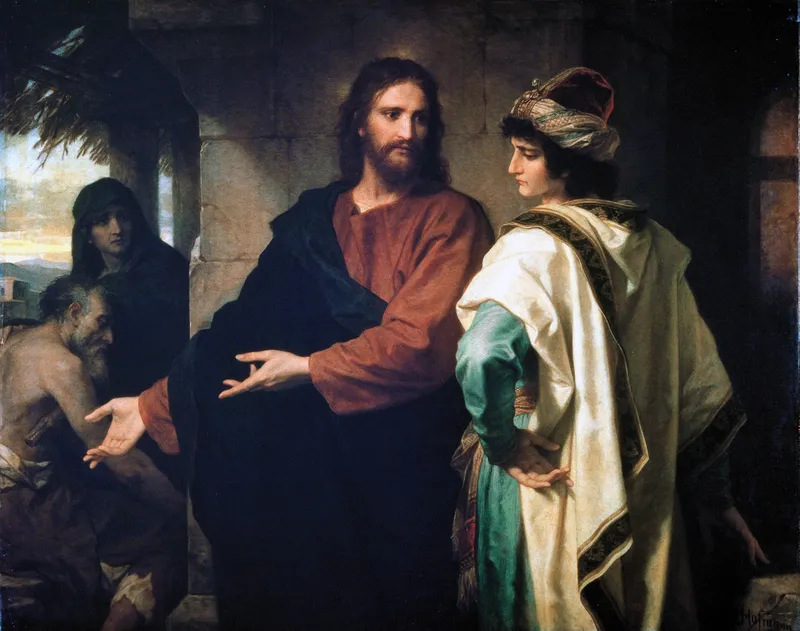
17And when he was gone forth into the way, there came one running, and kneeled to him, and asked him, Good Master, what shall I do that I may inherit eternal life? 18And Jesus said unto him, Why callest thou me good? there is none good but one, that is, God. 19Thou knowest the commandments, Do not commit adultery, Do not kill, Do not steal, Do not bear false witness, Defraud not, Honour thy father and mother. 20And he answered and said unto him, Master, all these have I observed from my youth. 21Then Jesus beholding him loved him, and said unto him, One thing thou lackest: go thy way, sell whatsoever thou hast, and give to the poor, and thou shalt have treasure in heaven: and come, take up the cross, and follow me. 22And he was sad at that saying, and went away grieved: for he had great possessions. 23And Jesus looked round about, and saith unto his disciples, How hardly shall they that have riches enter into the kingdom of God! 24And the disciples were astonished at his words. But Jesus answereth again, and saith unto them, Children, how hard is it for them that trust in riches to enter into the kingdom of God! 25It is easier for a camel to go through the eye of a needle, than for a rich man to enter into the kingdom of God. 26And they were astonished out of measure, saying among themselves, Who then can be saved? 27And Jesus looking upon them saith, With men it is impossible, but not with God: for with God all things are possible. 28Then Peter began to say unto him, Lo, we have left all, and have followed thee. 29And Jesus answered and said, Verily I say unto you, There is no man that hath left house, or brethren, or sisters, or father, or mother, or wife, or children, or lands, for my sake, and the gospel’s, 30But he shall receive an hundredfold now in this time, houses, and brethren, and sisters, and mothers, and children, and lands, with persecutions; and in the world to come eternal life. 31But many that are first shall be last; and the last first.
A man comes running, kneels in the road, and asks with evident earnestness: Good Master, what shall I do that I may inherit eternal life? (v. 17). Everything about his approach is admirable - the haste, the kneeling, the hunger for eternal life. Jesus' first reply is unexpected, and it has puzzled readers ever since: Why callest thou me good? there is none good but one, that is, God (v. 18). It is best to let this question stand exactly as Jesus asks it, without rushing to resolve it.
Jesus is not denying that He is good; He is taking the word the man tossed out lightly - Good Master, perhaps a mere flattering courtesy - and pressing him to weigh what he has just said. Do you know what you are saying when you call me good? Goodness in its fullness belongs to God alone. Are you prepared to follow that word where it leads? Far from a denial, it is an invitation to think harder about the One kneeling before him.
The man wants to know what good thing he must do; Jesus turns the spotlight first onto the question of who is truly good, and onto the identity of the One he is addressing. The whole encounter that follows will test whether the man means what his greeting implied.1
Jesus points the man to the commandments - Do not commit adultery, Do not kill, Do not steal… Honour thy father and mother (v. 19) - and the man answers, surely sincerely, Master, all these have I observed from my youth (v. 20). What happens next is the heart of the scene, and Mark alone records the look on Jesus' face: Then Jesus beholding him loved him (v. 21). This is no cold test. Jesus looks at this eager, moral, searching man and loves him - and it is precisely out of love that He names the one thing standing between him and the life he says he wants: One thing thou lackest: go thy way, sell whatsoever thou hast, and give to the poor, and thou shalt have treasure in heaven: and come, take up the cross, and follow me. Notice that the call is not finally about poverty for its own sake; the goal is follow me. The man's wealth has become the thing he cannot let go of, the rival that holds the throne of his heart, and so Jesus puts His finger on exactly that.
And he was sad at that saying, and went away grieved: for he had great possessions (v. 22). It is one of the saddest verses in the Gospels. He came running; he goes away grieving. He kept every commandment but could not surrender the one possession that possessed him. And note what Jesus did not do: He did not chase him down and soften the terms. Love sometimes tells the truth and then lets a person walk away to weigh it.
As the man leaves, Jesus turns to His disciples with a sobering observation: How hardly shall they that have riches enter into the kingdom of God! (v. 23). They are astonished, so He says it again, even more pointedly: Children, how hard is it for them that trust in riches to enter into the kingdom of God! (v. 24). The added phrase is illuminating - the danger is not money itself but trust in money, the way wealth quietly persuades a heart to lean on it instead of on God.
Then comes the famous, deliberately startling image: It is easier for a camel to go through the eye of a needle, than for a rich man to enter into the kingdom of God (v. 25). The largest animal His hearers knew, set against the smallest opening they could picture - it is meant to sound impossible, and the disciples hear it exactly that way: they were astonished out of measure, saying among themselves, Who then can be saved? (v. 26).
Their question is the right one, and it reaches further than wealth. If even the advantaged and the upright can be shut out, then no one's own resources are enough. The whole episode has been quietly demolishing the assumption that prosperity is a sign of God's favor and a head start into the kingdom. It turns out that nobody walks in on their own strength - which is exactly the ground Jesus is clearing for His next word.
To the disciples' despairing question - Who then can be saved? - Jesus gives the answer the whole scene has been driving toward: With men it is impossible, but not with God: for with God all things are possible (v. 27). He lifts the eyes. Salvation is indeed impossible - for men, by their own effort, wealth, or merit. But what is impossible for human strength is not impossible for God. The thing no one can do for himself, God can do.
Then Peter, perhaps anxious after watching the rich man walk away, blurts out the contrast: Lo, we have left all, and have followed thee (v. 28). Where the rich man would not, the disciples have. And Jesus meets their leaving with an extravagant promise: there is no one who has left house, or brethren, or sisters, or father, or mother, or wife, or children, or lands for His sake and the gospel's who will not receive an hundredfold now in this time - a new and vast family in the household of God - and in the world to come eternal life (vv. 29-30).
But He adds two words that keep the promise honest: with persecutions. The hundredfold is real, but it is not a life of ease; the road still runs to a cross. And He seals it with the kingdom's great reversal: many that are first shall be last; and the last first (v. 31). The grieving rich man, first by every worldly measure, has just made himself last; the disciples who left everything, last in the world's eyes, are being made first.
Mark 10:32-45To Give His Life a Ransom for Many
32And they were in the way going up to Jerusalem; and Jesus went before them: and they were amazed; and as they followed, they were afraid. And he took again the twelve, and began to tell them what things should happen unto him, 33Saying, Behold, we go up to Jerusalem; and the Son of man shall be delivered unto the chief priests, and unto the scribes; and they shall condemn him to death, and shall deliver him to the Gentiles: 34And they shall mock him, and shall scourge him, and shall spit upon him, and shall kill him: and the third day he shall rise again. 35And James and John, the sons of Zebedee, come unto him, saying, Master, we would that thou shouldest do for us whatsoever we shall desire. 36And he said unto them, What would ye that I should do for you? 37They said unto him, Grant unto us that we may sit, one on thy right hand, and the other on thy left hand, in thy glory. 38But Jesus said unto them, Ye know not what ye ask: can ye drink of the cup that I drink of? and be baptized with the baptism that I am baptized with? 39And they said unto him, We can. And Jesus said unto them, Ye shall indeed drink of the cup that I drink of; and with the baptism that I am baptized withal shall ye be baptized: 40But to sit on my right hand and on my left hand is not mine to give; but it shall be given to them for whom it is prepared. 41And when the ten heard it, they began to be much displeased with James and John. 42But Jesus called them to him, and saith unto them, Ye know that they which are accounted to rule over the Gentiles exercise lordship over them; and their great ones exercise authority upon them. 43But so shall it not be among you: but whosoever will be great among you, shall be your minister: 44And whosoever of you will be the chiefest, shall be servant of all. 45For even the Son of man came not to be ministered unto, but to minister, and to give his life a ransom for many.
Mark paints the mood of the road in a single haunting line: they were in the way going up to Jerusalem; and Jesus went before them: and they were amazed; and as they followed, they were afraid (v. 32). Jesus walks ahead, set and resolute, toward the city where He has said He will die; the disciples trail behind, gripped by amazement and dread. They sense that something terrible and final is approaching. And there, on that road, Jesus tells them a third time, now in unsparing detail, exactly what awaits: the Son of man shall be delivered unto the chief priests, and unto the scribes; and they shall condemn him to death, and shall deliver him to the Gentiles: and they shall mock him, and shall scourge him, and shall spit upon him, and shall kill him (vv. 33-34).
Every clause will come true to the letter in the chapters ahead. But the sentence does not end in the grave. He adds the words that change everything: and the third day he shall rise again. He is not being swept helplessly toward catastrophe. He is walking, eyes open, into a death He has chosen and a resurrection He foresees. The One out in front, leading the frightened band toward Jerusalem, knows the whole arc - the mocking, the scourging, the killing, and the rising.
What follows is almost unbearable in its timing. Jesus has just described being mocked, scourged, and killed - and James and John… come unto him with a request for the two best seats in the kingdom: Grant unto us that we may sit, one on thy right hand, and the other on thy left hand, in thy glory (vv. 35-37). They want the positions of highest honor and power; they have heard “glory” and skipped straight past the cross.
Jesus does not crush them, but He does correct them: Ye know not what ye ask: can ye drink of the cup that I drink of? and be baptized with the baptism that I am baptized with? (v. 38). The cup in Scripture is often the cup of suffering, the portion appointed to be drunk to the dregs - it is the very word Jesus will use in Gethsemane, praying let this cup pass from me. The baptism is His being plunged into death.
He is asking: do you grasp that the road to that glory runs straight through suffering? They answer, with more confidence than understanding, We can (v. 39). And Jesus, with sober grace, tells them they will indeed share His cup - both would suffer for His name, James to the point of martyrdom - yet the assigning of those seats is not His to hand out as a favor; it shall be given to them for whom it is prepared (v. 40).
The honor they crave is real, but it is not seized by request; it is granted by the Father, and it lies on the far side of the cup.
When the other ten hear of the request, they are much displeased with James and John (v. 41) - though their indignation likely owes more to rivalry than to humility; they wanted those seats too. So Jesus gathers them all and overturns the very idea of greatness they have absorbed from the world: Ye know that they which are accounted to rule over the Gentiles exercise lordship over them; and their great ones exercise authority upon them. But so shall it not be among you (vv. 42-43).
In the world's order, greatness means power over others - lordship, command, the ability to make people serve you. Jesus declares that in His community the arrow is reversed: whosoever will be great among you, shall be your minister; and whosoever of you will be the chiefest, shall be servant of all (vv. 43-44). Greatness is measured by how many you serve. The one who would be first must become the slave of all.
This is not a quaint moral; it is a complete inversion of how status works, and it strikes directly at the ambition the disciples have just displayed. The throne they keep angling for is real - but the way up to it, in Jesus' kingdom, leads down, to the towel and the basin, to the place of the servant.
Mark 10:46-52Jesus, Thou Son of David, Have Mercy on Me
46And they came to Jericho: and as he went out of Jericho with his disciples and a great number of people, blind Bartimaeus, the son of Timaeus, sat by the highway side begging. 47And when he heard that it was Jesus of Nazareth, he began to cry out, and say, Jesus, thou son of David, have mercy on me. 48And many charged him that he should hold his peace: but he cried the more a great deal, Thou son of David, have mercy on me. 49And Jesus stood still, and commanded him to be called. And they call the blind man, saying unto him, Be of good comfort, rise; he calleth thee. 50And he, casting away his garment, rose, and came to Jesus. 51And Jesus answered and said unto him, What wilt thou that I should do unto thee? The blind man said unto him, Lord, that I might receive my sight. 52And Jesus said unto him, Go thy way; thy faith hath made thee whole. And immediately he received his sight, and followed Jesus in the way.
The chapter closes with a scene that quietly answers everything before it. As Jesus leaves Jericho with a great crowd, a blind beggar sits by the roadside - blind Bartimaeus, the son of Timaeus… sat by the highway side begging (v. 46). He has nothing the world prizes: no sight, no wealth, no status, no seat of honor. He is the opposite of the rich man and the opposite of the ambitious disciples - a man with empty hands and a place at the very bottom.
But when he hears that Jesus of Nazareth is passing, he does the one thing he can do: he cries out, and the title he reaches for is no accident. Jesus, thou Son of David, have mercy on me (v. 47). Son of David is the royal, messianic title - the name of the promised King. A blind beggar by the road sees, with the eyes of faith, what the religious leaders missed and what the rich man and the disciples kept stumbling over: that this passing teacher is the Messiah, the King of David's line.
He cannot see Jesus' face, but he perceives His identity. And he asks for the one thing the chapter has insisted no one can earn or buy - mercy.
The crowd tries to silence him - many charged him that he should hold his peace (v. 48) - just as the disciples had tried to turn away the children. The lowly are once again treated as an interruption to be managed. But Bartimaeus will not be hushed: he cried the more a great deal, Thou Son of David, have mercy on me. His desperation outlasts their disapproval. And the King going up to Jerusalem to die - with all the weight of the cross before Him - stood still (v. 49).
He stops the whole procession for one blind beggar. He commanded him to be called, and the crowd's tone instantly turns: Be of good comfort, rise; he calleth thee. Bartimaeus' response is full of urgency and abandon: casting away his garment, rose, and came to Jesus (v. 50). The beggar's cloak was likely his most valuable possession, perhaps the very thing he spread to collect alms - and he flings it aside to come.
Where the rich man could not let go of his possessions to follow, this man casts away his one possession to come running. Then Jesus asks the same question He had put to James and John just verses earlier - What wilt thou that I should do unto thee? (v. 51; compare v. 36). They had asked for thrones; Bartimaeus asks for the thing he most needs and cannot give himself: Lord, that I might receive my sight.
Jesus' answer joins the man's healing to his faith: Go thy way; thy faith hath made thee whole (v. 52). The same desperate, persistent trust that cried out over the crowd's rebuke is the faith Jesus honors. He says thy faith hath made thee whole - lifting up the empty-handed reaching that simply would not stop calling on Him. And then the closing line of the whole chapter, every word of it weighted: And immediately he received his sight, and followed Jesus in the way. The man who had been sitting still in darkness by the roadside is now seeing and moving - and the direction he moves is the decisive thing.
He followed Jesus in the way - and “the way” in this chapter is the road up to Jerusalem, the road to the cross. He does not take his new sight and walk off to his own life; the first thing he sees is Jesus, and the first thing he does with his sight is follow Him toward suffering and glory. He is the picture the whole chapter has been building toward: not the rich man who went away grieving, not the disciples grasping for seats, but a beggar who cried for mercy, received it freely, and followed the Servant-King down the road He was walking.
Research trail
Sources & further study
These references support the historical, linguistic, manuscript, and contextual notes in this chapter. Scripture remains the primary text; external sources are provided so readers can inspect the research directly.
- Mark 10 - Translators' NotesThe NET Bible's detailed footnotes on Mark 10 - the divorce question and Moses' bill of divorcement (vv. 2-9), the proverb of the camel and the needle's eye (v. 25), the much-discussed phrase “Why callest thou me good?” (v. 18), and the meaning of ransom for many in verse 45.
- Mark 10 · Greek interlinear + lexiconThe Greek text of Mark 10 word by word, each term keyed to Strong's and a parsing guide - useful for lutron (v. 45, the “ransom” price paid to free captives), diakoneo / diakonos (vv. 43-45, “minister” and “servant”), and agathos (v. 18, the “good” of “Why callest thou me good?”).
- Mark 10 ↔ Genesis 2 · Isaiah 53 · 1 Timothy 2 · 1 Peter 1Traces the threads tying Mark 10 to the rest of Scripture - the one-flesh design (vv. 6-8) drawn straight from Genesis 1:27 and 2:24, and the ransom saying (v. 45) read alongside the Servant who poured out his soul unto death (Isa. 53:12), who gave himself a ransom for all (1 Tim. 2:6), and the redemption purchased with the precious blood of Christ (1 Pet. 1:18-19).
Where this echoes in Scripture
What Therefore God Hath Joined Together
- Genesis 2:24Therefore shall a man leave his father and his mother, and shall cleave unto his wife: and they shall be one flesh.The word from the beginning that Jesus quotes in verses 7-8 - the original design of marriage.
- Genesis 1:27So God created man in his own image, in the image of God created he him; male and female created he them.The making of humanity male and female that Jesus appeals to in verse 6.
- Malachi 2:16For the LORD, the God of Israel, saith that he hateth putting away.The same reverence for the marriage covenant that Jesus presses against Moses' concession (vv. 5-9).
- Ephesians 5:31-32they two shall be one flesh. This is a great mystery: but I speak concerning Christ and the church.The one-flesh joining of verse 8 read as a living picture of Christ and His people.
- Matthew 19:4-6Have ye not read, that he which made them at the beginning made them male and female... What therefore God hath joined together, let not man put asunder.The same teaching as verses 6-9 - marriage grounded in the Creator's own act from the beginning.
Suffer the Little Children to Come unto Me
- Matthew 18:3Except ye be converted, and become as little children, ye shall not enter into the kingdom of heaven.The same condition as verse 15 - the kingdom entered only by those who become like children.
- Isaiah 40:11He shall feed his flock like a shepherd: he shall gather the lambs with his arm, and carry them in his bosom.The Shepherd's embrace pictured in verse 16 - the lambs gathered up in his arms.
- Ephesians 2:8-9For by grace are ye saved through faith; and that not of yourselves: it is the gift of God: not of works.The empty-handed receiving of verse 15 - salvation given freely as a gift.
- Matthew 11:25thou hast hid these things from the wise and prudent, and hast revealed them unto babes.The reversal of verses 14-15 - the kingdom opened to the childlike, hidden from the self-sufficient.
- Psalm 131:2Surely I have behaved and quieted myself, as a child that is weaned of his mother: my soul is even as a weaned child.The childlike trust Jesus commends in verse 15 - a soul quieted and dependent before God.
One Thing Thou Lackest · With God All Things Are Possible
- Luke 18:18-27Why callest thou me good? none is good, save one, that is, God... The things which are impossible with men are possible with God.The same encounter as verses 17-27 - the rich ruler, the one lack, and the God of the impossible.
- 1 Timothy 6:9-10they that will be rich fall into temptation and a snare... the love of money is the root of all evil.The danger Jesus names in verse 24 - the heart that trusts in riches rather than in God.
- Genesis 18:14Is any thing too hard for the LORD?The same truth as verse 27 - what is impossible with men is possible with God.
- Philippians 3:7-8But what things were gain to me, those I counted loss for Christ... that I may win Christ.The trade the rich man refused (vv. 21-22) - counting all gain as loss to gain Christ.
- Matthew 6:19-21Lay up for yourselves treasures in heaven... For where your treasure is, there will your heart be also.The treasure in heaven Jesus offers in verse 21 - set against the possessions that held the man's heart.
To Give His Life a Ransom for Many
- Isaiah 53:5-6he was wounded for our transgressions... and the LORD hath laid on him the iniquity of us all.The Servant whose death is the ransom of verse 45 - bearing the iniquity of the many.
- 1 Timothy 2:6Who gave himself a ransom for all, to be testified in due time.The ransom of verse 45 named again - the gift given for all, received by the many who come.
- 1 Peter 1:18-19ye were not redeemed with corruptible things, as silver and gold... but with the precious blood of Christ.The ransom price of verse 45 - not silver or gold, but the blood of the spotless Lamb.
- Philippians 2:5-8took upon him the form of a servant... he humbled himself, and became obedient unto death.The downward way of verses 43-45 - the One who served and gave His life.
- John 13:14-15If I then, your Lord and Master, have washed your feet; ye also ought to wash one another's feet.The servanthood Jesus commands and embodies in verses 43-45 - greatness as service.
Jesus, Thou Son of David, Have Mercy on Me
- Isaiah 35:5-6Then the eyes of the blind shall be opened, and the ears of the deaf shall be unstopped.The messianic sign Bartimaeus receives in verse 52 - the Son of David opening blind eyes.
- Psalm 34:6This poor man cried, and the LORD heard him, and saved him out of all his troubles.The pattern of verses 47-52 - the lowly cry that the Lord hears and answers.
- Luke 18:35-43And he cried, saying, Jesus, thou Son of David, have mercy on me... Thy faith hath saved thee.The same healing as verses 46-52 - the blind man's persistent cry and the sight restored by faith.
- Hebrews 12:1-2let us run with patience the race that is set before us, looking unto Jesus the author and finisher of our faith.The following of verse 52 - new sight given so that we follow Jesus in the way He walks.
- Romans 10:13For whosoever shall call upon the name of the Lord shall be saved.The cry for mercy of verse 47 - the calling on the Lord that is heard and answered.