Genesis 16
People in this chapter
Genesis 16 says Abram has lived ten years in Canaan. Sarai remains barren and gives Hagar, her Egyptian enslaved servant, to Abram as a wife. Hagar conceives; conflict and harsh treatment follow, and she flees into the wilderness.
Tap any highlighted phrase to jump to the commentary that unpacks it.
Genesis 16:1-6Harm in Abram's Household
1Now Sarai Abram’s wife bare him no children: and she had an handmaid, an Egyptian, whose name was Hagar. 2And Sarai said unto Abram, Behold now, the LORD hath restrained me from bearing: I pray thee, go in unto my maid; it may be that I may obtain children by her. And Abram hearkened to the voice of Sarai. 3And Sarai Abram’s wife took Hagar her maid the Egyptian, after Abram had dwelt ten years in the land of Canaan, and gave her to her husband Abram to be his wife. 4And he went in unto Hagar, and she conceived: and when she saw that she had conceived, her mistress was despised in her eyes. 5And Sarai said unto Abram, My wrong be upon thee: I have given my maid into thy bosom; and when she saw that she had conceived, I was despised in her eyes: the LORD judge between me and thee. 6But Abram said unto Sarai, Behold, thy maid is in thy hand; do to her as it pleaseth thee. And when Sarai dealt hardly with her, she fled from her face.
After ten years in Canaan, Sarai gives Hagar, her Egyptian enslaved servant, to Abram. Hagar conceives, conflict follows, and Sarai deals harshly with her. Hagar flees. The chapter does not narrate Hagar's consent or explain the harm.
Genesis 16:7-12The Messenger Finds Hagar
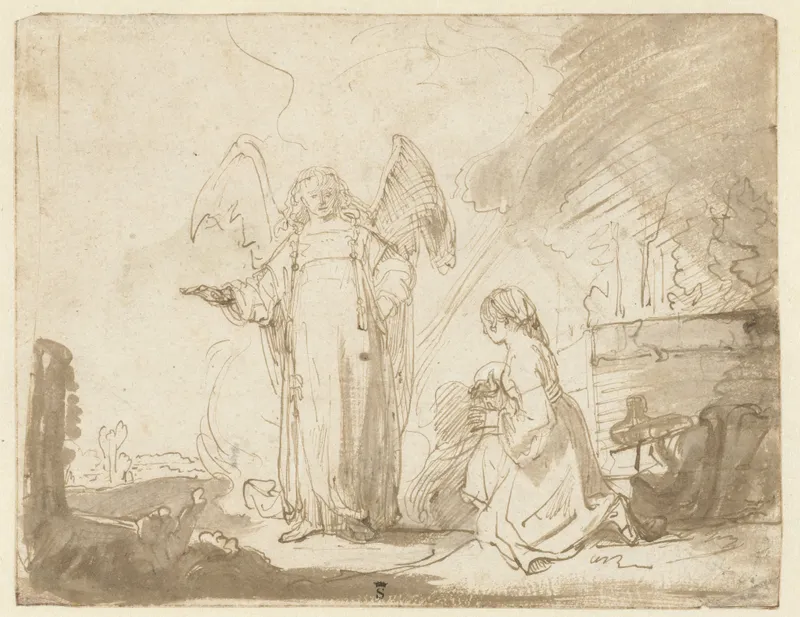
7And the angel of the LORD found her by a fountain of water in the wilderness, by the fountain in the way to Shur. 8And he said, Hagar, Sarai’s maid, whence camest thou? and whither wilt thou go? And she said, I flee from the face of my mistress Sarai. 9And the angel of the LORD said unto her, Return to thy mistress, and submit thyself under her hands. 10And the angel of the LORD said unto her, I will multiply thy seed exceedingly, that it shall not be numbered for multitude. 11And the angel of the LORD said unto her, Behold, thou art with child, and shalt bear a son, and shalt call his name Ishmael; because the LORD hath heard thy affliction. 12And he will be a wild man; his hand will be against every man, and every man’s hand against him; and he shall dwell in the presence of all his brethren.
The angel of the LORD finds Hagar and hears that she is fleeing Sarai. He tells her to return, promises many descendants, and names her son Ishmael because the LORD has heard her affliction. The text does not report Hagar's safety; this is not advice for someone facing abuse or danger to return. Seek safety and trusted support.
Genesis 16:13-14Thou God Seest Me
13And she called the name of the LORD that spake unto her, Thou God seest me: for she said, Have I also here looked after him that seeth me? 14Wherefore the well was called Beerlahairoi; behold, it is between Kadesh and Bered.
Hagar calls the LORD “Thou God seest me.” The following Hebrew wording is difficult, so translations vary. Verse 14 remembers the well as Beer-lahai-roi, between Kadesh and Bered, after Hagar has been found and heard in the wilderness.
Genesis 16:15-16Ishmael Is Born
15And Hagar bare Abram a son: and Abram called his son’s name, which Hagar bare, Ishmael. 16And Abram was fourscore and six years old, when Hagar bare Ishmael to Abram.
Hagar bears a son, and Abram names him Ishmael, as the messenger announced. Abram is eighty-six. Later Genesis says God blesses Ishmael, hears him, and makes him a great nation.
Research trail
Sources & further study
These references support the historical, linguistic, manuscript, and contextual notes in this chapter. Scripture remains the primary text; external sources are provided so readers can inspect the research directly.
- Genesis 16 ↔ Genesis 17 · Genesis 21 · Galatians 4A study tool for tracing later biblical passages about Ishmael and Paul's figurative use of Hagar and Sarah in Galatians 4.
- Genesis 16 · Hebrew + classical Jewish commentaryThe Hebrew text of Genesis 16 with classical commentary, including the terms translated “despised,” “messenger,” “God hears,” and “Thou God seest me.”
- Genesis 16 · Translators' NotesTranslation notes on the household language, the messenger of the LORD, Ishmael's name and oracle, and the difficult Hebrew in verse 13.
Where this echoes in Scripture
Harm in Abram's Household
- Genesis 15:5-6Look now toward heaven, and tell the stars... So shall thy seed be. And he believed in the LORD.The promise of descendants forms the immediate background to Genesis 16.
- Genesis 21:9-13Also of the son of the bondwoman will I make a nation, because he is thy seed.A later chapter records both lasting family conflict and God's stated care for Ishmael.
The Messenger Finds Hagar
- Exodus 3:7I have surely seen the affliction of my people... and have heard their cry.A later biblical echo of God seeing and hearing affliction.
- Genesis 21:17-20God heard the voice of the lad... I will make him a great nation. And God was with the lad.Later Genesis returns to God's stated care for Hagar and Ishmael.
Thou God Seest Me
- Genesis 24:62Isaac came from the way of the well Lahairoi.The well named in Genesis 16 remains a landmark later in the Abraham narratives.
- Psalm 139:7-12Whither shall I flee from thy presence?... even there shall thy hand lead me.A later psalm reflects on God's presence across every place of flight and darkness.
Ishmael Is Born
- Genesis 17:20As for Ishmael, I have heard thee: Behold, I have blessed him... and I will make him a great nation.God explicitly promises blessing and numerous descendants for Ishmael.
- Galatians 4:4-7, 21-31God sent forth his Son... to redeem them that were under the law... which things are an allegory.Paul uses Hagar and Sarah figuratively in an argument about freedom in Christ.