Job 10
People in this chapter
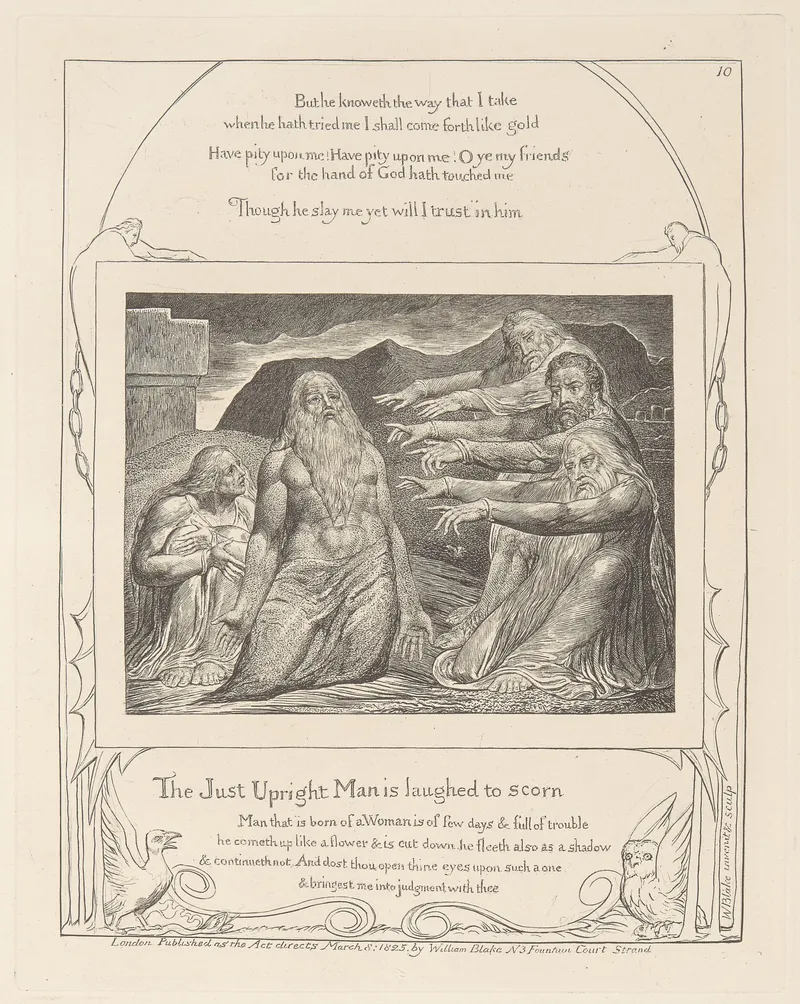
Job turns away from his friends. He has heard enough of their arguments, and he will speak now to God directly, with the unguarded cry of one whose pain has gone past pretense, past the careful and composed prayer of a man trying to say the right thing. My soul is weary of my life, he begins; I will leave my complaint upon myself; I will speak in the bitterness of my soul. And his opening plea is not an accusation but a request, almost a child's request of a parent: Do not condemn me; shew me wherefore thou contendest with me. Tell me what I am charged with.
Let me at least know why.1
Tap any highlighted phrase to jump to the commentary that unpacks it.
Job 10:1-7Do Not Condemn Me; Show Me Why
1My soul is weary of my life; I will leave my complaint upon myself; I will speak in the bitterness of my soul. 2I will say unto God, Do not condemn me; shew me wherefore thou contendest with me. 3Is it good unto thee that thou shouldest oppress, that thou shouldest despise the work of thine hands, and shine upon the counsel of the wicked? 4Hast thou eyes of flesh? or seest thou as man seeth? 5Are thy days as the days of man? are thy years as man’s days, 6That thou enquirest after mine iniquity, and searchest after my sin? 7Thou knowest that I am not wicked; and there is none that can deliver out of thine hand.
The chapter opens at the place where many of Job's speeches begin and end: exhaustion. My soul is weary of my life. This is a weariness with existence itself, the deep fatigue of one for whom waking up has become a burden and the day ahead a thing to be endured rather than received. And out of that weariness comes a decision: I will leave my complaint upon myself; I will speak in the bitterness of my soul. Job resolves to stop censoring himself.
He will not strain to sound accepting, will not dress the grief up in language fit for company. He will let the complaint be what it actually is - bitter, raw, unedited - and he will say it. There is a kind of honesty here that polite religion often discourages and that this book quietly honours. The man does not pretend to a peace he does not feel.
And then, having resolved to speak freely, Job turns and aims his words at God: I will say unto God, Do not condemn me. It is worth pausing over how much faith that single sentence contains. Job turns toward God and pleads, the very act of address itself an act of faith. His first request reaches past healing, past restored wealth, past vindication before his accusers, to this single plea: do not condemn me. He cannot bear to think that the weight pressing on him is a verdict, that all this suffering means God has found him guilty and is carrying out a sentence.
So he asks for the one thing a defendant most needs: not to be condemned, and to be told the charge. The plea is the cry of a man who still believes the One he is speaking to is listening, and can be reasoned with, and is not finally his enemy.1
The plea sharpens into a demand for clarity: shew me wherefore thou contendest with me. Job is not asking God to drop the case; he is asking to be told what it is. The silence is its own torment - to suffer without explanation, to feel the hand of God heavy upon you and not know why, is in some ways worse than suffering you can name. A charge you can answer; a sentence you can appeal; but a contention with no stated cause leaves a man flailing in the dark.
So Job presses for the thing every accused person craves: shew me. Name it. Bring it into the light. He would rather hear an indictment he could face than go on enduring a silence he cannot interpret.1
Now Job reaches for the argument that will carry the whole chapter, and he reaches for it here first in seed form: Is it good unto thee that thou shouldest oppress, that thou shouldest despise the work of thine hands? The phrase is the hinge of everything to come. Job is God's work - something God Himself made, shaped, brought into being. And so the suffering, as Job experiences it, is not God striking at a stranger; it is God turning against His own handiwork, despising the very thing His hands have done.
There is a logic of love hidden inside the complaint: surely a maker does not hate what he has made; surely the care that went into the making should count for something in how the made thing is now treated. Job cannot square the tenderness he believes went into his creation with the harshness he is now enduring - and out of that impossible gap, the question rises.
Then Job presses a strange and searching line of questions: Hast thou eyes of flesh? or seest thou as man seeth? Are thy days as the days of man… that thou enquirest after mine iniquity, and searchest after my sin? He is reasoning with God about God's own nature. Men squint and misjudge; men are pressed for time and must hunt out a fault quickly before the chance is gone. But God is not like that - God does not have eyes of flesh, is not racing against a short life.
So why, Job asks, does God seem to behave as though He must scour Job for some hidden sin, as a suspicious man might frantically search a servant? The argument cuts both ways: it is at once a complaint and a confession of faith. Job is appealing to what he knows of God's patience and depth in order to protest what feels, from the inside, like impatient prosecution. And underneath it all sits the quiet certainty of verse 7 - thou knowest that I am not wicked - which is precisely why the searching feels so wrong to him.
Job 10:8-13Thine Hands Have Made Me and Fashioned Me
8Thine hands have made me and fashioned me together round about; yet thou dost destroy me. 9Remember, I beseech thee, that thou hast made me as the clay; and wilt thou bring me into dust again? 10Hast thou not poured me out as milk, and curdled me like cheese? 11Thou hast clothed me with skin and flesh, and hast fenced me with bones and sinews. 12Thou hast granted me life and favour, and thy visitation hath preserved my spirit. 13And these things hast thou hid in thine heart: I know that this is with thee.
Here the chapter reaches its summit. Job lifts his eyes from the courtroom to the workshop - from the image of God as prosecutor to the image of God as maker - and the change of register is the most moving thing in the speech. Thine hands have made me and fashioned me together round about; yet thou dost destroy me. Two clauses, joined by a yet that holds the whole anguish of the book. The hands that made me are destroying me.
Job does not soften it or resolve it; he simply lays the two facts side by side and lets them grind against each other. And notice what he assumes without arguing for it: that he is, in the most literal sense, handmade - the deliberate work of God's own hands, shaped together round about, formed on every side with care. The complaint only stings because the love is presumed. You do not protest that a maker is destroying his work unless you first believe the work was made with love.
Remember, I beseech thee, that thou hast made me as the clay; and wilt thou bring me into dust again? The plea is almost tender - remember. As though God might have forgotten the labour of His own hands. Job presses the potter image into its full shape: clay, lifted from the dust and worked into a living form, and now - will it be crushed back down into the dust it came from? There is a whole arc of creation and un-creation in the single line.
God took the dust and made it into something; is He now reversing the work, returning the vessel to the formless ground? Job is not denying that he will die; he is asking why the making was undertaken at all, if this is the end of it. Why shape the clay with such care only to grind it back to powder? The question is the bewilderment of a vessel that cannot understand why its maker would unmake it.2
Then comes one of the strangest and most vivid images in all of Scripture: Hast thou not poured me out as milk, and curdled me like cheese? Job reaches for the everyday miracle of the dairy to describe the mystery of his own formation - the way a liquid is poured out and then, by some hidden process, thickens and sets into something solid and whole.1 It is his attempt to put words to the wonder that a human being should be formed at all, that the unformed should become formed, the liquid become flesh.
And every verb keeps God as the agent: thou didst pour me out; thou didst curdle me. The transformation that made Job a living body was not his own doing and not an accident of nature - it was the work of God, as deliberate as a person making cheese from milk. Job marvels, even in his bitterness, at the sheer craft of his own making. The wonder is real even where the comfort has fled.
Thou hast clothed me with skin and flesh, and hast fenced me with bones and sinews. The catalogue of God's care grows more detailed and more intimate. God clothed Job - the body itself a garment laid over the frame - and fenced him with bones and sinews. That word fenced is worth dwelling on: a fence is built to protect, to enclose, to hold safe what is precious within it. The skeleton, in Job's image, is shelter as much as structure - God's own provision for holding His handiwork together.
Every layer of the body, from skin to sinew to bone, Job reads as evidence of a maker who built him not carelessly but protectively, with the attentiveness of one safeguarding something he means to keep. And that, again, is the wound at the centre: the One who fenced him round for protection now seems to have turned the fence into a trap.
Thou hast granted me life and favour, and thy visitation hath preserved my spirit. Beyond the body, Job names the deeper gifts. Life itself - the breath in the lungs, the spirit in the frame. Favour - the kindness, the goodwill, the sense that he had stood in God's good regard. And visitation - God's active attention, His coming near, His watchful presence - which Job says preserved my spirit, kept him alive and whole. Here Job is remembering the days before the catastrophe, when God's nearness felt like protection and not pursuit.
He had known the favour of God as a settled, warming thing. That is what makes the present so disorienting: the very visitation that once preserved his spirit now seems to be the thing crushing it. The God who came near to keep him appears to have come near to break him - and Job cannot reconcile the two visitations, the old one and the new.
Job 10:14-22A Little Comfort Before the Land of Darkness
14If I sin, then thou markest me, and thou wilt not acquit me from mine iniquity. 15If I be wicked, woe unto me; and if I be righteous, yet will I not lift up my head. I am full of confusion; therefore see thou mine affliction; 16For it increaseth. Thou huntest me as a fierce lion: and again thou shewest thyself marvellous upon me. 17Thou renewest thy witnesses against me, and increasest thine indignation upon me; changes and war are against me. 18Wherefore then hast thou brought me forth out of the womb? Oh that I had given up the ghost, and no eye had seen me! 19I should have been as though I had not been; I should have been carried from the womb to the grave. 20Are not my days few? cease then, and let me alone, that I may take comfort a little, 21Before I go whence I shall not return, even to the land of darkness and the shadow of death; 22A land of darkness, as darkness itself; and of the shadow of death, without any order, and where the light is as darkness.
The tone darkens. Job describes a situation with no exit: If I sin, then thou markest me… If I be wicked, woe unto me; and if I be righteous, yet will I not lift up my head. He feels trapped between two impossibilities. If he has sinned, he is condemned; but even if he is righteous - and he believes he is - he still cannot lift his head, still cannot escape the affliction. Innocence brings him no relief; the suffering presses down on the righteous and the wicked alike.
I am full of confusion, he says, and the word is exactly right: he is bewildered, disoriented, unable to find the logic that would make sense of his pain. The categories he was taught - the righteous prosper, the wicked suffer - have broken in his hands, and he is left holding a grief that fits none of them.
And then a startling image: thou huntest me as a fierce lion. The God who, a few verses earlier, was the tender potter shaping clay is now the lion stalking its prey - the same God, Job insists, in both pictures. This is the vertigo at the heart of the chapter: Job cannot hold the Maker and the hunter apart, because in his experience they are one. The God whose hands formed him with care is the God who now seems to track him down, and again thou shewest thyself marvellous upon me - the displays of divine power that should evoke worship instead land on Job as fresh assault.
He feels not protected but pursued, not kept but cornered. It is the cry of a man who has not stopped believing in God's greatness; he has simply come to feel that greatness aimed against him - the marvellous power of the Maker turned, somehow, into the relentlessness of a predator.
The lament now circles back to its origin, the question Job has asked before and asks again here with fresh anguish: Wherefore then hast thou brought me forth out of the womb? Oh that I had given up the ghost, and no eye had seen me! If this is where it all leads - to confusion, to the hunt, to a suffering with no exit - why was he ever born at all? Why did the Maker who so carefully shaped him in the womb (vv. 8-11) bring that handiwork out into the light to endure this?
The two halves of the chapter press against each other one last time: the tender making and the unbearable result. I should have been as though I had not been; I should have been carried from the womb to the grave. Better, Job thinks, never to have drawn breath than to have lived into this. It is the cry of one for whom the gift of life has become a weight he cannot carry - and who cannot understand why a careful Maker would form him only for this.
And then the plea shrinks to almost nothing, and in its smallness it is heartbreaking: Are not my days few? cease then, and let me alone, that I may take comfort a little. Job has lowered his asking to the barest mercy: a brief respite, a little comfort, before the end comes. His days are few; could he not have even a moment's peace in what remains of them? It is the request of a man worn down past hoping for much, who has lowered his asking to the barest mercy: not joy, not relief, just a pause in the relentlessness before the dark.
There is a particular sorrow in a sufferer whose prayer has contracted this far - who no longer dares ask for rescue, only for a short reprieve before the grave.
The chapter ends in unrelieved gloom: a land of darkness, as darkness itself; and of the shadow of death, without any order, and where the light is as darkness. Job stacks the words for darkness until they almost lose meaning, as if no single phrase could carry the weight of the place he dreads. And the detail that chills most is without any order - for Job is a man whose every bone and sinew was fashioned together round about, ordered and structured by the hand of God.
The grave, as he pictures it, is the unmaking of all that: a place where the careful order of creation dissolves into formlessness, where even light behaves like darkness. There is no resolution at the end of this chapter, no turn toward hope, no “yet I will trust.” Job simply names the darkness and falls silent in it. And the chapter is content to end there, because honest suffering sometimes does - and the book is unafraid to let it.
Research trail
Sources & further study
These references support the historical, linguistic, manuscript, and contextual notes in this chapter. Scripture remains the primary text; external sources are provided so readers can inspect the research directly.
- Job 10 - Translators' NotesThe NET Bible's detailed footnotes on Job 10 - the legal sense of “contend” in verse 2, the difficult curdled-milk imagery of verse 10, and the layered words for gloom (“darkness” and “the shadow of death”) that crowd the closing verses.
- Art of the Ancient Near East · Heilbrunn TimelineThe Met's survey of the ancient Near Eastern world Job belongs to - the potter at his wheel working wet clay into form, the imagery behind “thou hast made me as the clay” (v. 9), and the household world of favour and visitation Job pictures in verse 12.
- Job 10 · Hebrew + classical Jewish commentaryThe Hebrew text of Job 10 with Rashi, Ibn Ezra, and other classical commentators side by side - useful for the potter-and-clay verb in verse 8 (made me and fashioned me), the strange embryology of verse 10 (poured me out as milk, and curdled me like cheese), and the long discussion of how a righteous man could press so hard against God without charging Him foolishly.
- Job 10 ↔ Psalm 139 · Isaiah 64 · John 1Traces the threads tying Job's appeal to his Maker - I am fearfully and wonderfully made (Ps. 139:14), the potter and the clay (Isa. 64:8), and the Maker who was made flesh (John 1:14) - so the reader can see Job's cry answered across Scripture.
Where this echoes in Scripture
Do Not Condemn Me; Show Me Why
- Psalm 142:2I poured out my complaint before him; I shewed before him my trouble.The same posture as Job - the complaint poured out before God Himself rather than buried or aimed sideways.
- Micah 6:2For the LORD hath a controversy with his people… he will plead with Israel.The courtroom word (riv) Job uses - the assumption that even God's dealings can be brought into the open and argued.
- Romans 8:1There is therefore now no condemnation to them which are in Christ Jesus.Job's opening plea - “do not condemn me” - given its answer in the gospel.
- Job 13:23How many are mine iniquities and sins? make me to know my transgression and my sin.The same demand to be shown the charge - Job's refusal to suffer a contention with no stated cause.
Thine Hands Have Made Me and Fashioned Me
- Psalm 139:13For thou hast possessed my reins: thou hast covered me in my mother's womb.The wonder Job names - the intimate, hands-on making in the womb - sung in full.
- Isaiah 64:8We are the clay, and thou our potter; and we all are the work of thy hand.The potter-and-clay image (yatsar) Job reaches for, turned into a prayer of trust.
- Genesis 2:7And the LORD God formed man of the dust of the ground.The same verb Job uses - God forming (yatsar) the man from dust, the making Job begs God to remember.
- John 1:14And the Word was made flesh, and dwelt among us.The Maker who clothed Job with skin and flesh taking skin and flesh Himself.
A Little Comfort Before the Land of Darkness
- Psalm 23:4Yea, though I walk through the valley of the shadow of death, I will fear no evil: for thou art with me.The same word (tsalmaveth) Job dreads - the shadow of death, now a valley one is led through, and not alone.
- Isaiah 9:2They that dwell in the land of the shadow of death, upon them hath the light shined.Light promised for the very land of darkness Job pictures at the chapter's close.
- John 3:17For God sent not his Son into the world to condemn the world; but that the world through him might be saved.Job's opening plea - “do not condemn me” - answered: the Maker did not come to condemn the work of His hands.
- Jeremiah 20:18Wherefore came I forth out of the womb to see labour and sorrow?The prophet's lament in Job's very words - another faithful man asking why he was ever brought forth, and not condemned for it.