Revelation 10
People in this chapter
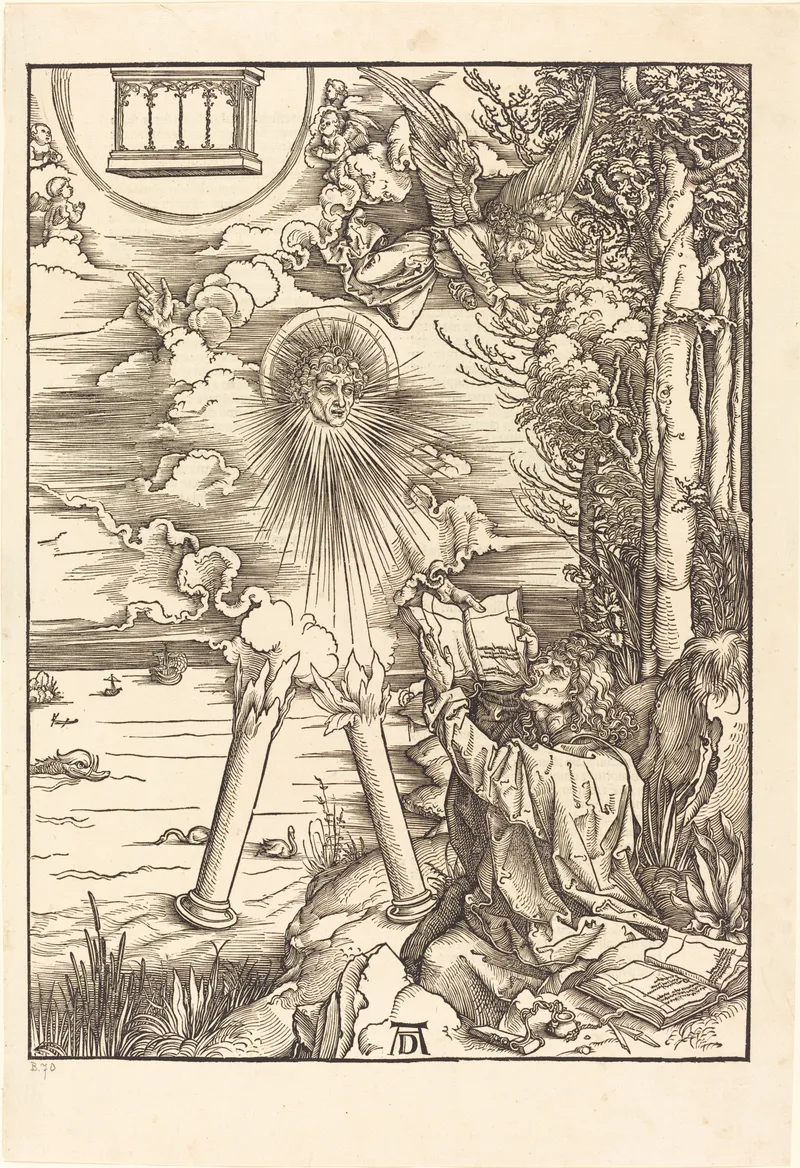
Between the sixth trumpet and the seventh, the trumpet sequence halts and the vision opens onto something different. And I saw another mighty angel come down from heaven, clothed with a cloud: and a rainbow was upon his head, and his face was as it were the sun, and his feet as pillars of fire (v. 1). The descriptions pile up - cloud, rainbow, sun, fire - every one of them an image Scripture keeps for the presence and majesty of God, so that the messenger arrives wrapped in the glory of the One who sent him.
In his hand is something small and significant: a little book open (v. 2). He plants his right foot upon the sea, and his left foot on the earth, a stance that takes in the whole world at once, and cries out with a voice as when a lion roareth - and at the sound, seven thunders uttered their voices (v. 3).1
Tap any highlighted phrase to jump to the commentary that unpacks it.
Revelation 10:1-4The Mighty Angel and the Sealed Thunders
1And I saw another mighty angel come down from heaven, clothed with a cloud: and a rainbow was upon his head, and his face was as it were the sun, and his feet as pillars of fire: 2And he had in his hand a little book open: and he set his right foot upon the sea, and his left foot on the earth, 3And cried with a loud voice, as when a lion roareth: and when he had cried, seven thunders uttered their voices. 4And when the seven thunders had uttered their voices, I was about to write: and I heard a voice from heaven saying unto me, Seal up those things which the seven thunders uttered, and write them not.
The judgments of the trumpets pause, and a new figure fills the vision: another mighty angel come down from heaven, clothed with a cloud: and a rainbow was upon his head, and his face was as it were the sun, and his feet as pillars of fire (v. 1). The descriptions arrive in a rush, and each one is borrowed from the Scriptures' pictures of God's own presence. The cloud is the covering in which the LORD came down on Sinai and filled the tabernacle; the rainbow is the sign set in the sky after the flood and the arch of color around the throne John saw in chapter 4; the face… as it were the sun echoes the very countenance of the glorified Christ in chapter 1, whose countenance was as the sun shineth in his strength; the feet as pillars of fire recall both His burning feet there and the pillar of fire that led Israel by night.
The messenger comes drenched in the glory of the One who sent him - not a glory of his own, but the reflected weight of heaven. Whatever this angel is about to do, the imagery announces it before he speaks a word: what he brings is from God, and it carries the full authority of God's presence.
Two details mark out the angel's significance. First, what he holds: he had in his hand a little book open (v. 2). It is small - not the great sealed scroll of chapter 5 that only the Lamb could open, but a little book, and already open, ready to be read, ready to be given. The contents are not hidden behind seals; they are held out. Second, where he stands: he set his right foot upon the sea, and his left foot on the earth. One foot on the sea, one on the land - a stance that spans the whole created world, sea and dry ground together, as if to claim that what he brings concerns everything and everyone, that no corner of the earth lies outside it.
Then he cries out, and the sound is overwhelming: a loud voice, as when a lion roareth (v. 3). It is the roar the prophets heard in the voice of the LORD - The lion hath roared, who will not fear? - a sound of majesty and of warning. And at that cry, creation answers back: seven thunders uttered their voices. Thunder is the Scriptures' frequent sign of the voice of God, and here it sounds seven times, the number of fullness.
Heaven and earth alike are speaking.1
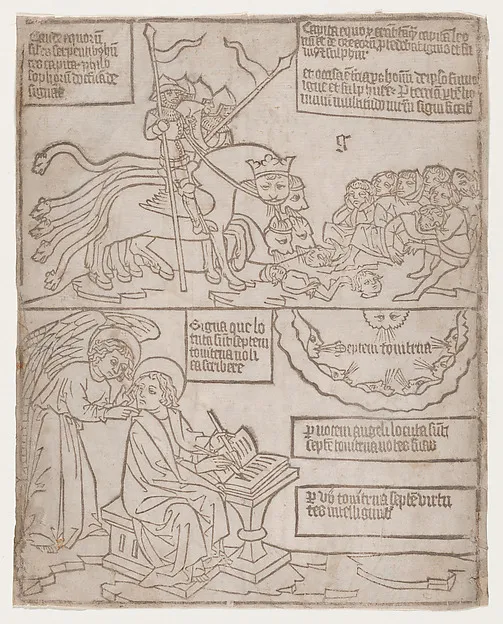
Then comes the surprise. And when the seven thunders had uttered their voices, I was about to write - for John has been told, from the first chapter, to write what he sees - and I heard a voice from heaven saying unto me, Seal up those things which the seven thunders uttered, and write them not (v. 4). In a book whose very name means unveiling, here is something deliberately veiled. John heard the thunders; he understood them well enough to begin recording them; and he is stopped.
Seal them up. Write them not. The text refuses to tell the reader everything. It is a quiet but important word about how this whole book asks to be read: not as a code in which every last thing can be decoded, not as a chart with no gaps. Some of what God knows He keeps with Himself. The secret things belong unto the LORD our God: but those things which are revealed belong unto us and to our children (Deut. 29:29).
Daniel was told the same - shut up the words, and seal the book - and here John is too. The point is not frustration but humility. The reader is given what is good to be given, and is gently kept from grasping after what is not. There is a faithfulness that consists in not knowing, and in being content that God does.2
Revelation 10:5-7The Oath: The Mystery of God Finished
5And the angel which I saw stand upon the sea and upon the earth lifted up his hand to heaven, 6And sware by him that liveth for ever and ever, who created heaven, and the things that therein are, and the earth, and the things that therein are, and the sea, and the things which are therein, that there should be time no longer: 7But in the days of the voice of the seventh angel, when he shall begin to sound, the mystery of God should be finished, as he hath declared to his servants the prophets.
The angel, still straddling sea and earth, now makes the most solemn gesture a person can make: And the angel which I saw stand upon the sea and upon the earth lifted up his hand to heaven, and sware by him that liveth for ever and ever (vv. 5-6). To lift the hand to heaven is the ancient posture of the oath - the same gesture Abraham made when he lift up mine hand unto the LORD, the same the man in Daniel's vision made when he held up his right hand and his left hand unto heaven, and sware by him that liveth for ever, the very passage standing behind this one.
An oath calls God to witness; it stakes the truth of what is said on the One sworn by. And here the angel swears by him that liveth for ever and ever - by the everlasting, undying God, the only fitting guarantor of a word about the end of all things. This is not a casual announcement. It is a sworn pledge, sealed by an appeal to the eternal Life of God Himself. Whatever the angel is about to say, heaven has put its full weight behind it.
The reader is meant to lean in: what follows is certain.
The God by whom the angel swears is named by His works: who created heaven, and the things that therein are, and the earth, and the things that therein are, and the sea, and the things which are therein (v. 6). The threefold sweep - heaven, earth, sea - takes in the whole of creation; the God invoked is the Maker of all that is, the One who brought heaven and earth and sea and everything in them into being.
And the content of the oath is this: that there should be time no longer. The phrase has been pondered for centuries, and it does not mean that time as such ceases to exist. It is the language of delay - that there should be no more waiting, no further postponement. The long stretch of “not yet,” the patience the earlier visions called for as the souls under the altar cried How long?, is drawing to its close.
The God who made all things and who outlasts all things has sworn that the season of delay is nearly spent. For a people enduring under pressure, weary of waiting for God to act, this is the word they most need: the wait is not endless. The Maker of heaven and earth has put His own eternal life behind the promise that the time of waiting will end.
The oath reaches its point in verse 7: But in the days of the voice of the seventh angel, when he shall begin to sound, the mystery of God should be finished, as he hath declared to his servants the prophets. Here is what the sworn word secures. When the last trumpet sounds, the mystery of God - His long-hidden, long-unfolding purpose - will be finished, brought to its completion, carried fully through to its end.
And the last clause is the anchor: as he hath declared to his servants the prophets. What is being finished is nothing new or unforeseen; it is exactly what God has been announcing all along, through the long line of those He sent to speak for Him. The line leans on Amos: Surely the Lord GOD will do nothing, but he revealeth his secret unto his servants the prophets (Amos 3:7).2 God does not improvise.
The purpose moving toward completion is the very purpose He declared centuries before, faithfully kept and faithfully advanced. The chapter does not lay out a timetable or decode the sequence of the end; it makes a far simpler and weightier promise. Whatever God has spoken, He finishes. No word of His falls to the ground. The story is going exactly where He long ago said it would.
Revelation 10:8-11Sweet as Honey, Bitter in the Belly
8And the voice which I heard from heaven spake unto me again, and said, Go and take the little book which is open in the hand of the angel which standeth upon the sea and upon the earth. 9And I went unto the angel, and said unto him, Give me the little book. And he said unto me, Take it, and eat it up; and it shall make thy belly bitter, but it shall be in thy mouth sweet as honey. 10And I took the little book out of the angel’s hand, and ate it up; and it was in my mouth sweet as honey: and as soon as I had eaten it, my belly was bitter. 11And he said unto me, Thou must prophesy again before many peoples, and nations, and tongues, and kings.
The voice from heaven that had stopped John's pen now sets him in motion: Go and take the little book which is open in the hand of the angel which standeth upon the sea and upon the earth (v. 8). John is no longer merely a watcher of the vision; he is sent into it, told to walk up to the towering, sun-faced figure and take the book from his hand. And he obeys without hesitation: And I went unto the angel, and said unto him, Give me the little book (v. 9).
There is something to notice in the simple sequence. The word of God here is not seized or studied from a distance; it is asked for and received - Give me the little book. The servant comes with open hands. But the angel's reply turns the moment from receiving into something far more intimate and costly. He does not say “read it” or “copy it” or “study it.” He says: Take it, and eat it up. The book is to be consumed - taken inside, swallowed whole, made part of the one who carries it.
And in the same breath the angel tells John exactly what eating it will be like, sparing him nothing: it shall make thy belly bitter, but it shall be in thy mouth sweet as honey. The warning comes before the meal. John knows, going in, that this word will taste of two things at once.
John eats, and it is exactly as the angel said: And I took the little book out of the angel's hand, and ate it up; and it was in my mouth sweet as honey: and as soon as I had eaten it, my belly was bitter (v. 10). The two tastes come in order - first the sweetness on the tongue, then the bitterness within. This is the experience of taking God's word truly into oneself, and it is worth dwelling on each half.
On the tongue it is sweet as honey, because the word of God genuinely is sweet: How sweet are thy words unto my taste! yea, sweeter than honey to my mouth (Ps. 119:103); sweeter also than honey and the honeycomb (Ps. 19:10). The first taste of God's truth is comfort, light, the relief of reality, the gladness of His promises. But the word does not stop at the tongue. Once it is taken in, the belly was bitter, because the word carries hard things along with the sweet - it speaks of judgment as well as mercy, of suffering as well as glory, of sin that must be named and a world that will not gladly hear.
The same word that gladdens also grieves. To digest it - to live with it inside you, to carry it into a resisting world - is to feel the bitterness of all that it costs. Notice the order one last time: the sweetness is tasted first, but the bitterness comes after and lingers. The servant who takes God's word fully into himself does not get the comfort without the cost. He gets both, in that order, and is changed by both.
The bitterness is still in John's belly when the commission comes: And he said unto me, Thou must prophesy again before many peoples, and nations, and tongues, and kings (v. 11). This is why the book had to be eaten. The word taken in is not meant to stay in; it is taken in so that it can be poured out. And notice that the sending does not wait for the bitterness to pass.
There is no “once you feel ready” or “when the hard part fades.” The word is must - thou must prophesy again - the obligation of one who has been given something he is now bound to declare. The reach of it is sweeping: before many peoples, and nations, and tongues, and kings. The fourfold phrase - peoples, nations, tongues, kings - sounds again and again through Revelation as the book's way of saying everyone, everywhere; the word John has eaten is for all of them, the small and the mighty alike, the unknown peoples and the kings on their thrones.
The one who has taken the word into himself is sent back out to speak it to the whole world. The chapter that began with a book held in an angel's hand ends with that book inside a man, and that man sent to the nations. The word of God comes full circle: received, consumed, and spoken again.
Research trail
Sources & further study
These references support the historical, linguistic, manuscript, and contextual notes in this chapter. Scripture remains the primary text; external sources are provided so readers can inspect the research directly.
- Revelation 10 - Translators' NotesThe NET Bible's detailed footnotes on Revelation 10 - the imagery describing the mighty angel in verse 1, the sealing of the seven thunders in verse 4, the difficult phrase there should be time no longer in verse 6, and the eating of the little book in verses 9-10.
- Revelation 10 ↔ Ezekiel 2-3 · Daniel 12 · Amos 3Traces the older Scriptures gathered into the chapter - the eaten scroll, sweet as honey, from Ezekiel 2:8-3:3; the sealing of words and the oath with hand lifted to heaven from Daniel 12:4-7; and the principle that God revealeth his secret unto his servants the prophets from Amos 3:7, standing behind verse 7.
- Revelation 10 · Greek interlinearThe Greek text of Revelation 10 word by word, with parsing and Strong's links - useful for biblaridion (v. 2, the “little book” John eats), for glykys and pikrainω (vv. 9-10, “sweet” and “made bitter”), and for mysterion (v. 7, “the mystery of God”).
Where this echoes in Scripture
The Mighty Angel and the Sealed Thunders
- Ezekiel 1:28As the appearance of the bow that is in the cloud in the day of rain... This was the appearance of the likeness of the glory of the LORD.The cloud and rainbow of verse 1 - the imagery the prophets keep for the glory of God's presence.
- Revelation 1:15-16his feet like unto fine brass, as if they burned in a furnace... his countenance was as the sun shineth in his strength.The sun-face and fiery feet of verse 1 - the same imagery laid on the risen Christ.
- Amos 3:8The lion hath roared, who will not fear? the Lord GOD hath spoken, who can but prophesy?The voice as a lion's roar in verse 3 - the sound of the LORD speaking, which compels the prophet.
- Daniel 12:4shut up the words, and seal the book, even to the time of the end.The sealing of verse 4 - words deliberately kept, as Daniel was told to seal his.
- Deuteronomy 29:29The secret things belong unto the LORD our God: but those things which are revealed belong unto us.The principle behind verse 4 - some things God keeps to Himself, and that is no loss to His servant.
The Oath: The Mystery of God Finished
- Daniel 12:7held up his right hand and his left hand unto heaven, and sware by him that liveth for ever.The oath of verses 5-6 - the same gesture and the same words John's vision draws upon directly.
- Amos 3:7Surely the Lord GOD will do nothing, but he revealeth his secret unto his servants the prophets.The anchor of verse 7 - God's long-declared purpose, made known beforehand through the prophets.
- Ephesians 1:9-10Having made known unto us the mystery of his will... that... he might gather together in one all things in Christ.The mystery of God (v. 7) - His hidden purpose for all things, now disclosed.
- Isaiah 55:11so shall my word be that goeth forth out of my mouth: it shall not return unto me void.The certainty behind the oath (vv. 6-7) - what God speaks, He accomplishes; His word never fails.
- Philippians 1:6he which hath begun a good work in you will perform it until the day of Jesus Christ.God finishes what He declares (v. 7) - the same faithfulness that completes His purpose in His people.
Sweet as Honey, Bitter in the Belly
- Ezekiel 3:1-3eat this roll, and go speak unto the house of Israel... then did I eat it; and it was in my mouth as honey for sweetness.The pattern behind verses 9-10 - the prophet who ate the scroll, sweet to the taste, before being sent.
- Psalm 119:103How sweet are thy words unto my taste! yea, sweeter than honey to my mouth!The sweetness of verse 10 - the genuine delight of God's word received.
- Jeremiah 15:16Thy words were found, and I did eat them; and thy word was unto me the joy and rejoicing of mine heart.The word eaten (vv. 9-10) - another prophet who took God's word into himself and found it joy.
- Matthew 24:14this gospel of the kingdom shall be preached in all the world for a witness unto all nations.The commission of verse 11 - the word carried to every people, nation, and tongue.
- Matthew 28:19Go ye therefore, and teach all nations, baptizing them in the name of the Father, and of the Son, and of the Holy Ghost.The sending of verse 11 - the same reach, the word taken in now spoken out to all nations.