Genesis 28
People in this chapter
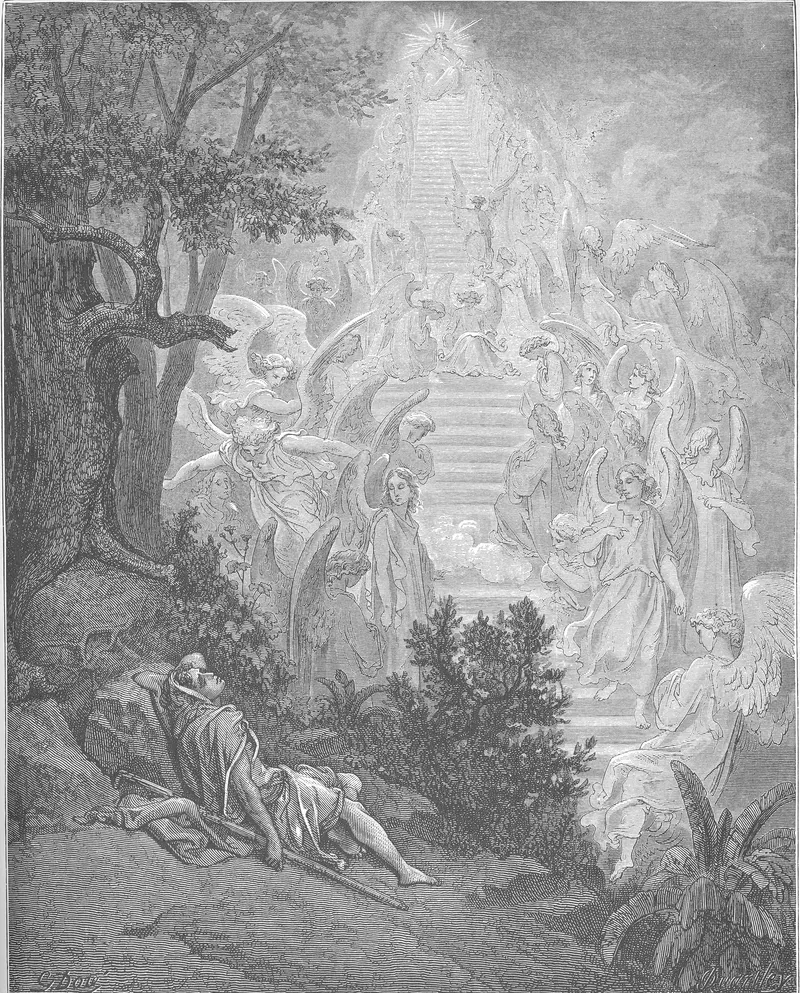
Jacob is on the run. He has cheated his brother, lied to his blind father, and now Esau wants him dead. At sunset he stops in open country, takes a stone for a pillow, and lies down in the dirt. The lowest night of his life. And there, before he has done a thing to earn it, heaven opens: a ladder set up on the earth, and the top of it reached to heaven, angels moving up and down it, and the LORD standing above it.1
Tap any highlighted phrase to jump to the commentary that unpacks it.
Genesis 28:1-9Sent Away with the Blessing of Abraham
1And Isaac called Jacob, and blessed him, and charged him, and said unto him, Thou shalt not take a wife of the daughters of Canaan. 2Arise, go to Padanaram, to the house of Bethuel thy mother’s father; and take thee a wife from thence of the daughters of Laban thy mother’s brother. 3And God Almighty bless thee, and make thee fruitful, and multiply thee, that thou mayest be a multitude of people; 4And give thee the blessing of Abraham, to thee, and to thy seed with thee; that thou mayest inherit the land wherein thou art a stranger, which God gave unto Abraham. 5And Isaac sent away Jacob: and he went to Padanaram unto Laban, son of Bethuel the Syrian, the brother of Rebekah, Jacob’s and Esau’s mother.
Isaac calls Jacob and blesses him a second time - a deliberate, open-eyed commissioning. Whatever Isaac suffered when he discovered the deception of the chapter before, he has come to peace with it; he now ratifies the very thing he had meant for Esau, freely and on purpose. The blessing comes wrapped in a charge: Thou shalt not take a wife of the daughters of Canaan. This is a matter of the covenant line: the household of promise was not to be folded into the idolatry of the surrounding peoples; Jacob is sent the long way back to his mother's kin precisely so that the line might stay distinct.
The chapter thus opens with a son being sent - charged, blessed, and pointed toward a future. The same journey that is in one sense a flight from Esau's anger is, in God's hand, a sending toward a wife, a family, and the keeping of a promise.2
Isaac's words in verses 3 and 4 are not improvised; they are the ancient promise of Abraham, handed down a generation. God Almighty - El Shaddai, the name under which God had sworn the covenant to Abraham - is invoked to make thee fruitful, and multiply thee, that thou mayest be a multitude of people. Then the heart of it: And give thee the blessing of Abraham, to thee, and to thy seed with thee; that thou mayest inherit the land. Everything God had pledged to Abraham - descendants beyond counting, a land, and a blessing that would reach the whole earth - now passes intact to Jacob.
It is striking where this is spoken: over a son about to leave the land empty-handed, with nothing in hand but his father's words. Jacob owns none of the land he is promised to inherit; he is walking out of it as a near-refugee. Yet the promise is laid on him as a settled thing. The covenant does not wait on Jacob's circumstances or even his character. It rests on the word of the God who first gave it, and that word is what Jacob carries into exile.
6When Esau saw that Isaac had blessed Jacob, and sent him away to Padanaram, to take him a wife from thence; and that as he blessed him he gave him a charge, saying, Thou shalt not take a wife of the daughters of Canaan; 7And that Jacob obeyed his father and his mother, and was gone to Padanaram; 8And Esau seeing that the daughters of Canaan pleased not Isaac his father; 9Then went Esau unto Ishmael, and took unto the wives which he had Mahalath the daughter of Ishmael Abraham’s son, the sister of Nebajoth, to be his wife.
Esau is watching all of this, and at last he understands something. He sees the blessing go to Jacob, sees his brother sent off with a charge to marry within the family, and sees - perhaps for the first time really registers - that the daughters of Canaan pleased not Isaac his father. His two Canaanite wives had been a grief of mind to his parents; now he grasps that this was part of why the blessing slipped past him.
So he tries to repair it: he goes to Ishmael's household and marries Mahalath, a granddaughter of Abraham, hoping a better marriage will mend his standing. But notice where he goes. Ishmael was the son sent away, the line that did not carry the covenant promise. Esau's instinct, even in trying to do right, leads him to the line that did not carry the promise. And the timing is the quiet tragedy of it: he understands too late, and even his correction is bent.
The blessing was never something a shrewd marriage could buy back. Esau keeps reaching for it by management and maneuver - the very thing it could never be gained by. There is a particular ache in finally seeing what someone valued only after the moment to act on it has passed.
Genesis 28:10-15The Angels of God Ascending and Descending
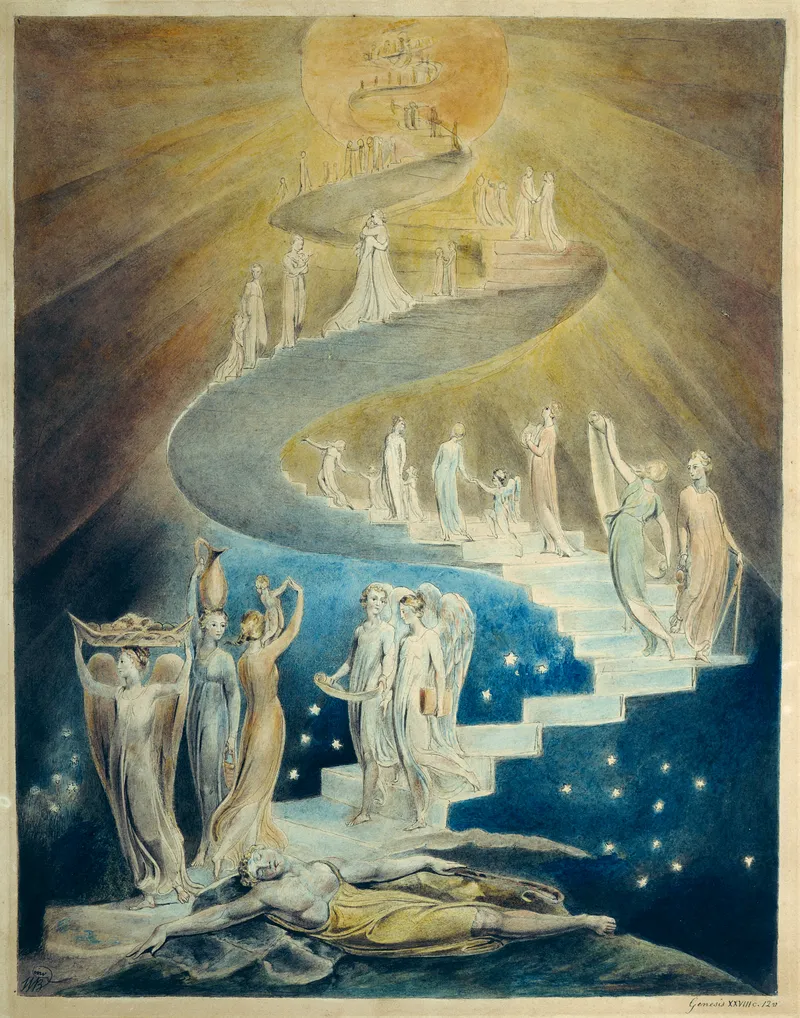
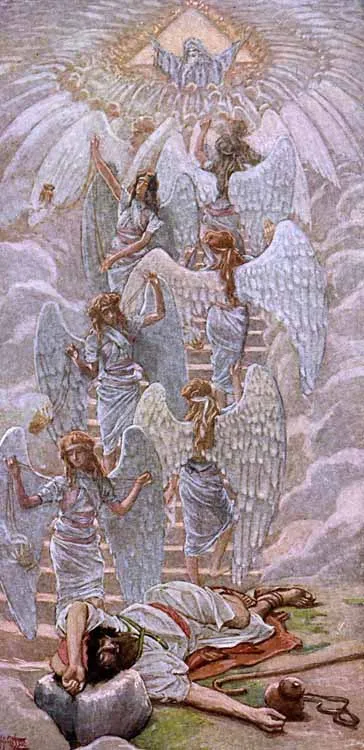
10And Jacob went out from Beersheba, and went toward Haran. 11And he lighted upon a certain place, and tarried there all night, because the sun was set; and he took of the stones of that place, and put them for his pillows, and lay down in that place to sleep. 12And he dreamed, and behold a ladder set up on the earth, and the top of it reached to heaven: and behold the angels of God ascending and descending on it. 13And, behold, the LORD stood above it, and said, I am the LORD God of Abraham thy father, and the God of Isaac: the land whereon thou liest, to thee will I give it, and to thy seed; 14And thy seed shall be as the dust of the earth, and thou shalt spread abroad to the west, and to the east, and to the north, and to the south: and in thee and in thy seed shall all the families of the earth be blessed. 15And, behold, I am with thee, and will keep thee in all places whither thou goest, and will bring thee again into this land; for I will not leave thee, until I have done that which I have spoken to thee of.
Everything about the setting is bare and accidental-seeming. Jacob lighted upon a certain place - an unnamed spot, no shrine, no altar, just wherever the road had taken him when the light gave out. He stops because the sun was set and a man has to sleep somewhere. He gathers stones for a pillow and lies down on open ground. This is the picture to hold: a lone fugitive at the edge of nowhere, a rock under his head, having lost home and safety and the moral high ground all at once.
He has done nothing to prepare for an encounter with God; he is not praying, not seeking, not even hoping. He is exhausted and afraid and asleep. And it is right there, on a random patch of dirt in the dark, that heaven chooses to open. The grace of the whole scene is set up by the plainness of the place. God comes to Jacob where Jacob actually is, which is at the bottom.
The dream answers, in a single image, the one thing Jacob most needed answered. He had felt cut off - from family, from home, from any sense of God's favour. So God shows him a structure joining the two worlds: a stairway planted in the dirt where he lies and rising all the way into the heavens, one continuous span across the chasm between God and a sleeping man. And it is not idle. The angels of God are ascending and descending on it, a constant two-way traffic between earth and sky.
The detail matters: they go up first and then down, as though heaven's commerce with this place is already underway. Above it all stands the LORD Himself, and from that height He speaks. The gap Jacob feels is not real. There is a way between earth and heaven, and it has been set down at the very spot where he thought himself most alone.
From the top of the ladder the LORD speaks, and what He gives the fleeing deceiver is a sheaf of promises. He names Himself first by covenant: I am the LORD God of Abraham thy father, and the God of Isaac - staking everything on the unbroken line of promise. Then He pours out the old pledges, now spoken directly to Jacob for the first time: the land Jacob is lying on will be his; his seed will be as the dust of the earth, spreading out in every direction; and in thee and in thy seed shall all the families of the earth be blessed. And then, beyond even the inherited promises, four personal words for this night and this fear: I am with thee… will keep thee in all places whither thou goest… will bring thee again into this land… I will not leave thee. Presence, protection, return, and faithfulness - spoken over a man who had given God no reason to say any of it.
There is not a single condition attached. The LORD does not say if you mend your ways or when you have proven yourself. He simply gives. Everything in the speech is sheer initiative on God's side, the kind of favour that comes before any deserving and asks for none.
Genesis 28:16-22This Is None Other but the House of God
16And Jacob awaked out of his sleep, and he said, Surely the LORD is in this place; and I knew it not. 17And he was afraid, and said, How dreadful is this place! this is none other but the house of God, and this is the gate of heaven. 18And Jacob rose up early in the morning, and took the stone that he had put for his pillows, and set it up for a pillar, and poured oil upon the top of it. 19And he called the name of that place Bethel: but the name of that city was called Luz at the first.
Jacob's first waking words are the quiet thunderclap of the chapter: a confession of how blind he had been. While he slept on a stone, certain he was alone and forsaken, the LORD was standing over him and speaking promises, and he had no idea. God's presence was simply there, real whether Jacob sensed it or not. The recognition comes only on waking, and it reframes the whole night: the barren spot he had stopped at by accident was holy ground the entire time.
This is a humbling truth about how God's nearness works. It does not wait on your feelings. You can be held, kept, spoken over on the night you feel most abandoned, and only see it later. And I knew it not is the late discovery of nearly everyone who looks back on the hardest stretch of their life and realizes they were never as alone as they felt.
His next reaction is fear, and the word he reaches for is telling. Not lovely, not wonderful, but dreadful - full of dread - because he has brushed against the holy and lived. This is the right and ancient response to a genuine encounter with God. Awe and a kind of holy trembling are the natural companion of nearness to Him. To stand where heaven touches earth is a fearful thing, because the God who is good is also overwhelming.
Yet the dread does not drive Jacob to flee. It drives him to name the place with reverent wonder: this is none other but the house of God, and this is the gate of heaven. The fear and the wonder are the same feeling. He has discovered that the unnamed patch of dirt was a doorway, the very threshold of God's dwelling. Reverence is what is left when a person realizes Who has been near.
Jacob does not roll over and treat the dream as merely a dream. He rose up early in the morning - the haste is the mark of a man who knows something has changed - and he takes the very stone that had been under his head and set it up for a pillar, and poured oil upon the top of it. The hard rock that was his pillow in the night becomes, by morning, a monument.
Setting up a pillar and anointing it with oil was how the ancients marked a spot as set apart, consecrated, charged with meaning; Jacob is making the place a memorial of what God did there. There is something deeply human and wise in the act. An encounter with God, left unmarked, fades into the blur of ordinary memory; Jacob refuses to let this one slip. He builds a marker so that the moment will have a location he can return to and point at - here. What was simply a stone, a thing he grabbed because he needed a place to lay his head, is transformed into a witness of grace.
The raw material of his hardest night becomes the altar of his clearest memory of God.
20And Jacob vowed a vow, saying, If God will be with me, and will keep me in this way that I go, and will give me bread to eat, and raiment to put on, 21So that I come again to my father’s house in peace; then shall the LORD be my God: 22And this stone, which I have set for a pillar, shall be God’s house: and of all that thou shalt give me I will surely give the tenth unto thee.
Jacob has just heard the living God promise him presence, protection, and a homecoming with no strings attached. And his response is to make a deal: If God will be with me, and will keep me… and will give me bread to eat, and raiment to put on… then shall the LORD be my God. It is hard not to notice the gap. God said I am with thee as a settled fact; Jacob answers if God will be with me.
God offered Himself freely; Jacob lays out terms - keep me, feed me, clothe me, bring me home, and then I will take you as my God and give back a tenth. The vow is not wicked; vows have an honoured place in Scripture, and Jacob's instinct to give back a tenth and consecrate the stone is genuine devotion. But the shape of it reveals a heart that has not yet learned what grace is.
Jacob is still the bargainer, still the man who grasped a birthright with a bowl of stew and a blessing with a disguise - now trying to secure even God by contract, to make the relationship something he can manage and control. The wonder of the chapter is that God had already given everything Jacob is anxiously trying to negotiate for. The promise came first, unconditioned and unbidden; Jacob meets it, as we so often do, by haggling over the very gift already in his hands.
Grace had run ahead of him. He answers with an if - and grace stays with him anyway.
Research trail
Sources & further study
These references support the historical, linguistic, manuscript, and contextual notes in this chapter. Scripture remains the primary text; external sources are provided so readers can inspect the research directly.
- Genesis 28 · Hebrew + classical Jewish commentaryThe Hebrew text of Genesis 28 with Rashi, Ibn Ezra, and other classical commentators side by side - useful for sullam (v. 12, the “ladder” or stairway, a word found nowhere else in Scripture) and for beth-el (v. 19, “house of God,” the name Jacob gives the place once called Luz).
- Genesis 28 - Translators' NotesThe NET Bible's detailed footnotes on Genesis 28 - the renewed Abrahamic blessing in verses 3-4, the difficult word rendered “ladder” in verse 12, the stone set up as a pillar and anointed with oil (v. 18), and the conditional grammar of Jacob's vow in verses 20-22.
- Genesis 28 ↔ John 1 · Galatians 3 · Hebrews 13Traces the threads tying Genesis 28 to the rest of Scripture - the ladder with angels ascending and descending (v. 12) read beside the Lord's own words to Nathanael (John 1:51), the blessing carried to Jacob's seed (v. 14) read alongside the one Seed who is Christ (Gal. 3:16), and the promise “I will not leave thee” (v. 15) echoed in I will never leave thee, nor forsake thee (Heb. 13:5).
Where this echoes in Scripture
Sent Away with the Blessing of Abraham
- Genesis 22:17-18in multiplying I will multiply thy seed... and in thy seed shall all the nations of the earth be blessed.The original promise to Abraham (vv. 3-4) - the very words now handed down to Jacob.
- Galatians 3:16And to thy seed, which is Christ.Where the blessing of verse 4 was headed all along - the one Seed in whom all nations are blessed.
- Genesis 26:34-35And Esau... took to wife Judith... which were a grief of mind unto Isaac and to Rebekah.The marriages Esau is finally trying to atone for in verses 8-9 - understood too late.
- Hebrews 12:16-17Esau, who for one morsel of meat sold his birthright. For ye know how that afterward... he found no place of repentance, though he sought it carefully.The tragedy beneath verses 6-9 - Esau seeking to recover the blessing after the moment had passed.
The Angels of God Ascending and Descending
- John 1:51Hereafter ye shall see heaven open, and the angels of God ascending and descending upon the Son of man.The Lord takes the ladder of verse 12 and puts Himself where it stood - the one link between heaven and earth.
- 1 Timothy 2:5For there is one God, and one mediator between God and men, the man Christ Jesus.The single stairway of verse 12 named in person - the one Mediator by whom the way is opened.
- Hebrews 13:5-6I will never leave thee, nor forsake thee. So that we may boldly say, The Lord is my helper.The promise of verse 15 carried to all God's people - the ground of confidence in His unfailing presence.
- Genesis 31:13I am the God of Bethel, where thou anointedst the pillar, and where thou vowedst a vow unto me.God Himself recalls this night to Jacob years later - the dream was no passing thing but a covenant kept.
- Matthew 28:20and, lo, I am with you alway, even unto the end of the world.The “I am with thee” of verse 15 spoken at the last by the One who is Himself the ladder.
This Is None Other but the House of God
- John 10:9I am the door: by me if any man enter in, he shall be saved, and shall go in and out, and find pasture.The gate of heaven of verse 17 named in person - the open door who is Himself the way in.
- Hebrews 10:19-20Having therefore, brethren, boldness to enter into the holiest... by a new and living way, which he hath consecrated for us.The access Jacob found at Bethel (v. 17) opened wide - a living way into the presence of God.
- Genesis 35:1-7Arise, go up to Bethel, and dwell there: and make there an altar unto God, that appeared unto thee.Jacob returns to keep the vow of verses 20-22 - God brings him back to Bethel as He promised.
- Psalm 139:7-10Whither shall I go from thy spirit?... If I make my bed in hell, behold, thou art there.The truth Jacob woke to in verse 16 - the LORD present even where we are sure we are alone.
- Numbers 30:2If a man vow a vow unto the LORD... he shall not break his word, he shall do according to all that proceedeth out of his mouth.The seriousness of the vow Jacob makes in verses 20-22 - a word to God that must be kept.