Genesis 31
People in this chapter
Genesis 31 is a chapter about departure-about the moment when a man must leave behind the place where he built everything and return to the land God promised him. Jacob has served Laban faithfully for twenty years, but the relationship has soured. Laban keeps changing Jacob's wages. The sons of Laban, once friendly, now whisper that Jacob has stolen from their father. Jacob is caught between loyalty to the man who took him in and obedience to the God who has been with him.
Tap any highlighted phrase to jump to the commentary that unpacks it.
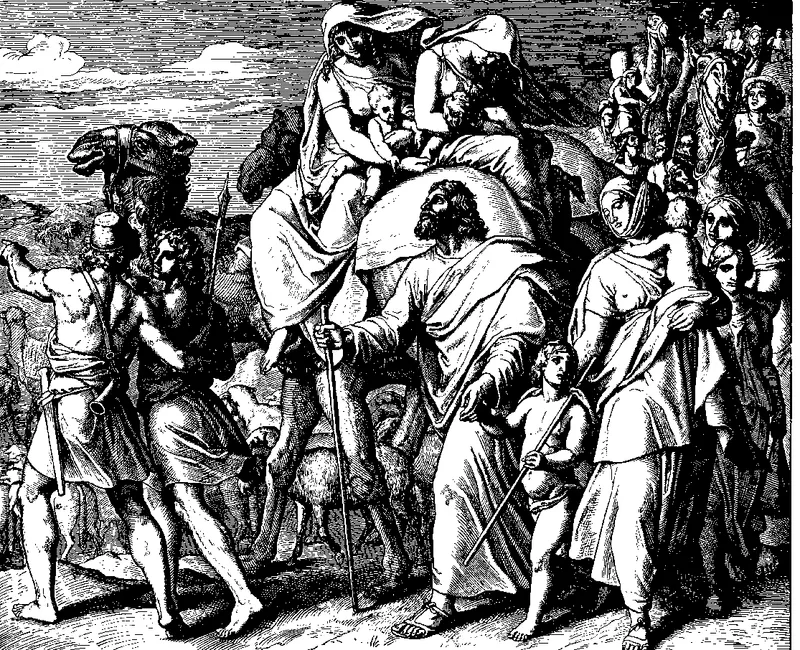
Genesis 31:1-16The Divine Call and the Secret Flight
1And he heard the words of Laban’s sons, saying, Jacob hath taken away all that was our father’s; and of that which was our father’s hath he gotten all this glory. 2And Jacob beheld the countenance of Laban, and, behold, it was not toward him as before. 3And the LORD said unto Jacob, Return unto the land of thy fathers, and to thy kindred; and I will be with thee.
The accusation is false--Jacob has built his wealth honestly, as verse 6 will explain. But lies have a way of poisoning relationships. Even when Laban's sons are speaking envy, Jacob feels the wall going up. 1 Sometimes staying becomes impossible the moment the people around you decide it has become so.
God's command is a calling, not a reward for faithfulness. Jacob must leave. His covenant belongs in Canaan, and God is calling him back to it. 2 God names him to go home.
4And Jacob sent and called Rachel and Leah to the field unto his flock, 5And said unto them, I see your father’s countenance, that it is not toward me as before; but the God of my father hath been with me. 6And ye know that with all my power I have served your father. 7And your father hath deceived me, and changed my wages ten times; but God suffered him not to hurt me.
Ten times is completeness, exhaustion. Jacob is not exaggerating--he is naming a pattern of betrayal that has become habitual. Laban promised him wages, then shifted the terms. A relationship built on shifting ground cannot hold.
8If he said thus, The speckled shall be thy wages; then all the cattle bare speckled: and if he said thus, The ringstraked shall be thy hire; then bare all the cattle ringstraked. 9Thus God hath taken away the cattle of your father, and given them to me. 10And it came to pass at the time that the cattle conceived, that I lifted up mine eyes, and saw in a dream, and, behold, the rams which leaped upon the cattle were ringstraked, speckled, and grisled.
11And the angel of God spake unto me in a dream, saying, Jacob: And I said, Here am I. 12And he said, Lift up now thine eyes, and see, all the rams which leap upon the cattle are ringstraked, speckled, and grisled: for I have seen all that Laban doeth unto thee. 13I am the God of Bethel, where thou anointedst the pillar, and where thou vowedst a vow unto me: now arise, get thee out from this land, and return unto the land of thy kindred.
God does not argue Jacob into obedience. He reminds him. Bethel--the place where Jacob once saw the ladder and made a vow to God--becomes the anchor for this new command. God is saying: You made me a promise there. This is how you keep it. The vow Jacob made in desperation, fleeing from Esau, is now being called back in his name.
14And Rachel and Leah answered and said unto him, Is there yet any portion or inheritance for us in our father’s house? 15Are we not counted of him strangers? for he hath sold us, and hath quite devoured also our money. 16For all the riches which God hath taken from our father, that is ours, and our children’s: now then, whatsoever God hath said unto thee, do.
The wives have a legitimate claim. In ancient custom, the bride-price belonged to the family, and if a man remarried the daughters of a different father, his wealth should remain in the household. But Laban has spent it. Rachel and Leah are saying: We have no home here. We have no inheritance. God has made us your wives--let us follow you to yours. It is both practical and loyal.
Genesis 31:17-25Laban Pursues
17Then Jacob rose up, and set his sons and his wives upon camels; 18And he carried away all his cattle, and all his goods which he had gotten, the cattle of his getting, which he had gotten in Padanaram, for to go to Isaac his father in the land of Canaan. 19And Laban went to shear his sheep: and Rachel had stolen the images that were her father’s.
Rachel steals the teraphim--small household idols believed in the ancient Near East to confer inheritance rights and protection on a household. Why does she take them? The text never tells us. She might believe they protect her on the journey. She might be reclaiming what she sees as rightfully hers--a daughter's share of the household gods. Or she might be acting out of bitterness toward a father who has treated her like a commodity. The text leaves the theft unresolved, and that silence is important. Not every act of disobedience the Bible records is directly condemned.
20And Jacob stole away unawares to Laban the Syrian, in that he told him not that he fled. 21So he fled with all that he had; and he rose up, and passed over the river, and set his face toward the mount Gilead. 22And it was told Laban on the third day that Jacob was fled. 23And he took his brethren with him, and pursued after him seven days’ journey; and they overtook him in the mount Gilead.
Jacob leaves without saying goodbye. For a man who has just received a direct command from God, he is oddly secretive. He does not announce the departure. He does not ask permission. He simply goes--and in doing so, he exposes how deep the mistrust has become. Two men who once shared a tent and a life cannot speak to each other anymore.
24And God came to Laban the Syrian in a dream by night, and said unto him, Take heed that thou speak not to Jacob either good or bad. 25Then Laban overtook Jacob. Now Jacob had pitched his tent in the mount: and Laban with his brethren pitched in the mount of Gilead.
Genesis 31:26-35The Search and Rachel's Deception
26And Laban said to Jacob, What hast thou done, that thou hast stolen away unawares to me, and carried away my daughters, as captives taken with the sword? 27Wherefore didst thou flee away secretly, and steal away from me; and didst not tell me, that I might have sent thee away with mirth, and with songs, with tabret, and with harp? 28And hast not suffered me to kiss my sons and my daughters? thou hast now done foolishly in so doing.
Laban is wounded, and his words betray it. He speaks as if Jacob has kidnapped his daughters, as if the man he loved has robbed him. Notice what Laban does not mention first: the livestock, the wealth. He grieves the daughters. It is a moment of real pain beneath the anger, and it complicates the picture. Laban is a father losing his children without goodbyes, and the anger belongs to that grief.
29It is in the power of my hand to do you hurt: but the God of your father spake unto me yesternight, saying, Take thou heed that thou speak not to Jacob either good or bad. 30And now, though thou wouldest needs be gone, because thou sore longedst after thy father’s house, yet wherefore hast thou stolen my gods? 31And Jacob answered and said to Laban, Because I was afraid: for I said, Peradventure thou wouldest take by force thy daughters from me. 32With whomsoever thou findest thy gods, let him not live: before our brethren discern thou what is thine with me, and take it to thee. For Jacob knew not that Rachel had stolen them.
Jacob, not knowing Rachel has the images, makes a curse: let him not live. It hangs in the air. Jacob will learn later that Rachel is pregnant with Benjamin, her second son. She will die giving birth to him (35:19), bringing Jacob's unwitting curse to pass. The text does not explicitly say the curse caused her death, but the echo is there, and generations of readers have heard it. Not every word we speak carelessly goes harmless into the air.
33And Laban went into Jacob’s tent, and into Leah’s tent, and into the two maidservants’ tents; but he found them not. Then went he out of Leah’s tent, and entered into Rachel’s tent. 34Now Rachel had taken the images, and put them in the camel’s furniture, and sat upon them. And Laban searched all the tent, but found them not. 35And she said to her father, Let it not displease my lord that I cannot rise up before thee; for the custom of women is upon me. And he searched, but found not the images.
Rachel sits on the gods. It is a gesture of profound disrespect in the ancient world--a woman, ritually unclean according to her own culture's standards, sitting on her father's household deities. She uses the very thing that makes her unclean--menstruation--to protect what she has stolen. She has inverted the household order completely. The gods that were meant to protect the family now rest under the body of the woman Laban tried to control.
Genesis 31:36-42Jacob Speaks His Truth
36And Jacob was wroth, and chode with Laban: and Jacob answered and said to Laban, What is my trespass? what is my sin, that thou hast so hotly pursued after me? 37Whereas thou hast searched all my stuff, what hast thou found of all thy household stuff? set it here before my brethren and thy brethren, that they may judge betwixt us both. 38This twenty years have I been with thee; thy ewes and thy she goats have not cast their young, and the rams of thy flock have I not eaten. 39That which was torn of beasts I brought not unto thee; I bare the loss of it; of my hand didst thou require it, whether stolen by day, or stolen by night.
Jacob is claiming faithfulness. For twenty years, he bore losses that belonged to the owner--the animals that died, the ones torn by beasts. He demanded nothing of Laban in return. He is asking: What more do you want from me? It is a legitimate question of a man worn out by ingratitude.
40Thus I was; in the day the drought consumed me, and the frost by night; and my sleep departed from mine eyes. 41Thus have I been twenty years in thy house; I served thee fourteen years for thy two daughters, and six years for thy cattle: and thou hast changed my wages ten times. 42Except the God of my father, the God of Abraham, and the fear of Isaac, had been with me, surely thou hadst sent me away now empty. God hath seen mine affliction and the labour of my hands, and rebuked thee yesternight.
Jacob's final appeal goes to God's justice. Except the God of my father had been with me--this is the refrain that runs through Jacob's whole journey. He has been alone, far from home, working for a man who betrays him repeatedly, and the only thing that has kept him from utter ruin is that God saw him. God witnessed his suffering. God defended him. This is the language of vindication. Jacob has been justified by One greater than Laban, and that is enough.
Genesis 31:43-55The Covenant of Mizpah
43And Laban answered and said unto Jacob, These daughters are my daughters, and these children are my children, and these cattle are my cattle, and all that thou seest is mine: and what can I do this day unto these my daughters, or unto their children which they have born? 44Now therefore come thou, let us make a covenant, I and thou; and let it be for a witness between me and thee. 45And Jacob took a stone, and set it up for a pillar. 46And Jacob said unto his brethren, Gather stones; and they took stones, and made an heap: and they did eat there upon the heap.
Laban's words are both true and false. Yes, he is Jacob's father-in-law and has legal claims. But Jacob has paid for every daughter and every lamb with his own labor. The moment Laban invokes these claims is the moment he loses the power to enforce them. He cannot touch Jacob now. God has made that clear. So instead, Laban asks for something different: a boundary. A witness. Something to mark that two men who were once close can no longer be trusted together.
47And Laban called it Jegarsahadutha: but Jacob called it Galeed. 48And Laban said, This heap is a witness between me and thee this day. Therefore was the name of it called Galeed; 49And Mizpah; for he said, The LORD watch between me and thee, when we are absent one from another.
50If thou shalt afflict my daughters, or if thou shalt take other wives beside my daughters, no man is with us; see, God is witness betwixt me and thee. 51And Laban said to Jacob, Behold this heap, and behold this pillar, which I have cast betwixt me and thee: 52This heap be witness, and this pillar be witness, that I will not pass over this heap to thee, and that thou shalt not pass over this heap and this pillar unto me, for harm. 53The God of Abraham, and the God of Nahor, the God of their father, judge betwixt us. And Jacob sware by the fear of his father Isaac.
54Then Jacob offered sacrifice upon the mount, and called his brethren to eat bread: and they did eat bread, and tarried all night in the mount. 55And early in the morning Laban rose up, and kissed his sons and his daughters, and blessed them: and Laban departed, and returned unto his place.
Before they part, they eat together. The covenant is sealed over a shared meal, a moment where they remember that they were once family. Laban blesses his daughters and grandchildren before he leaves. It is a sad goodbye--a goodbye that marks an ending of intimacy--but it is a goodbye. Two men who cannot live together have found a way to part without destroying each other.
Research trail
Sources & further study
These references support the historical, linguistic, manuscript, and contextual notes in this chapter. Scripture remains the primary text; external sources are provided so readers can inspect the research directly.