Genesis 32
People in this chapter
Jacob is going home. For twenty years he has lived in exile in Haran, hiding from the brother he cheated. He has built a family, amassed herds and servants, and survived the schemes of his father-in-law. Now the time has come to go back to Canaan, to face the man he wronged. And Esau is coming to meet him - with four hundred men.
Tap any highlighted phrase to jump to the commentary that unpacks it.
Genesis 32:1-8Fear and Division
1And Jacob went on his way, and the angels of God met him. 2And when Jacob saw them, he said, This is God’s host: and he called the name of that place Mahanaim. 3And Jacob sent messengers before him to Esau his brother unto the land of Seir, the country of Edom. 4And he commanded them, saying, Thus shall ye speak unto my lord Esau; Thy servant Jacob saith thus, I have sojourned with Laban, and stayed there until now:
Jacob flees Laban and encounters God's army at Mahanaim. His prayer is raw-he names his fear of Esau and cries out for deliverance.
5And I have oxen, and asses, flocks, and menservants, and womenservants: and I have sent to tell my lord, that I may find grace in thy sight. 6And the messengers returned to Jacob, saying, We came to thy brother Esau, and also he cometh to meet thee, and four hundred men with him. 7Then Jacob was greatly afraid and distressed: and he divided the people that was with him, and the flocks, and herds, and the camels, into two bands; 8And said, If Esau come to the one company, and smite it, then the other company which is left shall escape.
Jacob has barely left Laban's house when angels appear. He has not sought them out or deserved them. They come. The God who will wrestle with Jacob later - who will wound him and remake him - sends His messengers first. 1 Before the breaking, there is comfort. Before the trial, there is a sign that Jacob is not alone.
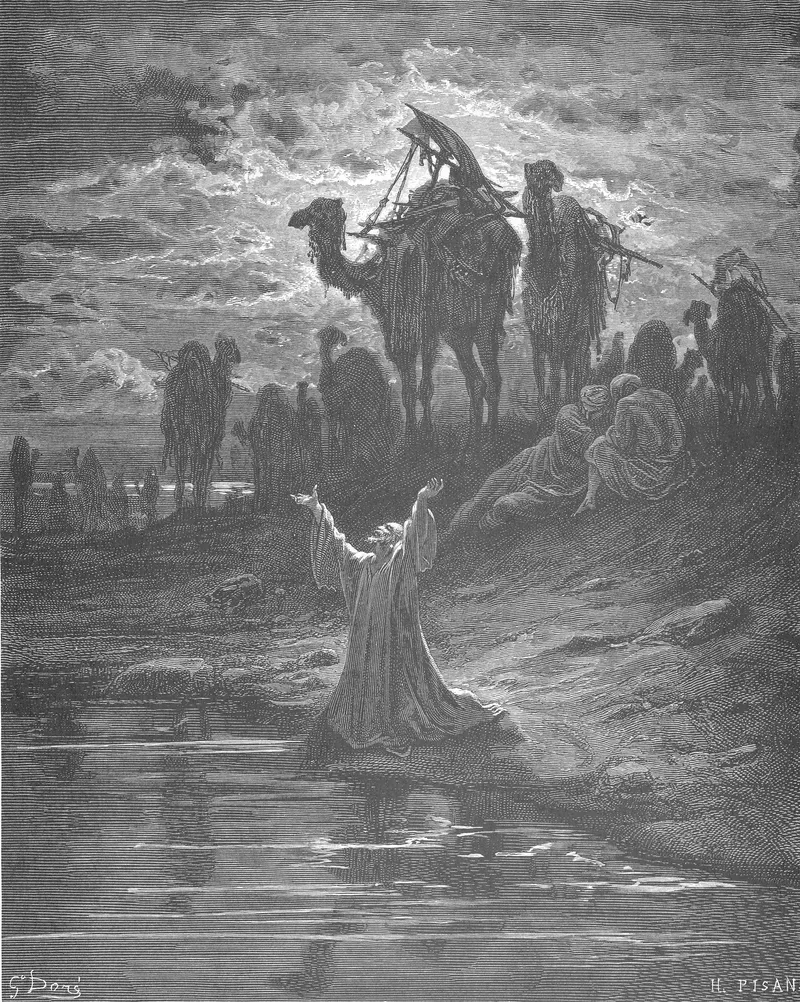
Four hundred men. The number is meant to be terrifying. Esau has become powerful in the land while Jacob lived in exile. And now Jacob learns that his brother is coming to meet him at speed. 2 The reconciliation he hoped for is about to become a battle.
Jacob's first response to fear is to divide. Split the people, divide the animals - if half are destroyed, at least half survive. It is a logical response, a practical hedge, and it is fear doing the thinking. Faith says, God is with me. I will walk forward whole. Jacob is about to learn that wholeness comes through being broken by God and held fast.
Genesis 32:9-12The Prayer
9And Jacob said, O God of my father Abraham, and God of my father Isaac, the LORD which saidst unto me, Return unto thy country, and to thy kindred, and I will deal well with thee: 10I am not worthy of the least of all the mercies, and of all the truth, which thou hast shewed unto thy servant; for with my staff I passed over this Jordan; and now I am become two bands. 11Deliver me, I pray thee, from the hand of my brother, from the hand of Esau: for I fear him, lest he will come and smite me, and the mother with the children. 12And thou saidst, I will surely do thee good, and make thy seed as the sand of the sea, which cannot be numbered for multitude.
Jacob begins by naming the God of Abraham and Isaac - the God whose promises have been fulfilled across generations. He is praying into a covenant that precedes him and will outlast him. The prayer is an anchor into something larger than his terror.
This is the most honest sentence in the prayer: I am not worthy. Jacob came with a staff - one man, alone, with nothing. God gave him wives, children, flocks, and servants. He has become two bands, multiplied beyond measure. And yet he fears losing it all. The prayer holds two truths together: everything is a gift, and everything can be taken. That tension is the place where Jacob will meet God.
It is important that Jacob names the threat precisely. Not just himself, but the mother with the children. His family. The fear is specific and embodied: the people he loves might be destroyed. In a moment, God will answer this prayer by breaking Jacob himself, teaching him that his family cannot be protected by his strength or his schemes. Only by God's keeping.
Genesis 32:13-21The Gifts Sent Ahead
13And he lodged there that same night; and took of that which came to his hand a present for Esau his brother; 14Two hundred she goats, and twenty he goats, two hundred ewes, and twenty rams, 15Thirty milch camels with their colts, forty kine, and ten bulls, twenty she asses, and ten foals. 16And he delivered them into the hand of his servants, every drove by themselves; and said unto his servants, Pass over before me, and put a space betwixt drove and drove.
Jacob prepares; but then he encounters the stranger and wrestles until dawn-fear gives way to transformation.
17And he commanded the foremost, saying, When Esau my brother meeteth thee, and asketh thee, saying, Whose art thou? and whither goest thou? and whose are these before thee? 18Then thou shalt say, They be thy servant Jacob’s; it is a present sent unto my lord Esau: and, behold, also he is behind us. 19And so commanded he the second, and the third, and all that followed the droves, saying, On this manner shall ye speak unto Esau, when ye find him. 20And say ye moreover, Behold, thy servant Jacob is behind us. For he said, I will appease him with the present that goeth before me, and afterward I will see his face; peradventure he will accept of me. 21So went the present over before him: and himself lodged that night in the company.
Jacob sends a present. Not once, but in waves - the droves divided so that each encounter with Esau prepares him for the next. Jacob is still trying to manage the encounter through his own resources. He trusts his gifts more than he trusts God. The gifts are legitimate, but the key turns out to be what Jacob leaves behind - himself, alone, at the river.
Jacob says, “I will appease him with the present, and afterward I will see his face.” He will see Esau's face. But before that, in the dark at the Jabbok, he will see another face - the face of God. And he will say of that encounter, “I have seen God face to face, and my life is preserved.” The order matters. The encounter with God precedes the reconciliation with the brother.
Genesis 32:22-28The Wrestler in Darkness
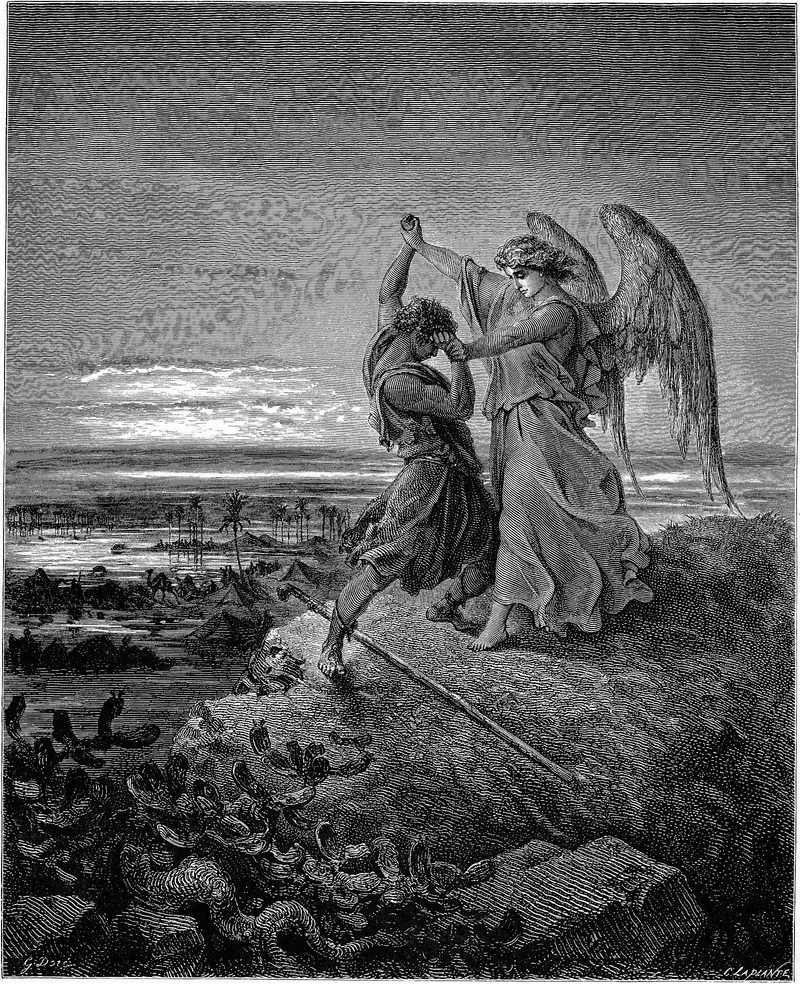
22And he rose up that night, and took his two wives, and his two womenservants, and his eleven sons, and passed over the ford Jabbok. 23And he took them, and sent them over the brook, and sent over that he had. 24And Jacob was left alone; and there wrestled a man with him until the breaking of the day.
The gift is sent ahead, but Jacob stays behind--alone at the river. A man wrestles him until dawn, and Jacob will not let go until he is blessed and renamed.
25And when he saw that he prevailed not against him, he touched the hollow of his thigh; and the hollow of Jacob’s thigh was out of joint, as he wrestled with him. 26And he said, Let me go, for the day breaketh. And he said, I will not let thee go, except thou bless me. 27And he said unto him, What is thy name? And he said, Jacob. 28And he said, Thy name shall be called no more Jacob, but Israel: for as a prince hast thou power with God and with men, and hast prevailed.
Jacob sends everyone across. He is alone. At the moment of greatest need, he is separated from everything - wife, children, servants, animals, the weight of his wealth. There is nothing left but Jacob and the darkness and a river. The condition is necessary. What is about to happen cannot happen while Jacob is still holding on to his defenses.
A Man appears. The text does not explain who He is. Jacob will later tell his name - Peniel, “the face of God” - “because I have seen God face to face, and my life is preserved” (v. 30). But in the moment, Jacob does not know. He only knows that something is holding him, and he cannot let go.
The Man touches his thigh - the socket of the hip - and it goes out of joint. In a moment, Jacob will be physically broken. He will limp the rest of his life. This is not gentle. The God who comes to Jacob in the dark comes to break him, and in breaking him, to remake him.
Jacob holds on. The Man says, Let me go, for the day breaketh. But Jacob refuses. I will not let thee go, except thou bless me. Jacob is broken, outnumbered, alone in the dark, and he demands a blessing. He will not let go. The prayer of verse 9-12 was the orderly petition of a frightened man; this is the prayer of a man who has been torn apart and found something worth holding onto even more. The Man is breaking free and Jacob is holding on with the last strength he has. Bless me.
Genesis 32:29-32The New Name and the Broken Thigh
29And Jacob asked him, and said, Tell me, I pray thee, thy name. And he said, Wherefore is it that thou dost ask after my name? And he blessed him there. 30And Jacob called the name of the place Peniel: for I have seen God face to face, and my life is preserved. 31And as he passed over Penuel the sun rose upon him, and he halted upon his thigh. 32Therefore the children of Israel eat not of the sinew which shrank, which is upon the hollow of the thigh, unto this day: because he touched the hollow of Jacob’s thigh in the sinew that shrank.
The Man asks, Wherefore is it that thou dost ask after my name? The question is not answered. Jacob never learns the name. And then the Man blesses him. Despite the wrestling, despite the refusal to let go - or perhaps because of it - the Man grants the blessing. The blessing requires only that Jacob receive it.
I have seen God face to face, and my life is preserved. This is extraordinary. The Old Testament assumption is that no one can see God and live (cf. Exodus 33:20). Jacob has broken that assumption. He has met the presence of God visibly and survived. The mystery is not explained. The text does not say how this is possible. It only says that it happened. And Jacob knows it.
And he halted upon his thigh. Jacob limps for the rest of his life. The blessing does not undo the wound. The breaking is permanent. Israel - the new name - is a name written in a limp. Every step Jacob takes reminds him of the night he met God. The limp is a mark, a sign that he has been held by something stronger than himself and that he did not let go.
The Limp That Proves the Blessing
Jacob entered this chapter terrified - looking over his shoulder at an enemy he had wronged, dividing his people to hedge against loss, sending gifts ahead to appease. By the end, he has been dismantled. His thigh is broken. His body bears the mark. And he is whole. Israel - the new name - walks forward into the day, limping. The blessing required the breaking. The wholeness required the wound.
This is the pattern that runs through all of Scripture. The God who comes to us comes to remake us. Paul writes, “If any man be in Christ, he is a new creature: old things are passed away; behold, all things are become new” (2 Cor. 5:17). The newness is not purchased cheaply. Christ was broken. He rose. And those who follow Him are broken too - unmade and made again. The limp is the proof. It says: I have been held by God. I will not let go.
Research trail
Sources & further study
These references support the historical, linguistic, manuscript, and contextual notes in this chapter. Scripture remains the primary text; external sources are provided so readers can inspect the research directly.