Genesis 33
People in this chapter
Jacob has crossed the river Jabbok. He has wrestled all night with God in the dark and been given a new name - Israel, “for as a prince hast thou power with God and with men, and hast prevailed” (32:28). He limps from the encounter, blessed and broken. But the dread that has shadowed him for twenty years is about to walk over the horizon in person. Jacob lifted up his eyes, and looked, and, behold, Esau came, and with him four hundred men (v. 1).
The brother he deceived out of birthright and blessing, the brother who once swore to kill him (27:41), is here.1
Tap any highlighted phrase to jump to the commentary that unpacks it.
Genesis 33:1-3He Lifted Up His Eyes
1And Jacob lifted up his eyes, and looked, and, behold, Esau came, and with him four hundred men. And he divided the children unto Leah, and unto Rachel, and unto the two handmaids. 2And he put the handmaids and their children foremost, and Leah and her children after, and Rachel and Joseph hindermost. 3And he passed over before them, and bowed himself to the ground seven times, until he came near to his brother.
The chapter opens on a single dreadful sight: Jacob lifted up his eyes, and looked, and, behold, Esau came, and with him four hundred men (v. 1). For twenty years the fear has lived inside Jacob as a story he told himself in the dark - the brother he cheated, the death-threat he fled (27:41). Now the story has a body and a number. Four hundred men is the size of a raiding band, the same figure later used for David's armed company in the wilderness (1 Sam. 22:2).
And yet the timing matters enormously. This is the morning after Peniel. Jacob meets his brother only after he has met God and been wounded and renamed. The man who lifts his eyes here has wrestled through the night and been changed, walking out to face the thing he most dreads while the dawn is still on him.1
Watch how carefully Jacob arranges his household: the handmaids and their children foremost, and Leah and her children after, and Rachel and Joseph hindermost (v. 2). The order is a confession. He sets the ones he loves least where the first blow would fall and the ones he loves most where they would have time to flee. It is the arithmetic of a man bracing for slaughter, trying to minimize what he stands to lose.
There is something painfully honest in it. Jacob has just been told he prevailed with God; he has the promise. But promise and fear can occupy the same heart at the same time, and at this moment fear is still doing the planning. He does not yet know that mercy is walking toward him. He is preparing for the worst because the worst is all his history has taught him to expect.
Then Jacob does the one thing a man of his cunning does not naturally do: he passed over before them, and bowed himself to the ground seven times, until he came near to his brother (v. 3). He goes out ahead of his family rather than hiding behind them - the first sign that something has shifted. And he bows seven times. In the diplomacy of the ancient world this was the homage a subject paid a king, the lowest and most complete form of submission; letters recovered from the period describe a vassal falling before his overlord “seven times and seven times.” Jacob, who grasped at the right to rule over his brother (27:29), now puts his face in the dust before him seven times over.
He is abasing himself completely before the brother he wronged, asking for a grace he has no power to compel and no certainty will come.2
Genesis 33:4-11He Ran to Meet Him · I Have Seen Thy Face
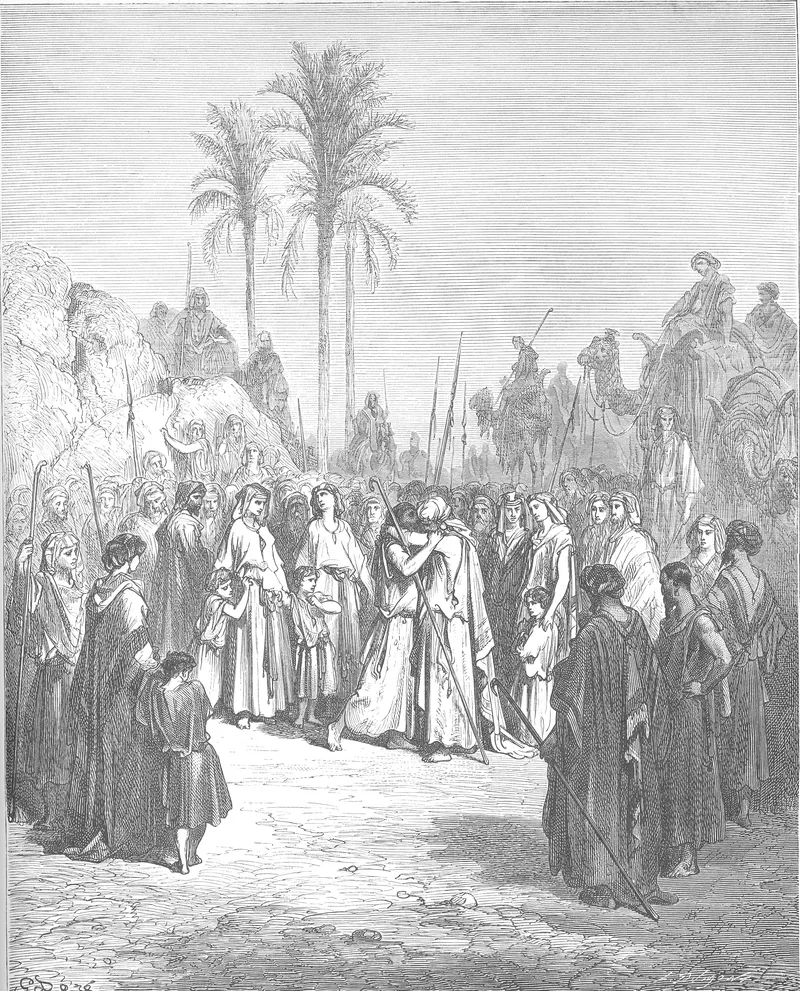
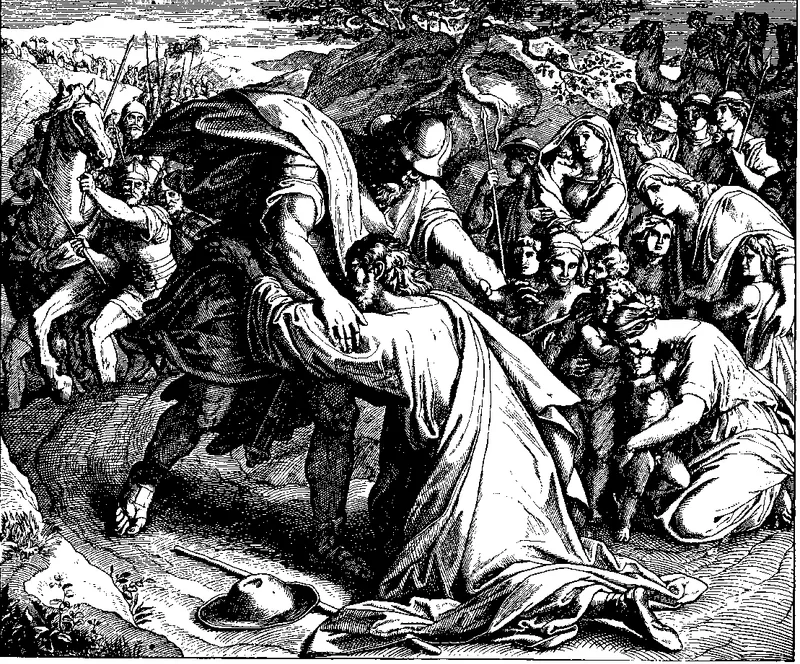
4And Esau ran to meet him, and embraced him, and fell on his neck, and kissed him: and they wept. 5And he lifted up his eyes, and saw the women and the children; and said, Who are those with thee? And he said, The children which God hath graciously given thy servant. 6Then the handmaidens came near, they and their children, and they bowed themselves. 7And Leah also with her children came near, and bowed themselves: and after came Joseph near and Rachel, and they bowed themselves. 8And he said, What meanest thou by all this drove which I met? And he said, These are to find grace in the sight of my lord. 9And Esau said, I have enough, my brother; keep that thou hast unto thyself. 10And Jacob said, Nay, I pray thee, if now I have found grace in thy sight, then receive my present at my hand: for therefore I have seen thy face, as though I had seen the face of God, and thou wast pleased with me. 11Take, I pray thee, my blessing that is brought to thee; because God hath dealt graciously with me, and because I have enough. And he urged him, and he took it.
Every line of preparation is undone in a single sentence: Esau ran to meet him, and embraced him, and fell on his neck, and kissed him: and they wept (v. 4). The man with four hundred men runs - arms open, not raised. The one who had sworn to kill throws his arms around the brother who wronged him before a word of apology is offered, before the carefully ordered gifts are explained, before Jacob can finish bowing.
And then they both weep. Twenty years of dread, the death-threat, the stolen blessing, the long exile - all of it gives way to tears on each other's necks. The text does not tell us what changed in Esau across those years; it simply shows us the change. While Jacob wrestled God on one side of the river, God had not been idle on the other. Grace has gotten to Esau first, and the brother Jacob braced himself against is the brother who runs to meet him.
When Esau lifts his eyes to the women and children and asks who they are, Jacob answers without a trace of his old craft: The children which God hath graciously given thy servant (v. 5). He names everything he has as a gift graciously given, making no claim of his own. The family he had positioned for a massacre now comes forward in turn and bows - the handmaids and their children, then Leah and hers, then Joseph and Rachel last of all (vv. 6-7).
Then Esau asks about the droves of livestock that had met him on the road, the waves of gifts Jacob had sent ahead (v. 8). Esau's reply is striking: I have enough, my brother; keep that thou hast unto thyself (v. 9). He calls Jacob my brother - the relationship restored in a word - and he refuses the gift, because a man who has already forgiven does not need to be paid for it. The reconciliation is real before any present changes hands.
Jacob will not let the matter rest there. He presses the gift on his reluctant brother: Nay, I pray thee, if now I have found grace in thy sight, then receive my present at my hand… Take, I pray thee, my blessing that is brought to thee; because God hath dealt graciously with me, and because I have enough (vv. 10-11). Notice the order of things. The grace has already come in the embrace; Jacob gives in response to it, from abundance already received.
He gives because God hath dealt graciously with him, and because, like Esau, he can now say I have enough. Two brothers who once fought over a single blessing now stand here each insisting he has plenty and pressing the abundance on the other. And the verse ends with quiet beauty: he urged him, and he took it. Jacob, who once schemed to take what was his brother's, now urges his brother to take what is his own - and the taking, this time, is grace on both sides.2
Genesis 33:12-20The Parting · El-elohe-Israel
12And he said, Let us take our journey, and let us go, and I will go before thee. 13And he said unto him, My lord knoweth that the children are tender, and the flocks and herds with young are with me: and if men should overdrive them one day, all the flock will die. 14Let my lord, I pray thee, pass over before his servant: and I will lead on softly, according as the cattle that goeth before me and the children be able to endure, until I come unto my lord unto Seir. 15And Esau said, Let me now leave with thee some of the folk that are with me. And he said, What needeth it? let me find grace in the sight of my lord. 16So Esau returned that day on his way unto Seir. 17And Jacob journeyed to Succoth, and built him an house, and made booths for his cattle: therefore the name of the place is called Succoth. 18And Jacob came to Shalem, a city of Shechem, which is in the land of Canaan, when he came from Padanaram; and pitched his tent before the city. 19And he bought a parcel of a field, where he had spread his tent, at the hand of the children of Hamor, Shechem’s father, for an hundred pieces of money. 20And he erected there an altar, and called it EleloheIsrael.
After the tears, the practical parting - and here the chapter is honest about Jacob in a way that does not flatter him. Esau offers to travel together: Let us take our journey, and let us go, and I will go before thee (v. 12). Jacob declines, with reasons that are perfectly reasonable on their face: the children are tender, the nursing flocks cannot be driven hard, and if men should overdrive them one day, all the flock will die (v. 13).
He asks Esau to go on ahead, promising, I will lead on softly… until I come unto my lord unto Seir (v. 14). And when Esau offers to leave some of his men as an escort, Jacob gently waves it off (v. 15). The care for the young and the vulnerable is real and good; a shepherd who refuses to overdrive tender flocks is doing right by them. But read on, and you notice Jacob does not in fact go to Seir - he turns toward Succoth and Shechem instead.
The man has been embraced, but he is not yet ready to fold his life into his brother's. He keeps a little distance, keeps control of the pace.
It is worth pausing over Jacob's lingering caution rather than rushing to scold it. So Esau returned that day on his way unto Seir - but Jacob journeyed to Succoth, and built him an house, and made booths for his cattle (vv. 16-17). He spoke of following to Seir; he went the other way. The text simply records it, without a word of blame, and we can afford the same restraint. Grace had been given fully; the courage to live close to the one who gave it comes more slowly.
Forgiveness can be received in an instant, while learning to trust it - to relax the old guardedness, to stop managing the distance - can take far longer. Jacob is somewhere in between: genuinely reconciled, not yet wholly at ease. That is most of us, most of the time. The reunion was real even though the wariness lingered; the embrace was not undone by the fact that Jacob still kept his own counsel about where to go.
Grace had opened a door he was not yet brave enough to walk all the way through - and the chapter lets that stand without condemning the man for it.1
But notice what Jacob does do, for it is the quiet triumph of the whole chapter. Jacob came to Shalem, a city of Shechem… and pitched his tent before the city. And he bought a parcel of a field… for an hundred pieces of money (vv. 18-19). For the first time since he fled as a frightened young man, Jacob is not running. He buys land - he puts down a stake in the country of promise, the same ground his grandfather Abraham had been promised (12:7).
And then: he erected there an altar, and called it El-elohe-Israel (v. 20). The arc of flight and fear that has defined him since chapter 27 closes here. A worshiper with a home and an altar has taken the place of the fugitive. The chapter does not end in perfect safety - Shechem is where the violence of chapter 34 waits. But the long running is over. A man who has been met by grace, even an imperfect and still-cautious man, can at last stop fleeing and start to build, and buy, and worship.3
Research trail
Sources & further study
These references support the historical, linguistic, manuscript, and contextual notes in this chapter. Scripture remains the primary text; external sources are provided so readers can inspect the research directly.
- Genesis 33 - Translators' NotesThe NET Bible's detailed footnotes on Genesis 33 - the customs behind the sevenfold bow and the gift Jacob calls his blessing, the diplomacy of the parting in verses 12-15, and the meaning of the place names Succoth, Shalem, and the altar El-elohe-Israel in verses 17-20.
- Genesis 33 · Hebrew + classical Jewish commentaryThe Hebrew text of Genesis 33 with Rashi, Ibn Ezra, and other classical commentators side by side - useful for the repeated word panim (“face,” vv. 10, 18, and behind Peniel in 32:30), for berakah (v. 11, the “blessing” pressed on Esau), and for the much-discussed sevenfold bowing of verse 3.
- Genesis 33 ↔ Luke 15 · 2 Corinthians 5 · Matthew 18Traces the threads tying Genesis 33 to the rest of Scripture - the running embrace of verse 4 read alongside the father who ran, and fell on his neck, and kissed him (Luke 15:20), and the reconciliation of two brothers read beside the apostolic plea, be ye reconciled to God (2 Cor. 5:20), and the forgiven debtor who must forgive his fellow (Matt. 18:33).
Where this echoes in Scripture
He Lifted Up His Eyes
- Genesis 32:6-7Esau... cometh to meet thee, and four hundred men with him. Then Jacob was greatly afraid and distressed.The dread that hangs over verse 1 - the report that set Jacob arranging his family for the worst.
- Genesis 27:41Esau hated Jacob... and Esau said in his heart... then will I slay my brother Jacob.Why four hundred men terrified Jacob (v. 1) - the death he fled twenty years before.
- Genesis 32:28Thy name shall be called no more Jacob, but Israel: for as a prince hast thou power with God... and hast prevailed.The night just past - the man bowing in verse 3 walks out newly named and newly broken.
- Proverbs 16:7When a man's ways please the LORD, he maketh even his enemies to be at peace with him.The mercy Jacob cannot see coming as he bows - an enemy turned, against all his expectation.
He Ran to Meet Him · I Have Seen Thy Face
- Luke 15:20when he was yet a great way off, his father saw him... and ran, and fell on his neck, and kissed him.The same running embrace as verse 4 - the picture the Lord chose for the Father welcoming a child home.
- 2 Corinthians 5:18-20God... hath given to us the ministry of reconciliation... be ye reconciled to God.The reconciliation behind verse 10 - the human embrace standing in for the greater one.
- Matthew 5:23-24first be reconciled to thy brother, and then come and offer thy gift.Why Jacob sees God in Esau's face (v. 10) - reconciliation with brother and with God bound together.
- Genesis 27:35-36Thy brother came with subtilty, and hath taken away thy blessing... he... hath taken away my blessing.The blessing once stolen - the very word (berakah) Jacob now presses back on Esau in verse 11.
- Romans 5:8God commendeth his love toward us, in that, while we were yet sinners, Christ died for us.The grace that runs first (v. 4) - love moving toward the guilty before the apology is ready.
The Parting · El-elohe-Israel
- Genesis 12:7And the LORD appeared unto Abram, and said, Unto thy seed will I give this land: and there builded he an altar unto the LORD.The land Jacob buys and the altar he builds (vv. 19-20) - staking down in the country first promised to Abraham.
- Genesis 35:1Arise, go up to Beth-el, and dwell there: and make there an altar unto God, that appeared unto thee.Where the altar-building begun here leads - God calling Jacob on from Shechem to Beth-el.
- Matthew 11:28Come unto me, all ye that labour and are heavy laden, and I will give you rest.The rest at the end of Jacob's long flight (vv. 17-20) - the weary wrestler ceasing to run.
- 2 Corinthians 12:9My grace is sufficient for thee: for my strength is made perfect in weakness.Jacob limping to his altar (v. 20) - the blessed life carried on a wounded leg.
- Joshua 24:32the bones of Joseph... buried they in Shechem, in a parcel of ground which Jacob bought.The lasting worth of the field Jacob purchased here (v. 19) - holy ground for generations after.