Genesis 27
People in this chapter
Isaac is old. His eyes fail him. He knows the time has come to give his blessing-the prayer that would shape his eldest son's future, spoken by a dying father, irreversible once spoken. But while Isaac lies in his tent, Rebekah overhears from the doorway. The blessing Isaac means to give Esau is about to go to Jacob instead. And she is going to make it happen.
Tap any highlighted phrase to jump to the commentary that unpacks it.
Genesis 27:1-4A Blessing Prepared
1And it came to pass, that when Isaac was old, and his eyes were dim, so that he could not see, he called Esau his eldest son, and said unto him, My son: and he said unto him, Behold, here am I. 2And he said, Behold now, I am old, I know not the day of my death: 3Now therefore take, I pray thee, thy weapons, thy quiver and thy bow, and go out to the field, and take me some venison; 4And make me savoury meat, such as I love, and bring it to me, that I may eat; that my soul may bless thee before I die.
The blessing in the ancient world was a word with power in it-a father's prophetic prayer, once spoken, could not be unmade. Isaac knows this. He is moving carefully and ceremonially, with words that have already started to do their work before Esau ever brings the food. By verse 4, the blessing has already begun.
Genesis 27:5-17Rebekah Hears
5And Rebekah heard when Isaac spake to Esau his son. And Esau went to the field to hunt for venison, and to bring it. 6And Rebekah spake unto Jacob her son, saying, Behold, I heard thy father speak unto Esau thy brother, saying, 7Bring me venison, and make me savoury meat, that I may eat, and bless thee before the LORD before my death.
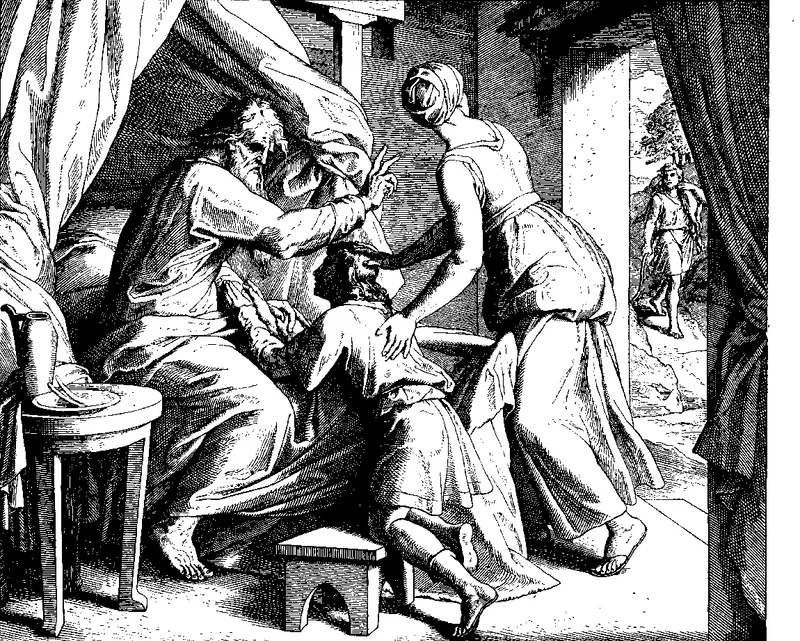
Jacob, disguised, receives the blessing meant for Esau. Isaac is deceived completely--the words of covenant flow to the wrong son.
8Now therefore, my son, obey my voice according to that which I command thee. 9Go now to the flock, and fetch me from thence two good kids of the goats; and I will make them savoury meat for thy father, such as he loveth: 10And thou shalt bring it to thy father, that he may eat, and that he may bless thee before his death. 11And Jacob said to Rebekah his mother, Behold, Esau my brother is a hairy man, and I am a smooth man:
Jacob's objection is practical - he's afraid of being caught. Rebekah's answer is just as practical: upon me be thy curse. A mother offering to take a curse for her son sounds noble, but the next chapters show what it actually costs. The deception will hold; the family will not.
12My father peradventure will feel me, and I shall seem to him as a deceiver; and I shall bring a curse upon me, and not a blessing. 13And his mother said unto him, Upon me be thy curse, my son: only obey my voice, and go fetch me them. 14And he went, and fetched, and brought them to his mother: and his mother made savoury meat, such as his father loved. 15And Rebekah took goodly raiment of her eldest son Esau, which were with her in the house, and put them upon Jacob her younger son: 16And she put the skins of the kids of the goats upon his hands, and upon the smooth of his neck: 17And she gave the savoury meat and the bread, which she had prepared, into the hand of her son Jacob.
One sentence: Rebekah heard. She does not ask the Father to move. She does not pray. She listens, understands immediately that the blessing is about to go to Esau, and decides in that moment to make it go to Jacob instead. This is a woman making a choice about her son's future, and she chooses deceit. Notice what the text does not do: it does not condemn her in the moment. It simply shows her acting.
Jacob's objection is physical: Esau is hairy, I am smooth. My father will feel me and know I am deceiving him. Jacob is afraid. Rebekah answers with five words: Upon me be thy curse. She will bear the consequences. The prayer is already made. Now Jacob moves.
Genesis 27:18-29The Voice Is Jacob's
18And he came unto his father, and said, My father: and he said, Here am I; who art thou, my son? 19And Jacob said unto his father, I am Esau thy first born; I have done according as thou badest me: arise, I pray thee, sit and eat of my venison, that thy soul may bless me. 20And Isaac said unto his son, How is it that thou hast found it so quickly, my son? And he said, Because the LORD thy God brought it to me. 21And Isaac said unto Jacob, Come near, I pray thee, that I may feel thee, my son, whether thou be my very son Esau or not. 22And Jacob went near unto Isaac his father; and he felt him, and said, The voice is Jacob’s voice, but the hands are the hands of Esau. 23And he discerned him not, because his hands were hairy, as his brother Esau’s hands: so he blessed him.
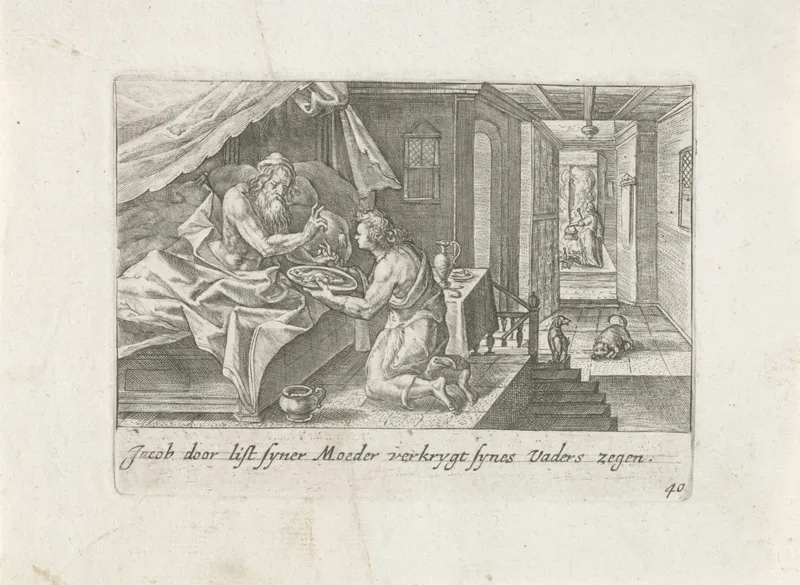
The deception succeeds. Isaac feels the hairy hands and his doubt evaporates. The goatskins held. The meal tastes right. The voice is young but it is asking for a blessing. And Isaac proceeds with the blessing-the word that will reshape a future, spoken now, irreversible. The moment of doubt passes, and Isaac surrenders to the deception. He does not continue questioning.
24And he said, Art thou my very son Esau? And he said, I am. 25And he said, Bring it near to me, and I will eat of my son’s venison, that my soul may bless thee. And he brought it near to him, and he did eat: and he brought him wine, and he drank. 26And his father Isaac said unto him, Come near now, and kiss me, my son. 27And he came near, and kissed him: and he smelled the smell of his raiment, and blessed him, and said, See, the smell of my son is as the smell of a field which the LORD hath blessed: 28Therefore God give thee of the dew of heaven, and the fatness of the earth, and plenty of corn and wine: 29Let people serve thee, and nations bow down to thee: be lord over thy brethren, and let thy mother’s sons bow down to thee: cursed be every one that curseth thee, and blessed be he that blesseth thee.
The most famous moment: Isaac's doubt. The voice is Jacob's voice, but the hands-those goatskin-wrapped hands-are Esau's. Isaac senses something is wrong. He hesitates. But the blessing is already pushing forward through his lips. He feels the hairy arms, smells what he expects to smell, eats what tastes right, and the hesitation dissolves. Doubt and desire collide, and desire wins. Isaac goes on blessing.
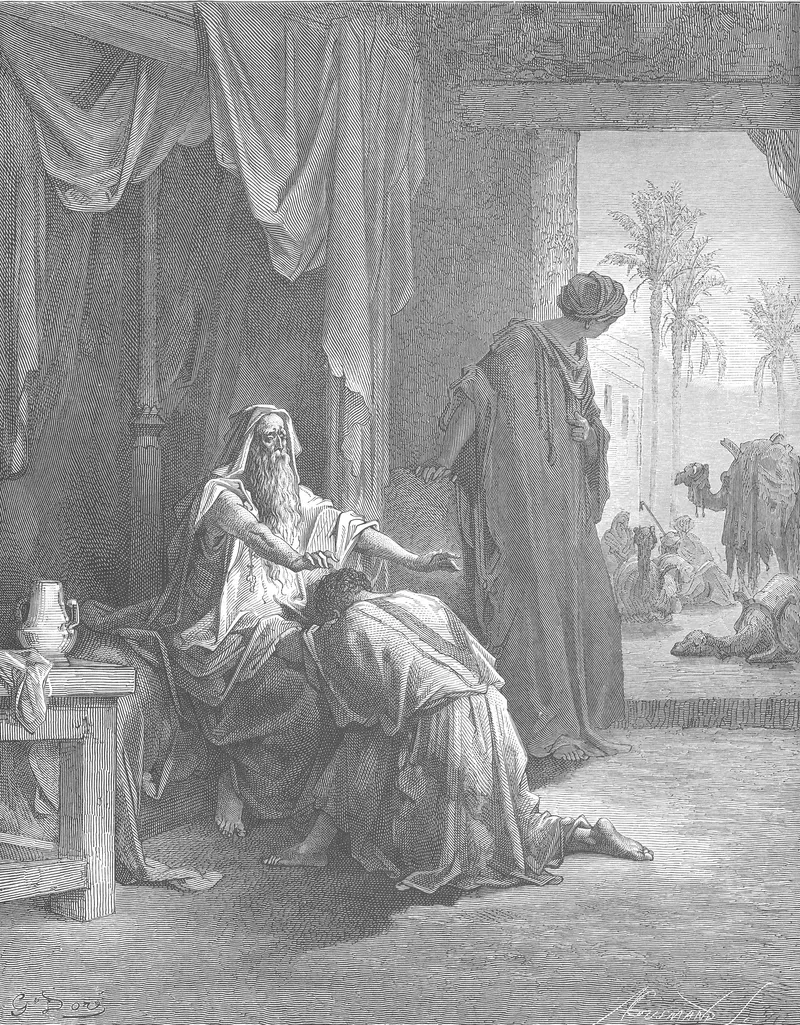
A father and son embrace. Isaac leans close enough to smell his raiment-and in that moment of physical intimacy, the deception succeeds completely. The smell of Esau's field-clothes seals what the goatskins began. Jacob's body is no longer himself in Isaac's senses; it is Esau.
Genesis 27:30-40Too Late
30And it came to pass, as soon as Isaac had made an end of blessing Jacob, and Jacob was yet scarce gone out from the presence of Isaac his father, that Esau his brother came in from his hunting. 31And he also had made savoury meat, and brought it unto his father, and said unto his father, Let my father arise, and eat of his son’s venison, that thy soul may bless me. 32And Isaac his father said unto him, Who art thou? And he said, I am thy son, thy firstborn Esau. 33And Isaac trembled very exceedingly, and said, Who? where is he that hath taken venison, and brought it me, and I have eaten of all before thou camest, and have blessed him? yea, and he shall be blessed. 34And when Esau heard the words of his father, he cried with a great and exceeding bitter cry, and said unto his father, Bless me, even me also, O my father. 35And he said, Thy brother came with subtilty, and hath taken away thy blessing.
In one sentence, Isaac tells Esau what happened: your brother deceived you and stole your blessing. The truth is laid bare. Jacob came with subtilty-with cunning, with design. And he took what was yours. Isaac does not excuse the deception. He names it clearly. And now Esau understands: his loss was orchestrated. Someone he loved conspired against him.
36And he said, Is not he rightly named Jacob? for he hath supplanted me these two times: he took away my birthright; and, behold, now he hath taken away my blessing. And he said, Hast thou not reserved a blessing for me? 37And Isaac answered and said unto Esau, Behold, I have made him thy lord, and all his brethren have I given to him for servants; and with corn and wine have I sustained him: and what shall I do now unto thee, my son? 38And Esau said unto his father, Hast thou but one blessing, my father? bless me, even me also, O my father. And Esau lifted up his voice, and wept. 39And Isaac his father answered and said unto him, Behold, thy dwelling shall be the fatness of the earth, and of the dew of heaven from above; 40And by thy sword shalt thou live, and shalt serve thy brother; and it shall come to pass when thou shalt have the dominion, that thou shalt break his yoke from off thy neck.
Timing matters. Esau returns with his own venison, his own gift, his own love. He asks a simple question: Who art thou? And Isaac understands in that moment what he has done. The voice was not Esau's. The hands were not Esau's. And now the blessing is gone, already given, already spoken, already irrevocable.
Three words that end a world: he shall be blessed. Isaac understands what has happened. The blessing cannot be unmade. It cannot be taken back. Whatever blessing he gives Esau now, it will be lesser, secondary. The law of primogeniture has been broken. Jacob, the younger, has the greater blessing.
Read that cry slowly: Bless me, even me also, O my father. Esau is not angry in this moment. He is desperate. He is the eldest son, the one who was supposed to inherit the blessing, and he is asking his father if there is something left for him. The text does not judge Esau for weeping. It simply shows us a man who has lost what was his.
Genesis 27:41-46Rebekah Sends Jacob Away
41And Esau hated Jacob because of the blessing wherewith his father blessed him: and Esau said in his heart, The days of mourning for my father are at hand; then will I slay my brother Jacob. 42And these words of Esau her elder son were told to Rebekah: and she sent and called Jacob her younger son, and said unto him, Behold, thy brother Esau, as touching thee, doth comfort himself, purposing to kill thee. 43Now therefore, my son, obey my voice; and arise, flee thou to Laban my brother to Haran; 44And tarry with him a few days, until thy brother’s fury turn away; 45Until thy brother’s anger turn away from thee, and he forget that which thou hast done to him: then I will send, and fetch thee from thence: why should I be deprived also of you both in one day? 46And Rebekah said to Isaac, I am weary of my life because of the daughters of Heth: if Jacob take a wife of the daughters of Heth, such as these which are of the daughters of the land, what good shall my life do me?
Esau's grief turns to rage. He has been dishonored in front of his father. The blessing that shaped his future has been taken by his younger brother. In his mind, there is one solution: Jacob must die. But not yet-not while Isaac lives, because he will not shame his dying father with fratricide. 1 So Esau makes a mental note. When Isaac is dead, Jacob will pay.
Rebekah hears that Esau is planning to kill Jacob. She sends her younger son away. Notice what she does not do: she does not confess to Isaac. She does not ask for his help. She cannot face what she has done. Instead, she invents a cover story-something about the daughters of Heth being unsuitable wives-and sends Jacob away to her brother Laban in Haran. 2 “A few days,” she tells him, “until thy brother's fury turn away.” Jacob will be gone twenty years.
The text says nothing more about Rebekah and Jacob together. They never see each other again.
The Shape of Genesis 27What We Do for Those We Love
Genesis 27 does not end with a moral. It ends with a fracture. A mother sends her favored son away. A father has blessed the wrong child-or rather, the right child by deception. Esau plots murder. The household is broken. And the blessing, once transferred, cannot be taken back. These are the stakes. Not “do not deceive”-though the chapter shows deception. Not “take your turn to be blessed”-though that would be easier.
But: this is what it looks like when we take our future into our own hands, when we cannot wait for God's timing, when we love someone so much that we are willing to break everything to secure them a good.
Research trail
Sources & further study
These references support the historical, linguistic, manuscript, and contextual notes in this chapter. Scripture remains the primary text; external sources are provided so readers can inspect the research directly.