Genesis 26
People in this chapter
Genesis 26 is Isaac's chapter - the only long narrative told mostly through his eyes. There is no Abraham to overshadow it, no Jacob to steal the story yet. And it is quieter than both: a chapter about staying when you would rather flee, and about digging again wells that others have filled in. A famine comes to the land. God appears to Isaac and tells him: do not go down to Egypt. Stay here. And so Isaac stays. He builds, he plants, he prospers - and when others tear down what he has built, he builds it again.
Tap any highlighted phrase to jump to the commentary that unpacks it.
Genesis 26:1-6Famine in the Land
1And there was a famine in the land, beside the first famine that was in the days of Abraham. And Isaac went unto Abimelech king of the Philistines unto Gerar. 2And the LORD appeared unto him, and said, Go not down into Egypt; dwell in the land which I shall tell thee of: 3Sojourn in this land, and I will be with thee, and will bless thee; for unto thee, and unto thy seed, I will give all these countries, and I will perform the oath which I sware unto Abraham thy father; 4And I will make thy seed to multiply as the stars of heaven, and will give unto thy seed all these countries; and in thy seed shall all the nations of the earth be blessed; 5Because that Abraham obeyed my voice, and kept my charge, my commandments, my statutes, and my laws. 6And Isaac dwelt in Gerar:
Famine is to the patriarchs what the sea is to sailors - the constant threat, the moment when faith either deepens or shatters. Isaac is at Gerar when the famine strikes. The natural move is clear: flee south to Egypt, where water still runs and granaries still stand. Abraham had done it. Why shouldn't Isaac?
But God appears to Isaac before he leaves, and tells him: stay here. Don't go down to Egypt. The word is direct, even stern. No elaborate vision, just a command and a reason. God is drawing a line for Isaac. This is Isaac's test: a trial of whether he will trust the promise when staying looks foolish12.
Here is the covenant restated for Isaac, the second generation. The same promises: land, seed like the stars, blessing to the nations. It comes to him because Abraham believed, because Abraham kept God's law, because the covenant runs in his blood. Yet it also comes with an implied weight: will Isaac keep the faith as his father did?
Genesis 26:7-11The Lie About the Wife
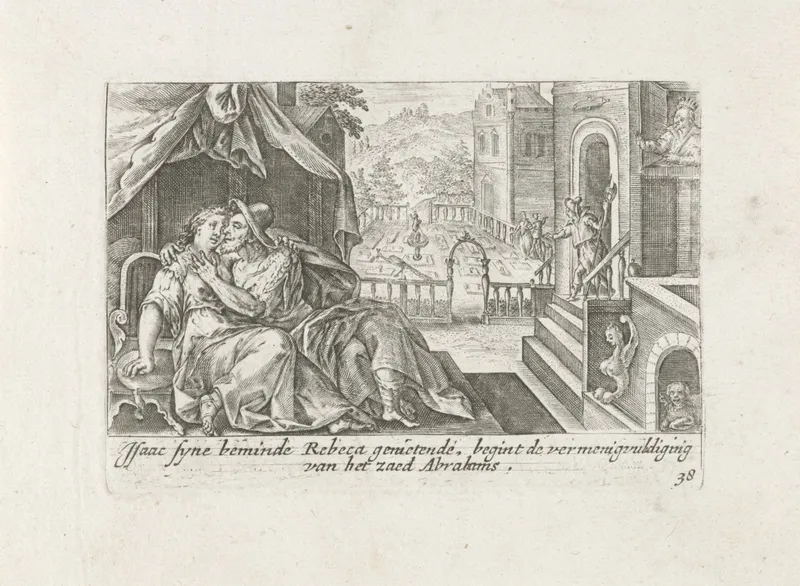
7And the men of the place asked him of his wife; and he said, She is my sister: for he feared to say, She is my wife; lest, said he, the men of the place should kill me for Rebekah; because she was fair to look upon. 8And it came to pass, when he had been there a long time, that Abimelech king of the Philistines looked out at a window, and saw, and, behold, Isaac was sporting with Rebekah his wife. 9And Abimelech called Isaac, and said, Behold, of a surety she is thy wife: and how saidst thou, She is my sister? And Isaac said unto him, Because I said, Lest I die for her. 10And Abimelech said, What is this thou hast done unto us? one of the people might lightly have lien with thy wife, and thou shouldest have brought guiltiness upon us. 11And Abimelech charged all his people, saying, He that toucheth this man or his wife shall surely be put to death.
Isaac does exactly what his father Abraham did in Genesis 12 and 20. He tells the king that Rebekah is his sister, not his wife, out of fear that her beauty will get him killed. The lie is rational. It is also, apparently, endemic to this family. And it still works - in a sense. Abimelech doesn't kill him. But the text does not celebrate the deception. It simply records it, uncomfortable as it is. A man of faith can still act as if he has no faith.
How long does the lie last? Long enough that Abimelech eventually sees Isaac and Rebekah together in an intimate moment and figures out the truth. The word translated "sporting" carries overtones of tenderness, affection - the opposite of the suspicion Isaac's fear conjured. If Abimelech had known from the start that Rebekah was Isaac's wife, he would have protected her. Instead, Isaac's cowardice almost cost Rebekah her honor and Abimelech his unwitting guilt. The text holds both truths: Isaac got what he wanted (safety) and set the stage for a near-catastrophe. Fear-driven solutions often do.
Genesis 26:12-22Sowing and Digging Again
12Then Isaac sowed in that land, and received in the same year an hundredfold: and the LORD blessed him. 13And the man waxed great, and went forward, and grew until he became very great: 14For he had possession of flocks, and possession of herds, and great store of servants: and the Philistines envied him. 15For all the wells which his father’s servants had digged in the days of Abraham his father, the Philistines had stopped them, and filled them with earth. 16And Abimelech said unto Isaac, Go from us; for thou art much mightier than we.
Success creates enemies. The Philistines see Isaac thriving, his flocks multiplying, his power growing, and they become afraid. Their solution is swift: leave. Go away. It is a demand backed by political power. Isaac has been blessed so much that he has become a threat. And he obeys.
17And Isaac departed thence, and pitched his tent in the valley of Gerar, and dwelt there. 18And Isaac digged again the wells of water, which they had digged in the days of Abraham his father; for the Philistines had stopped them after the death of Abraham: and he called their names after the names by which his father had called them. 19And Isaac’s servants digged in the valley, and found there a well of springing water. 20And the herdmen of Gerar did strive with Isaac’s herdmen, saying, The water is ours: and he called the name of the well Esek; because they strove with him. 21And they digged another well, and strove for that also: and he called the name of it Sitnah. 22And he removed from thence, and digged another well; and for that they strove not: and he called the name of it Rehoboth; and he said, For now the LORD hath made room for us, and we shall be fruitful in the land.
Abraham had dug wells. A well in the desert is survival: the difference between life and death, between passing through and staying. When Isaac inherits, the Philistines have deliberately filled them in. They have erased his father's mark on the land. And Isaac does not rage at them. He simply digs again.
What is the text teaching here? Isaac keeps having to move, to abandon his wells, to start over. His wisdom is the patience to do the same work three times. To name each well with honest acknowledgment of what happened there, carrying the memory without the bitterness. And to keep going. The wells are a small thing, repeated. This is the whole of the chapter.
Genesis 26:23-33The Covenant and Rest
23And he went up from thence to Beersheba. 24And the LORD appeared unto him the same night, and said, I am the God of Abraham thy father: fear not, for I am with thee, and will bless thee, and multiply thy seed for my servant Abraham’s sake. 25And he builded an altar there, and called upon the name of the LORD, and pitched his tent there: and there Isaac’s servants digged a well. 26Then Abimelech went to him from Gerar, and Ahuzzath one of his friends, and Phichol the chief captain of his army. 27And Isaac said unto them, Wherefore come ye to me, seeing ye hate me, and have sent me away from you? 28And they said, We saw certainly that the LORD was with thee: and we said, Let there be now an oath betwixt us, even betwixt us and thee, and let us make a covenant with thee;
Abimelech arrives to propose a covenant. His words are key: "We saw certainly that the LORD was with thee." What the Philistines saw was not Isaac's strength or military might. They saw God. The well-digging, the perseverance, the refusal to fight-all of it had become visible proof that God was with him. His faithfulness had spoken louder than his words ever could.
29That thou wilt do us no hurt, as we have not touched thee, and as we have done unto thee nothing but good, and have sent thee away in peace: thou art now the blessed of the LORD. 30And he made them a feast, and they did eat and drink. 31And they rose up betimes in the morning, and sware one to another: and Isaac sent them away, and they departed from him in peace. 32And it came to pass the same day, that Isaac’s servants came, and told him concerning the well which they had digged, and said unto him, We have found water. 33And he called it Shebah: therefore the name of the city is Beersheba unto this day.
Isaac moves to Beersheba, and God appears to him again, grounding the old promises in something deeper: "I am the God of Abraham thy father." Your father's faith is holding you up. The God who walked with Abraham walks with you. Fear not.
After digging three wells, building an altar, and calling on God, Abimelech arrives. The man who drove Isaac out now comes seeking peace. And Isaac receives him with a feast. The shift is remarkable. Abimelech sees that "the LORD was with thee." The wells, the prosperity, the patience itself-they have become a visible sign. Enemies seek covenant with a blessed man.
At Beersheba a final well is dug, and it remains: a well that stays open, one Isaac never has to dig again. Shebah means "oath" or "seven"-the number of completion, of rest. Like Rehoboth before it, it marks a turning. The pressure releases. There is room now, and covenant, and peace.
Genesis 26:34-35Esau's Wives
34And Esau was forty years old when he took to wife Judith the daughter of Beeri the Hittite, and Bashemath the daughter of Elon the Hittite: 35Which were a grief of mind unto Isaac and to Rebekah.
The chapter ends with a parent's grief. Esau, forty years old, chooses Hittite women for wives. In the covenant world of Abraham and Isaac, this is serious: Esau is marrying outside the covenant family. The promise runs through Isaac, and will run through Jacob. Esau is choosing a different path. And it breaks Isaac and Rebekah's hearts.
Notice: Isaac did everything right. He stayed when told to stay. He prospered. He made covenant with his enemy. He was blessed. And his son still chose differently. The chapter teaches us something hard: faithfulness does not guarantee that your children will be faithful. The promises are for Isaac, not for Esau. The covenant goes to Jacob, not to Esau. And a faithful parent can only watch as their child walks away.
Research trail
Sources & further study
These references support the historical, linguistic, manuscript, and contextual notes in this chapter. Scripture remains the primary text; external sources are provided so readers can inspect the research directly.
- Genesis 26 · Hebrew + Jewish commentaryHebrew text with rabbinic commentary on Isaac's perseverance, the well-digging, and the covenant with Abimelech.
- Ancient Israel Archaeological SitesArchaeological evidence from Beersheba, Gerar, and other sites associated with Isaac's era and activities.
- Jacob, Israel, and the CovenantSBL article on Isaac's faith, his covenant with God, and the foundation for Jacob's generation.