Genesis 29
People in this chapter
Jacob flees Canaan after stealing Esau's blessing. He travels east to find his mother's family, and at a well he meets a woman who will change everything. Genesis 29 is a betrothal type-scene - a pattern repeated in Scripture when a foreigner meets his bride at a well. Isaac met Rebekah the same way. Moses will meet Zipporah at a well. But Jacob's story carries an edge the others don't: the man who tricked his father and brother is about to be tricked in the dark, and the woman he doesn't love will become the mother of the line of Christ.
Tap any highlighted phrase to jump to the commentary that unpacks it.
Genesis 29:1-8The Well
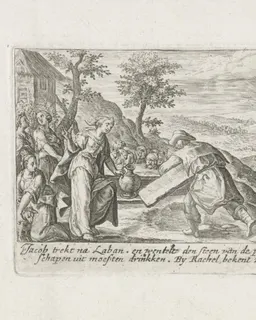
1Then Jacob went on his journey, and came into the land of the people of the east. 2And he looked, and behold a well in the field, and, lo, there were three flocks of sheep lying by it; for out of that well they watered the flocks: and a great stone was upon the well’s mouth. 3And thither were all the flocks gathered: and they rolled the stone from the well’s mouth, and watered the sheep, and put the stone again upon the well’s mouth in his place. 4And Jacob said unto them, My brethren, whence be ye? And they said, Of Haran are we.
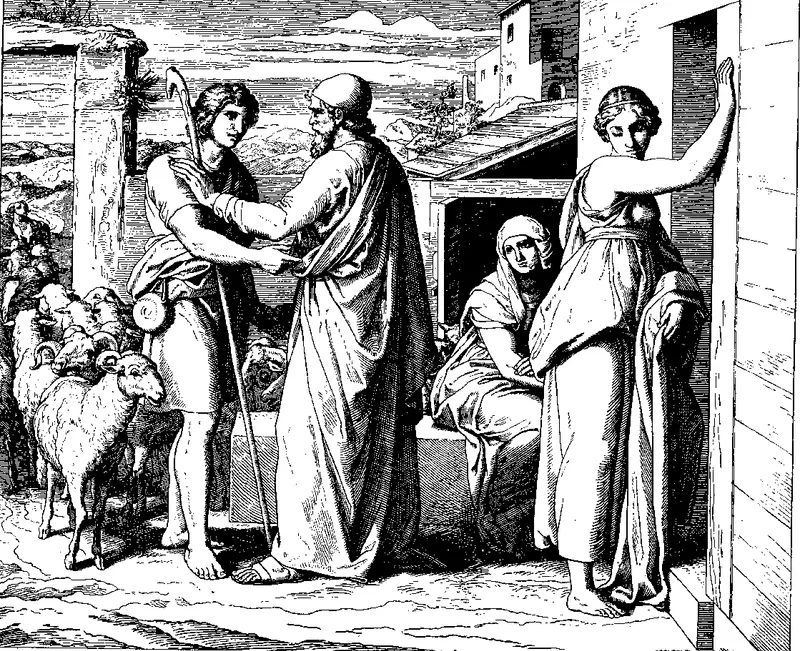
Jacob reaches the well and sees Rachel--the moment stretches like eternity. He weeps, rolls the stone aside, and her beauty stops his breath.
5And he said unto them, Know ye Laban the son of Nahor? And they said, We know him. 6And he said unto them, Is he well? And they said, He is well: and, behold, Rachel his daughter cometh with the sheep. 7And he said, Lo, it is yet high day, neither is it time that the cattle should be gathered together: water ye the sheep, and go and feed them. 8And they said, We cannot, until all the flocks be gathered together, and till they roll the stone from the well’s mouth; then we water the sheep.
The well scene is one of Scripture's great courtship patterns. Isaac met Rebekah at a well (Gen. 24). Moses met Zipporah at a well (Ex. 2:15-17). The well is where a foreigner, traveling far from home, meets his bride. But Genesis signals something in Jacob's case that is different: everyone else is waiting for the full company to arrive. It is too early, the shepherds say. Not yet time. Jacob, arriving alone at this threshold, will have to wait as well.
Genesis 29:9-12Rachel
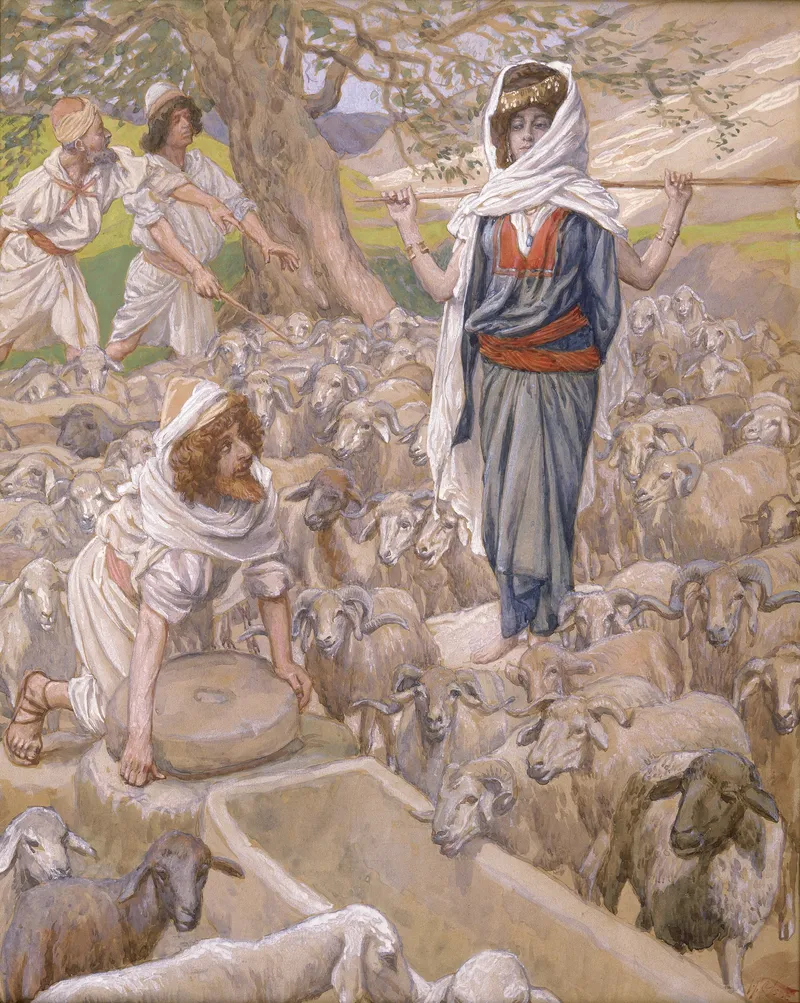
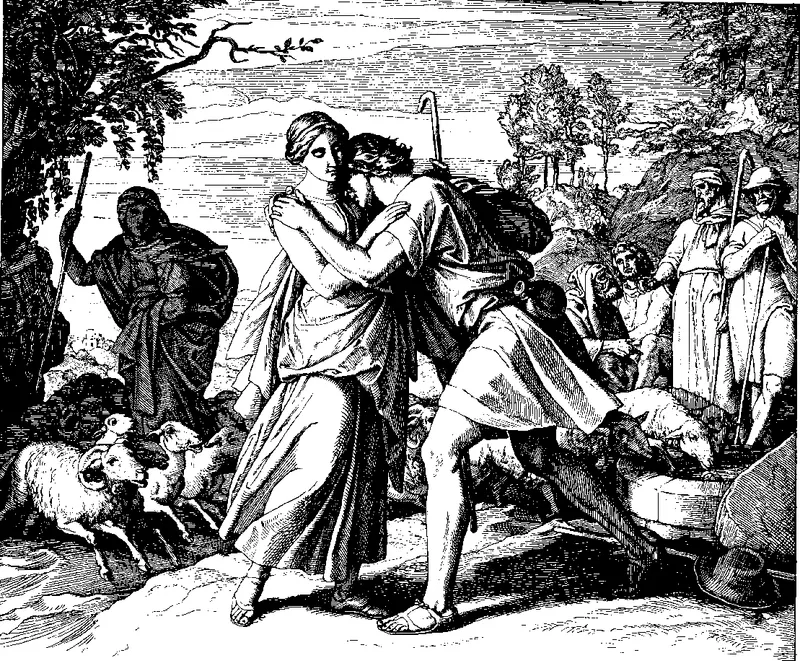
9And while he yet spake with them, Rachel came with her father’s sheep: for she kept them. 10And it came to pass, when Jacob saw Rachel the daughter of Laban his mother’s brother, and the sheep of Laban his mother’s brother, that Jacob went near, and rolled the stone from the well’s mouth, and watered the flock of Laban his mother’s brother. 11And Jacob kissed Rachel, and lifted up his voice, and wept. 12And Jacob told Rachel that he was her father’s brother, and that he was Rebekah’s son: and she ran and told her father.
Rachel appears without warning, and in that instant Jacob-who has been cautious with the other shepherds, asking questions, waiting-becomes capable of the impossible. "While he yet spake," the text says. He sees her, and strength enters him. 1 This is what Scripture means by love: a willingness to be remade by the presence of another.
The shepherds said, "We cannot, until all the flocks be gathered." The stone required the whole company. But Jacob, alone, rolls it. The text moves from "they rolled" (v. 3) to "Jacob rolled" (v. 10)-and he does it without help, without waiting, because love gave him a strength that solitude had not. 2 There is a kind of work that only love can do.
Genesis 29:13-20Seven Years for Love
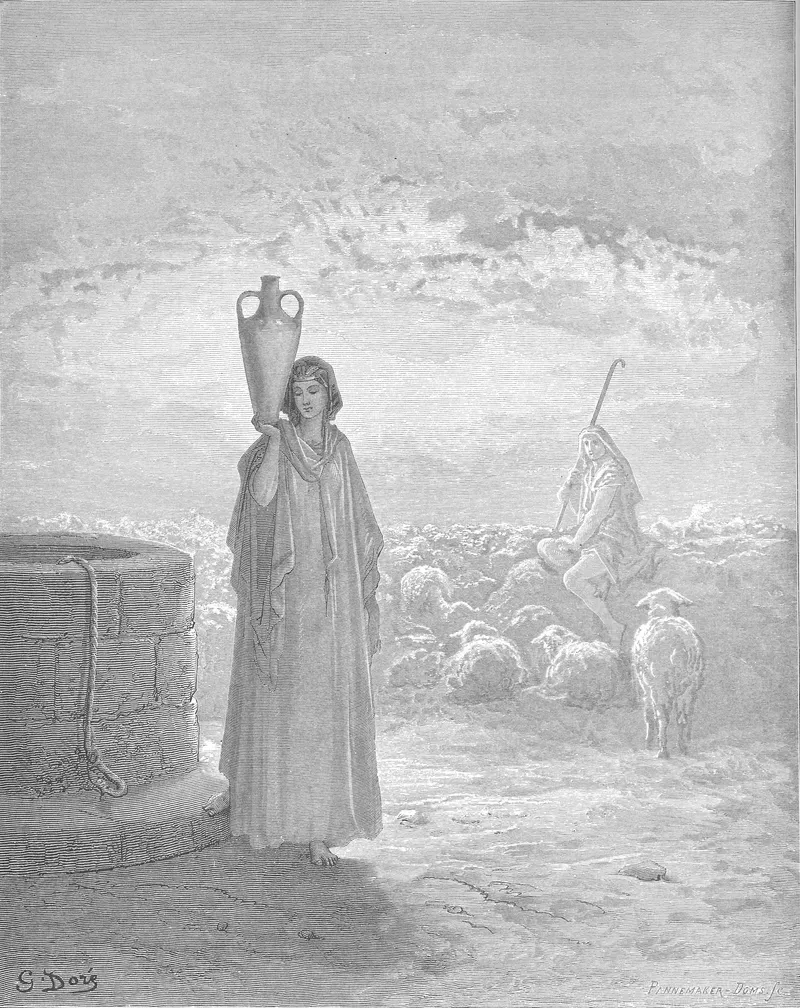
13And it came to pass, when Laban heard the tidings of Jacob his sister’s son, that he ran to meet him, and embraced him, and kissed him, and brought him to his house. And he told Laban all these things. 14And Laban said to him, Surely thou art my bone and my flesh. And he abode with him the space of a month. 15And Laban said unto Jacob, Because thou art my brother, shouldest thou therefore serve me for nought? tell me, what shall thy wages be? 16And Laban had two daughters: the name of the elder was Leah, and the name of the younger was Rachel.
Laban offers Rachel--if Jacob serves seven years. The years vanish, but on the wedding night Laban trades Leah for Rachel. Jacob's deception returns to him.
17Leah was tender eyed; but Rachel was beautiful and well favoured. 18And Jacob loved Rachel; and said, I will serve thee seven years for Rachel thy younger daughter. 19And Laban said, It is better that I give her to thee, than that I should give her to another man: abide with me. 20And Jacob served seven years for Rachel; and they seemed unto him but a few days, for the love he had to her.
Jacob's love for Rachel is named explicitly, plainly, three times in these verses. Laban approves. Laban says yes to the arrangement. But Laban is a deceiver like Jacob-and deception, in Genesis, always carries consequences. Nothing here suggests Laban is planning betrayal yet. The text does not explain his heart. But when Laban has what he needs from Jacob, the twist will come.
Seven years of labor. Seven years of watching Rachel, working for the right to marry her, carrying the ache of desire. And the Bible says they "seemed unto him but a few days, for the love he had to her." This is what love does to time. Years disappear. Ordinary days become transparent. The length of suffering is measured by the absence of what you love. Jacob would have served seventy years if that's what it took. Love does not count the cost.
Genesis 29:21-25The Darkness and the Morning
21And Jacob said unto Laban, Give me my wife, for my days are fulfilled, that I may go in unto her. 22And Laban gathered together all the men of the place, and made a feast. 23And it came to pass in the evening, that he took Leah his daughter, and brought her to him; and he went in unto her. 24And Laban gave unto his daughter Leah Zilpah his maid for an handmaid. 25And it came to pass, that in the morning, behold, it was Leah: and he said to Laban, What is this thou hast done unto me? did not I serve with thee for Rachel? wherefore then hast thou beguiled me?
Laban, who has been warm and welcoming, now shows his hand. He takes Leah-his own daughter-and brings her to Jacob in the darkness. The bride-switching is one of the most poignant betrayals in Scripture. Leah is not wicked; she is a pawn. Jacob is not told he is being deceived; he is told nothing. In the dark, in joy, he receives his bride-only to find, "in the morning, behold, it was Leah."
The deceiver has been deceived by darkness. The phrase echoes Eden, where Adam and Eve hid in darkness after the Fall. But this darkness is not chosen; it is imposed. Jacob, like Leah, is a victim of his own father-in-law's deception.
Laban gives Zilpah to Leah-as a handmaid, but also as a partial compensation for the marriage, perhaps a signal of status. It is a custom, a small mercy, a token of duty performed. But it cannot comfort Leah for the fact that she is married to a man who does not love her, and never chose her.
Genesis 29:26-30Seven More Years
26And Laban said, It must not be so done in our country, to give the younger before the firstborn. 27Fulfil her week, and we will give thee this also for the service which thou shalt serve with me yet seven other years. 28And Jacob did so, and fulfilled her week: and he gave him Rachel his daughter to wife also. 29And Laban gave to Rachel his daughter Bilhah his handmaid to be her maid. 30And he went in also unto Rachel, and he loved also Rachel more than Leah, and served with him yet seven other years.
Laban's explanation is technically true-it was custom to marry off the elder daughter first. But his custom did not forbid him from saying so beforehand. He hid it, deceived Jacob, and only after the deed is done does he invoke custom as justification. This is how deception works: it uses truth as a mask. The law becomes an excuse only after the damage is done.
Jacob agrees to seven more years, in surrender. He has already given seven years. Now he will give seven more. Fourteen years of labor for the woman he loves, while living in a marriage-to Leah-that is unwanted. The text does not soften this. Jacob will have two wives, will love one and not the other, and will live in the house of a deceiver who holds him to further servitude. The consequences of deception ripple outward, catching everyone.
The text says plainly: "he loved Rachel more than Leah." Not equally. More. Leah is present in the text by her absence. She is wife, she will be mother, she will bear sons-but the man she is married to loves another woman more. The Bible does not hide this tragedy. It names it. And it names it at the very moment when Leah, unknown to herself, is about to become the bearer of the line that leads to Christ.
Genesis 29:31-35Leah's Prayer in Four Names
31And when the LORD saw that Leah was hated, he opened her womb: but Rachel was barren. 32And Leah conceived, and bare a son, and she called his name Reuben: for she said, Surely the LORD hath looked upon my affliction; now therefore my husband will love me. 33And she conceived again, and bare a son; and said, Because the LORD hath heard that I was hated, he hath therefore given me this son also: and she called his name Simeon. 34And she conceived again, and bare a son; and said, Now this time will my husband be joined unto me, because I have born him three sons: therefore was his name called Levi. 35And she conceived again, and bare a son: and she said, Now will I praise the LORD: therefore she called his name Judah; and left bearing.
The text introduces a new voice: the LORD. Not Laban, not Jacob. God. "When the LORD saw that Leah was hated, he opened her womb." The one who bore the shame of not being chosen is seen by God. The barren Rachel, whom Jacob loves, is set aside. The unloved Leah, whom the text has shown us with careful cruelty, is given fertility. God's eyes are on the person the world has overlooked. This is the pattern that will repeat throughout Scripture-the younger chosen over the older, the weak chosen over the strong, the overlooked chosen to bear the line of Christ.
Research trail
Sources & further study
These references support the historical, linguistic, manuscript, and contextual notes in this chapter. Scripture remains the primary text; external sources are provided so readers can inspect the research directly.