Job 32
People in this chapter
For thirty-one chapters the conversation has run between four men: Job and the three friends who came to comfort him and stayed to accuse him. Now, abruptly, a fifth voice breaks in. Then was kindled the wrath of Elihu the son of Barachel the Buzite. We were never told he was there. He has been standing at the edge of the circle the whole time - younger than everyone, holding his tongue because in the ancient world age had the first claim on speech - and listening to the whole exhausting debate grind to a halt.
The three friends ceased to answer Job (v. 1) because they were beaten. And in that silence, the young man can hold back no longer.
Tap any highlighted phrase to jump to the commentary that unpacks it.
Job 32:1-5Then Was Kindled the Wrath of Elihu
1So these three men ceased to answer Job, because he was righteous in his own eyes. 2Then was kindled the wrath of Elihu the son of Barachel the Buzite, of the kindred of Ram: against Job was his wrath kindled, because he justified himself rather than God. 3Also against his three friends was his wrath kindled, because they had found no answer, and yet had condemned Job. 4Now Elihu had waited till Job had spoken, because they were elder than he. 5When Elihu saw that there was no answer in the mouth of these three men, then his wrath was kindled.
The debate ends in a collapse. The three friends ceased to answer Job - and the narrator names the reason without flattering anyone: because he was righteous in his own eyes. They had no more arguments; he had no more doubt about his own innocence; the whole conversation had seized up. This is the natural end of a certain kind of argument, where each side has dug in so far that no one is really listening anymore.
The same impasse drives the ancient dialogue poems of the wider world - the Babylonian Theodicy1, for one, sets a sufferer and a friend trading stanzas about divine justice until the exchange exhausts itself. Into that kind of dead air Elihu steps.
Four times in four verses the narrator strikes the same note: Elihu's wrath was kindled... was kindled... was kindled... was kindled. The repetition is deliberate; we are meant to feel the young man's heat building. But the object of his anger is carefully specified, and it is telling. His anger is about God's honor - that Job justified himself rather than God, and that the friends condemned Job while finding no answer. In Elihu's eyes, both sides have managed to put themselves in the right and leave God in the wrong: Job by clinging to his innocence, the friends by defending a theology the facts would not support.
Whatever we make of Elihu's self-assurance, the thing that angers him is not small.
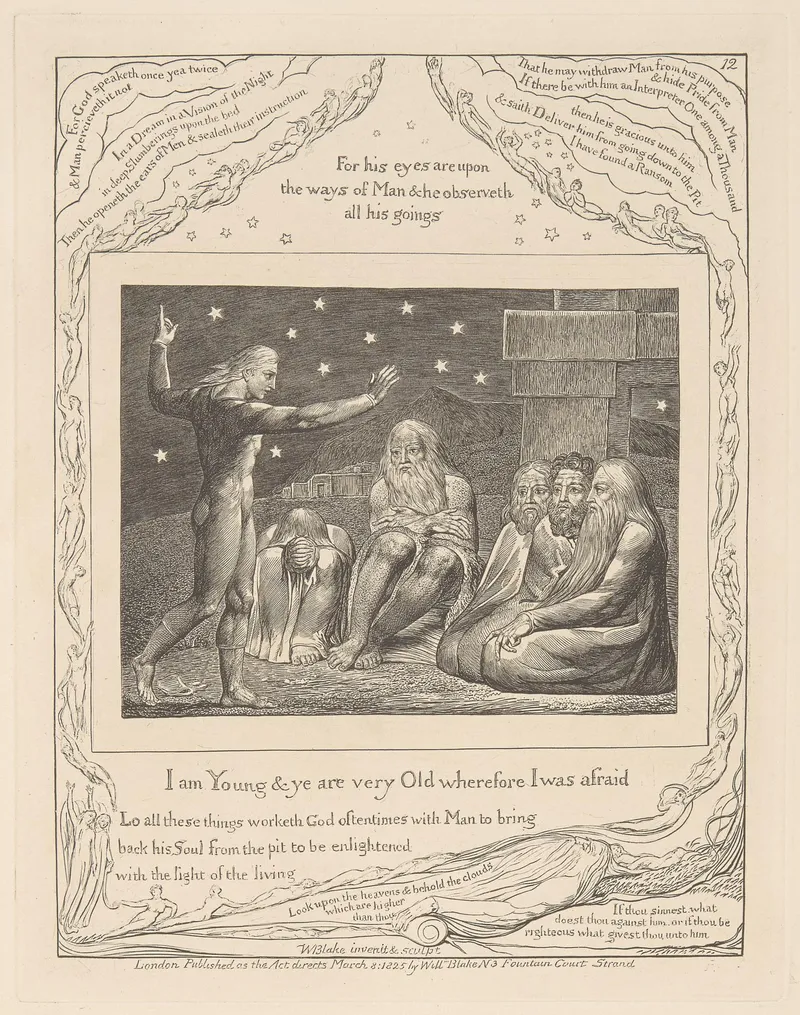
Job 32:6-14There Is a Spirit in Man
6And Elihu the son of Barachel the Buzite answered and said, I am young, and ye are very old; wherefore I was afraid, and durst not shew you mine opinion. 7I said, Days should speak, and multitude of years should teach wisdom. 8But there is a spirit in man: and the inspiration of the Almighty giveth them understanding. 9Great men are not always wise: neither do the aged understand judgment. 10Therefore I said, Hearken to me; I also will shew mine opinion.
Elihu begins with a courtesy that is also a complaint. I am young, and ye are very old - so he had held his peace, afraid to push his opinion forward, because he had been taught what everyone in that world was taught: Days should speak, and multitude of years should teach wisdom. The elders go first; the young wait. But then Elihu says the thing that turns the rule on its head. Age is not the same as wisdom.
Great men are not always wise: neither do the aged understand judgment. There is a deeper source of understanding than the calendar - there is a spirit in man: and the inspiration of the Almighty giveth them understanding. The claim is that wisdom comes from God's breath, and God is free to breathe it into whomever He pleases, regardless of how many years they have lived.
11Behold, I waited for your words; I gave ear to your reasons, whilst ye searched out what to say. 12Yea, I attended unto you, and, behold, there was none of you that convinced Job, or that answered his words: 13Lest ye should say, We have found out wisdom: God thrusteth him down, not man. 14Now he hath not directed his words against me: neither will I answer him with your speeches.
Elihu makes his case for the right to speak: he has earned it by listening. I waited for your words; I gave ear to your reasons - he heard the friends out completely, and the verdict of his attention is blunt: there was none of you that convinced Job, or that answered his words. Their arguments did not land. And he names the temptation the friends were under (v. 13) - the urge to congratulate themselves (We have found out wisdom) by concluding that only God, not any human argument, could ever humble a man like Job.
Elihu refuses that exit. He also refuses to recycle their failed material: neither will I answer him with your speeches. Whatever he is about to say, he insists it will be his own - fresh words for a conversation that the old words could not move.
Job 32:15-22I Am Full of Matter
15They were amazed, they answered no more: they left off speaking. 16When I had waited, (for they spake not, but stood still, and answered no more;) 17I said, I will answer also my part, I also will shew mine opinion. 18For I am full of matter, the spirit within me constraineth me. 19Behold, my belly is as wine which hath no vent; it is ready to burst like new bottles.
Now the heat finds its image. Elihu says he is full of matter - packed with things to say - and that the spirit within me constraineth me, presses and pushes him to speak. Then comes one of the most physical descriptions of inner pressure in the Bible: my belly is as wine which hath no vent; it is ready to burst like new bottles. New wine still fermenting gives off gas; sealed in a skin with no outlet, it stretches the leather to the breaking point - the same image Jesus would use of new wine and old wineskins (Matt. 9:17).
That, Elihu says, is what holding his tongue has felt like: a young man bursting at the seams with words he believes God has put in him to say. Whether or not every word that follows lives up to the buildup, the picture of a conviction that cannot stay silent is one Scripture takes seriously.
20I will speak, that I may be refreshed: I will open my lips and answer. 21Let me not, I pray you, accept any man’s person, neither let me give flattering titles unto man. 22For I know not to give flattering titles; in so doing my maker would soon take me away.
Before he says a word of his argument, Elihu makes a vow about how he will speak: Let me not... accept any man's person, neither let me give flattering titles unto man. To accept a person is to play favorites - to weigh words differently depending on who is speaking them or who might be offended. Flattering titles are the honeyed words we hand the powerful to stay in their good graces. Elihu swears off both.
He will not soften the truth to spare Job's feelings or to keep the respect of the older men, and he gives a striking reason: if he started dealing in flattery, my maker would soon take me away - as though false speech before God were a kind of slow self-destruction. Whatever else we make of Elihu, this is a worthy resolve: to speak the truth as he sees it, plainly, to small and great alike.
Research trail
Sources & further study
These references support the historical, linguistic, manuscript, and contextual notes in this chapter. Scripture remains the primary text; external sources are provided so readers can inspect the research directly.
- The Babylonian Theodicy - an ancient dialogue on divine justiceAn overview of the Akkadian acrostic poem in which a sufferer and a friend debate, stanza by stanza, whether the gods deal justly with the righteous - the closest ancient parallel to the very kind of dialogue Elihu interrupts, and a foil for the God-centered hope the book of Job is reaching toward.
- Job 32 · Hebrew + Jewish commentaryThe Hebrew text of Job 32 with Rashi, Ibn Ezra, and Ramban side by side - useful for the fourfold charah (“kindled”) of Elihu's aph (anger) in vv. 2-5 and the neshamah (“the inspiration of the Almighty”) that gives understanding in v. 8.
- Job 32 ↔ Matthew 11:25 · Joel 2:28 · 1 Corinthians 1Maps Elihu's claim that understanding is breathed by God rather than earned by age onto the New Testament's welcome of the overlooked - the truth revealed unto babes (Matt. 11:25) and the Spirit poured out on young and old (Joel 2:28; Acts 2:17).
Where this echoes in Scripture
Then Was Kindled the Wrath of Elihu
- Exodus 34:6The LORD, The LORD God, merciful and gracious, longsuffering, and abundant in goodness and truth.God is “slow to anger” - literally “long of nostril” (cf. the aph of v. 2).
- John 2:17The zeal of thine house hath eaten me up.The holy anger Elihu's wrath (vv. 2-5) only imperfectly reflects.
- Job 42:7My wrath is kindled against thee... for ye have not spoken of me the thing that is right, as my servant Job hath.God's own wrath is finally kindled - but against the friends, not Job, the reverse of Elihu's aim.
There Is a Spirit in Man
- Genesis 2:7The LORD God... breathed into his nostrils the breath of life; and man became a living soul.The neshamah of v. 8 - the breath that makes both life and understanding.
- Matthew 11:25Thou hast hid these things from the wise and prudent, and hast revealed them unto babes.Elihu's claim (v. 9), on the lips of the Son.
- 1 Corinthians 1:27God hath chosen the foolish things of the world to confound the wise.The same pattern: God's wisdom bypasses human seniority.
- Psalm 119:100I understand more than the ancients, because I keep thy precepts.Understanding drawn from God's word, available to young and old alike.
I Am Full of Matter
- Matthew 9:17Neither do men put new wine into old bottles... but they put new wine into new bottles, and both are preserved.Elihu's bursting wineskin (v. 19) - conviction that cannot be contained.
- Matthew 22:16Thou art true, and teachest the way of God in truth... for thou regardest not the person of men.The impartial truth-telling Elihu vows (v. 21), perfected in Christ.
- Leviticus 19:15Thou shalt not respect the person of the poor, nor honour the person of the mighty.The impartiality Elihu swears (v. 21), already commanded in the Law.
- Acts 4:20We cannot but speak the things which we have seen and heard.The constraint of v. 18, in its purified form.