Matthew 22
People in this chapter
It is the last week. Jesus is teaching in the temple courts two days before the Passover, surrounded by crowds and circled by men who want Him dead. He answers their hostility with a parable, the third in a row against the leaders who reject Him: the kingdom of heaven is like unto a certain king, which made a marriage for his son (v. 2). The invited guests will not come - some indifferent, made light of it, off to a farm or a business; some violent, seizing the servants and killing them.
The king's armies destroy the murderers and burn their city, and then the invitation goes wide: Go ye therefore into the highways, and as many as ye shall find, bid to the marriage (v. 9). The hall fills with guests both bad and good - but one is found without a wedding garment and is cast out, and the parable lands on a line that hangs over the whole chapter: For many are called, but few are chosen (v. 14).1
Tap any highlighted phrase to jump to the commentary that unpacks it.
Matthew 22:1-14The Marriage of the King's Son
1And Jesus answered and spake unto them again by parables, and said, 2The kingdom of heaven is like unto a certain king, which made a marriage for his son, 3And sent forth his servants to call them that were bidden to the wedding: and they would not come. 4Again, he sent forth other servants, saying, Tell them which are bidden, Behold, I have prepared my dinner: my oxen and my fatlings are killed, and all things are ready: come unto the marriage. 5But they made light of it, and went their ways, one to his farm, another to his merchandise: 6And the remnant took his servants, and entreated them spitefully, and slew them. 7But when the king heard thereof, he was wroth: and he sent forth his armies, and destroyed those murderers, and burned up their city. 8Then saith he to his servants, The wedding is ready, but they which were bidden were not worthy. 9Go ye therefore into the highways, and as many as ye shall find, bid to the marriage. 10So those servants went out into the highways, and gathered together all as many as they found, both bad and good: and the wedding was furnished with guests. 11And when the king came in to see the guests, he saw there a man which had not on a wedding garment: 12And he saith unto him, Friend, how camest thou in hither not having a wedding garment? And he was speechless. 13Then said the king to the servants, Bind him hand and foot, and take him away, and cast him into outer darkness; there shall be weeping and gnashing of teeth. 14For many are called, but few are chosen.
Jesus is still answering the chief priests and elders who challenged His authority, and this is the third parable He aims at them in a row. The first word sets the key: The kingdom of heaven is like unto a certain king, which made a marriage for his son (v. 2). A royal wedding feast was the most lavish, most joyful summons a person could receive in that world; to be on the king's guest list was the highest of honors, and to be present at the marriage of the heir was a privilege beyond price.
The picture is sheer generosity. The king has prepared everything - my oxen and my fatlings are killed, and all things are ready (v. 4) - and all that remains is for the invited to come. Notice that the guests were already bidden; the servants are sent not to issue a first invitation but to call those who had long been told the day was coming. That is the whole posture of God toward His people throughout the Scriptures: a feast prepared, a long-promised joy, a Father saying come. The astonishing thing the parable is about to expose is not the king's reluctance - he holds nothing back - but the refusal of those he honored most.1
The refusal comes in two forms, and both are sobering. But they made light of it, and went their ways, one to his farm, another to his merchandise (v. 5). This first group is not violent; it is simply indifferent. They have other things to do - a field, a business, the ordinary press of getting and spending - and a royal wedding cannot compete. They made light of it: they treated the king's greatest honor as a small thing, a thing easily set aside for whatever was in front of them that day.
This is the quieter and more common way the invitation is spurned, not by hatred but by distraction, by letting the urgent crowd out the eternal. The second group is openly hostile: the remnant took his servants, and entreated them spitefully, and slew them (v. 6). It is the long, grim pattern of how God's messengers were treated - the prophets sent and stoned, the servants beaten and killed. The king's response is severe: he sent forth his armies, and destroyed those murderers, and burned up their city (v. 7).
The verse carries the weight of a real judgment falling on those who, having been honored with the invitation, answered it with contempt and blood. They which were bidden were not worthy - not because the king was stingy, but because they would not come.
With the first guests disqualified by their own refusal, the king throws the doors wide: Go ye therefore into the highways, and as many as ye shall find, bid to the marriage (v. 9). The invitation now runs out past the expected guest list to anyone the servants can find on the open roads - the overlooked, the outsiders, the people who never imagined they would be summoned to a royal wedding. And the line that follows is one of the most quietly stunning in the parable: those servants went out into the highways, and gathered together all as many as they found, both bad and good (v. 10).
Both bad and good. The net is not thrown only over the respectable. It sweeps in the disreputable too, the ones with nothing to recommend them but their willingness to come. This is the great reversal Jesus has been pressing on the temple leaders: the ones who assumed the feast was theirs by right refused it, and the hall is filled instead with those they would never have invited. The wedding was furnished with guests - the king will have a full table, and he will fill it with whoever will come.
Then the parable takes a turn that has unsettled readers ever since. The king comes in to see the guests, he saw there a man which had not on a wedding garment (v. 11), and when questioned the man is speechless, and is bound and cast into outer darkness. At first this seems harsh - the man was pulled in off the highway; how could he be expected to have proper clothes? But that is precisely the point the image makes.
A wedding garment was the one thing required of every guest, and in a royal feast such as this the covering was the king's own provision, supplied to all who came; it was not earned, it was given. This man, then, has not failed to buy something he could not afford; he has refused the very covering the king held out, presuming to take his place at the feast on his own terms, in his own clothes.
His silence is the silence of someone with no excuse. He wanted the feast without the garment, the kingdom without being clothed by the King. And so the parable closes on a line that hangs over the whole chapter: For many are called, but few are chosen (v. 14). The call goes out wide - to all on the highways, bad and good alike - but the feast is entered only by those who come clothed as the King provides.
The text states the two together, the wide call and the narrow entrance, and leaves them standing side by side.1
Matthew 22:15-22Render unto Caesar, and unto God
15Then went the Pharisees, and took counsel how they might entangle him in his talk. 16And they sent out unto him their disciples with the Herodians, saying, Master, we know that thou art true, and teachest the way of God in truth, neither carest thou for any man: for thou regardest not the person of men. 17Tell us therefore, What thinkest thou? Is it lawful to give tribute unto Caesar, or not? 18But Jesus perceived their wickedness, and said, Why tempt ye me, ye hypocrites? 19Shew me the tribute money. And they brought unto him a penny. 20And he saith unto them, Whose is this image and superscription? 21They say unto him, Caesar’s. Then saith he unto them, Render therefore unto Caesar the things which are Caesar’s; and unto God the things that are God’s. 22When they had heard these words, they marvelled, and left him, and went their way.
The Pharisees withdraw and lay a careful trap, sending their own disciples together with the Herodians - an unlikely alliance, since the Pharisees resented Roman rule and the Herodians collaborated with it, but they are united in wanting Jesus ruined. They open with flattery: Master, we know that thou art true… neither carest thou for any man: for thou regardest not the person of men (v. 16). Every word is calculated to back Him into a corner where He must answer plainly and offend someone.
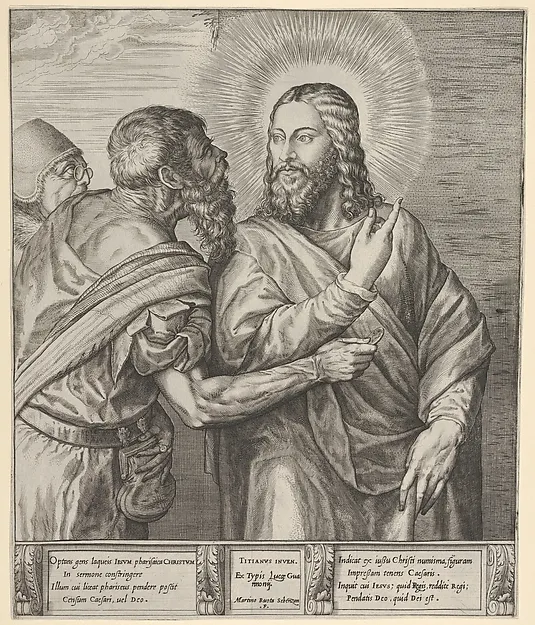
Then comes the question: Is it lawful to give tribute unto Caesar, or not? (v. 17). It is a perfect snare. The tribute was the deeply resented poll tax paid to Rome, a standing reminder that Israel was an occupied people. If Jesus says yes, pay it, He looks like a friend of the occupier and loses the crowd that longs for freedom. If He says no, do not pay it, the Herodians have grounds to report Him to Rome as an agitator inciting tax revolt - the very charge that could cost a man his life.
There is no safe answer; the question is built so that any straight reply destroys Him. Jesus, perceiving their wickedness, does not take either horn of the trap. He calls them hypocrites - play-actors mouthing a question they do not mean - and asks for the coin itself.
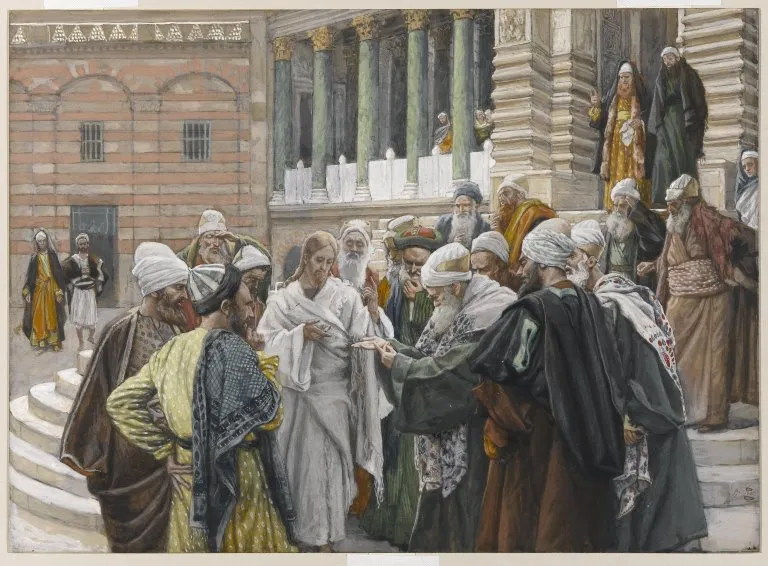
Jesus turns the trap on a single object: Shew me the tribute money. And they brought unto him a penny (v. 19) - a denarius, the coin in which the hated tax was paid. He holds it up and asks one question: Whose is this image and superscription? (v. 20). The Roman coin bore the head of the emperor stamped in profile, with an inscription naming him. They answer the only thing they can: Caesar's. And in that one word the trap springs harmlessly open.
The coin carries Caesar's likeness; it came from his mint; it bears his name. By using his money for their commerce they have already acknowledged his rule in the ordinary business of life. So Jesus draws the conclusion they did not see coming: Render therefore unto Caesar the things which are Caesar's; and unto God the things that are God's (v. 21). The word for image here is the same idea that runs back to the beginning - the coin bears the stamp of Caesar and so belongs, in its proper place, to Caesar; but a human being bears a different stamp altogether, and the unspoken second half of the saying does all the work.
Matthew 22:23-33The God of the Living
23The same day came to him the Sadducees, which say that there is no resurrection, and asked him, 24Saying, Master, Moses said, If a man die, having no children, his brother shall marry his wife, and raise up seed unto his brother. 25Now there were with us seven brethren: and the first, when he had married a wife, deceased, and, having no issue, left his wife unto his brother: 26Likewise the second also, and the third, unto the seventh. 27And last of all the woman died also. 28Therefore in the resurrection whose wife shall she be of the seven? for they all had her. 29Jesus answered and said unto them, Ye do err, not knowing the scriptures, nor the power of God. 30For in the resurrection they neither marry, nor are given in marriage, but are as the angels of God in heaven. 31But as touching the resurrection of the dead, have ye not read that which was spoken unto you by God, saying, 32I am the God of Abraham, and the God of Isaac, and the God of Jacob? God is not the God of the dead, but of the living. 33And when the multitude heard this, they were astonished at his doctrine.
A new set of opponents steps up the same day. The Sadducees were the priestly, aristocratic party, and Matthew names their distinctive belief plainly: they say that there is no resurrection (v. 23). They accepted only the books of Moses and found in them no clear teaching of life beyond death, so they came to Jesus not with an honest question but with a riddle designed to make the resurrection look absurd. They invoke the law of levirate marriage - Moses said, If a man die, having no children, his brother shall marry his wife (v. 24) - and then spin out a deliberately extreme case: seven brothers in turn marry the same woman, each dying childless, and finally the woman dies too.
Then the trap: Therefore in the resurrection whose wife shall she be of the seven? for they all had her (v. 28). The whole story is built to ridicule the very idea of rising from the dead, as though the next life were simply this one extended, with all its tangles carried forward unresolved. They assume the resurrection must mean a return to exactly these arrangements, and so they think they have shown it to be a contradiction.
Jesus will overturn the riddle by overturning the assumption beneath it.
Jesus answers with unusual directness: Ye do err, not knowing the scriptures, nor the power of God (v. 29). He names two failures at once, and they are linked. They do not know the scriptures - they have read Moses without seeing what is there - and they do not know the power of God, the power that can raise the dead and remake human life in a higher key than the present one. Their first error is to imagine the resurrection life as a mere continuation of this one: For in the resurrection they neither marry, nor are given in marriage, but are as the angels of God in heaven (v. 30).
The whole premise of their riddle collapses here. Jesus is not making a sweeping pronouncement about every dimension of the life to come; He is answering the specific trap they set. Their riddle depended entirely on the assumption that the practice of levirate marriage - a provision given to raise up children for a dead man and continue his name in this mortal world - would still be in force in the resurrection. It will not, because the conditions that made it necessary belong to mortality.
The risen are as the angels of God in heaven, no longer bound by death and therefore no longer governed by an arrangement designed to answer death. The Sadducees pictured the next life too small, and their whole objection dissolves once that smallness is corrected. The text answers their narrow question and does not press beyond it.
Then Jesus does what the Sadducees claimed could not be done: He proves the resurrection from the books of Moses themselves, the only Scriptures they accepted. Have ye not read that which was spoken unto you by God, saying, I am the God of Abraham, and the God of Isaac, and the God of Jacob? (vv. 31-32). The whole argument turns on a single tense. At the burning bush, long after the patriarchs had died, God did not say “I was the God of Abraham,” as one speaks of the dead and gone.
He said I am - present tense, a living relationship with men whose bodies had been in the ground for centuries. And Jesus draws the conclusion like a hammer-blow: God is not the God of the dead, but of the living (v. 32). If God still calls Himself their God, then Abraham, Isaac, and Jacob still live to Him; the covenant He made with them is not annulled by the grave. A God who binds Himself to people in faithful love does not let death have the last word over them.
The argument is so tight and so unexpected that the multitude… were astonished at his doctrine (v. 33). The Sadducees had searched Moses and found no resurrection; Jesus opens the same text and shows that the living God who keeps covenant with His own is, by that very fact, the God who raises the dead.
Matthew 22:34-46The Great Commandment, and David's Lord
34But when the Pharisees had heard that he had put the Sadducees to silence, they were gathered together. 35Then one of them, which was a lawyer, asked him a question, tempting him, and saying, 36Master, which is the great commandment in the law? 37Jesus said unto him, Thou shalt love the Lord thy God with all thy heart, and with all thy soul, and with all thy mind. 38This is the first and great commandment. 39And the second is like unto it, Thou shalt love thy neighbour as thyself. 40On these two commandments hang all the law and the prophets. 41While the Pharisees were gathered together, Jesus asked them, 42Saying, What think ye of Christ? whose son is he? They say unto him, The son of David. 43He saith unto them, How then doth David in spirit call him Lord, saying, 44The LORD said unto my Lord, Sit thou on my right hand, till I make thine enemies thy footstool? 45If David then call him Lord, how is he his son? 46And no man was able to answer him a word, neither durst any man from that day forth ask him any more questions.
The Pharisees regroup after the Sadducees are silenced, and one of them, a lawyer - an expert in the law of Moses - puts the last of the day's testing questions: Master, which is the great commandment in the law? (v. 36). On its surface it sounds like an honest theological inquiry, the kind the rabbis debated; underneath, Matthew tells us, he is tempting him, hoping to catch Jesus elevating one command and so appearing to slight the rest.
The law contained hundreds of precepts, and to name a single one as the great commandment was to risk seeming to rank God's own words. Jesus answers not by picking a favorite rule out of the list but by naming the wellspring from which every rule flows. He reaches for the words every faithful Israelite recited daily, the Shema: Thou shalt love the Lord thy God with all thy heart, and with all thy soul, and with all thy mind (v. 37).
The first and greatest thing the law requires is not an action but a love - and not a partial love but a total one, claiming the heart, the soul, and the mind, the whole of a person turned Godward. Everything else the law commands is downstream of this.
Jesus does not stop at one commandment; He binds a second to it as inseparable: And the second is like unto it, Thou shalt love thy neighbour as thyself (v. 39). He draws this from Leviticus, joining it to the Shema so tightly that the two cannot be pulled apart. They are like one another - cut from the same cloth, both commands to love - and the order matters: love of God comes first and grounds the second, but love of God that does not flow outward into love of neighbor has misunderstood itself.
To love thy neighbour as thyself is a searching standard. It does not ask for a warm feeling; it asks for the same active, practical care a person instinctively gives to his own wellbeing, now turned toward the person beside him. It means I cannot use my neighbor as a means to my own ends, cannot be indifferent to his need, cannot hoard while he lacks. The measure is brutally simple: the concern you already lavish on yourself, extend it to him.
Jesus has taken the entire moral law and pressed it into two commands that a child can recite and a lifetime cannot exhaust.
Then comes the summary that gathers everything: On these two commandments hang all the law and the prophets (v. 40). The image is vivid - the whole law and all the prophets hang on these two, the way a door hangs on its hinges, the way a great weight hangs from a single beam. Every commandment about worship and sabbath and offering unfolds the first; every commandment about honesty and justice and mercy unfolds the second.
The hundreds of precepts the lawyer prized are not abolished; they are fulfilled, shown to be the branching out of a single root. This is the great simplification at the heart of Jesus' teaching: righteousness is not finally a maze of rules to be navigated but a love to be lived - love of God with everything, love of neighbor as oneself. Where that love is real, the law is kept from the inside; where it is absent, no amount of outward rule-keeping can stand in for it.
The lawyer came to test which command outranked the others, and Jesus handed him the key that unlocks them all at once.
Now the questioning turns. All day Jesus has been answering; now He asks, and the question goes to the heart of everything: What think ye of Christ? whose son is he? (v. 42). They give the answer every Israelite knew - the Messiah is the son of David, the promised king from David's line. It is true, and it is not wrong; but it is not the whole truth, and Jesus presses past it with David's own words.
He points to the psalm in which David, in spirit, speaks of the Messiah: The LORD said unto my Lord, Sit thou on my right hand, till I make thine enemies thy footstool (v. 44). The two words rendered “LORD” and “Lord” are not the same: the first is the divine name itself, God speaking; the second is the one God addresses and seats at His right hand - David's Lord. And there is the riddle Jesus lays before them: If David then call him Lord, how is he his son? (v. 45).
A father does not normally call his own descendant Lord; the greater does not bow to the lesser. Yet David, by the Spirit, calls his promised son his Lord and watches God seat Him at His own right hand. The question does not deny that the Christ is David's son; it insists that He is also, somehow, David's Lord - more than a merely human heir, One whose origin and dignity reach past the throne of David.
And to this no man was able to answer him a word (v. 46). The questioners who came to trap Him are left, at last, with the one question they cannot answer - the question of who He really is.
Research trail
Sources & further study
These references support the historical, linguistic, manuscript, and contextual notes in this chapter. Scripture remains the primary text; external sources are provided so readers can inspect the research directly.
- Matthew 22 - Translators' NotesThe NET Bible's detailed footnotes on Matthew 22 - the marriage-feast parable and the meaning of the wedding garment (vv. 11-12), the coin and its image in the tribute question (vv. 19-21), the Sadducees' denial of resurrection (v. 23), and the much-discussed citation of Psalm 110 in the closing exchange (vv. 43-45).
- Matthew 22 · Greek interlinear, word by wordThe Greek text of Matthew 22 set under the English word by word, with parsing and Strong's numbers for each term - useful for apodidomi (v. 21, “render,” to give back what is owed), agapao (v. 37, the wholehearted “love” commanded), and Kyrios (v. 44, “Lord”), the word Jesus presses in the closing question.
- Matthew 22 ↔ Deuteronomy 6 · Leviticus 19 · Psalm 110Traces the Scripture Jesus quotes and alludes to here - the great commandment drawn from Hear, O Israel… thou shalt love the LORD thy God (Deut. 6:4-5) and thou shalt love thy neighbour as thyself (Lev. 19:18), the God of the living from I am the God of Abraham (Ex. 3:6), and the closing riddle from The LORD said unto my Lord, Sit thou on my right hand (Ps. 110:1).
Where this echoes in Scripture
The Marriage of the King's Son
- Luke 14:16-24A certain man made a great supper, and bade many... go out into the highways and hedges, and compel them to come in, that my house may be filled.The same parable from Luke - the invited who excuse themselves, and the table filled from the highways (vv. 9-10).
- Revelation 19:7-9the marriage of the Lamb is come, and his wife hath made herself ready... Blessed are they which are called unto the marriage supper of the Lamb.The feast the parable points to - the marriage of the King's Son, the Lamb (v. 2).
- Isaiah 61:10he hath clothed me with the garments of salvation, he hath covered me with the robe of righteousness.The wedding garment as a covering given, not earned (v. 11) - righteousness the King supplies.
- Isaiah 25:6And in this mountain shall the LORD of hosts make unto all people a feast of fat things... a feast of wines on the lees.The prepared feast of verse 4 - the LORD's long-promised banquet for all peoples.
- Matthew 8:11-12many shall come from the east and west, and shall sit down with Abraham... but the children of the kingdom shall be cast out into outer darkness.The reversal of the parable - outsiders gathered in, the presumed heirs cast out (vv. 10, 13).
Render unto Caesar, and unto God
- Genesis 1:27So God created man in his own image, in the image of God created he him.The unspoken second half of verse 21 - the coin bears Caesar's image, but the human being bears God's.
- Romans 13:7Render therefore to all their dues: tribute to whom tribute is due... honour to whom honour.The apostle echoing verse 21 - the earthly powers given their proper, limited due.
- Colossians 1:15Who is the image of the invisible God, the firstborn of every creature.Christ Himself the image of God (v. 20) - the One in whom the likeness we bear is restored.
- Romans 8:29whom he did foreknow, he also did predestinate to be conformed to the image of his Son.What it means to render ourselves to God (v. 21) - to be remade into the image we were stamped with.
- Acts 5:29Then Peter and the other apostles answered and said, We ought to obey God rather than men.Where the two claims of verse 21 collide - the higher allegiance that belongs to God alone.
The God of the Living
- Exodus 3:6I am the God of thy father, the God of Abraham, the God of Isaac, and the God of Jacob.The very word Jesus presses in verse 32 - God speaking in the present tense of men long dead.
- John 11:25-26I am the resurrection, and the life: he that believeth in me, though he were dead, yet shall he live.The God of the living (v. 32) named in person - the One who is Himself the resurrection.
- 1 Corinthians 15:20now is Christ risen from the dead, and become the firstfruits of them that slept.The ground of the resurrection Jesus defends (vv. 29-32) - His own rising, the firstfruits of ours.
- Daniel 12:2many of them that sleep in the dust of the earth shall awake, some to everlasting life.The resurrection the Sadducees denied (v. 23) - promised plainly in the Scriptures.
- Luke 20:38For he is not a God of the dead, but of the living: for all live unto him.Luke's telling of verse 32 - with the added note that to God, all His own are alive.
The Great Commandment, and David's Lord
- Deuteronomy 6:4-5Hear, O Israel: The LORD our God is one LORD: And thou shalt love the LORD thy God with all thine heart.The Shema Jesus quotes as the first commandment (v. 37) - the daily confession of Israel.
- Leviticus 19:18thou shalt love thy neighbour as thyself: I am the LORD.The second commandment Jesus binds to the first (v. 39) - love of neighbor drawn from the law itself.
- Psalm 110:1The LORD said unto my Lord, Sit thou on my right hand, until I make thine enemies thy footstool.The psalm Jesus presses in verses 43-45 - David calling his promised son his Lord.
- Romans 13:10Love worketh no ill to his neighbour: therefore love is the fulfilling of the law.The truth of verse 40 - the whole law gathered up and fulfilled in love.
- Romans 1:3-4his Son Jesus Christ our Lord, which was made of the seed of David according to the flesh... declared to be the Son of God with power.The answer the riddle of verses 42-45 points toward - David's son according to the flesh, and David's Lord.