Painter of the Bible
Jacques Callot
Jacques Callot was the great French printmaker of the early seventeenth century — a Lorraine-born etcher and engraver whose technical innovations and prolific output made him the most reproduced single-leaf print artist in Europe between Dürer and Rembrandt.

Their faith
Why Jacques Callot painted Christ
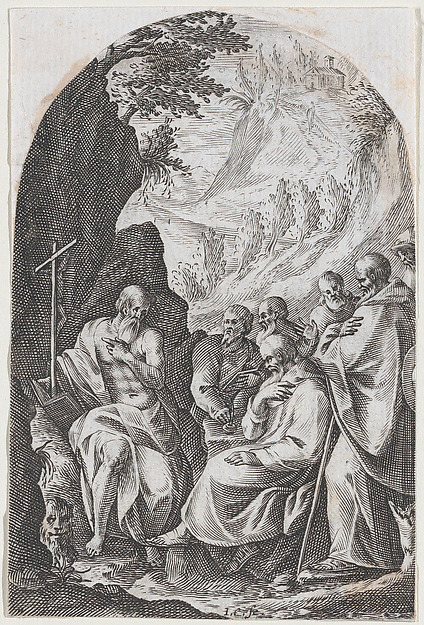
Jacques Callot was a devout Christian whose faith profoundly influenced his artistic vision. Born in Lorraine in 1592, he was raised in a Catholic environment, which shaped his understanding of spirituality and the world around him. Throughout his life, Callot dedicated himself to creating religious art that reflected his beliefs. His works often drew inspiration from scripture and the lives of saints, showcasing his reverence for the Christian narrative. The Lives of the Holy Hermits, for instance, highlights his admiration for the early desert fathers, illustrating their piety and devotion in serene, idealized landscapes. Callot's commitment to his faith is also evident in his meticulous approach to his craft, as he sought to honor God through the beauty of his etchings.
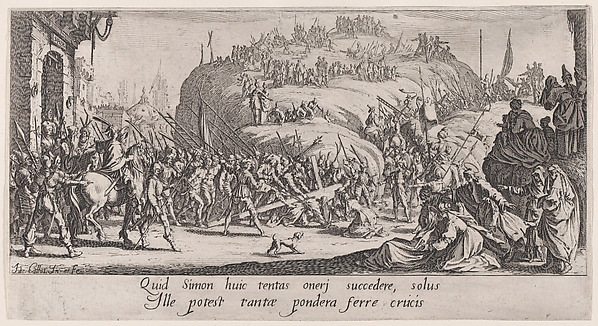
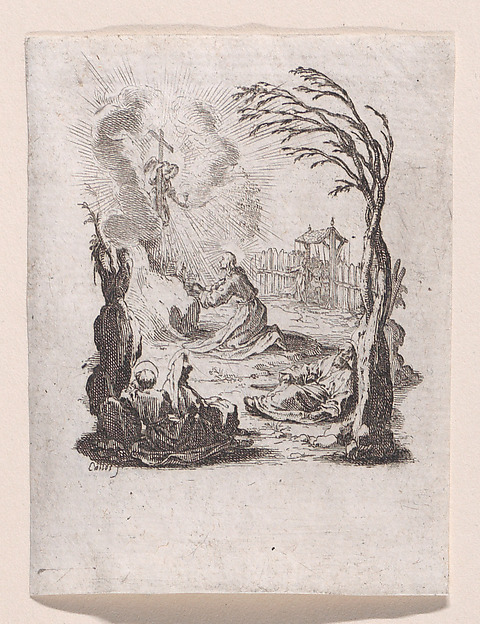
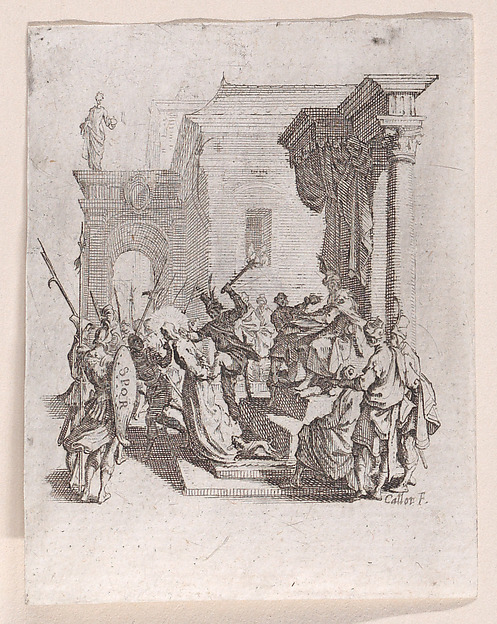
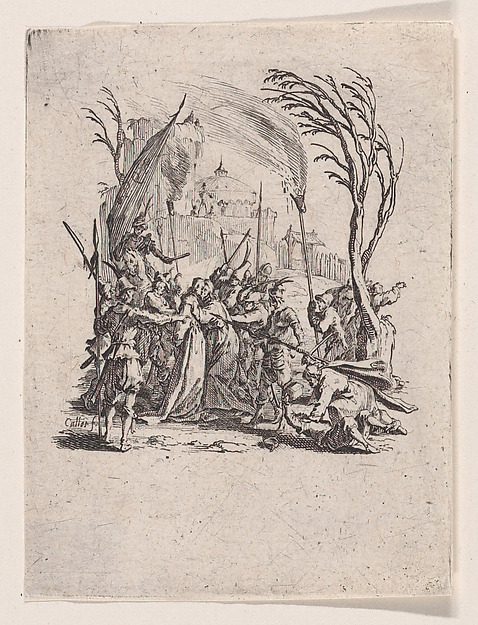
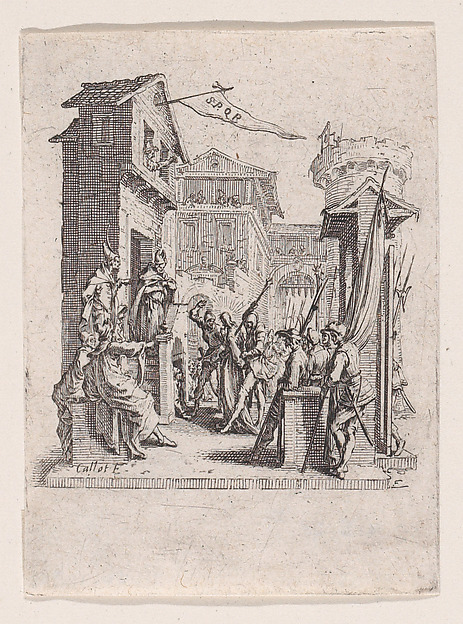
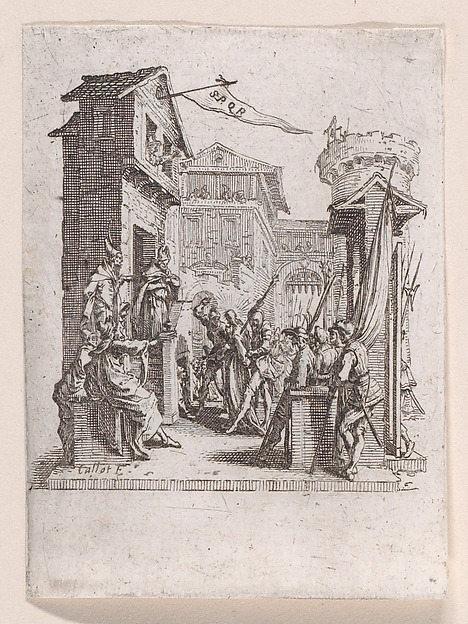
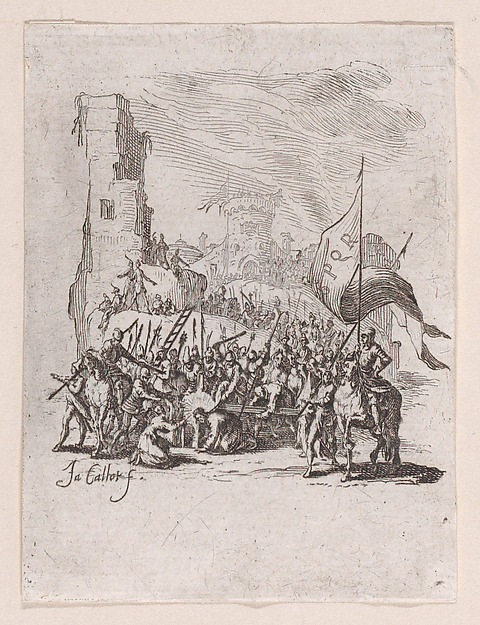
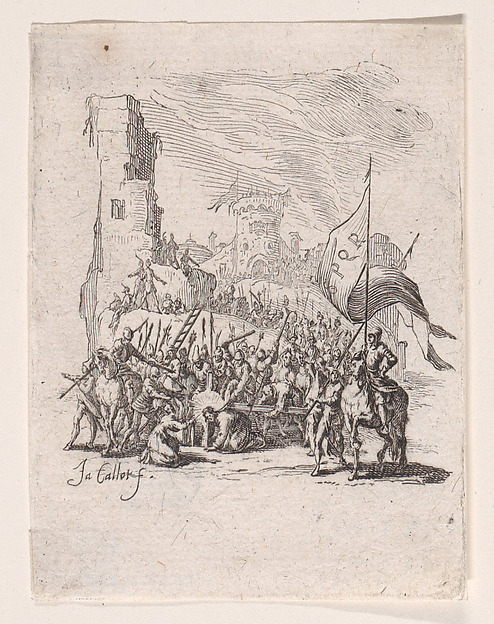
Callot's artistic output includes a remarkable series titled The Great Passion, which captures the journey of Christ from the Last Supper to the Resurrection. This work not only demonstrates his technical prowess but also reveals his deep spiritual engagement with the events of Christ's life. By depicting these sacred moments, Callot invites viewers to reflect on the significance of Christ's sacrifice and triumph. His etchings serve as a bridge between the viewer and the divine, encouraging contemplation and reverence. Through his art, Callot's devotion continues to inspire and uplift, reminding us of the beauty and depth of faith that can be expressed through creativity.
Life & work
Jacques Callot was the great French printmaker of the early seventeenth century — a Lorraine-born etcher and engraver whose technical innovations and prolific output made him the most reproduced single-leaf print artist in Europe between Dürer and Rembrandt. Born in Nancy in 1592 to a herald at the ducal court, sent to Italy as a teenager (against his father's wishes, the early biographies say) and trained first in Rome and then in Florence in the workshop of the Medici court engraver Antonio Tempesta, he returned to Lorraine in 1621 and worked there for the rest of his life, dying in Nancy in 1635.
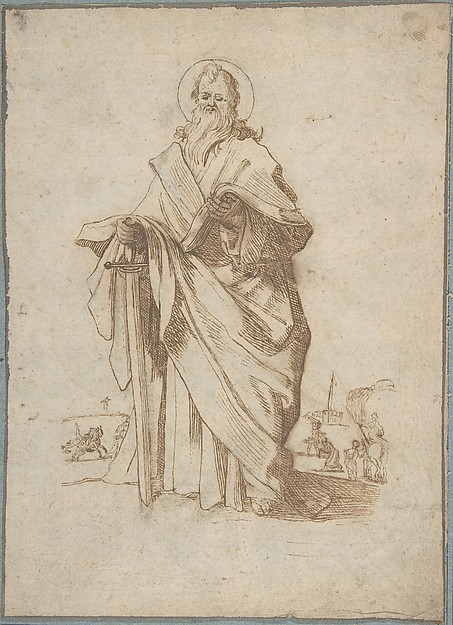
His Christian religious output is large. The Lives of the Holy Hermits (1629) is a series of small etchings of the desert fathers in idealized Italianate landscapes. The Great Passion (Lyon, 1623) is a horizontal series tracing the Passion of Christ from the Last Supper to the Resurrection. Saint John the Evangelist on Patmos, the Saint Sebastian, the Annunciation, the various Madonna prints, and a long sequence of saints' lives — including the Apostles, the Martyrdom of Saint Sebastian, and the Saint Peter Walking on the Water — appear and reappear across his catalogue.
His secular masterpiece, the Miseries and Misfortunes of War (Paris, 1633), eighteen small etchings of the suffering of civilians in the Thirty Years' War, has become one of the most-cited series of antiwar imagery in the history of art. It draws directly on the New Testament moral imagination — judgment, sin, the destruction of the wicked — even when its subject is the contemporary armies of Catholic and Protestant Europe.
Callot perfected the use of the échoppe, a hardened oval-pointed etching needle that allowed him to draw lines of variable width directly into the wax ground, mimicking the swell and taper of the engraver's burin without the engraver's labor. The technique, combined with multiple bath-stoppings, gave him etchings of unprecedented atmospheric range and crowd density. He produced over fourteen hundred etchings in his thirty-year career, and his influence on Rembrandt, Goya, and the entire later printmaking tradition is direct.
Notable works in detail
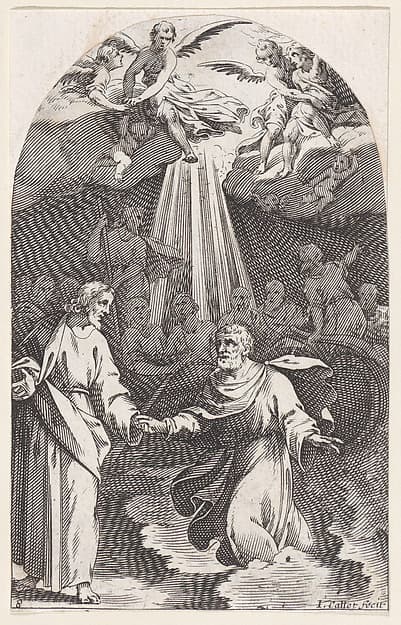
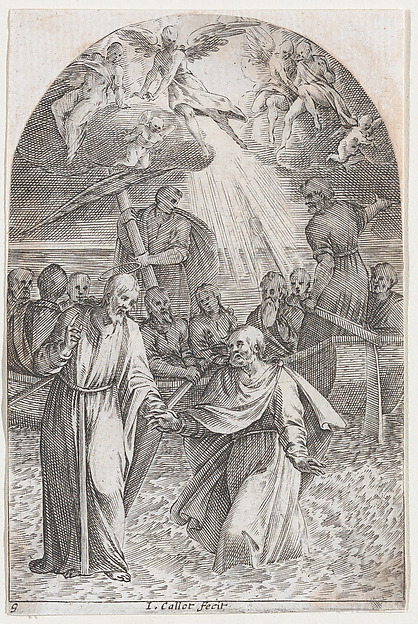
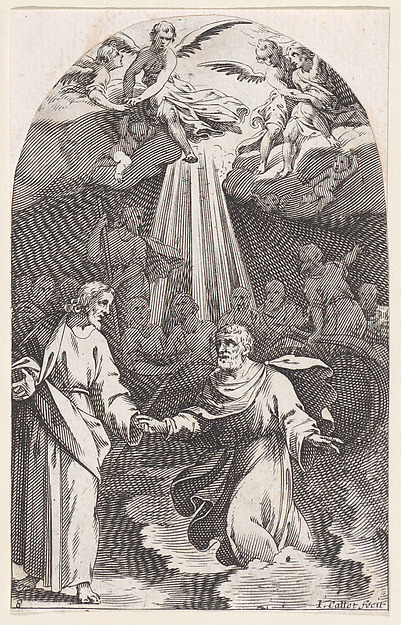
Christ Walking on Water, Holding the Hand of Saint Peter, etched by Jacques Callot around 1607 (in his early Italian years in Rome and Florence) and now in the Metropolitan Museum of Art in New York, illustrates the climactic moment from Matthew 14 in which Peter, walking out across the water of the Sea of Galilee toward Christ, begins to sink and is caught by the outstretched hand. Callot stages the scene with characteristic dense narrative composition: Christ stands upright on the water at the right with one arm extended, gripping the wrist of the half-sunken Peter who has begun to fall; the small fishing boat with the other apostles is visible in the distance behind, tossed on the storm-roughened water. The print is among the early Callot treatments of a Gospel subject and demonstrates the technical accomplishment of the etched line that would later mature into the Lorraine Callot signature.
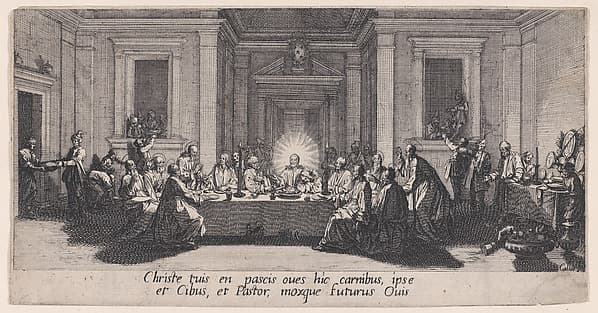
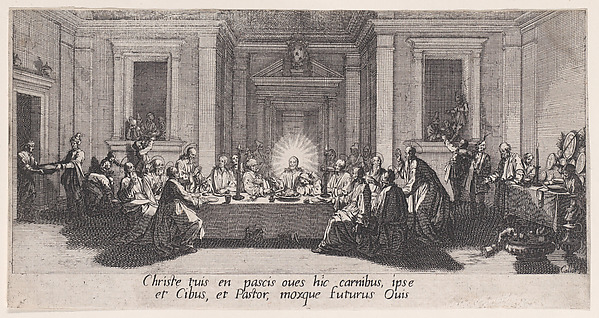
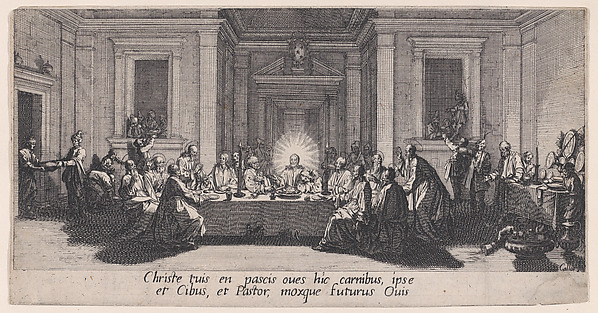
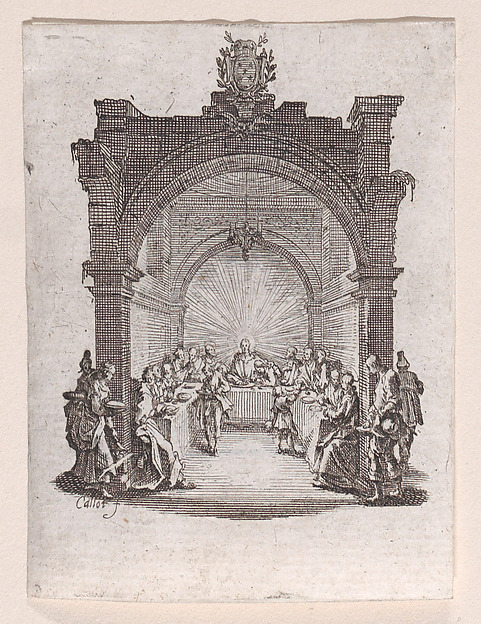
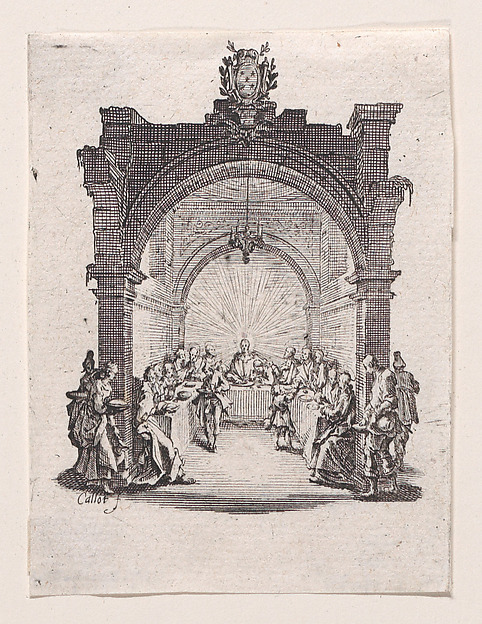
La Cêne (The Last Supper), from "La Grande Passion" (The Large Passion)
The Last Supper, etched by Jacques Callot around 1618 as one of the plates of his Grande Passion series and now in the Metropolitan Museum of Art in New York, depicts the moment from the Synoptic Gospels at which Christ institutes the Eucharist with the apostles in the upper room on the night before his Crucifixion. Callot composes the scene at a long horizontal table with Christ in the center seated under an architectural canopy, the twelve apostles ranged on either side with John leaning into Christ's chest and Judas isolated in profile in the lower-right foreground. The Grande Passion series, etched in Florence and Lorraine across the late 1610s, represents one of the most ambitious of Callot's serial Passion projects; the technical accomplishment of the etched line — the famous échoppe needle Callot developed himself — gives the prints an atmospheric range no engraved Passion of the period had achieved.
L'Adoration des Mages (The Adoration of the Magi)
L'Adoration des Mages (The Adoration of the Magi), etched by Jacques Callot around 1621 in his late Italian years in Florence and now in the Metropolitan Museum of Art in New York, illustrates the visit of the three kings to the infant Christ as recorded in Matthew 2. Callot stages the scene as a dense crowded composition with the seated Virgin and the Christ Child at the center, the three Magi in formal attendance with their large retinue of attendants and animals filling the background, and a distant Italianate landscape with hills and small figures fading into atmospheric haze. The technical accomplishment of the print — the rich tonal range achieved through Callot's invention of the échoppe needle and his use of multiple bath-stoppings in the etching process — marks it as one of the foundational documents of seventeenth-century French printmaking.
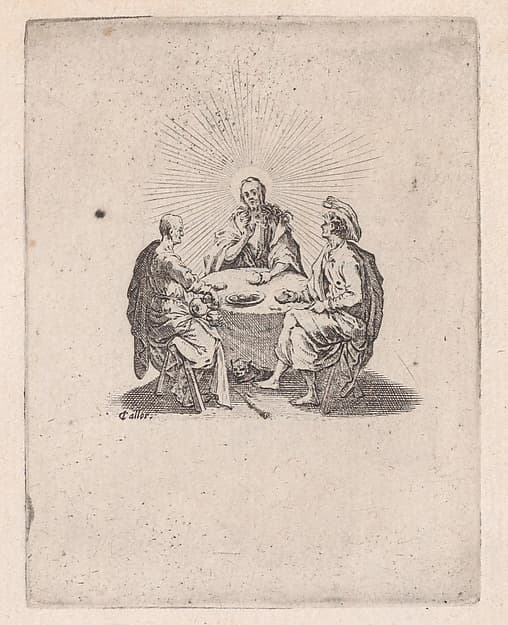
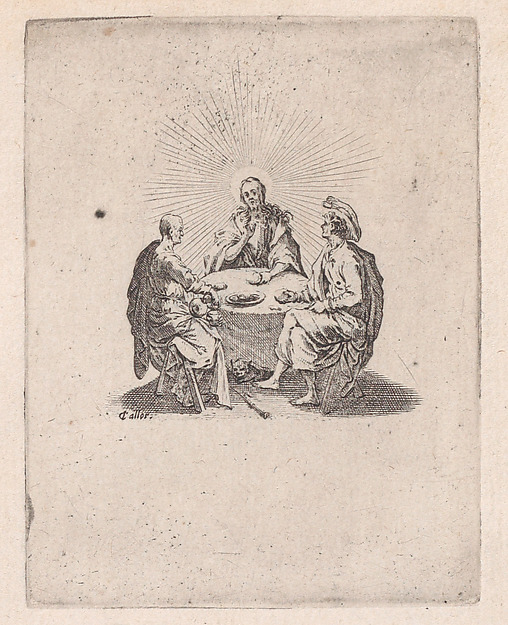
Le Souper d'Emmaüs (Supper at Emmaus, also called The Disciples at Emmaus), etched by Jacques Callot around 1620 in his late Florentine years and now in the Metropolitan Museum of Art in New York, illustrates the moment from Luke 24 in which the risen Christ is recognized by the two disciples at the inn at Emmaus when he breaks the bread at the supper table. Callot stages the scene in a small Italian inn interior: the three figures seated at a horizontal table in the foreground, Christ in the center in the act of breaking the bread, the two disciples on either side leaning back in postures of sudden recognition; an attendant servant approaches from the back with a tray. The print is among the most reproduced of Callot's Italian-period etchings and a defining statement of his ability to translate the Gospel-recognition subject into the new precise atmospheric etching format.
Bible scenes Jacques Callot painted
Acts
Matthew
Romans
Luke
John
Mark
Exodus
Genesis
Revelation
Job
Daniel