Joel 2
People in this chapter
The first chapter of Joel described a land stripped bare by locusts, wave after wave devouring everything green until the fields lay in mourning. Now, in chapter 2, the prophet lifts that disaster up and uses it as a window onto something larger still: the day of the LORD. A trumpet sounds in Zion, an alarm rings out from the holy mountain, and an army advances that makes the locust plague look like a rehearsal.
A day of darkness and of gloominess, a day of clouds and of thick darkness (v. 2) - fire before it and desolation behind, the earth quaking, the heavens trembling, the sun and moon gone dark. The movement climbs to a single dreadful line and a single open question: the day of the LORD is great and very terrible; and who can abide it? (v. 11).1
Tap any highlighted phrase to jump to the commentary that unpacks it.
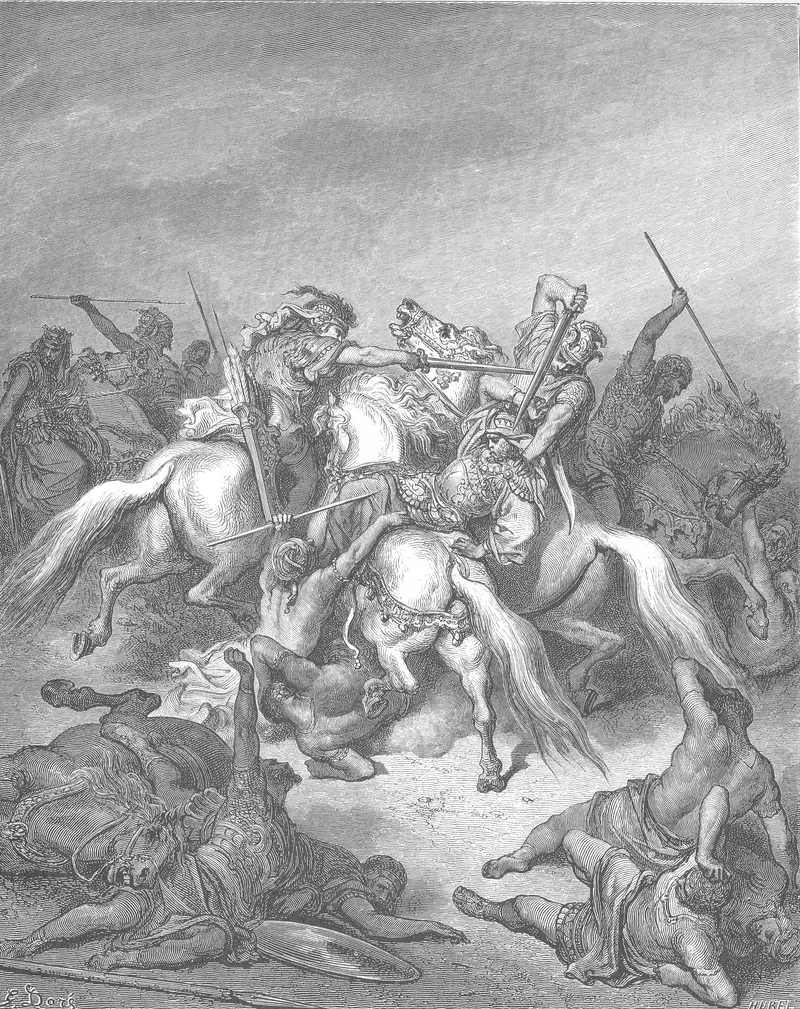
Joel 2:1-11Blow Ye the Trumpet in Zion
1Blow ye the trumpet in Zion, and sound an alarm in my holy mountain: let all the inhabitants of the land tremble: for the day of the LORD cometh, for it is nigh at hand; 2A day of darkness and of gloominess, a day of clouds and of thick darkness, as the morning spread upon the mountains: a great people and a strong; there hath not been ever the like, neither shall be any more after it, even to the years of many generations. 3A fire devoureth before them; and behind them a flame burneth: the land is as the garden of Eden before them, and behind them a desolate wilderness; yea, and nothing shall escape them. 4The appearance of them is as the appearance of horses; and as horsemen, so shall they run. 5Like the noise of chariots on the tops of mountains shall they leap, like the noise of a flame of fire that devoureth the stubble, as a strong people set in battle array. 6Before their face the people shall be much pained: all faces shall gather blackness.
The chapter opens with a sound, and it is the sound of emergency: Blow ye the trumpet in Zion, and sound an alarm in my holy mountain: let all the inhabitants of the land tremble (v. 1). The trumpet here is the shofar, the ram's horn that summoned a city to assembly and warned it of an army at the gates. Its blast meant: drop everything, this is not a drill. And the reason given is the gravest the prophet knows: for the day of the LORD cometh, for it is nigh at hand. The locust plague of chapter 1 has become a lens.
Behind the literal swarm Joel sees something vaster - the day when the LORD Himself acts in judgment, when the affairs of the world are brought before His throne. He describes it as a darkness that swallows the dawn: a day of darkness and of gloominess, a day of clouds and of thick darkness (v. 2). Where the rising sun should bring light, this day brings a spreading black. The alarm sounds for urgency. Something is coming that no one should sleep through - and the only fitting response is to wake, and tremble, and listen for what the LORD will say next.1
Joel paints the advancing host in strokes of fire and ruin: A fire devoureth before them; and behind them a flame burneth: the land is as the garden of Eden before them, and behind them a desolate wilderness (v. 3). The contrast is meant to stop the reader cold. Ahead of this army lies a paradise - lush, green, like Eden itself; behind it lies a scorched waste. Whatever it touches, it consumes; nothing shall escape them. Then the imagery turns military and relentless: they have the appearance of horses and charge like cavalry (v. 4); they come with the roar of chariots on the tops of mountains and the crackle of a flame of fire that devoureth the stubble (v. 5).
This is the locust swarm seen for what it truly signifies - an unstoppable force set in battle array. And the effect on the watching people is dread that shows on the body: Before their face the people shall be much pained: all faces shall gather blackness (v. 6). The faces of the onlookers go ashen, drained of color by terror. Joel is not exaggerating for effect. He wants his hearers to feel, in their stomachs, the weight of a day they cannot stop and cannot outrun - so that they will turn while there is still time.
7They shall run like mighty men; they shall climb the wall like men of war; and they shall march every one on his ways, and they shall not break their ranks: 8Neither shall one thrust another; they shall walk every one in his path: and when they fall upon the sword, they shall not be wounded. 9They shall run to and fro in the city; they shall run upon the wall, they shall climb up upon the houses; they shall enter in at the windows like a thief. 10The earth shall quake before them; the heavens shall tremble: the sun and the moon shall be dark, and the stars shall withdraw their shining: 11And the LORD shall utter his voice before his army: for his camp is very great: for he is strong that executeth his word: for the day of the LORD is great and very terrible; and who can abide it?
The army's terror is its perfect, tireless discipline. They shall run like mighty men; they shall climb the wall like men of war; and they shall march every one on his ways, and they shall not break their ranks (v. 7). There is no confusion in this host, no jostling, no breaking of formation: neither shall one thrust another; they shall walk every one in his path (v. 8). They cannot be stopped by ordinary means - when they fall upon the sword, they shall not be wounded. Anyone who has watched a locust swarm pour over a wall and through every crack will recognize the picture: they shall run upon the wall, they shall climb up upon the houses; they shall enter in at the windows like a thief (v. 9).
Nothing keeps them out. And then the language lifts from the earthly to the cosmic. The whole created order convulses: The earth shall quake before them; the heavens shall tremble: the sun and the moon shall be dark, and the stars shall withdraw their shining (v. 10). This is the signature of the day of the LORD throughout the prophets - the lights of heaven failing, the solid ground trembling. Joel is telling his hearers that what looks like a natural disaster is bound up with something far greater: the LORD drawing near, and all creation shaking at His approach.
Joel 2:12-17Rend Your Heart, and Not Your Garments
12Therefore also now, saith the LORD, turn ye even to me with all your heart, and with fasting, and with weeping, and with mourning: 13And rend your heart, and not your garments, and turn unto the LORD your God: for he is gracious and merciful, slow to anger, and of great kindness, and repenteth him of the evil. 14Who knoweth if he will return and repent, and leave a blessing behind him; even a meat offering and a drink offering unto the LORD your God?
Everything pivots on a single word: Therefore also now, saith the LORD, turn ye even to me with all your heart, and with fasting, and with weeping, and with mourning (v. 12). After eleven verses of advancing terror, the very next voice is the LORD's own, and it says turn - to me. This is the astonishing mercy at the center of the chapter: the One whose day is so terrible is the same One pleading with His people to come back to Him before it arrives.
Notice where the turning is aimed. Not merely away from sin, but even to me - the goal of repentance is not just to stop doing wrong but to come home to a Person. And notice how total He asks it to be: with all your heart. Half-hearted returning will not do. The fasting and weeping and mourning He names are the outward signs of grief over sin - right and good in their place. But the next verse will guard against the danger that always shadows them: that a person might perform the signs of repentance while the heart stays exactly where it was.
The door home stands open. The LORD Himself is holding it. And the word He uses is the gentlest summons in all of judgment: turn.
Then comes the line that has comforted the grieving for three thousand years: And rend your heart, and not your garments, and turn unto the LORD your God: for he is gracious and merciful, slow to anger, and of great kindness, and repenteth him of the evil (v. 13). To rend - to tear - one's garments was the ancient sign of overwhelming grief; people ripped their clothing at news of death or disaster. The LORD does not forbid the gesture, but He demands what it was always meant to express: a heart actually broken, not merely a robe theatrically torn.
Tear the inside. God looks for a heart genuinely broken, not a public show of sorrow draped over an unchanged one. And the reason He gives for turning is the depth of His own mercy: he is gracious and merciful, slow to anger, and of great kindness. These are the very words the LORD spoke over Moses on the mountain, declaring His own name and nature. Repentance here is a confident return to a God who has revealed Himself as merciful from the start, not a desperate gamble that an angry God might possibly relent.
Even the tentative who knoweth of verse 14 - who knoweth if he will return and repent, and leave a blessing behind him? - is humility before His freedom, not doubt about His goodness. The God who is gracious and merciful may well leave a blessing where the locust left a ruin.
15Blow the trumpet in Zion, sanctify a fast, call a solemn assembly: 16Gather the people, sanctify the congregation, assemble the elders, gather the children, and those that suck the breasts: let the bridegroom go forth of his chamber, and the bride out of her closet. 17Let the priests, the ministers of the LORD, weep between the porch and the altar, and let them say, Spare thy people, O LORD, and give not thine heritage to reproach, that the heathen should rule over them: wherefore should they say among the people, Where is their God?
The same trumpet that sounded the alarm in verse 1 now sounds a summons to assemble: Blow the trumpet in Zion, sanctify a fast, call a solemn assembly (v. 15). And the gathering is sweeping - no one is exempt. Gather the people, sanctify the congregation, assemble the elders, gather the children, and those that suck the breasts: let the bridegroom go forth of his chamber, and the bride out of her closet (v. 16). The aged and the nursing infants, the leaders and the newlyweds - even a wedding, the most joyful and protected of occasions, is interrupted, the bridegroom and bride called out from their celebration to join the corporate plea.
This is not a private matter to be handled alone; the whole community turns together. At the head stand the priests, and their place is striking: Let the priests, the ministers of the LORD, weep between the porch and the altar (v. 17) - in the most sacred space, between the temple itself and the altar of sacrifice, exactly where they would normally minister. And their prayer is shaped not by self-pity but by jealousy for God's honor: Spare thy people, O LORD… wherefore should they say among the people, Where is their God? The deepest concern of true repentance is not merely escaping consequences but that the LORD's name not be mocked.
They plead His glory back to Him - and a God whose own name is at stake is a God who listens.
Joel 2:18-27I Will Restore the Years the Locust Hath Eaten
18Then will the LORD be jealous for his land, and pity his people. 19Yea, the LORD will answer and say unto his people, Behold, I will send you corn, and wine, and oil, and ye shall be satisfied therewith: and I will no more make you a reproach among the heathen: 20But I will remove far off from you the northern army, and will drive him into a land barren and desolate, with his face toward the east sea, and his hinder part toward the utmost sea, and his stink shall come up, and his ill savour shall come up, because he hath done great things. 21Fear not, O land; be glad and rejoice: for the LORD will do great things. 22Be not afraid, ye beasts of the field: for the pastures of the wilderness do spring, for the tree beareth her fruit, the fig tree and the vine do yield their strength.
The turn the prophet hoped for in verse 14 now arrives as fact. The people turn, and God answers: Then will the LORD be jealous for his land, and pity his people (v. 18). The word jealous here is the fierce, protective love of one who will not see what belongs to Him harmed or shamed - the love of a husband for his bride, a father for his own. The same intensity that drove the judgment now drives the rescue.
And the LORD speaks directly to His people in promises as tangible as the loss had been: Behold, I will send you corn, and wine, and oil, and ye shall be satisfied therewith (v. 19). The locusts had stripped exactly these - the grain, the vine, the olive. Now they are restored in abundance, until the people are not merely fed but satisfied. And the reproach is lifted: I will no more make you a reproach among the heathen. The destroying army is driven off and gone (v. 20).
Then comes a threefold call to rejoice that reverses the mourning of chapter 1: Fear not, O land… be glad and rejoice (v. 21); Be not afraid, ye beasts of the field (v. 22). The very ground and the very animals that had groaned under the plague are now told to stop fearing - for the LORD will do great things. The same God whose great day was terrible now does great things of mercy.
23Be glad then, ye children of Zion, and rejoice in the LORD your God: for he hath given you the former rain moderately, and he will cause to come down for you the rain, the former rain, and the latter rain in the first month. 24And the floors shall be full of wheat, and the vats shall overflow with wine and oil. 25And I will restore to you the years that the locust hath eaten, the cankerworm, and the caterpiller, and the palmerworm, my great army which I sent among you. 26And ye shall eat in plenty, and be satisfied, and praise the name of the LORD your God, that hath dealt wondrously with you: and my people shall never be ashamed. 27And ye shall know that I am in the midst of Israel, and that I am the LORD your God, and none else: and my people shall never be ashamed.
Now comes the promise that has carried hope to ruined lives ever since: And I will restore to you the years that the locust hath eaten, the cankerworm, and the caterpiller, and the palmerworm, my great army which I sent among you (v. 25). The four names are the waves of devastation from chapter 1 - layer upon layer of loss, each finishing what the last began. And the LORD does not merely promise to stop the swarm or to grant a single good harvest.
He promises to give back the years - the time itself that the locusts devoured, the seasons that were eaten alive. This is restoration on a scale no farmer could engineer: not just next year's crop, but recompense for everything the lost years cost. Notice too the staggering admission woven in - my great army which I sent among you. The LORD owns the judgment as His own, and yet that same LORD is the one now restoring.
The hand that disciplined is the hand that heals. The result is overflowing plenty (vv. 23-24) and a satisfaction that turns to worship: ye shall eat in plenty, and be satisfied, and praise the name of the LORD your God, that hath dealt wondrously with you (v. 26). And twice, like a refrain hammered home, comes the line that answers every shame the plague had heaped on them: my people shall never be ashamed.
The crown of all the restoration is a Presence, deeper than the grain or the wine: And ye shall know that I am in the midst of Israel, and that I am the LORD your God, and none else (v. 27). The deepest gift is a known and present God, dwelling among His people. The locust plague had raised the taunt of the nations - where is their God? (v. 17). Now the answer rings out: in the midst of His people.
The restored harvest is meant to teach them something far greater than agriculture - that the LORD is among them, that He alone is God, that there is none else. And once more, sealing the whole section, comes the promise: my people shall never be ashamed. Twice in two verses (vv. 26-27) the LORD swears it, and the repetition is the point. The shame of the ruined fields, the shame of the mocking nations, the shame of a people who wondered if their God had abandoned them - all of it is overturned, and overturned for good.
To know that God is in the midst is to be set permanently beyond shame. The full vats are wonderful; but the wonder beneath the wonder is that the God who fills them dwells among His own.
Joel 2:28-32I Will Pour Out My Spirit Upon All Flesh
28And it shall come to pass afterward, that I will pour out my spirit upon all flesh; and your sons and your daughters shall prophesy, your old men shall dream dreams, your young men shall see visions: 29And also upon the servants and upon the handmaids in those days will I pour out my spirit. 30And I will shew wonders in the heavens and in the earth, blood, and fire, and pillars of smoke. 31The sun shall be turned into darkness, and the moon into blood, before the great and the terrible day of the LORD come. 32And it shall come to pass, that whosoever shall call on the name of the LORD shall be delivered: for in mount Zion and in Jerusalem shall be deliverance, as the LORD hath said, and in the remnant whom the LORD shall call.
Here the chapter opens onto its widest horizon. After the restored harvest comes a far greater outpouring: And it shall come to pass afterward, that I will pour out my spirit upon all flesh; and your sons and your daughters shall prophesy, your old men shall dream dreams, your young men shall see visions (v. 28). The word afterward lifts the eye beyond the immediate rescue to a later, greater day. And the gift is breathtaking in its reach.
Up to now, the Spirit of the LORD had come upon select individuals - a prophet here, a judge or king there, set apart for a particular task. Now the promise is upon all flesh. The barriers fall in every direction the ancient world knew. Sons and daughters - the gift crosses the line between male and female. Old men… young men - it crosses the line of age. And lest anyone think it is only for the free and the highborn, verse 29 presses further still: And also upon the servants and upon the handmaids in those days will I pour out my spirit. The Spirit is poured out even on bondservants, the lowest rung of that society.
This is not a trickle rationed to the worthy few; it is a flood given to the many, regardless of station. The God who restores the fields has a gift greater than grain to give - His own Spirit, poured out without measure on all who are His.
The outpouring of the Spirit is set against the backdrop of the great day still to come: And I will shew wonders in the heavens and in the earth, blood, and fire, and pillars of smoke. The sun shall be turned into darkness, and the moon into blood, before the great and the terrible day of the LORD come (vv. 30-31). The chapter circles back to where it began - the darkened sun and moon of verse 10, the cosmic signs of the day of the LORD.
But the placement now is full of mercy. These wonders come before the great and terrible day arrives, and they come after the Spirit has been poured out. In other words, the age of the outpoured Spirit and the open door of deliverance is the very window of grace that runs up to the final day. The signs in the heavens are not given to terrify the faithful but to warn the world that the day is real and is coming - and that now, in the meantime, is the time to call upon the LORD.
The terrible day is held back; the Spirit is given; the invitation stands open. Joel sets the dread and the deliverance side by side on purpose, so that the reader feels both the weight of what is coming and the wideness of the mercy offered before it does.
The whole chapter comes to rest on one of the most open invitations in all of Scripture: And it shall come to pass, that whosoever shall call on the name of the LORD shall be delivered: for in mount Zion and in Jerusalem shall be deliverance, as the LORD hath said, and in the remnant whom the LORD shall call (v. 32). After the terror of the army, after the call to rend the heart, after the restored fields and the outpoured Spirit, the door of rescue is flung wide to a single word: whosoever. Not the worthy alone, not the priestly class, not one nation only - whosoever calls.
The deliverance does not depend on status or pedigree but on a cry: to call on the name of the LORD is to turn to Him in trust and ask to be saved. And notice the beautiful balance in the verse's end. On the one side, the human act: whosoever shall call. On the other, God's initiative: the remnant whom the LORD shall call. Those who call are themselves the called - God's summons and the sinner's answer meet in the same moment of deliverance.
The day that opened with an alarm no one could abide closes with a promise no one need fear: call, and be delivered. It is the same gospel the apostles will carry to the ends of the earth.
Research trail
Sources & further study
These references support the historical, linguistic, manuscript, and contextual notes in this chapter. Scripture remains the primary text; external sources are provided so readers can inspect the research directly.
- Joel 2 - Translators' NotesThe NET Bible's detailed footnotes on Joel 2 - the imagery of the advancing army in verses 1-11, the difficult military descriptions, the “former and latter rain” of verse 23, and the scope of the Spirit poured out on all flesh in verses 28-29.
- Joel 2 · Hebrew + classical Jewish commentaryThe Hebrew text of Joel 2 with Rashi, Ibn Ezra, and other classical commentators side by side - useful for the phrase qir'u levavchem (v. 13, “rend your heart”), the verb shafak (vv. 28-29, “pour out”), and the much-discussed scope of kol basar (v. 28, “all flesh”).
- Joel 2 ↔ Acts 2 · Romans 10 · Exodus 34Traces the threads tying Joel 2 to the rest of Scripture - the outpouring of the Spirit (vv. 28-29) quoted at Pentecost (Acts 2:16-21), whosoever shall call (v. 32) carried by Paul (Rom. 10:13), and the mercy formula gracious and merciful, slow to anger (v. 13) drawn from the LORD's own words to Moses (Exod. 34:6).
Where this echoes in Scripture
Blow Ye the Trumpet in Zion
- Amos 5:18Woe unto you that desire the day of the LORD! ... the day of the LORD is darkness, and not light.The same day of the LORD as verses 1-11 - darkness for the unprepared, not the deliverance they assumed.
- Zephaniah 1:14-15The great day of the LORD is near... that day is a day of wrath, a day of trouble and distress, a day of darkness and gloominess.The darkness and dread of verse 2 echoed - the prophets' shared portrait of the day of the LORD.
- Mark 4:39-41he... rebuked the wind... What manner of man is this, that even the wind and the sea obey him?The voice that commands the army of verse 11 - the One whose word even wind and sea obey.
- Revelation 6:17For the great day of his wrath is come; and who shall be able to stand?The unanswered question of verse 11 - who can abide the day of the LORD?
- Joel 2:31The sun shall be turned into darkness, and the moon into blood, before the great and the terrible day of the LORD come.The darkened sun and moon of verse 10 sounded again later in the same chapter - the signs of the day drawing near.
Rend Your Heart, and Not Your Garments
- Exodus 34:6The LORD, The LORD God, merciful and gracious, longsuffering, and abundant in goodness and truth.The very words Joel quotes in verse 13 - God's own declaration of His name and nature to Moses.
- Psalm 51:17The sacrifices of God are a broken spirit: a broken and a contrite heart, O God, thou wilt not despise.The torn heart of verse 13 - the inward brokenness God receives over the outward show.
- Luke 15:20when he was yet a great way off, his father saw him, and had compassion, and ran, and fell on his neck, and kissed him.The God who is slow to anger and of great kindness (v. 13) - running to meet the one who turns home.
- James 4:8Draw nigh to God, and he will draw nigh to you. Cleanse your hands, ye sinners; and purify your hearts.The turning of verse 12 answered - come near to God, and find Him coming near to you.
- Jonah 2:8-9I will sacrifice unto thee with the voice of thanksgiving... Salvation is of the LORD.The hope of verse 14 - the God who relents and leaves a blessing where judgment seemed certain.
I Will Restore the Years the Locust Hath Eaten
- Isaiah 61:7For your shame ye shall have double... they shall rejoice in their portion... everlasting joy shall be unto them.The reversal of verses 25-26 - double restoration in place of shame, the lost given back with overflow.
- Luke 4:18he hath anointed me to preach the gospel to the poor... to heal the brokenhearted... to set at liberty them that are bruised.The restoration of verse 25 fulfilled - the One sent to give back what loss and sin devoured.
- Psalm 126:5-6They that sow in tears shall reap in joy... shall doubtless come again with rejoicing, bringing his sheaves with him.The harvest of joy that follows the weeping - the pattern of verses 18-26.
- Revelation 21:3-4the tabernacle of God is with men... God shall wipe away all tears from their eyes.The “I am in the midst” of verse 27 brought to its fullness - God dwelling with His people, all shame and sorrow gone.
- Romans 8:18the sufferings of this present time are not worthy to be compared with the glory which shall be revealed in us.The eaten years of verse 25 set against the restoration to come - loss outweighed beyond measure.
I Will Pour Out My Spirit Upon All Flesh
- Acts 2:16-21this is that which was spoken by the prophet Joel... I will pour out of my Spirit upon all flesh.Peter at Pentecost quoting verses 28-32 nearly word for word - the outpouring begun, the door declared open.
- Romans 10:12-13the same Lord over all is rich unto all that call upon him. For whosoever shall call upon the name of the Lord shall be saved.Paul making verse 32 the charter of the gospel for all nations - no difference, no exclusion.
- Numbers 11:29would God that all the LORD's people were prophets, and that the LORD would put his spirit upon them!Moses' longing answered in verses 28-29 - the Spirit no longer on a few, but poured out on all.
- Acts 1:8ye shall receive power, after that the Holy Ghost is come upon you... unto the uttermost part of the earth.The promised Spirit of verse 28 - given by the risen Lord to carry His witness to all flesh.
- John 6:37him that cometh to me I will in no wise cast out.The open door of verse 32 in the Lord's own words - whosoever comes, received without exception.