Acts 22
People in this chapter
A mob has Paul by the throat. Dragged from the temple, accused of smuggling a Gentile past the barrier, beaten, bound in chains - and then he asks the officer for permission to speak. He turns to the crowd that wants him dead and raises his hand. He begins in Hebrew, and the screaming stops.1
Tap any highlighted phrase to jump to the commentary that unpacks it.
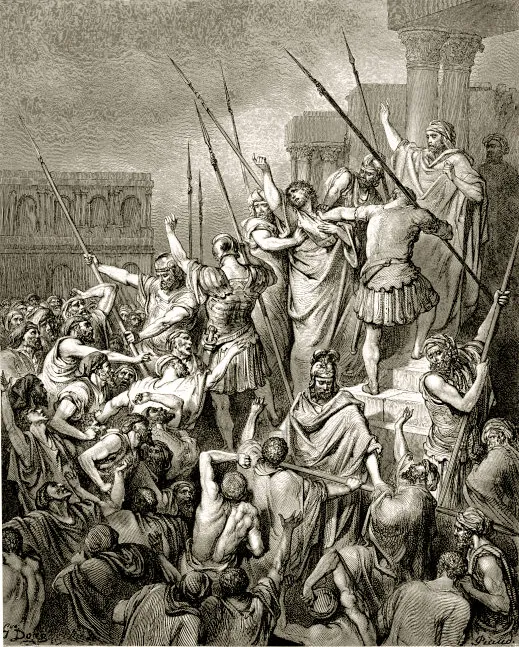
Acts 22:1-3Hebrew Silences the Crowd
1Men, brethren, and fathers, hear ye my defence which I make now unto you. 2(And when they heard that he spake in the Hebrew tongue to them, they kept the more silence: and he saith,) 3I am verily a man which am a Jew, born in Tarsus, a city in Cilicia, yet brought up in this city at the feet of Gamaliel, and taught according to the perfect manner of the law of the fathers, and was zealous toward God, as ye all are this day.
The crowd has been screaming in Greek, the lingua franca of the Roman empire. Paul speaks in Hebrew - the language of their ancestors, the language of their law, the language of their identity. It is a rhetorical move, yes, but also something more: a claim of belonging. I am one of you. I speak your language. I know where you come from. The mob quiets. They listen.
Tarsus was no backwater. It was a Hellenistic city of learning and commerce1 - yet Paul identifies himself first as a Jew. His birthplace gives him standing among the Gentiles; his identity as a Jew gives him standing before this crowd. He is simply telling the truth in full: this is who I am.
Acts 22:4-5The Hunter's Confession
4And I persecuted this way unto the death, binding and delivering into prisons both men and women. 5As also the high priest doth bear me witness, and all the estate of the elders: from whom also I received letters unto the brethren, and went to Damascus, to bring them which were there bound unto Jerusalem, for to be punished.
Paul uses the word diok&ō; - to hunt, to pursue, to chase down. He is confessing to violence, to organized persecution. He hunted believers. He bound them. This is his own testimony before the crowd who wants him dead. There is a fearlessness in this confession: I did what you accuse me of. And I was absolutely, completely wrong.
Acts 22:6-9The Light and the Voice
6And it came to pass, that, as I made my journey, and was come nigh unto Damascus about noon, suddenly there shone from heaven a great light round about me. 7And I fell unto the ground, and heard a voice saying unto me, Saul, Saul, why persecutest thou me? 8And I answered, Who art thou, Lord? And he said unto me, I am Jesus of Nazareth, whom thou persecutest. 9And they that were with me saw indeed the light, and were afraid; but they heard not the voice of him that spake to me.
Light. The same word Jesus used in Acts 9: "more bright than the sun."2 Paul retells it here, and the crowd hears the echo of resurrection power. A light that knocked him off his horse, that blinded him, that could not be explained away. The barrier between heaven and earth opened, and Paul was struck down by it.
Acts 22:10-11Sent Into Damascus
10And I said, What shall I do, LORD? And the Lord said unto me, Arise, and go into Damascus; and there it shall be told thee of all things which are appointed for thee to do. 11And when I could not see for the glory of that light, being led by the hand of them that were with me, I came into Damascus.
Acts 22:12-16Ananias and the Witness
12And one Ananias, a devout man according to the law, having a good report of all the Jews which dwelt there, 13Came unto me, and stood, and said unto me, Brother Saul, receive thy sight. And the same hour I looked up upon him. 14And he said, The God of our fathers hath chosen thee, that thou shouldest know his will, and see that Just One, and shouldest hear the voice of his mouth. 15For thou shalt be his witness unto all men of what thou hast seen and heard. 16And now why tarriest thou? arise, and be baptized, and wash away thy sins, calling on the name of the Lord.
Ananias speaks as if Saul's blindness was itself a form of sight - a blindness that is about to yield to a vision more true than anything his eyes had ever seen. "Thou shalt know his will" - through encounter, through obedience. The God of Abraham, Isaac, and Jacob has chosen this persecutor.
Saul rises from his blindness and is baptized immediately. The washing away of sins is connected to "calling on the name of the Lord." He enters the water as a man named Saul the persecutor. He comes up as a man named Paul the apostle. His sins are washed away as he is baptized and calls on the name of the Lord, the water and the calling joined in a single command, the appointed means and the cry of surrender held together, and beneath them both the cleansing power of the One whose name he is calling upon.
Acts 22:17-21Depart, unto the Gentiles
17And it came to pass, that, when I was come again to Jerusalem, even while I prayed in the temple, I was in a trance; 18And saw him saying unto me, Make haste, and get thee quickly out of Jerusalem: for they will not receive thy testimony concerning me. 19And I said, Lord, they know that I imprisoned and beat in every synagogue them that believed on thee: 20And when the blood of thy martyr Stephen was shed, I also was standing by, and consenting unto his death, and kept the raiment of them that slew him. 21And he said unto me, Depart: for I will send thee far hence unto the Gentiles.
Acts 22:17-21The Temple Vision: "Far Hence unto the Gentiles"
17And it came to pass, that, when I was come again to Jerusalem, even while I prayed in the temple, I was in a trance; 18And saw him saying unto me, Make haste, and get thee quickly out of Jerusalem: for they will not receive thy testimony concerning me. 19And I said, Lord, they know that I imprisoned and beat in every synagogue them that believed on thee: 20And when the blood of thy martyr Stephen was shed, I also was standing by, and consenting unto his death, and kept the raiment of them that slew him. 21And he said unto me, Depart: for I will send thee far hence unto the Gentiles.
Paul is praying in the temple - the very place where hours before he stood bound, surrounded by a mob. He is in a trance, and the Lord speaks. What the crowd below is hearing, Paul cannot hear. What Paul sees, the crowd cannot see. He is caught between two worlds: the physical danger surrounding him and the spiritual reality confronting him in the trance.
Paul objects. "Lord, they know what I did to believers. My past proves I belong here." But the Lord sends him away. The word is simple: "Depart." And the destination: "the Gentiles." This is an apostolic commission.
Acts 22:22-25Away with Such a Fellow
22And they gave him audience unto this word, and then lifted up their voices, and said, Away with such a fellow from the earth: for it is not fit that he should live. 23And as they cried out, and cast off their clothes, and threw dust into the air, 24The chief captain commanded him to be brought into the castle, and bade that he should be examined by scourging; that he might know wherefore they cried so against him. 25And as they bound him with thongs, Paul said unto the centurion that stood by, Is it lawful for you to scourge a man that is a Roman, and uncondemned?
The word "Gentiles" is the breaking point. Paul has told them his entire story, and they have listened. But when he reveals that he was sent to the Gentiles - that the gospel is not for Jews alone - the crowd loses all restraint. They cry out for his death. They cast off their clothes as if preparing to stone him. The narrative of a Jewish persecutor converted makes sense. But a Gentile mission? That is blasphemy.
The Roman commander does not understand a word of the dispute. To him, a prisoner who triggers a riot is guilty of something, and the way to find out what is the lash - the standard practice for dragging information out of a man. The flogging scourge was weighted to tear flesh; it could cripple or kill. But the law that licensed it also forbade using it on a citizen. Paul is stretched and tied when he speaks.
Acts 22:26-29Free Born
26When the centurion heard that, he went and told the chief captain, saying, Take heed what thou doest: for this man is a Roman. 27Then the chief captain came, and said unto him, Tell me, art thou a Roman? He said, Yea. 28And the chief captain answered, With a great sum obtained I this freedom. And Paul said, But I was free born. 29Then straightway they departed from him which should have examined him: and the chief captain also was afraid, after he knew that he was a Roman, and because he had bound him.
Watch the status flip in a single exchange. The commander brags that his citizenship cost him a fortune; the beaten prisoner at his feet answers that he has had it free since birth. In one sentence the man with the whip becomes the man who is afraid - he has illegally bound a citizen, and he knows it. There is no boasting in Paul's reply, only fact, calmly placed. And the fact does the work: the thongs come off, and his body is spared.
Research trail
Sources & further study
These references support the historical, linguistic, manuscript, and contextual notes in this chapter. Scripture remains the primary text; external sources are provided so readers can inspect the research directly.
Where this echoes in Scripture
Sent Into Damascus
- 1 Corinthians 12:26And whether one member suffer, all the members suffer with it; or one member be honoured, all the members rejoice with it.The body Paul met on the road is the body he later describes - so joined that Christ feels what His people feel.
- Matthew 25:40Inasmuch as ye have done it unto one of the least of these my brethren, ye have done it unto me.The same identification, spoken by Jesus Himself: what is done to His own is done to Him.
- 1 Timothy 1:13Who was before a blasphemer, and a persecutor, and injurious: but I obtained mercy.Paul's own verdict on the man he describes here - and the mercy that overtook him.
- Galatians 1:23He which persecuted us in times past now preacheth the faith which once he destroyed.The churches could hardly believe the hunter had become the herald.
The Temple Vision: "Far Hence unto the Gentiles"
- Matthew 28:19-20Go ye therefore, and teach all nations... teaching them to observe all things whatsoever I have commanded you.The commission spoken to all the disciples is now spoken by name to one man for the Gentile world.
- Acts 9:15He is a chosen vessel unto me, to bear my name before the Gentiles, and kings, and the children of Israel.What Christ told Ananias at the start is now confirmed to Paul himself in the temple.
- Acts 13:47I have set thee to be a light of the Gentiles, that thou shouldest be for salvation unto the ends of the earth.Paul takes Isaiah's words for the Servant and reads his own sending inside them.
- Ephesians 3:8Unto me... is this grace given, that I should preach among the Gentiles the unsearchable riches of Christ.The temple objection, looked back on as sheer grace.