Numbers 21
People in this chapter
Numbers 21 opens with a fight Israel asked God to win. King Arad the Canaanite, hearing they were on the move, attacked and took some of them prisoners (v. 1). Israel answered with a vow laid before the LORD: If thou wilt indeed deliver this people into my hand, then I will utterly destroy their cities (v. 2). The LORD heard, delivered up the Canaanites, and the place was named Hormah after the destruction carried out there. It is a clean beginning - a prayer made in dependence, a deliverance given, a vow kept.1
Tap any highlighted phrase to jump to the commentary that unpacks it.
Numbers 21:1-9The Fiery Serpents and the Brass Serpent on a Pole
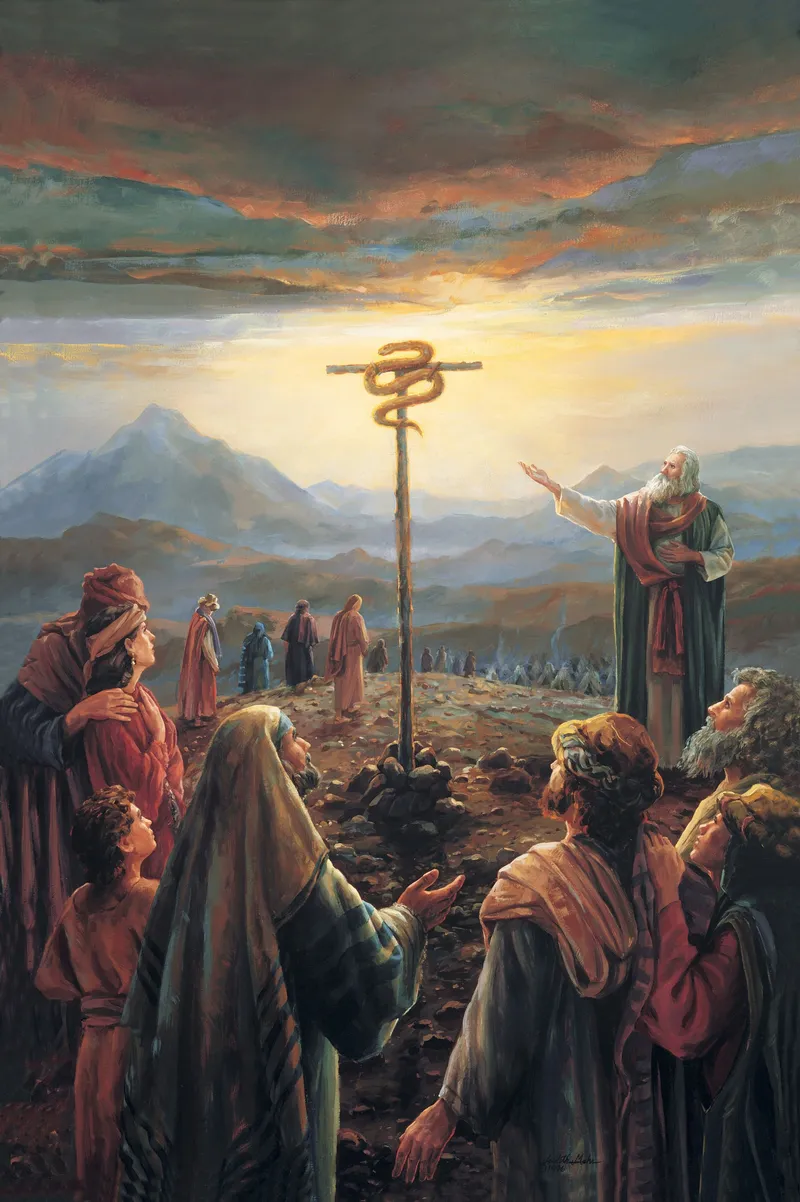
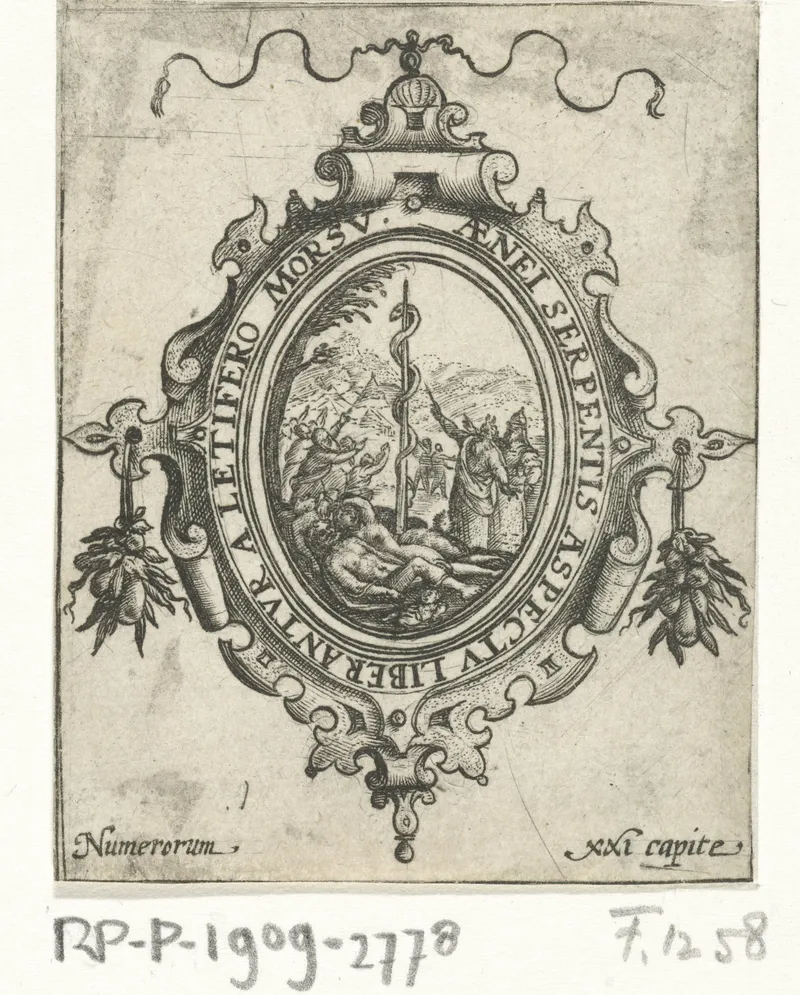
1And when king Arad the Canaanite, which dwelt in the south, heard tell that Israel came by the way of the spies; then he fought against Israel, and took some of them prisoners. 2And Israel vowed a vow unto the LORD, and said, If thou wilt indeed deliver this people into my hand, then I will utterly destroy their cities. 3And the LORD hearkened to the voice of Israel, and delivered up the Canaanites; and they utterly destroyed them and their cities: and he called the name of the place Hormah. 4And they journeyed from mount Hor by the way of the Red sea, to compass the land of Edom: and the soul of the people was much discouraged because of the way. 5And the people spake against God, and against Moses, Wherefore have ye brought us up out of Egypt to die in the wilderness? for there is no bread, neither is there any water; and our soul loatheth this light bread. 6And the LORD sent fiery serpents among the people, and they bit the people; and much people of Israel died. 7Therefore the people came to Moses, and said, We have sinned, for we have spoken against the LORD, and against thee; pray unto the LORD, that he take away the serpents from us. And Moses prayed for the people. 8And the LORD said unto Moses, Make thee a fiery serpent, and set it upon a pole: and it shall come to pass, that every one that is bitten, when he looketh upon it, shall live. 9And Moses made a serpent of brass, and put it upon a pole, and it came to pass, that if a serpent had bitten any man, when he beheld the serpent of brass, he lived.
The chapter opens with a setback that becomes a victory. King Arad the Canaanite, which dwelt in the south, hears that Israel is on the move and strikes first, and the strike lands: he took some of them prisoners (v. 1). It is a hard start - the people of God, on the edge of the land, suffer a real loss. But watch how Israel answers. With a vow laid before the LORD: If thou wilt indeed deliver this people into my hand, then I will utterly destroy their cities (v. 2).
They put the outcome in God's hands and bind themselves to follow through. And the LORD hearkened to the voice of Israel (v. 3). He heard, He delivered, and the place was named for the deliverance. The contrast with what comes next could hardly be sharper: here the people meet a setback with prayer and dependence; a few verses later they meet mere discomfort with contempt.
The vow is worth pausing over, because it shows what faith looks like under pressure. Israel does not bargain - they do not say, deliver us and we will give you gold. They ask the LORD to do what only He can do, and they pledge obedience in return: then I will utterly destroy their cities. This is covenant language, the language of a people who know their strength is not their own. And the LORD answers it.
He does not shame them for asking, nor make them wait; He hearkened to the voice of Israel and gave the victory. There is a quiet lesson in the placement of this scene at the head of the chapter. The same God who hears a prayer made in dependence will, before the chapter is over, send judgment on a people who have stopped depending on Him at all. The difference between Hormah and the fiery serpents is the posture of the heart that meets the trouble.
The trouble that breaks the people is not an enemy army but a long detour. To skirt the territory of Edom, who had refused them passage, Israel had to turn back south, by the way of the Red sea - marching away from the land of promise to get around an obstacle. And the soul of the people was much discouraged because of the way (v. 4). It is an honest and very human moment. The hardship here is the sheer length and apparent backwardness of the road.
They can see they are going the wrong direction, even though God is leading them the right way around. Discouragement of this kind is not yet sin - the road really was long, and the heart really does grow weary. But it is the soil in which the next thing grows. What a person does with discouragement is the test, and here the discouragement is about to turn its face toward God and accuse Him.
Discouragement hardens into rebellion: the people spake against God, and against Moses (v. 5). This is no longer a private complaint about circumstances; it is speech aimed against God - against His character, His leading, His care. And the words are an old, ugly refrain: Wherefore have ye brought us up out of Egypt to die in the wilderness? It is nearly word for word the accusation of an earlier generation, the one that died in the desert for unbelief.
To say it again, after everything they have seen, is to have learned nothing. They rewrite their own history until slavery in Egypt looks like rescue and rescue looks like a death sentence. This is what unbelief always does with the past: it sands off the mercy and sharpens the grievance, until the very deliverance of God is recast as cruelty. The complaint has moved from the road under their feet all the way up to the throne, and it has carried a lie with it.
The deepest wound in the complaint is saved for last: our soul loatheth this light bread (v. 5). The light bread is the manna - the bread of heaven, the daily miracle that had fallen at their feet every morning for forty years to keep them alive. And they call it loathsome. There is something chilling in it. The very sign of God's faithfulness, the thing that proved every single day that He had not abandoned them, has become an object of disgust.
Their complaint of no bread is not even true; the bread is right there, as it has always been. The problem is the appetite. Familiarity has curdled gratitude into contempt - the surest way to despise a gift is to receive it long enough to take it for granted. When a mercy is given daily, the danger is not that it will stop coming but that the heart will stop seeing it. Israel can no longer taste the miracle in their mouths.
The judgment is swift and it is real: the LORD sent fiery serpents among the people, and they bit the people; and much people of Israel died (v. 6). This is not a warning shot. People die. The God who had patiently fed them manna day after day now lets the wilderness become what it always was beneath His protection - a place of deadly things. There is a terrible fitness in the instrument. The people had let a poison into their hearts, a venom of contempt for the goodness of God, and now venom is loosed among their bodies.
The serpents make visible what the sin already was: something that kills. Scripture does not flinch from naming this as the LORD's doing, and neither should the reader. Yet even here, in the sending of the serpents, mercy is already on its way - because the very judgment is what finally drives the people to the only words that can save them.
Under the weight of real death, the people come to a true confession: We have sinned, for we have spoken against the LORD, and against thee (v. 7). Notice what makes it true. It is specific - they name the exact sin, speaking against God and against Moses. It owns the guilt - we have sinned, honestly and plainly. And it turns outward for help: pray unto the LORD, that he take away the serpents from us. They do not presume to approach on their own; they ask for a mediator, and Moses - the very man they had just spoken against - prays for them without a word of reproach.
That detail is its own small picture of grace: the one sinned against intercedes for the sinners. Repentance like this often comes only when every other option is gone and the alternative has become unbearable. It is late. But it is real, and the LORD answers it.
14And as Moses lifted up the serpent in the wilderness, even so must the Son of man be lifted up: 15That whosoever believeth in him should not perish, but have eternal life.
These are the Lord's own words, and they hand us the key to the whole scene. Jesus does not treat Numbers 21 as a distant curiosity; He treats it as a prophecy with His name on it. As Moses lifted up the serpent… even so must the Son of man be lifted up. The little phrase lifted up is the hinge - in John's Gospel it becomes His own word for the cross, the raising up of the Son of man before the eyes of all.
And just as the bitten lived by looking, the perishing live by believing: whosoever believeth in him should not perish, but have eternal life. Believing, here, is exactly what looking was - the turn of a dying person toward the only remedy God has provided. But mark the difference in what the two cures reach. The serpent on the pole healed a snakebite and gave back the rest of an earthly life; the Son lifted up on the cross heals the bite of sin and gives eternal life. The wilderness cure was a shadow cast backward from this.
The substance is Christ.
Numbers 21:10-20The Wilderness Stations and the Song of the Well
10And the children of Israel set forward, and pitched in Oboth. 11And they journeyed from Oboth, and pitched at Ijeabarim, in the wilderness which is before Moab, toward the sunrising. 12From thence they removed, and pitched in the valley of Zared. 13From thence they removed, and pitched on the other side of Arnon, which is in the wilderness that cometh out of the coasts of the Amorites: for Arnon is the border of Moab, between Moab and the Amorites. 14Wherefore it is said in the book of the wars of the LORD, What he did in the Red sea, and in the brooks of Arnon, 15And at the stream of the brooks that goeth down to the dwelling of Ar, and lieth upon the border of Moab. 16And from thence they went to Beer: that is the well whereof the LORD spake unto Moses, Gather the people together, and I will give them water. 17Then Israel sang this song, Spring up, O well; sing ye unto it: 18The princes digged the well, the nobles of the people digged it, by the direction of the lawgiver, with their staves. And from the wilderness they went to Mattanah: 19And from Mattanah to Nahaliel: and from Nahaliel to Bamoth: 20And from Bamoth in the valley, that is in the country of Moab, to the top of Pisgah, which looketh toward Jeshimon.
After the serpents, the chapter changes key entirely. The bitter narrative gives way to an itinerary - Oboth, Ijeabarim, the valley of Zared, the far side of Arnon - the patient list of a people on the move again (vv. 10-13). And woven into the march is a snatch of old poetry, quoted from a source the text names but we no longer possess: the book of the wars of the LORD (v. 14). The very title is a quiet sermon.
Israel's battles were remembered as the wars of the LORD - His victories, fought on their behalf, set down and sung. That a song-book of God's mighty acts existed at all tells us something about this people at their best: they kept the memory of His deliverances alive in verse, so that What he did in the Red sea would be rehearsed at every later crossing. The God who split the sea is the same who now brings them past Arnon.
The detour and the discouragement were real; but stitched right through them is the testimony that the LORD has been winning their battles the whole way.
They come to a place called Beer - the word simply means well - and here the LORD does the very thing the people had falsely accused Him of failing to do. They had said, there is no water (v. 5); now He says, Gather the people together, and I will give them water (v. 16). The contrast is gentle and pointed. Where the people grumbled that God had abandoned them in a place of thirst, God answers the grumbling not only with judgment but, a few steps farther on, with a well.
He gives the very thing they had despaired of. And notice that the water comes by His word and His gathering - it is the well whereof the LORD spake. The provision is sheer gift; the people are told to assemble and receive what God has promised to give. After the bite and the cure, the road opens onto a place of water, and the God who had let the wilderness turn deadly now lets it turn generous.
Numbers 21:21-35The Defeat of Sihon and Og
21And Israel sent messengers unto Sihon king of the Amorites, saying, 22Let me pass through thy land: we will not turn into the fields, or into the vineyards; we will not drink of the waters of the well: but we will go along by the king’s high way, until we be past thy borders. 23And Sihon would not suffer Israel to pass through his border: but Sihon gathered all his people together, and went out against Israel into the wilderness: and he came to Jahaz, and fought against Israel. 24And Israel smote him with the edge of the sword, and possessed his land from Arnon unto Jabbok, even unto the children of Ammon: for the border of the children of Ammon was strong. 25And Israel took all these cities: and Israel dwelt in all the cities of the Amorites, in Heshbon, and in all the villages thereof. 26For Heshbon was the city of Sihon the king of the Amorites, who had fought against the former king of Moab, and taken all his land out of his hand, even unto Arnon. 27Wherefore they that speak in proverbs say, Come into Heshbon, let the city of Sihon be built and prepared: 28For there is a fire gone out of Heshbon, a flame from the city of Sihon: it hath consumed Ar of Moab, and the lords of the high places of Arnon. 29Woe to thee, Moab! thou art undone, O people of Chemosh: he hath given his sons that escaped, and his daughters, into captivity unto Sihon king of the Amorites. 30We have shot at them; Heshbon is perished even unto Dibon, and we have laid them waste even unto Nophah, which reacheth unto Medeba. 31Thus Israel dwelt in the land of the Amorites. 32And Moses sent to spy out Jaazer, and they took the villages thereof, and drove out the Amorites that were there. 33And they turned and went up by the way of Bashan: and Og the king of Bashan went out against them, he, and all his people, to the battle at Edrei. 34And the LORD said unto Moses, Fear him not: for I have delivered him into thy hand, and all his people, and his land; and thou shalt do to him as thou didst unto Sihon king of the Amorites, which dwelt at Heshbon. 35So they smote him, and his sons, and all his people, until there was none left him alive: and they possessed his land.
Israel's request to Sihon is the soul of restraint. Let me pass through thy land: we will not turn into the fields, or into the vineyards; we will not drink of the waters of the well: but we will go along by the king's high way (v. 22). They ask only for passage, pledging to touch nothing - no field, no vineyard, no well - and to keep to the main road until they are past his borders.
There is no provocation here, no land-grab; the people of God ask leave to walk through and promise to do no harm. The aggression is entirely Sihon's. He would not suffer Israel to pass through his border: but Sihon gathered all his people together, and went out against Israel (v. 23). He could have let them go by untouched; instead he marshals his whole nation and marches out to attack. His refusal is his own choice, and it becomes his undoing.
The war that follows is one he started.
The outcome is swift: Israel smote him with the edge of the sword, and possessed his land from Arnon unto Jabbok (v. 24). The king who came out to destroy Israel is destroyed, and the whole territory he ruled - from the Arnon in the south to the Jabbok in the north, the heart of the country east of the Jordan, with its chief city Heshbon - passes into Israel's hands. Israel dwelt in all the cities of the Amorites (v. 25).
This is a turning point in the book. The generation that had refused to enter the land in fear is gone; the new generation, marching the same wilderness, now begins to possess territory. They are taking the first ground of their inheritance. And the deep cause is named plainly enough across the wider story: this is not the achievement of a strong army but the gift of God, who hands the land of the opposing kings into the hand of His people.
A second snatch of old poetry is quoted here, this time a taunt-song sung by they that speak in proverbs (v. 27). Its history has a sharp irony folded into it. The song originally celebrated Sihon's own conquest: it was Heshbon that had gone out like a fire and a flame to consume Ar of Moab, and it was Moab that had been told, Woe to thee, Moab! thou art undone, O people of Chemosh (vv. 28-29).
Sihon had taken this land from Moab and made Heshbon his proud capital. Now the very song that had once mocked Moab's defeat is turned against the conqueror - for the city that boasted of burning others has itself been perished even unto Dibon (v. 30). The mention of Chemosh, the god of Moab, only deepens the point: neither Moab's god nor Sihon's strength could hold the land against the purpose of the LORD.
The boast of the strong is brief. The taunt-song of the victor becomes the epitaph of the vanquished, and Israel inherits the ground over which both had fought.
Og of Bashan stands at the end of the chapter as the last and most formidable of these kings - remembered elsewhere in Scripture as a giant of a man, the king of a land of fortified cities. By every earthly measure he was the more fearsome foe. And yet the LORD's word over him is the calmest in the chapter: Fear him not. The result follows exactly as promised: they smote him, and his sons, and all his people, until there was none left him alive: and they possessed his land (v. 35).
The verse Israel had sung over its battles - that they were the wars of the LORD - is proved true again. The word of God set the outcome. This is the note the chapter ends on, and it is a fitting close to so dark a beginning. The book opened with a people dying of snakebite for their unbelief; it ends with that same people, taught and chastened, standing in possession of the land of two kings, because the LORD had gone before them and given the word.
Research trail
Sources & further study
These references support the historical, linguistic, manuscript, and contextual notes in this chapter. Scripture remains the primary text; external sources are provided so readers can inspect the research directly.
- Numbers 21 - Translators' NotesThe NET Bible's detailed footnotes on Numbers 21 - the vow and the “ban” that gives Hormah its name (vv. 1-3), the “fiery serpents” of verse 6 and what the adjective describes, the brass serpent on the pole (vv. 8-9), and the quoted poetry from the book of the wars of the LORD and the song at the well (vv. 14-18).
- Numbers 21 · Hebrew + classical Jewish commentaryThe Hebrew text of Numbers 21 with Rashi, Ibn Ezra, and other classical commentators side by side - useful for the wordplay running through the serpent scene (nachash, “serpent,” and the burning seraphim of v. 6), for cherem behind the name Hormah (vv. 2-3), and for the imperative ali be'er, “spring up, O well,” in the song of verse 17.
- Numbers 21 ↔ John 3 · 2 Corinthians 5 · 1 Peter 2Traces the threads tying Numbers 21 to the rest of Scripture - above all the brass serpent lifted on the pole (vv. 8-9) read alongside the Lord's own words, even so must the Son of man be lifted up (John 3:14), and the cure-by-looking set beside Look unto me, and be ye saved (Isa. 45:22), and the later fate of the serpent as the idol Nehushtan (2 Kings 18:4).
Where this echoes in Scripture
The Fiery Serpents and the Brass Serpent on a Pole
- John 3:14-15as Moses lifted up the serpent in the wilderness, even so must the Son of man be lifted up.The Lord's own reading of verses 8-9 - the brass serpent on the pole as the figure of His cross.
- 2 Corinthians 5:21For he hath made him to be sin for us, who knew no sin; that we might be made the righteousness of God in him.Why the image lifted up is a serpent - the sinless One made to bear the form of the curse (v. 8).
- Galatians 3:13Christ hath redeemed us... being made a curse for us: for it is written, Cursed is every one that hangeth on a tree.The curse lifted up on the pole (v. 9) - borne by the One who hung on a tree.
- Isaiah 45:22Look unto me, and be ye saved, all the ends of the earth: for I am God, and there is none else.The cure-by-looking of verse 8 spoken as the Gospel offer - salvation by a look toward God.
- 2 Kings 18:4he brake in pieces the brasen serpent that Moses had made... and he called it Nehushtan.The afterlife of the serpent of verse 9 - the sign of deliverance turned, in time, into an idol.
The Wilderness Stations and the Song of the Well
- John 4:14the water that I shall give him shall be in him a well of water springing up into everlasting life.The springing well of verse 17 carried to its fullness - the living water that rises up unto eternal life.
- John 7:37-38If any man thirst, let him come unto me, and drink... out of his belly shall flow rivers of living water.The God who gave water at Beer (v. 16) come in person as the giver of living water.
- Exodus 17:6thou shalt smite the rock, and there shall come water out of it, that the people may drink.The same provision of water in the desert that the well at Beer (vv. 16-17) recalls.
- Isaiah 12:3Therefore with joy shall ye draw water out of the wells of salvation.The song over the well (v. 17) become a picture of joy drawn from the wells of God's salvation.
- Psalm 105:41He opened the rock, and the waters gushed out; they ran in the dry places like a river.The God who gives water in the wilderness (v. 16) praised in Israel's later song.
The Defeat of Sihon and Og
- Deuteronomy 2:24-25Rise ye up... behold, I have given into thine hand Sihon the Amorite, king of Heshbon, and his land: begin to possess it.The same victory of verses 21-24 retold - the land of Sihon given by the LORD into Israel's hand.
- Psalm 136:17-20To him which smote great kings... Sihon king of the Amorites... And Og the king of Bashan: for his mercy endureth for ever.The defeat of Sihon and Og (vv. 24, 35) remembered forever as an act of the LORD's steadfast mercy.
- John 16:33In the world ye shall have tribulation: but be of good cheer; I have overcome the world.The same already-won victory as verse 34 - I have overcome, spoken before the trial is past.
- Romans 8:37Nay, in all these things we are more than conquerors through him that loved us.The courage of verse 34 in its fullness - victory in the One who has gone before His people.
- Joshua 1:9Be strong and of a good courage; be not afraid... for the LORD thy God is with thee whithersoever thou goest.The word Fear him not of verse 34 sounded again - courage grounded in God's presence.