Numbers 20
People in this chapter
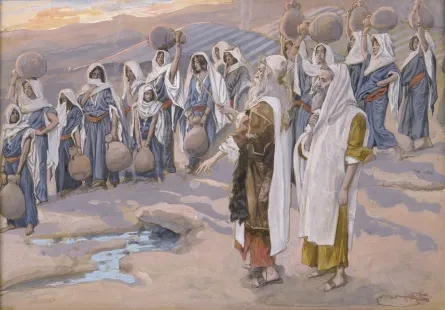
Numbers 20 is where the wilderness finally breaks Moses. After forty years of leading a rebellious people - complaining about food, water, leadership - the people thirst again at Kadesh. God tells Moses to SPEAK to the rock. But Moses, in anger, STRIKES it twice, and says words that put himself and Aaron at the center, displacing God's holiness. Water comes anyway, but the consequence is final: neither Moses nor Aaron will enter the Promised Land.
Tap any highlighted phrase to jump to the commentary that unpacks it.
Numbers 20:1Miriam Dies at Kadesh
1Then came the children of Israel, even the whole congregation, into the desert of Zin in the first month: and the people abode in Kadesh; and Miriam died there, and was buried there.
Zin is the barren place where the people will again demand water. It is forty years after they first left Egypt. A generation has died in the wilderness. The momentum of history is finally catching up. 1
Miriam is one of the most important women in the Bible's first half - the sister who watched over baby Moses, the prophet who led the women in song at the Red Sea, the voice that challenged Moses and Aaron. Yet her death is recorded in a single clause. It is the first sign that this chapter belongs to endings.
Numbers 20:2-5The People Thirst and Complain
2And there was no water for the congregation: and they gathered themselves together against Moses and against Aaron. 3And the people chode with Moses, and spake, saying, Would God that we had died when our brethren died before the LORD! 4And why have ye brought up the congregation of the LORD into this wilderness, that we and our cattle should die there? 5And wherefore have ye made us to come up out of Egypt, to bring us in unto this evil place? it is no place of seed, or of figs, or of vines, or of pomegranates; neither is there any water to drink.
This is not the first water crisis - they have faced this exact complaint before in Exodus 17. But this time, after forty years of the same cycle, something in Moses breaks. He has heard this accusation too many times.
The Hebrew word “chode” is the word for strife, for quarreling. They are not just thirsty; they are angry at Moses. They want to argue the case that he led them wrong.
After forty years in the wilderness, they are still framing Egypt as the better option. They speak as if their only two choices are dying in the wilderness or dying in the desert. They cannot imagine that God is leading them anywhere.
Numbers 20:6-8God's Command: SPEAK to the Rock
6And Moses and Aaron went from the presence of the assembly unto the door of the tabernacle of the congregation, and they fell upon their faces: and the glory of the LORD appeared unto them.
Moses does what he has learned to do - he takes the problem to God. He falls on his face before the Lord's glory. This moment still shows his reverence, his knowledge that God is the only source. The tragedy is what happens next. 2
7And the LORD spake unto Moses, saying, 8Take the rod, and gather thou the assembly together, thou, and Aaron thy brother, and speak ye unto the rock before their eyes; and it shall give forth his water, and thou shalt bring forth to them water out of the rock: so thou shalt give the congregation and their beasts drink.
Notice: God says to gather the congregation together - to have the people watch. What happens next is meant to be a public demonstration of God's character and power. That's why the instruction is so specific.
Numbers 20:9-13Moses Strikes Twice in Anger
9And Moses took the rod from before the LORD, as he commanded him. 10And Moses and Aaron gathered the congregation together before the rock, and he said unto them, Hear now, ye rebels; must we fetch you water out of this rock? 11And Moses lifted up his hand, and with his rod he smote the rock twice: and the water came out abundantly, and the congregation drank, and their beasts also.
Moses has run out of patience. He calls them rebels, spoken with the bitterness of a leader who has been carrying an impossible burden for four decades. The people's thirst has become unbearable to him.
This is the moment of failure: “must we fetch you water?” Moses makes himself and Aaron the heroes of the story, placing himself at the center of the miracle. The rod is in his hand; the water comes out because of his action. The point was always God's faithfulness displayed before the people.
Moses does not speak to the rock - he strikes it. Not once, but twice. He strikes it in his anger, the rod coming down twice against the stone. The water comes out abundantly. The people drink. The miracle happens - but the testimony is ruined. God gave water, yes. But the people saw their leader's rage first. 3
Numbers 20:12Barred from the Promised Land
12And the LORD spake unto Moses and Aaron, Because ye believed me not, to sanctify me in the eyes of the children of Israel, therefore ye shall not bring this congregation into the land which I have given them.
This is final. Moses and Aaron, who led the people out of Egypt, who have carried them through the wilderness, will not enter the Promised Land. Aaron will die on a mountain within the year. Moses will see the land from a distance and die in the wilderness at 120 years old. The consequence is absolute.
Numbers 20:13The Waters of Meribah
13This is the water of Meribah; because the children of Israel strove with the LORD, and he was sanctified in them.
Numbers 20:14-21Edom Refuses Passage
14And Moses sent messengers from Kadesh unto the king of Edom, Thus saith thy brother Israel, Thou knowest all the travail that hath befallen us: 15How our fathers went down into Egypt, and we have dwelt in Egypt a long time; and the Egyptians vexed us, and our fathers: 16And when we cried unto the LORD, he heard our voice, and sent an angel, and hath brought us forth out of Egypt: and, behold, we are in Kadesh, a city in the uttermost of thy border: 17Let us pass, I pray thee, through thy country: we will not pass through the fields, or through the vineyards, neither will we drink of the water of the wells: we will go by the king’s high way, we will not turn to the right hand nor to the left, until we have passed thy borders.
From Kadesh, Moses sends messengers to the king of Edom, recalling Israel's affliction in Egypt and how the LORD heard them and brought them out. He asks to pass through Edom along the king's highway, promising to touch no field, vineyard, or well.
18And Edom said unto him, Thou shalt not pass by me, lest I come out against thee with the sword. 19And the children of Israel said unto him, We will go by the high way: and if I and my cattle drink of thy water, then I will pay for it: I will only, without doing anything else, go through on my feet. 20And he said, Thou shalt not go through. And Edom came out against him with much people, and with a strong hand. 21Thus Edom refused to give Israel passage through his border: wherefore Israel turned away from him.
Edom is a brother nation - descended from Esau, Jacob's twin. Moses makes the appeal as one relative to another. He offers to stay on the road, to touch nothing, to pay for what they use. It is reasonable and humble. And Edom refuses. Israel must turn back and go the long way around. Even the simple request for passage is denied. This is one more grief in a chapter full of them.
Numbers 20:22-29Aaron Dies; Eleazar Succeeds
22And the children of Israel, even the whole congregation, journeyed from Kadesh, and came unto mount Hor. 23And the LORD spake unto Moses and Aaron in mount Hor, by the coast of the land of Edom, saying, 24Aaron shall be gathered unto his people: for he shall not enter into the land which I have given unto the children of Israel, because ye rebelled against my word at the water of Meribah. 25Take Aaron and Eleazar his son, and bring them up unto mount Hor:
Israel journeys from Kadesh to Mount Hor. There the LORD tells Moses that Aaron will be gathered to his people and will not enter the promised land, because of the rebellion at the waters of Meribah, and directs Moses to bring Aaron and his son Eleazar up the mountain.
26And strip Aaron of his garments, and put them upon Eleazar his son: and Aaron shall be gathered unto his people, and shall die there. 27And Moses did as the LORD commanded: and they went up into mount Hor in the sight of all the congregation. 28And Moses stripped Aaron of his garments, and put them upon Eleazar his son; and Aaron died there in the top of the mount: and Moses and Eleazar came down from the mount. 29And when all the congregation saw that Aaron was dead, they mourned for Aaron thirty days, even all the house of Israel.
Aaron dies within sight of the people. His priestly garments are transferred to Eleazar on the mountain itself, so that the priesthood visibly continues. There is no gap. There is no moment when the priestly office is vacant. As soon as one priest falls, another rises up to take his place.
Research trail
Sources & further study
These references support the historical, linguistic, manuscript, and contextual notes in this chapter. Scripture remains the primary text; external sources are provided so readers can inspect the research directly.
- Numbers 20Text and commentary on Miriam's death, the waters of Meribah, and Moses' failure to sanctify God.
- Numbers 20 ↔ 1 Corinthians 10:4Paul identifies the rock in the wilderness as Christ, linking the water that flowed to the spiritual sustenance in Jesus.
- Meribah (Waters of Contention)Etymology and significance of Meribah, where Israel contended with the Lord and Moses was sanctified before the congregation.