Numbers 22
People in this chapter
Israel is camped on the plains of Moab, east of the Jordan, and Balak king of Moab is afraid. Israel has conquered the Amorites and drawn nearer to Moab with every mile. In desperation, Balak sends for a prophet named Balaam to curse Israel. Balaam is famous across the ancient world - whatever he blesses is blessed, whatever he curses is cursed. Surely this man can deliver Moab from the threat.
Tap any highlighted phrase to jump to the commentary that unpacks it.
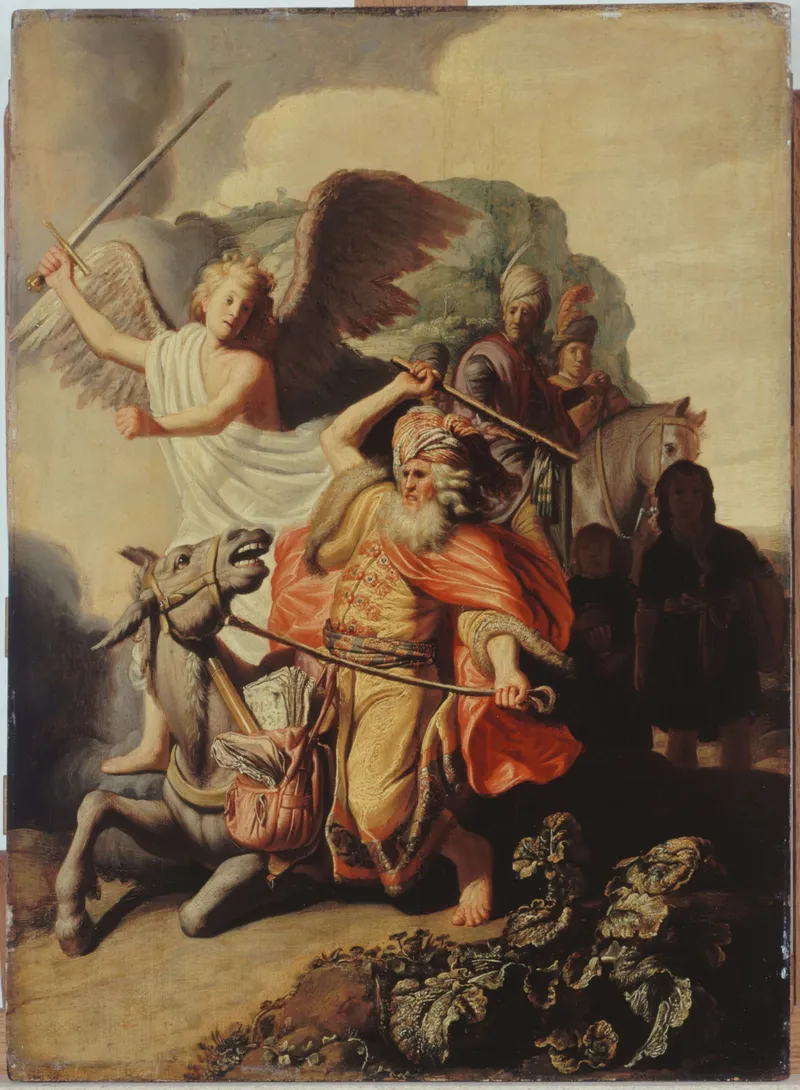
Numbers 22:1-8The First No
1And the children of Israel set forward, and pitched in the plains of Moab on this side Jordan by Jericho. 2And Balak the son of Zippor saw all that Israel had done to the Amorites. 3And Moab was sore afraid of the people, because they were many: and Moab was distressed because of the children of Israel. 4And Moab said unto the elders of Midian, Now shall this company lick up all that are round about us, as the ox licketh up the grass of the field. And Balak the son of Zippor was king of the Moabites at that time. 5He sent messengers therefore unto Balaam the son of Beor to Pethor, which is by the river of the land of the children of his people, to call him, saying, Behold, there is a people come out from Egypt: behold, they cover the face of the earth, and they abide over against me: 6Come now therefore, I pray thee, curse me this people; for they are too mighty for me: peradventure I shall prevail, that we may smite them, and that I may drive them out of the land: for I wot that he whom thou blessest is blessed, and he whom thou cursest is cursed. 7And the elders of Moab and the elders of Midian departed with the rewards of divination in their hand; and they came unto Balaam, and spake unto him the words of Balak. 8And he said unto them, Lodge here this night, and I will bring you word again, as the LORD shall speak unto me: and the princes of Moab abode with Balaam.
Balak has watched Israel's campaign against the Amorites. He knows what Israel has done to the nations that stood in their way. His fear is reasonable by any earthly measure. But fear makes men do desperate things - and Moab's desperation leads them to hire a prophet to work against Israel.
The image is visceral: the whole people swallowing the land whole, like an ox grazing. Balak's language shows a man gripped by panic, imagining total annihilation. It is from this terror that he seeks a supernatural answer.
Balaam was famous throughout the ancient Near East. His name is even found in extra-biblical inscriptions. What made him famous was his power over words - whatever he blessed thrived, whatever he cursed withered. Balak is offering him great wealth to use that power against Israel. The stakes are being set very high, and money is already part of the temptation.
Notice Balaam's response: he will ask the Lord. This is not the answer of a man corrupted yet. Balaam seems to respect the Lord's authority. He will sleep on it and see what God says. That respect is about to be tested.
Numbers 22:9-14The Word Is No
9And God came unto Balaam, and said, What men are these with thee? 10And Balaam said unto God, Balak the son of Zippor, king of Moab, hath sent unto me, saying, 11Behold, there is a people come out of Egypt, which covereth the face of the earth: come now, curse me them; peradventure I shall be able to overcome them, and drive them out. 12And God said unto Balaam, Thou shalt not go with them; thou shalt not curse the people: for they are blessed. 13And Balaam rose up in the morning, and said unto the princes of Balak, Get you into your land: for the LORD refuseth to give me leave to go with you. 14And the princes of Moab rose up, and they went unto Balak, and said, Balaam refuseth to come with us.
God's word is unambiguous. "Thou shalt not go." Balaam hears it clearly and is obedient - at least at first. He refuses Balak's embassy and sends them back. He knows God's will. This is the moment he should have kept. This is the line he should have held. It is what a faithful prophet does.
Numbers 22:15-20The Returning Temptation
15And Balak sent yet again princes, more, and more honourable than they. 16And they came to Balaam, and said to him, Thus saith Balak the son of Zippor, Let nothing, I pray thee, hinder thee from coming unto me: 17For I will promote thee unto very great honour, and I will do whatsoever thou sayest unto me: come therefore, I pray thee, curse me this people. 18And Balaam answered and said unto the servants of Balak, If Balak would give me his house full of silver and gold, I cannot go beyond the word of the LORD my God, to do less or more. 19Now therefore, I pray you, tarry ye also here this night, that I may know what the LORD will say unto me more. 20And God came unto Balaam at night, and said unto him, If the men come to call thee, rise up, and go with them; but yet the word which I shall say unto thee, that shalt thou do.
Balak does not accept the first refusal. He sends more princes - more important, more impressive, more persuasive. Each embassy is a fresh attempt, a renewed offer. The pressure escalates. Most of us hold firm the first time and fall somewhere in the middle of the seventh repetition.
Now the bribe is explicit. Balak promises great honor and power. He will listen to Balaam's counsel. He will elevate him above normal limits. The wealth and status are no longer implied - they are laid out plainly for Balaam to consider.
Here is Balaam's first crack - "If Balak would give me his house full of silver and gold, I cannot go beyond the word of the Lord my God." Notice the language. He is refusing because he cannot - a man bound by constraint, not love. His phrasing - "I cannot go beyond" - contains a hidden hope: what if there is a way to stay within God's word while still cursing Israel? What if he can find a workaround?
Balaam asks to tarry another night. He will pray again. But here is the dangerous shift: he already knows what God said. God told him "thou shalt not go." Instead of simply refusing Balak and leaving, Balaam keeps the conversation open. "Let me ask again." This is where the fall begins, right here, in the refusal to accept the answer God already gave.
And here is the mysterious move: God lets him go. "If the men come to call thee, rise up, and go with them." This is not permission. God is saying: go ahead, but you will go knowing that you will do what I tell you to do - nothing else. The trap is set. Balaam will go looking to curse, but his mouth will only bless.
Numbers 22:21-27The Donkey's Vision
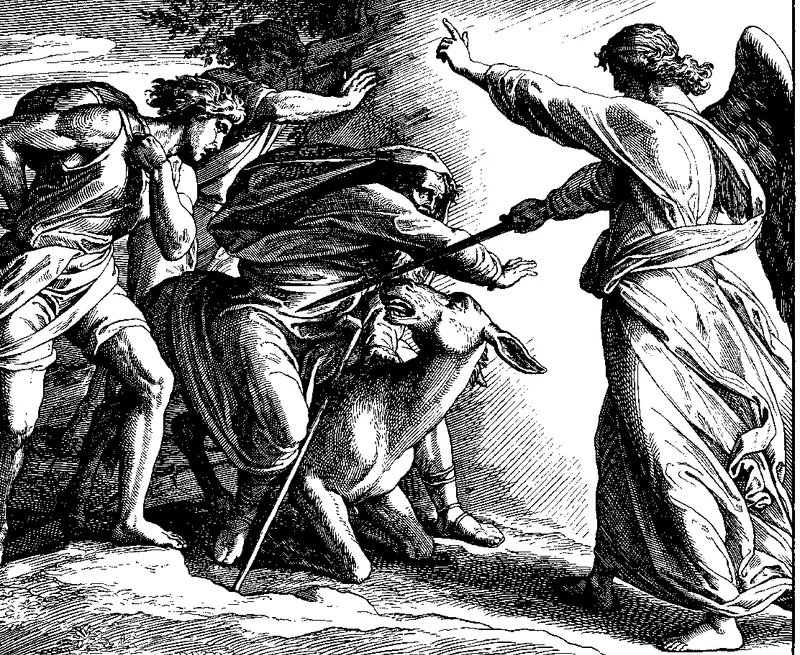
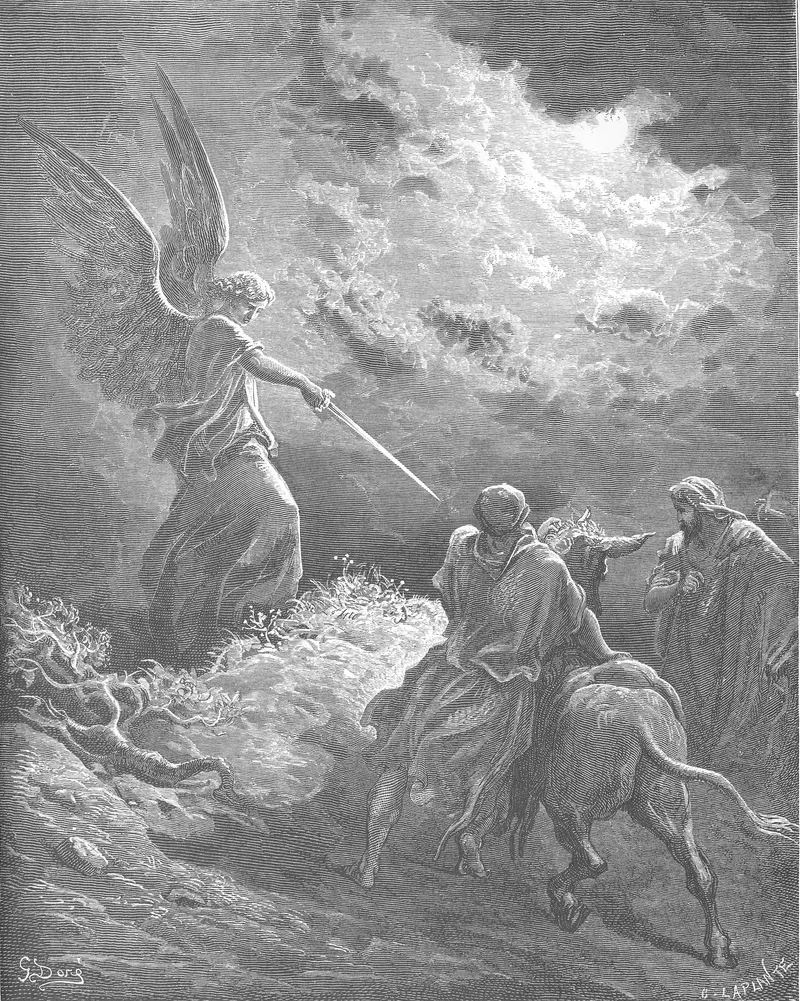
21And Balaam rose up in the morning, and saddled his ass, and went with the princes of Moab. 22And God’s anger was kindled because he went: and the angel of the LORD stood in the way for an adversary against him. Now he was riding upon his ass, and his two servants were with him. 23And the ass saw the angel of the LORD standing in the way, and his sword drawn in his hand: and the ass turned aside out of the way, and went into the field: and Balaam smote the ass, to turn her into the way. 24But the angel of the LORD stood in a path of the vineyards, a wall being on this side, and a wall on that side. 25And when the ass saw the angel of the LORD, she thrust herself unto the wall, and crushed Balaam’s foot against the wall: and he smote her again. 26And the angel of the LORD went further, and stood in a narrow place, where was no way to turn either to the right hand or to the left. 27And when the ass saw the angel of the LORD, she fell down under Balaam: and Balaam’s anger was kindled, and he smote the ass with a staff.
God is angry because Balaam went. Not because he sinned - but because he went. He heard the word, asked again, God let him go, and he chose to go. His anger shows up as an obstacle: the angel of the LORD with a drawn sword, blocking the road.
The angel of the Lord is standing as an "adversary" - an accuser, an opponent. For Israel, God sends the angel as a protector. For Balaam, the same angel stands as a barrier. The same figure turns to shield or to wall depending on the heart of the one facing him.
Three times the donkey sees what Balaam cannot: the angel of the LORD. Three times she refuses to pass. And three times Balaam beats her. The number three runs through this scene like a drum beat, building to something. Three refusals. Three beatings. And finally, on the third occasion, the donkey speaks.
The second time, there is a wall on each side. The donkey cannot turn right or left. She does the only thing she can: she crushes herself against the wall rather than pass the angel. Her body absorbs the blow so that Balaam will see. And still he beats her.
Numbers 22:28-35The Donkey Speaks
28And the LORD opened the mouth of the ass, and she said unto Balaam, What have I done unto thee, that thou hast smitten me these three times? 29And Balaam said unto the ass, Because thou hast mocked me: I would there were a sword in mine hand, for now would I kill thee. 30And the ass said unto Balaam, Am not I thine ass, upon which thou hast ridden ever since I was thine unto this day? was I ever wont to do so unto thee? And he said, Nay. 31Then the LORD opened the eyes of Balaam, and he saw the angel of the LORD standing in the way, and his sword drawn in his hand: and he bowed down his head, and fell flat on his face. 32And the angel of the LORD said unto him, Wherefore hast thou smitten thine ass these three times? behold, I went out to withstand thee, because thy way is perverse before me: 33And the ass saw me, and turned from me these three times: unless she had turned from me, surely now also I had slain thee, and saved her alive. 34And Balaam said unto the angel of the LORD, I have sinned; for I knew not that thou stoodest in the way against me: now therefore, if it displease thee, I will get me back again. 35And the angel of the LORD said unto Balaam, Go with the men: but only the word that I shall speak unto thee, that thou shalt speak. So Balaam went with the princes of Balak.
The Lord opened the donkey's mouth. This is beyond any donkey's power. It is a direct act of God - the same God who parted the Red Sea, who rained fire on Sodom, now speaking through the throat of a beast. The point is what God is willing to do to reach someone who has hardened his heart. He will speak through whatever voice it takes.
Balaam's anger at this point is remarkable. A donkey has just spoken to him in Hebrew, and his response is to curse her for "mocking" him. His pride is so great that he cannot see what is happening. He cannot even imagine that a donkey might be right and a prophet wrong. But the donkey's question cuts through all of it: "What have I done unto thee?"
The donkey appeals to history. "Am not I thine ass, upon which thou hast ridden ever since I was thine unto this day? was I ever wont to do so unto thee?" The donkey is right. She has been faithful, obedient, steady. She has carried him faithfully for years. And now, three times, she has acted differently. Three times she has seen something Balaam cannot see. The question is: does her track record of faithfulness mean anything?
The angel names what has happened. Balaam's way is "perverse" - twisted, bent away from what is right. He set his face toward Moab knowing what God had said. He asked God again, hoping for a different answer. When God let him go, he went. Every step toward Moab was a step away from obedience.
This is the turning point of the chapter: had the donkey not turned aside, the angel would have slain Balaam and saved the donkey alive. The donkey's disobedience to Balaam's commands was obedience to God's protection. By refusing to move forward, the donkey saved the life of the prophet who was beating her. This is the economy of God's kingdom: the last serve the first, the weak save the strong, and an unnamed animal shows more wisdom than a famous prophet.
Numbers 22:36-41Arriving to Bless
36And when Balak heard that Balaam was come, he went out to meet him unto a city of Moab, which is in the border of Arnon, which is in the utmost coast. 37And Balak said unto Balaam, Did I not earnestly send unto thee to call thee? wherefore camest thou not unto me? am I not able indeed to promote thee to honour? 38And Balaam said unto Balak, Lo, I am come unto thee: have I now any power at all to say any thing? the word that God putteth in my mouth, that shall I speak. 39And Balaam went with Balak, and they came unto Kirjathhuzoth. 40And Balak offered oxen and sheep, and sent to Balaam, and to the princes that were with him. 41And it came to pass on the morrow, that Balak took Balaam, and brought him up into the high places of Baal, that thence he might see the utmost part of the people.
At this moment, Balaam finally speaks clearly. He tells Balak the truth: "I am come unto thee: have I now any power at all to say any thing? the word that God putteth in my mouth, that shall I speak." This is the binding that the angel effected. The prophet who came to curse is now chained to speak only blessing. His mouth is no longer his own.
Research trail
Sources & further study
These references support the historical, linguistic, manuscript, and contextual notes in this chapter. Scripture remains the primary text; external sources are provided so readers can inspect the research directly.
- Numbers 22Text and commentary on Balaam and the donkey, including Balaam's attempts to curse Israel despite God's prohibition.
- Deir Alla Inscription (Balaam)Ancient Aramaic inscription from the 8th century BCE mentioning Balaam, confirming the prophet's historical existence.
- Numbers 22 ↔ Jude 11Jude warns against following the way of Balaam, who ran greedily after error for reward.