Painter of the Bible
Ambrogio Lorenzetti
Ambrogio Lorenzetti was, with his older brother Pietro Lorenzetti, one of the two leading Sienese painters of the second quarter of the fourteenth century.

Their faith
Why Ambrogio Lorenzetti painted Christ
Ambrogio Lorenzetti was a devout Christian, deeply rooted in the rich spiritual traditions of medieval Siena. His work as a painter was not merely a profession but a vocation that reflected his faith. Trained in the workshop of his older brother Pietro, he was influenced by the religious fervor of the time, which permeated the artistic community. Lorenzetti's commitment to his faith is evident in the altarpieces and frescoes he created for local churches, including the Maestà altarpiece for Sant'Agostino and the Annunciation for the Biccherna. Through these works, he sought to convey profound theological themes and inspire devotion among the faithful. His art was a means of worship, and he approached his subjects with reverence, often drawing on scripture and the teachings of the Church to guide his creative process.
Lorenzetti's faith profoundly shaped his artistic vision, particularly in works like the Maestà and the Madonna del Latte. In the Maestà, he beautifully depicts the Virgin Mary enthroned, surrounded by angels and saints, inviting viewers to contemplate the divine. This altarpiece exemplifies his ability to blend intricate detail with a sense of spiritual grandeur, reflecting his understanding of the sacred. Similarly, the Madonna del Latte reveals his tenderness and devotion to the Holy Family, emphasizing the nurturing aspect of Mary. Through these paintings, Lorenzetti's devotion continues to resonate with viewers today, inviting them to engage with the divine and reflect on their own faith journeys. His legacy endures, reminding us of the transformative power of art rooted in profound belief.
Life & work
Ambrogio Lorenzetti was, with his older brother Pietro Lorenzetti, one of the two leading Sienese painters of the second quarter of the fourteenth century. Born in Siena around 1290, trained almost certainly in his older brother's workshop and possibly briefly in Florence (where he is documented working in the early 1320s), and active in Siena and the smaller Sienese hill towns for the rest of his career, he died in Siena in 1348 in the Black Death epidemic that killed both brothers along with much of their generation.
His central monument is the great fresco cycle of the Allegories of Good and Bad Government in the Sala dei Nove of the Palazzo Pubblico in Siena, painted between 1338 and 1339 for the Council of Nine that governed the Sienese republic. The cycle covers three walls of the council chamber: the Allegory of Good Government on the central wall (with the personification of the Common Good enthroned and surrounded by the personified Virtues), the Effects of Good Government in the City and the Country on the right wall (a panoramic view of fourteenth-century Siena and its contado at peace and prosperity), and the Allegory and Effects of Bad Government on the left wall (with the personification of Tyranny enthroned over a city in ruins). The cycle is widely held to be the supreme example of late-medieval Italian secular fresco painting and one of the most studied documents of fourteenth-century European political theory in painted form.
His Christian religious work is concentrated in altarpieces and fresco cycles for the Sienese churches. The Maestà altarpiece for the church of Sant'Agostino in Siena (now in the Pinacoteca Nazionale), the Annunciation altarpiece for the Sienese state office of the Biccherna (1344, Pinacoteca Nazionale), the Madonna del Latte (Pinacoteca Nazionale), and the small Madonnas and devotional panels in workshop variants fill the religious painted corpus.
His personal style is the unmistakable late-Sienese-Trecento signature inflected by his particular interest in legible architectural and landscape space — the panoramic view of Siena in the Effects of Good Government is one of the earliest sustained European treatments of urban portraiture as a serious painted subject. He died in Siena in 1348 along with his brother Pietro and most of their workshop in the catastrophic plague that ended the great Sienese Trecento school.
Notable works in detail
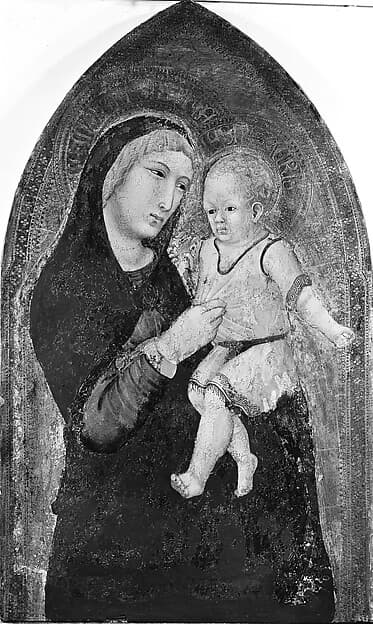
Madonna and Child, painted by Ambrogio Lorenzetti around 1319 (early in his career) in tempera and gold on panel and now in the Metropolitan Museum of Art in New York, is one of the surviving small Marian panels from his early Sienese workshop years. The Virgin sits in three-quarter view holding the standing Christ Child upright on her lap; the chromatic palette of saturated crimson, ultramarine, and tooled gold against the patterned gold-tooled background is characteristic of the early Ambrogio Lorenzetti manner. The painting demonstrates the Sienese workshop tradition descending from Duccio that Ambrogio absorbed during his apprentice years before developing his distinctive interest in legible architectural and landscape space — the interest that would culminate in the Allegories of Good and Bad Government frescoes in the Palazzo Pubblico of Siena two decades later.
Bible scenes Ambrogio Lorenzetti painted
Luke
