Painter of the Bible
Andrea del Sarto (Andrea d'Agnolo)
Andrea del Sarto — born Andrea d'Agnolo di Francesco di Luca di Paolo del Migliore in Florence in 1486, called del Sarto from his father's tailoring trade — was the leading Florentine painter of the High Renaissance gene…

Their faith
Why Andrea del Sarto (Andrea d'Agnolo) painted Christ
Andrea del Sarto, a prominent figure of the High Renaissance, was deeply rooted in the Christian faith that permeated the culture of Florence in the 16th century. His artistic journey began in the workshop of Piero di Cosimo, where he honed his skills and developed a profound appreciation for sacred subjects. Throughout his career, del Sarto dedicated himself to creating religious art for various churches and confraternities, reflecting his devotion to God and the teachings of Christ. His marriage to Lucrezia del Fede, while sometimes viewed as a distraction by early biographers, illustrates the human aspects of his life that intertwined with his faith. Del Sarto's commitment to his craft and his spiritual beliefs are evident in his meticulous attention to detail and the emotional depth he infused into his works.
Del Sarto's faith significantly shaped his artistic output, particularly in masterpieces such as the "Madonna of the Harpies" and "The Last Supper." In the former, he captures the tenderness of Mary holding the Christ Child, surrounded by saints, which serves as a powerful testament to his reverence for the divine. The serene expressions and soft contours in his paintings invite viewers to connect with the spiritual narrative he depicts. His work in the fresco cycle at the cloister of the Annunziata further exemplifies his ability to convey biblical stories with clarity and grace. Through his art, Andrea del Sarto continues to inspire and uplift those who encounter his depictions of Christ and the sacred, reminding us of the beauty and depth of faith that transcends time.
Life & work
Andrea del Sarto — born Andrea d'Agnolo di Francesco di Luca di Paolo del Migliore in Florence in 1486, called del Sarto from his father's tailoring trade — was the leading Florentine painter of the High Renaissance generation between Raphael's departure for Rome and the rise of Bronzino, Pontormo, and the Florentine Mannerists. Trained in the workshop of Piero di Cosimo and possibly briefly with Raffaellino del Garbo, he established his own workshop in Florence by 1508 and worked there for almost his entire career. He died in Florence in 1530, of plague during the siege of the city.
His Christian religious work is concentrated in fresco cycles, altarpieces, and devotional panels for Florentine churches and confraternities. The fresco cycle in the cloister of the Annunziata in Florence — the Stories of San Filippo Benizzi (1509–1510), the Birth of the Virgin (1514), the Procession of the Magi (1511) — anchors his early style. The Madonna of the Harpies (Uffizi, 1517) — Mary standing on a stone pedestal carved with harpy figures, holding the Christ Child between two saints — is widely held to be his masterpiece. The Last Supper in the refectory of San Salvi in Florence (c. 1520–1525) is one of the major surviving Italian Renaissance treatments of the subject. The Pietà of Luco (Florence, c. 1523–1524) and the Madonna del Sacco (Annunziata, 1525) round out his major religious commissions.
He worked briefly in France in 1518–1519 at the invitation of King Francis I, but returned to Florence within two years, allegedly because his wife Lucrezia del Fede missed him too acutely (the early biographers, especially his pupil Vasari, treat the marriage as a humiliating distraction from his art — modern scholarship has been more skeptical of that judgment). The Caritas (Louvre, 1518) is the principal surviving result of the French sojourn.
His personal style — soft contours, warm Florentine flesh against silvery cool drapery, a calm humanist organization of space — is sometimes described as senza errori (without errors), a Vasari phrase that has stuck. The phrase undersells his subtle daring; the late religious work, especially the Madonna del Sacco and the Last Supper, anticipates the Mannerist directions that his pupils Pontormo and Rosso Fiorentino would push much further in the next generation.
Notable works in detail
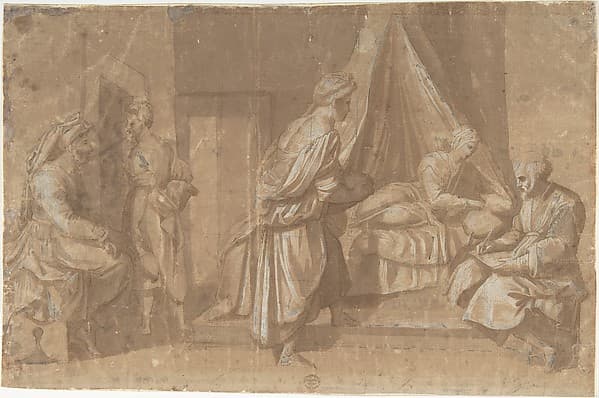
The Birth of Saint John the Baptist
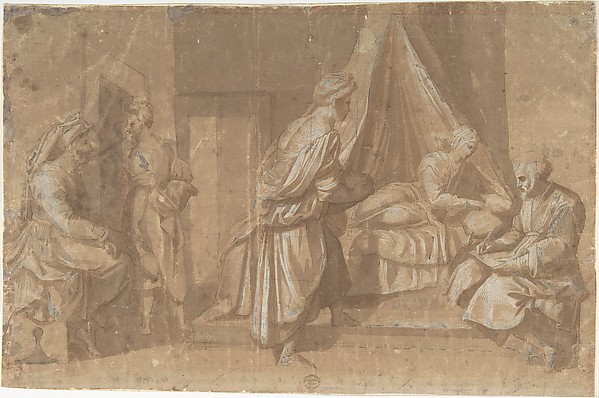
The Birth of Saint John the Baptist, drawn by Andrea del Sarto around 1500 in red chalk on paper and now in the Metropolitan Museum of Art in New York, is a small preparatory drawing for the fresco cycle Andrea would later paint in the cloister of the Compagnia dello Scalzo in Florence. The drawing shows the moment in Luke 1 immediately after the birth: the newborn John is being washed by attendants in the lower foreground while his mother Elizabeth lies in bed in the background and a small group of women attend to the household details. Andrea's fresco cycle of the life of Saint John the Baptist at the Scalzo, executed in monochrome over almost twenty years between 1511 and 1526, is one of the supreme Florentine cloister cycles of the High Renaissance; preparatory drawings like this one are the principal record of his working method in the years immediately preceding the start of the project.
Bible scenes Andrea del Sarto (Andrea d'Agnolo) painted
Luke