Painter of the Bible
Andrea del Verrocchio
Andrea del Verrocchio — born Andrea di Michele di Francesco di Cione in Florence around 1435, called Verrocchio (true eye) probably from a teacher's workshop nickname — was one of the leading Florentine sculptors and pai…

Their faith
Why Andrea del Verrocchio painted Christ
Andrea del Verrocchio, a prominent figure in the late Quattrocento, dedicated his life to the sacred arts, deeply rooted in his Christian faith. As a member of the Florentine artistic community, Verrocchio's work was often commissioned by the church and reflected a profound reverence for scripture. His training as a goldsmith and sculptor allowed him to explore the divine through various mediums, and his workshop became a hub for aspiring artists, including the young Leonardo da Vinci. Verrocchio's commitment to his craft was not merely professional but spiritual, as he sought to embody the beauty of Christ in his creations, believing that art could elevate the soul and inspire devotion among viewers.
This devotion is particularly evident in his notable works, such as "The Baptism of Christ," painted in collaboration with Leonardo. This piece not only showcases Verrocchio's mastery of composition and emotion but also serves as a testament to the sacred narrative of Christ's ministry. Another significant work, the "Christ and Saint Thomas" group, captures the moment of doubt turned to faith, inviting viewers to reflect on their own spiritual journeys. Through these masterpieces, Verrocchio's faith shines brightly, reminding us that his artistic legacy is a continuous invitation to encounter the divine. His ability to convey profound religious themes through art still resonates today, inspiring countless individuals to seek a deeper relationship with Christ.
Life & work
Andrea del Verrocchio — born Andrea di Michele di Francesco di Cione in Florence around 1435, called Verrocchio (true eye) probably from a teacher's workshop nickname — was one of the leading Florentine sculptors and painters of the late Quattrocento and the principal teacher of Leonardo da Vinci, who entered his workshop as a teenage apprentice around 1466. Trained as a goldsmith and then as a sculptor and painter, he ran the largest and most prolific Florentine workshop of the 1470s and 1480s, with commissions in painting, bronze sculpture, marble carving, and design for civic monuments. He died in Venice in 1488 while at work on the great equestrian monument to the condottiere Bartolomeo Colleoni.
His Christian religious work in painting is small but pivotal. The Baptism of Christ (Uffizi, c. 1472–1475), painted in collaboration with the young Leonardo (whose contribution — the kneeling angel on the left and the misty distant landscape — Vasari described as so superior to the rest of the panel that Verrocchio gave up painting in shame; modern scholarship has been more measured), is the foundational document of Leonardo's artistic apprenticeship. The Madonna and Child with Two Angels (London) and several other Madonnas of the 1470s round out the painted output.
His sculptural output is larger and includes some of the supreme religious bronzes of the Italian Quattrocento. The Christ and Saint Thomas group in the Orsanmichele tabernacle in Florence (1467–1483), commissioned by the Mercanzia (the Florentine merchants' guild) for one of the niches around the church-warehouse-confraternity building, shows the resurrected Christ pulling open his robe to reveal the wound in his side as Thomas reaches to touch it — a sustained meditation on John 20 in cast bronze and one of the most monumental sculptural treatments of the subject in Western art. The Putto with Dolphin fountain (Palazzo Vecchio), the bronze David (Bargello, c. 1475), and the great equestrian Colleoni (left unfinished at his death, completed and cast by Alessandro Leopardi for the Campo SS. Giovanni e Paolo in Venice) are the principal sculptural survivals.
His workshop was extraordinary: alongside Leonardo, his pupils and assistants included Pietro Perugino, Lorenzo di Credi, Domenico Ghirlandaio (briefly), and probably Sandro Botticelli for a time. The combined alumni list makes Verrocchio's bottega the single most consequential training ground in late-Quattrocento Florentine art.
Notable works in detail
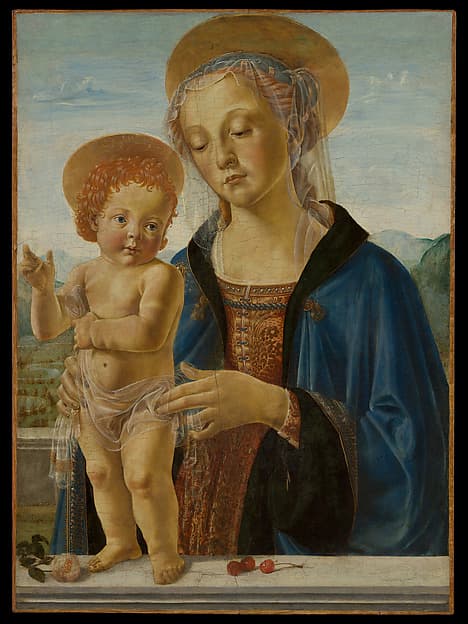
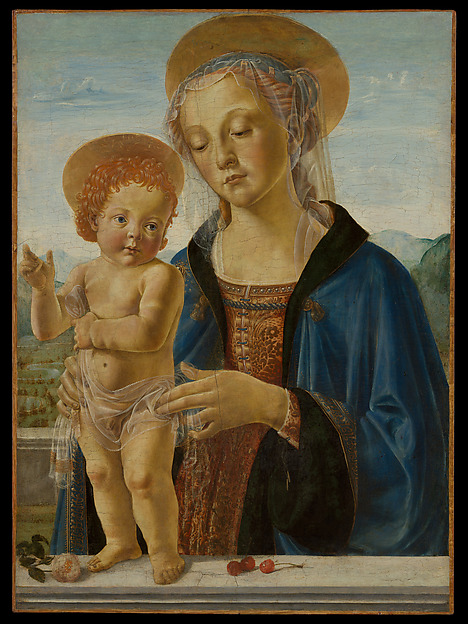
Madonna and Child, painted by Andrea del Verrocchio (or by the workshop he ran in Florence with Leonardo da Vinci, Pietro Perugino, and Lorenzo di Credi as his pupils in the 1470s) around 1465 in tempera on panel and now in the Metropolitan Museum of Art in New York, depicts the iconographic subject of the enthroned Virgin and Christ Child in the standard small-format Florentine Quattrocento devotional manner. The Virgin sits in three-quarter view holding the standing Christ Child upright on her lap; the chromatic palette of saturated rose, ultramarine, and warm flesh against a dark architectural background is characteristic of the late-Quattrocento Florentine workshop tradition that Verrocchio was running at the height of his fame. The panel is one of the principal Verrocchio-school Madonnas in any American collection and demonstrates the compositional and chromatic discipline that the young Leonardo and the young Perugino would absorb directly during their apprenticeship years in his bottega.
Bible scenes Andrea del Verrocchio painted
Luke