Painter of the Bible
Antonio Vivarini
Antonio Vivarini was the founding patriarch of the Vivarini dynasty — the second great Venetian painting family of the fifteenth century after the Bellinis — and the leading Venetian painter of the generation immediately…

Their faith
Why Antonio Vivarini painted Christ
Antonio Vivarini, a prominent figure in the Venetian painting tradition, was deeply rooted in his Christian faith, which profoundly influenced his artistic endeavors. As the patriarch of the Vivarini dynasty, he dedicated his life to creating sacred art that reflected the beauty and reverence of the divine. His works, primarily altarpieces and polyptychs, were crafted for various churches, showcasing his commitment to serving the spiritual needs of his community. Vivarini's training in Murano and his collaboration with his brother-in-law Giovanni d'Alemagna allowed him to develop a unique style that blended the late-Gothic tradition with emerging Renaissance elements, all while maintaining a focus on the sacred subjects that were central to his faith. His devotion to scripture and the church is evident in the meticulous care he took in his compositions, often using rich colors and gilded backgrounds to evoke a sense of heavenly splendor.
Vivarini's faith is particularly evident in masterpieces such as the polyptych for the church of Santa Sabina and the Coronation of the Virgin altarpiece. These works not only reflect his technical prowess but also his spiritual vision, as they invite viewers to contemplate the divine mysteries of Christ and the Virgin Mary. The elongated figures and jewel-bright colors serve to elevate the viewer's experience, drawing them into a deeper understanding of the sacred narratives. Vivarini's art continues to inspire and uplift, reminding us of the beauty of faith and the importance of devotion in our lives. Through his paintings, the legacy of his spiritual commitment endures, inviting all who encounter his work to reflect on their own relationship with the divine.
Life & work
Antonio Vivarini was the founding patriarch of the Vivarini dynasty — the second great Venetian painting family of the fifteenth century after the Bellinis — and the leading Venetian painter of the generation immediately before Giovanni Bellini transformed the city's pictorial tradition. Born in Murano (the small island in the Venetian lagoon famous for its glass production) around 1418, trained in his native Murano workshop, and active in Venice and Padua for his entire career, he ran the leading Venetian workshop of his early-to-mid career in close partnership with his German-born brother-in-law Giovanni d'Alemagna and later with his younger brother Bartolomeo Vivarini. He died in Venice around 1480.
His Christian religious work is concentrated in altarpieces and large polyptychs in the characteristic Venetian late-Gothic-into-Renaissance manner — figures in elongated proportions, tooled gold backgrounds, jewel-bright color, and the carved-and-gilded architectural altarpiece structures typical of the Venetian Quattrocento ecclesiastical commission. The polyptych for the church of Santa Sabina in Venice (1443–1445, now in the Cini Foundation), the Coronation of the Virgin altarpiece (San Pantalon in Venice), the Madonna of Humility with Saints (multiple workshop variants in the Pinacoteca Nazionale of Bologna and other Italian collections), the Saint Anthony Abbot Polyptych (Vatican), and the great altarpieces produced in collaboration with Giovanni d'Alemagna for the Eremitani Church in Padua (1448 — the chapel where the young Andrea Mantegna would shortly afterward begin his own work) anchor the painted corpus.
His personal style is the unmistakable mid-fifteenth-century Venetian late-Gothic signature, slightly slower to absorb the new Renaissance vocabulary than the contemporary Florentine workshops but with a particular jewel-bright chromatic warmth and a careful narrative restraint that defined the Murano-Venetian painting tradition. The collaboration with his brother-in-law Giovanni d'Alemagna gave the workshop its distinctive Italo-German character; the partnership ended when Giovanni d'Alemagna died in 1450.
His son Alvise Vivarini and his younger brother Bartolomeo Vivarini continued the workshop into the next generation; the family workshop ran more or less continuously through the second half of the fifteenth century before being eclipsed by the supreme rise of the Bellini workshop and its Giorgione-and-Titian succession in the early sixteenth century.
Notable works in detail
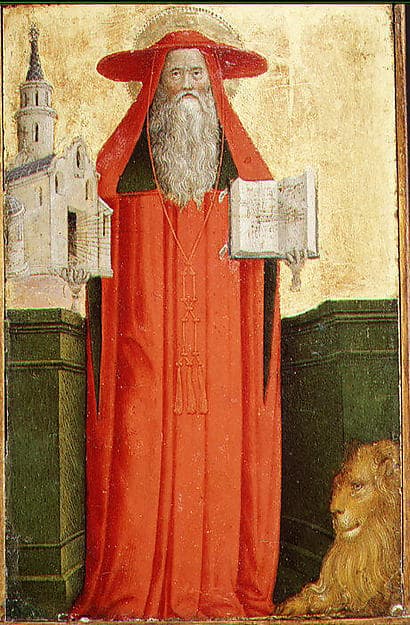
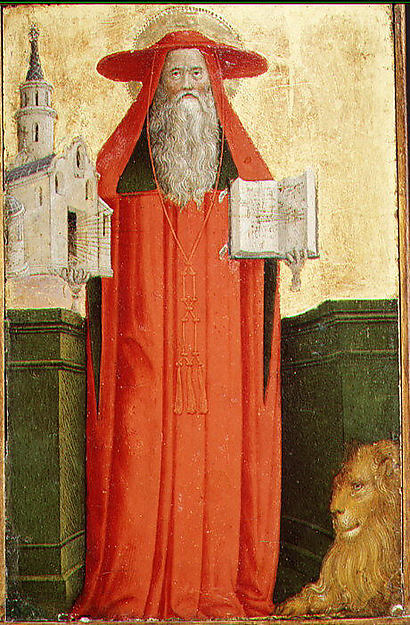
Saint Jerome, painted by Antonio Vivarini around 1440 in tempera and gold on panel and now in the Metropolitan Museum of Art in New York, depicts the early Church Father in the conventional iconographic posture of his hermit years in the Syrian desert — half-naked, kneeling on his rocks, beating his breast with a stone in penitence — with his lion (the iconographic attribute that distinguishes Jerome from any other bearded saint) at his feet. The chromatic palette of saturated brown, soft grey, and tooled gold against the patterned gold-tooled background is characteristic of the mid-fifteenth-century Murano-Venetian workshop manner of Antonio Vivarini, and the panel was originally part of one of his larger polyptych altarpieces with the Virgin and Christ Child at the center and individual saints in the side panels.
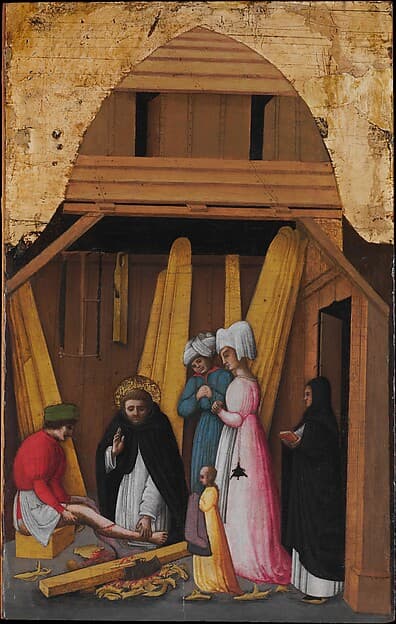
Saint Peter Martyr Healing the Leg of a Young Man
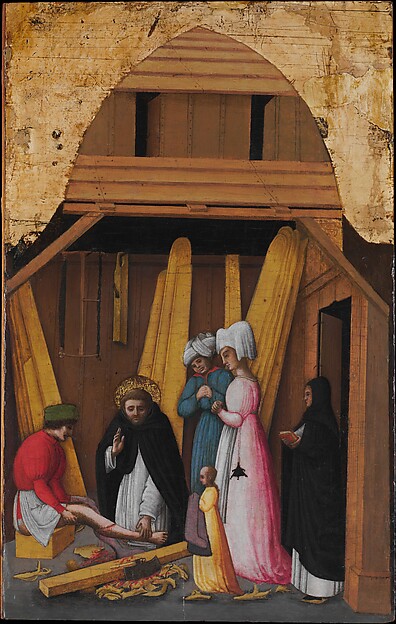
Saint Peter Martyr Healing the Leg of a Young Man, painted by Antonio Vivarini around 1445 in tempera and gold on panel and now in the Metropolitan Museum of Art in New York, depicts a miracle attributed to the thirteenth-century Dominican preacher and inquisitor Peter of Verona (Peter Martyr) who was canonized in 1253 after his murder by heretical assassins. The composition shows the saint kneeling on the left in his Dominican habit applying the healing touch to the leg of a young man seated in the foreground; small attendant figures of the young man's family witness the miracle in formal attendance. The chromatic palette and the careful narrative detail demonstrate the mature Antonio Vivarini Murano-Venetian workshop manner.