Painter of the Bible
Aurelio Luini
Aurelio Luini was a Lombard painter and the principal heir to the workshop tradition of his father Bernardino Luini, the great Milanese-Leonardesque painter of the early Cinquecento.

Their faith
Why Aurelio Luini painted Christ
Aurelio Luini, born into a family of artists deeply rooted in the Christian faith, inherited not only the artistic legacy of his father, Bernardino Luini, but also a profound commitment to sacred subjects. Raised in the vibrant artistic environment of Milan, Aurelio was immersed in the teachings of the Church from a young age. His father’s workshop was a place of devotion, where the beauty of scripture was translated into art. This upbringing instilled in Aurelio a reverence for the divine, shaping his identity as a devout Christian artist. His work was often commissioned for churches, reflecting his dedication to enhancing the worship experience through visual beauty. The influence of Counter-Reformation ideals, particularly during the time of Saint Charles Borromeo, further fueled his commitment to creating art that served the Church and inspired the faithful.
Aurelio's faith is vividly expressed in his altarpieces and frescoes, which are characterized by a warm chromatic palette and graceful figures that seem to breathe life into biblical narratives. His notable works, such as the frescoes for the Sacro Monte di Varallo and the Last Judgment in the church of San Barnaba, showcase his ability to convey spiritual truths through art. The Adoration of the Magi altarpieces exemplify his skill in depicting the wonder of Christ’s birth, inviting viewers to reflect on the mystery of the Incarnation. Through his art, Aurelio Luini continues to inspire and uplift, reminding us of the beauty of faith and the power of divine love that transcends time.
Life & work
Aurelio Luini was a Lombard painter and the principal heir to the workshop tradition of his father Bernardino Luini, the great Milanese-Leonardesque painter of the early Cinquecento. Born in Luino on Lake Maggiore around 1530 to Bernardino Luini and his second wife Margherita Lomazzo, trained in his father's workshop until Bernardino's death in 1532 (when Aurelio was only about two years old) and subsequently in the workshop of his older brother Pietro Luini and the broader Milanese late-Cinquecento workshop tradition, he was active in Milan and the surrounding Lombard towns for his entire career. He died in Milan around 1593.
His Christian religious work is concentrated in altarpieces and fresco cycles for the Milanese and Lombard churches, painted in his characteristic combination of late-Cinquecento Mannerist figural drawing and the soft chromatic warmth descending from his father's earlier Leonardesque workshop manner. The frescoes for the Sacro Monte di Varallo (in continuation of the great Sacro Monte sanctuary that Gaudenzio Ferrari had decorated in the previous generation), the great Last Judgment fresco for the church of San Barnaba in Milan, the Adoration of the Magi altarpieces in workshop variants for Lombard parish churches, and the Annunciation compositions in the standard Lombard format fill the painted corpus.
His personal style continued the Luini family workshop signature — soft sfumato modeling, warm flesh against deep saturated drapery color, and a particularly Lombard chromatic restraint — but in the slightly more elongated late-Mannerist proportions that defined the second half of the sixteenth-century Lombard pictorial tradition. He absorbed his father's Leonardesque vocabulary at one further remove (through workshop continuation rather than through direct apprenticeship) and inflected it toward the late-Mannerist current that ran through Milan in the 1560s, 1570s, and 1580s.
He was a contemporary of the great Counter-Reformation reformer Saint Charles Borromeo, the Cardinal-Archbishop of Milan from 1564 to 1584, and produced several altarpieces for the Borromean churches that the cardinal was building and renovating across his Milanese ministry. The Luini family workshop continued under Aurelio's direction through the 1570s and 1580s before being absorbed into the broader Lombard late-Cinquecento workshop tradition.
Notable works in detail
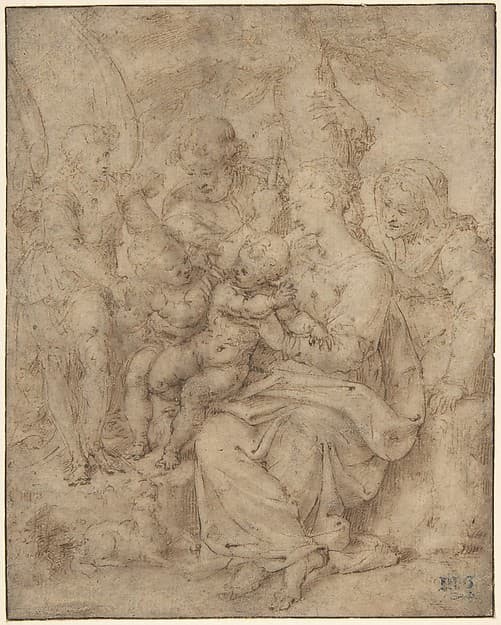
The Holy Family with the Infant Baptist, Saint Elizabeth, and an Attendant Angel
The Holy Family with the Infant Baptist, Saint Elizabeth, and Saint John, drawn by Aurelio Luini around 1550 in pen and ink with wash on paper and now in the Metropolitan Museum of Art in New York, depicts the iconographic subject of the Holy Family attended by Elizabeth and the small John the Baptist in the conventional Lombard sacra conversazione format. The drawing shows the seated Virgin holding the small Christ Child, with the small John the Baptist embracing the Christ Child from the side, Elizabeth standing behind in formal attendance, Joseph waiting in the background. The drawing demonstrates the Luini family workshop signature continued into the second half of the sixteenth century by Aurelio after his father Bernardino's death.
Bible scenes Aurelio Luini painted
Matthew