Painter of the Bible
Barent Fabritius
Barent Fabritius was a Dutch Golden Age painter and the younger brother of the more famous Carel Fabritius (the gifted Rembrandt pupil whose career was cut short by his death at age thirty-two in the catastrophic 1654 Delft gunpowder explosion).

Their faith
Why Barent Fabritius painted Christ
Barent Fabritius was deeply rooted in the Lutheran faith, a tradition that shaped both his life and his artistic expression. Born into a Lutheran family in the predominantly Calvinist Dutch Republic, he received his early artistic training in the workshop of his brother, Carel Fabritius, and later under the renowned Rembrandt van Rijn. This grounding in a faith-centered environment influenced his devotional practices and the themes he chose to explore in his work. Fabritius's commitment to his faith is evident in his focus on biblical narratives and altarpieces, which served to inspire and uplift the congregations he worked with throughout his career.
Fabritius's faith profoundly shaped his artistic vision, particularly in his series of biblical narrative paintings created for the Lutheran church of Leiden in 1660. Works like the "Naming of Saint John the Baptist" and "Adoration of the Shepherds" reflect not only his technical skill but also his desire to convey spiritual truths and narratives that resonate with the viewer's faith. His unique combination of chiaroscuro and vibrant color palette brings these sacred stories to life, inviting viewers into a deeper contemplation of their faith. Through his art, Fabritius continues to reach hearts, reminding us of the beauty and power of biblical narratives in our spiritual journeys.
Life & work
Barent Fabritius was a Dutch Golden Age painter and the younger brother of the more famous Carel Fabritius (the gifted Rembrandt pupil whose career was cut short by his death at age thirty-two in the catastrophic 1654 Delft gunpowder explosion). Born in Midden-Beemster in North Holland in 1624 to a schoolteacher (the surname Fabritius — Latin for craftsman — was an academic Latinization of the family's Dutch surname), trained briefly in his older brother Carel's Amsterdam workshop and then in the workshop of Rembrandt van Rijn alongside his brother, and active in Leiden, Amsterdam, and the small Dutch towns of the Zuiderzee region for his entire career, he died in Amsterdam in 1673.
His Christian religious work is concentrated in altarpieces and biblical narrative paintings in his characteristic combination of the late-Rembrandt workshop manner and a distinctively brighter chromatic palette than his brother Carel had used. The Hagar and Ishmael in the Wilderness (multiple versions), the Naming of Saint John the Baptist (multiple versions), the Peter in the House of Cornelius (multiple versions), the great series of seven biblical-narrative paintings for the Lutheran church of Leiden (1660), and the small-format devotional half-length figures of Old Testament patriarchs and prophets that the Rembrandt workshop generation specialized in fill the painted corpus.
His personal style — combining the dense atmospheric chiaroscuro of the late-Rembrandt manner with a particular Dutch interior-architectural compositional sensibility — gave him a position in the second-generation Rembrandt school slightly removed from the more Rembrandt-faithful manner of contemporaries like Govaert Flinck and Ferdinand Bol. He worked extensively for the Dutch Lutheran congregations (his family was Lutheran by background, an unusual confessional position in the predominantly Calvinist seventeenth-century Dutch Republic) and produced altarpiece commissions for several of the small Lutheran churches of the Zuiderzee region.
The Leiden Lutheran church series of 1660 — seven canvases of biblical narrative including the Naming of Saint John the Baptist, the Adoration of the Shepherds, and the Calling of Peter — remained in the Lutheran congregation through the eighteenth and early nineteenth centuries before being dispersed across various Dutch and German museum collections in the late nineteenth century. He was buried in Amsterdam in 1673.
Notable works in detail
Abraham Dismissing Hagar and Ishmael
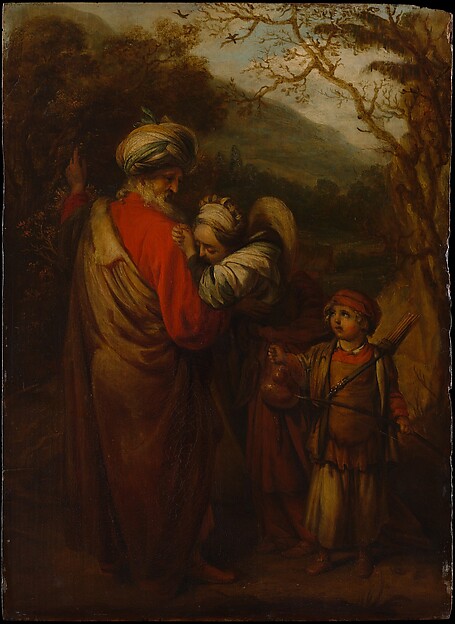
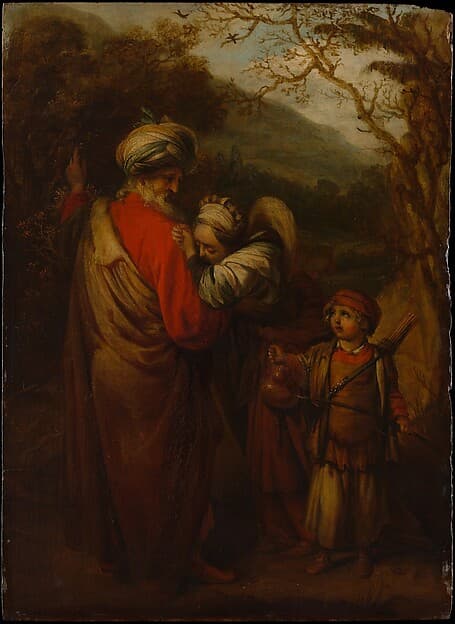
Abraham Dismissing Hagar and Ishmael, painted by Barent Fabritius around 1658 in oil on canvas and now in the Metropolitan Museum of Art in New York, illustrates the moment from Genesis 21 in which Abraham, at the urging of his wife Sarah, sends his concubine Hagar and their son Ishmael away into the wilderness. Barent Fabritius stages the scene as a tender outdoor encounter: Hagar at the right in the act of departure, the small Ishmael at her side, Abraham at the left in profile in attitude of patriarchal reluctance, with Sarah visible in the deeper background watching from the doorway of the household. The chromatic palette of warm earth tones and dramatic Caravaggesque chiaroscuro reflects the Rembrandt workshop tradition that Barent absorbed during his apprentice years and that defined the late-Rembrandt school output of the second half of the seventeenth century.
Bible scenes Barent Fabritius painted
Genesis