Painter of the Bible
Bartolomeo Vivarini
Bartolomeo Vivarini was the younger brother of Antonio Vivarini and the principal continuer of the Vivarini Murano-Venetian workshop after Antonio's death and after the dissolution of Antonio's earlier partnership with t…

Their faith
Why Bartolomeo Vivarini painted Christ
Bartolomeo Vivarini, a prominent figure in the Venetian art scene of the late 15th century, was deeply rooted in the Christian faith that permeated his life and work. As the younger brother of Antonio Vivarini, he inherited not only a family legacy of artistry but also a commitment to creating sacred art that served the church. His training in the Vivarini workshop, alongside the influence of renowned artists like Andrea Mantegna, shaped his understanding of religious themes and the importance of depicting the divine. Vivarini's dedication to his craft was evident in his altarpieces and polyptychs, which were not only artistic expressions but also acts of devotion. His works were meant to inspire worship and reflection, reflecting the vibrant faith of the Venetian community during the Renaissance.
Vivarini's faith profoundly influenced his artistic vision, as seen in masterpieces like the Saint Mark Polyptych and the Madonna and Saints altarpieces. These works reveal his ability to blend the late-Gothic decorative style with the more substantial figural drawing he absorbed from Mantegna, creating a unique visual language that spoke to the spiritual aspirations of his audience. The polyptych for the church of San Giovanni in Bragora, completed in 1478, exemplifies his commitment to conveying sacred narratives through beauty and clarity. Vivarini's art continues to resonate with viewers today, inviting them to experience the divine through the lens of his faith and creativity. His legacy endures, reminding us of the profound connection between art and spirituality, and how devotion can inspire generations to seek a deeper relationship with Christ.
Life & work
Bartolomeo Vivarini was the younger brother of Antonio Vivarini and the principal continuer of the Vivarini Murano-Venetian workshop after Antonio's death and after the dissolution of Antonio's earlier partnership with their German brother-in-law Giovanni d'Alemagna. Born in Murano around 1432, trained in his older brother's workshop alongside the brief partnership with Giovanni d'Alemagna, and active in Venice for his entire career, he ran the Vivarini workshop in close partnership with his nephew Alvise Vivarini in the later decades of his career. He died in Venice around 1499.
His Christian religious work is concentrated in altarpieces and large polyptychs that combined the late-Gothic Venetian decorative tradition with a slightly more legible figural drawing absorbed from his early exposure to Andrea Mantegna's Paduan workshop in the 1450s (the Eremitani frescoes in Padua, where Bartolomeo briefly worked alongside Mantegna and Antonio Vivarini, were the principal channel for Mantegna's transformative influence on the Vivarini workshop). The polyptych for the church of San Giovanni in Bragora in Venice (1478), the Madonna and Saints altarpieces in the Frari church and in San Giovanni e Paolo in Venice, the Saint Mark Polyptych (1474), and the polyptych for the church of Santa Maria Formosa anchor the painted corpus.
His personal style — combining the mid-fifteenth-century Venetian late-Gothic chromatic warmth with the more weighty Mantegnesque figural drawing he had absorbed in Padua — gave him a transitional position in the Venetian Quattrocento tradition between the older Vivarini-Murano workshop manner and the new Renaissance pictorial vocabulary that Giovanni Bellini was developing in close stylistic dialogue with the Vivarini workshop in the same Venetian decades. The two workshops — Bellini and Vivarini — were the two leading Venetian painting establishments of the second half of the fifteenth century, and the comparison between their respective polyptychs is the principal documentary record of mid-Quattrocento Venetian pictorial practice.
His nephew Alvise Vivarini continued the workshop after Bartolomeo's death; the Vivarini tradition was eventually absorbed into the broader Venetian sixteenth-century school as the Bellini workshop and its Giorgione-and-Titian succession came to dominate the city's pictorial production.
Notable works in detail
met-459024
The Madonna of Humility, the Annunciation, the Nativity, painted by Bartolomeo Vivarini around 1462 in tempera and gold on panel and now in the Metropolitan Museum of Art in New York, is a small triptych panel that combines three Marian subjects in a single small devotional format suitable for personal use. The central panel shows the Madonna of Humility (the Virgin seated on the ground rather than enthroned, an iconographic type associated with Marian humility); the side panels show the Annunciation and the Nativity in small narrative compositions. The chromatic palette and the careful figural drawing demonstrate Bartolomeo Vivarini's combination of the late-Gothic Murano-Venetian decorative tradition with the more weighty Mantegnesque figural drawing he had absorbed during his early Paduan years.
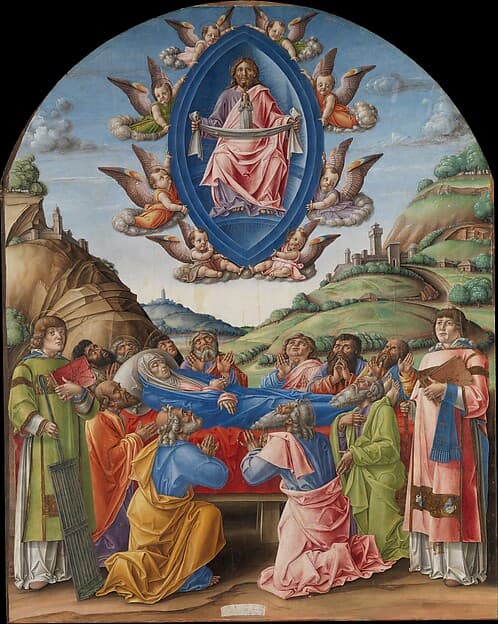
The Death of the Virgin, painted by Bartolomeo Vivarini around 1484 in tempera and gold on panel and now in the Metropolitan Museum of Art in New York, depicts the moment from the apocryphal Marian narrative in which the Virgin Mary, dying in her old age, is attended on her deathbed by the assembled apostles. Bartolomeo composes the scene with characteristic late-fifteenth-century Venetian compositional density: the Virgin lies in the bed at the lower center, the apostles gather around her in dense devotional postures of grief and prayer, with Peter (identified by the pyx of the Eucharist in his hand) leaning in over the bed and John (the youngest apostle) kneeling at the head. The painting belongs to his mature Venetian workshop output.
Bible scenes Bartolomeo Vivarini painted
Luke
