Painter of the Bible
Bramantino (Bartolomeo Suardi)
Bramantino — born Bartolomeo Suardi in Milan around 1465, called Bramantino (little Bramante) for his close artistic association with the architect Donato Bramante, who was his teacher in the Milanese painting tradition …

Their faith
Why Bramantino (Bartolomeo Suardi) painted Christ
Bramantino, born Bartolomeo Suardi in Milan, was deeply rooted in the Christian faith that permeated the art and culture of his time. Trained under the esteemed architect and painter Donato Bramante, Bramantino embraced the Milanese painting tradition, which was rich in religious themes and expressions. His role as pictor et ingeniarius at the Sforza court further underscores his commitment to his craft and the spiritual significance he found in it. The altarpieces and devotional works he created reflect a life devoted to God, where each brushstroke served as an act of worship. His artistic process was likely intertwined with prayer and reflection, as was common among artists of his era, allowing scripture and faith to guide his creative vision.
Bramantino's faith profoundly influenced his artistic output, particularly in works like "The Adoration of the Magi" and the "Crucifixion altarpiece." In these pieces, he masterfully combines architectural perspective with vibrant colors, creating a sense of divine presence and reverence. The intricate details and carefully constructed settings invite viewers into a sacred space, encouraging contemplation of the biblical narratives. His ability to blend the spiritual with the architectural showcases not only his technical skill but also his desire to elevate the viewer's experience of faith through art. Today, Bramantino's devotion continues to resonate, reminding us that art can be a powerful medium for expressing and deepening our relationship with Christ.
Life & work
Bramantino — born Bartolomeo Suardi in Milan around 1465, called Bramantino (little Bramante) for his close artistic association with the architect Donato Bramante, who was his teacher in the Milanese painting tradition before Bramante's later turn to architecture — was a leading Lombard painter of the late fifteenth and early sixteenth centuries. Trained in Milan in the workshop of Donato Bramante (during Bramante's Milanese painter-architect years before his 1499 move to Rome), and active in Milan for his entire career, he was appointed pictor et ingeniarius (painter and engineer) at the Sforza ducal court in 1525 and held the post under successive ducal patrons until his death in Milan around 1530.
His Christian religious work is concentrated in altarpieces, fresco cycles, and small devotional panels in his characteristic combination of Bramantesque architectural perspective and the Lombard pictorial tradition descending from Vincenzo Foppa. The Adoration of the Magi (London, c. 1500 — a small altarpiece set in an elaborate Renaissance architectural setting that demonstrates Bramantino's signature interest in legible perspectival space), the Crucifixion altarpiece (Brera, Milan, c. 1505), the Madonna of the Apple (Pinacoteca Ambrosiana, Milan), the Madonna delle Torri (Pinacoteca Ambrosiana, c. 1520 — set against a backdrop of carefully drawn Renaissance towers), the great series of Trivulzio tapestries cartoons (1503–1509 — twelve large cartoons illustrating the months of the year and biblical narrative scenes, woven into tapestries for the Trivulzio family of Milan), and the late frescoes for the Trivulzio Chapel in San Nazaro Maggiore in Milan anchor the painted corpus.
His personal style — combining the careful Bramantesque architectural perspective and figural elongation with the soft Lombard chromatic warmth that he absorbed from his early-career exposure to Vincenzo Foppa's late workshop — gave him a distinctive position in the Lombard pictorial tradition. The early Cinquecento Lombard-Leonardesque school of Boltraffio, Solario, and the early Andrea Solario absorbed his combination of architectural setting and Lombard color directly.
He worked closely with the architect Bramante on several Milanese projects in the 1490s before Bramante's 1499 move to the Roman court of Pope Alexander VI; the close personal and professional partnership of the two artists shaped the entire Milanese late-Quattrocento pictorial-architectural tradition.
Notable works in detail
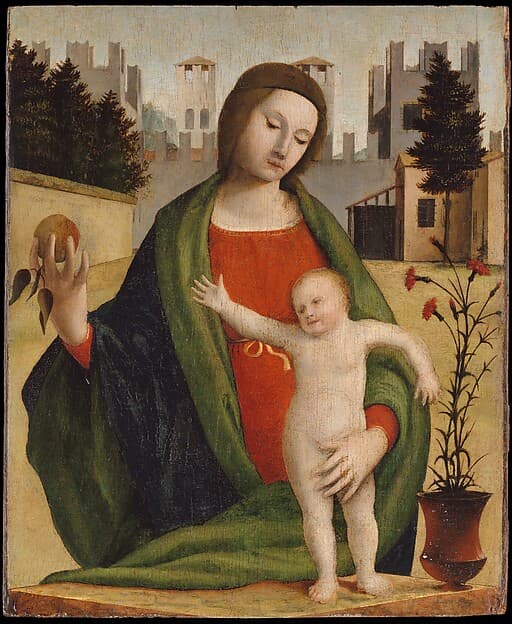
Madonna and Child, painted by Bramantino around 1507 in tempera and oil on panel and now in the Metropolitan Museum of Art in New York, is a small intimate Marian devotional panel from the central productive period of his Milanese workshop years. The Virgin sits in three-quarter view holding the Christ Child upright on her lap; the chromatic palette of warm flesh, deep crimson, and the cool grey-green that defines the Lombard tradition is characteristic of Bramantino's mature manner. The painting demonstrates his characteristic combination of Bramantesque architectural-perspective discipline (in the small architectural setting that frames the figures) and the soft Lombard chromatic warmth that he absorbed from his early-career exposure to Vincenzo Foppa's late workshop.
Bible scenes Bramantino (Bartolomeo Suardi) painted
Luke
