Painter of the Bible
Cesare da Sesto
Cesare da Sesto was one of the leading Lombard-Leonardesque painters of the early sixteenth century and one of the principal direct pupils of Leonardo da Vinci in his Milanese workshop years.

Their faith
Why Cesare da Sesto painted Christ
Cesare da Sesto, a gifted painter of the early sixteenth century, was deeply influenced by his Christian faith, which is evident in his numerous altarpieces and devotional works. As a pupil of Leonardo da Vinci, he absorbed not only the artistic techniques of his master but also the spiritual devotion that accompanied them. His works often reflect a reverence for scripture and the divine, showcasing a commitment to creating art that uplifts the soul. Da Sesto's time spent in various Italian cities, including Milan, Naples, and Rome, allowed him to enrich his understanding of Christian themes, and he became known for his warm, inviting depictions of the Madonna and Child, which resonated with the faithful of his time.
One of his most notable works, the "Madonna and Child with the Lamb," exemplifies his ability to blend the soft sfumato technique of Leonardo with the vibrant colors of the Lombard tradition. This painting not only highlights the tenderness of the relationship between Mary and Jesus but also serves as a devotional piece that invites contemplation and prayer. Similarly, his "Polyptych of Saint Rocco" reflects his commitment to depicting sacred narratives with both beauty and reverence. Cesare da Sesto's art continues to inspire viewers today, as it embodies a profound faith that transcends time, inviting all who encounter his work to experience the divine love of Christ through the beauty of his creations.
Life & work
Cesare da Sesto was one of the leading Lombard-Leonardesque painters of the early sixteenth century and one of the principal direct pupils of Leonardo da Vinci in his Milanese workshop years. Born in Sesto Calende on Lake Maggiore around 1477, trained in Milan in the workshop of Leonardo da Vinci during Leonardo's first Milanese sojourn at the court of Lodovico Sforza (1482–1499), and active subsequently in Milan, Naples, Rome, and Sicily, he died in Milan in 1523.
His Christian religious work is concentrated in altarpieces, devotional Madonnas, and small panel paintings in his characteristic combination of Leonardesque sfumato modeling, the warm Lombard chromatic palette descending from Vincenzo Foppa, and the Roman classicizing figural vocabulary that Cesare absorbed during his Roman sojourn of around 1508–1513 in the orbit of Raphael. The Salome with the Head of Saint John the Baptist (Vienna), the Madonna and Child with the Lamb (multiple versions in workshop variants in the Brera, the Hermitage, and other major collections — a Leonardesque composition derived directly from Leonardo's earlier prototype), the Adoration of the Magi (Capodimonte, Naples — painted during Cesare's Sicilian-Neapolitan years), the Polyptych of Saint Rocco (Messina), and the Baptism of Christ in the Pinacoteca Ambrosiana of Milan anchor the painted corpus.
His personal style — combining Leonardo's soft sfumato modeling and atmospheric depth with the warm chromatic palette of the Lombard tradition and the Roman classicizing figural drawing he absorbed from Raphael — gave him a distinctive position in the Italian early-Cinquecento pictorial scene as the painter who most successfully synthesized the Leonardesque and the Raphaelesque manners. The Madonna and Child with the Lamb compositions in particular became one of the most-copied Italian Renaissance Marian devotional types and circulated in workshop variants and copies through the European Catholic devotional market for the next century.
His Sicilian-Neapolitan years (around 1513–1517) introduced the Leonardesque manner into the southern Italian pictorial tradition; the Polyptych of Saint Rocco in Messina remained the principal Leonardesque work in southern Italy until Antonello da Messina's earlier Leonardesque-anticipating panels were rediscovered and properly attributed in the late nineteenth century. He returned to Milan in his late years and died in the city in 1523.
Notable works in detail
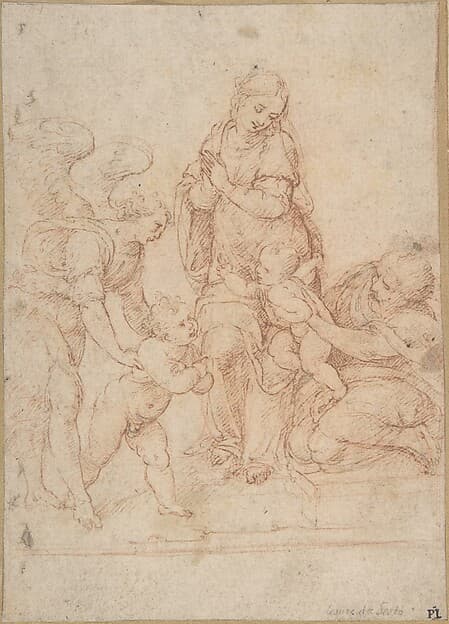
The Holy Family with the Infant St. John the Baptist and an Angel
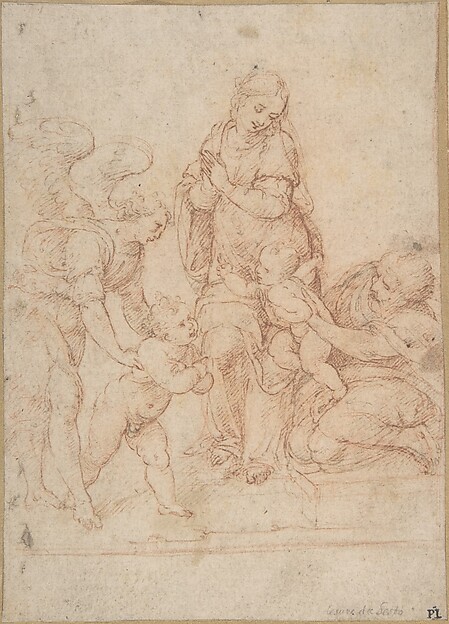
The Holy Family with the Infant St. John the Baptist, drawn by Cesare da Sesto around 1510 in pen and ink with wash on paper and now in the Metropolitan Museum of Art in New York, depicts the iconographic subject of the Holy Family attended by the small John the Baptist. The drawing shows the seated Virgin holding the small Christ Child, with the small John the Baptist embracing the Christ Child from the side, Joseph waiting in the background. The drawing demonstrates the early Cesare da Sesto draughtsmanship and his characteristic combination of Leonardesque sfumato modeling with the warm Lombard chromatic palette descending from Vincenzo Foppa — the synthesis that would define his entire workshop output.
Bible scenes Cesare da Sesto painted
Matthew