Painter of the Bible
Charles Le Brun
Charles Le Brun was the principal painter of the court of Louis XIV and the dominant figure in seventeenth-century French painting and decorative art.

Their faith
Why Charles Le Brun painted Christ
Charles Le Brun, a pivotal figure in seventeenth-century French art, was deeply rooted in the Christian faith that permeated his work. Born in Paris in 1619 to a sculptor father, Le Brun was trained in an environment that celebrated both artistic excellence and religious devotion. His training under Simon Vouet, a prominent painter of the era, and his travels to Italy allowed him to absorb the rich traditions of Roman classicism, which he harmoniously blended with his own faith. Throughout his career, Le Brun produced numerous altarpieces for Parisian churches and royal chapels, reflecting his commitment to his faith and the beauty of divine subjects. His works were not merely artistic expressions but were imbued with a sense of reverence and devotion to God, showcasing his understanding of scripture and the importance of Christian themes in art.
Le Brun's faith profoundly influenced his artistic vision, as seen in his remarkable altarpieces such as "The Crucifixion" and "The Pietà," which capture the essence of Christ's sacrifice and the compassion of the Virgin Mary. These works reveal not just technical mastery but also a deep spiritual insight, inviting viewers to reflect on the mysteries of faith and the love of Christ. His ability to convey emotion through expression, as discussed in his treatise on the passions, further emphasizes his desire to connect with the divine through art. Even today, Le Brun's devotion resonates with viewers, reminding us of the sacred narratives that inspire and uplift the human spirit through the beauty of his paintings.
Life & work
Charles Le Brun was the principal painter of the court of Louis XIV and the dominant figure in seventeenth-century French painting and decorative art. Born in Paris in 1619 to a sculptor father, trained in Paris in the workshop of Simon Vouet (the leading early-seventeenth-century Paris-based painter and the principal channel through which the Italian Baroque manner reached the French court), and traveling to Italy in 1642 in the company of Nicolas Poussin (where Le Brun absorbed the Roman classicizing tradition descending from the Carracci and Domenichino), he returned to Paris in 1646 and worked there for the rest of his career under successive royal patrons. He died in Paris in 1690.
His Christian religious work is concentrated in altarpieces produced for the Paris churches and the royal devotional spaces in his characteristic combination of Roman classicizing figural discipline and the warm chromatic palette of his Vouet-Italian background. The Crucifixion altarpieces, the Pietà compositions in workshop variants, the Christ on the Cross with the Virgin and Saint John for the Paris royal chapels, and the late Saint John the Baptist altarpieces fill the religious painted corpus. His major secular monuments — the great fresco cycles of the Galerie des Glaces and the Salon de la Guerre at Versailles (the Apotheosis of Hercules and the Triumph of the King), the Battles of Alexander cycle (1665–1670, a four-painting series at the Louvre depicting the major military victories of Alexander the Great as veiled allegory of Louis XIV's own military glory), and the great vault decorations at the Hôtel Lambert in Paris — established his career as the supreme decorative-painting director of seventeenth-century France.
He served as Premier Peintre du Roi (First Painter to the King) from 1664 until his death and as Director of the Gobelins royal tapestry manufactory and of the French Royal Academy of Painting and Sculpture (which he largely re-organized in the 1660s). His treatise Conférences sur l'expression des passions (Conferences on the Expression of the Passions, delivered to the French Academy in 1668 and published posthumously in 1698) became one of the foundational seventeenth-century French academic texts on the painting of facial expression and remained in use as an art-academy textbook through the eighteenth and nineteenth centuries.
His position as the principal arbiter of French royal taste under Louis XIV gave him an unusually centralized control over French painting, sculpture, and decorative art for nearly three decades. After his death the rising taste for the lighter Rococo manner of Antoine Watteau and his successors displaced the Le Brun grand-manner.
Notable works in detail
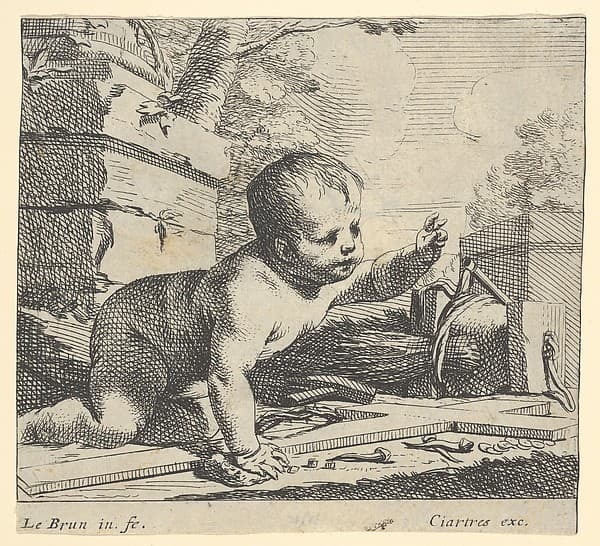
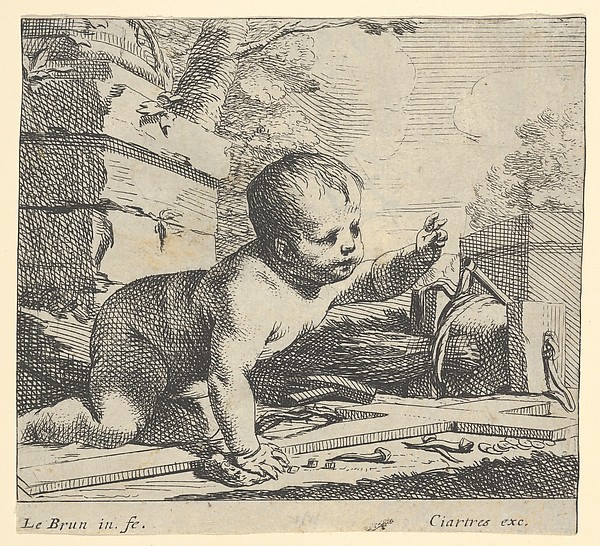
The Infant Jesus, drawn by Charles Le Brun around 1640 (early in his career, before his Italian sojourn of 1642–1646) in red and black chalk on paper and now in the Metropolitan Museum of Art in New York, is a small preparatory drawing for one of his early painted Marian compositions. The drawing shows the small Christ Child seated in a tender posture, his right arm raised in benediction, the soft sfumato modeling of the chalk demonstrating the early Le Brun absorption of his teacher Simon Vouet's Italianate French Baroque draughtsmanship. The drawing belongs to the early Le Brun preparatory output before his Italian sojourn transformed his style toward the Roman classicizing manner he would carry into his long French royal career.
Bible scenes Charles Le Brun painted
John