Painter of the Bible
Cosmè Tura (Cosimo di Domenico di Bonaventura)
Cosmè Tura (Cosimo di Domenico di Bonaventura) was the founder of the Ferrarese Renaissance painting school and the principal court painter of the Este dynasty in Ferrara across the third quarter of the fifteenth century.

Their faith
Why Cosmè Tura (Cosimo di Domenico di Bonaventura) painted Christ
Cosmè Tura, a pivotal figure in the Ferrarese Renaissance, dedicated his life to creating sacred art that reflected his deep Christian faith. As the principal court painter for the Este dynasty, Tura's work was infused with a sense of reverence and devotion, which stemmed from his upbringing in Ferrara, a city rich in artistic and spiritual heritage. His training in the Paduan workshop tradition, known for its emphasis on both technical precision and emotional expression, allowed him to develop a unique style that combined sharp figural representation with a vibrant color palette. Tura's commitment to his faith is evident in the numerous altarpieces and devotional panels he created, which served not only as artistic expressions but also as instruments of worship and reflection for the faithful. His works were deeply rooted in scripture, and he approached each piece with a sense of prayerful intention, embodying the spiritual discipline that characterized the artists of his time.
Tura's faith is particularly illuminated in masterpieces such as the Roverella Altarpiece and the Madonna of the Zodiac. The Roverella Altarpiece, with its central panel depicting the enthroned Madonna and Child, showcases Tura's ability to convey divine presence and grace, inviting viewers into a deeper contemplation of the sacred. Similarly, the emotional intensity of the Pietà reveals his profound understanding of Christ's suffering and sacrifice, resonating with the viewer's own spiritual journey. Through his innovative techniques and vibrant compositions, Tura's art continues to inspire and uplift those who encounter it, reminding us of the beauty and depth of faith that can be expressed through visual means. His legacy endures, reaching out to contemporary audiences with the same devotion that fueled his brushstrokes centuries ago.
Life & work
Cosmè Tura (Cosimo di Domenico di Bonaventura) was the founder of the Ferrarese Renaissance painting school and the principal court painter of the Este dynasty in Ferrara across the third quarter of the fifteenth century. Born in Ferrara around 1430, trained almost certainly in his native city in the orbit of the late Padua-Ferrarese workshop tradition descending from Squarcione (whose Paduan studio also produced Andrea Mantegna), and active in Ferrara for his entire career, he served the Este ducal court as principal painter from about 1458 onward and held the post under successive dukes Borso and Ercole I until his death in Ferrara in 1495.
His Christian religious work is concentrated in altarpieces, fresco cycles, and small devotional panels in his characteristic combination of Paduan figural sharpness and the jewel-bright Ferrarese chromatic palette that would define the late-Quattrocento Ferrara school. The Roverella Altarpiece (1474, dispersed across the National Gallery in London, the Pinacoteca Nazionale of Ferrara, the Colonna collection in Rome, and the Louvre — the central Madonna and Child enthroned panel was Tura's masterpiece), the Madonna of the Zodiac (Galleria Colonna, Rome), the Pietà (Louvre, c. 1474 — a small oval panel of unusual emotional intensity), the polyptych for the church of San Domenico in Modena, and the great Allegory of Spring fresco for the Schifanoia Palace in Ferrara (one of the principal surviving Quattrocento Italian secular fresco cycles, painted in collaboration with Francesco del Cossa and Ercole de' Roberti) anchor the painted corpus.
His personal style — angular, nervous, jewel-bright, with figures of extreme proportional intensity and elaborate carved-and-gilded altarpiece structures — gave the late-Quattrocento Ferrara school its distinctive identity. The Ferrara school of painters who continued his manner — Francesco del Cossa, Ercole de' Roberti, Lorenzo Costa — formed the most distinctive regional pictorial tradition of the late Italian Quattrocento outside Florence, Venice, and Umbria.
He died in Ferrara in 1495 in considerable poverty (the Este court patronage had begun to shift toward the next generation of painters in his late years) and was buried in the Ferrara church of San Lorenzo.
Notable works in detail
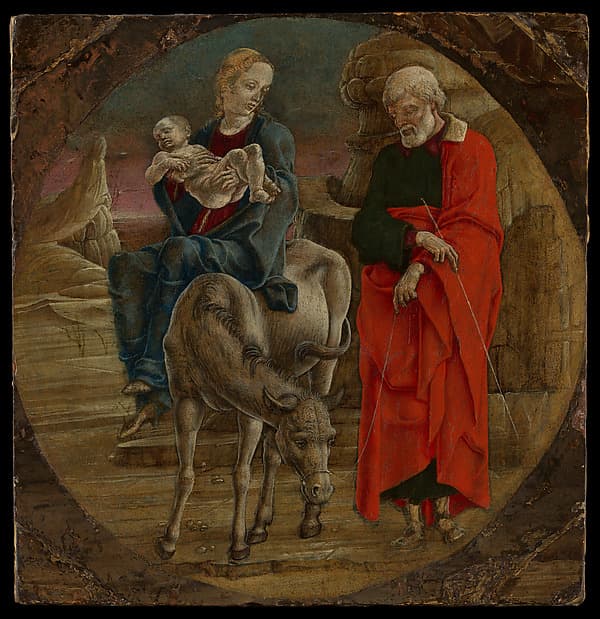
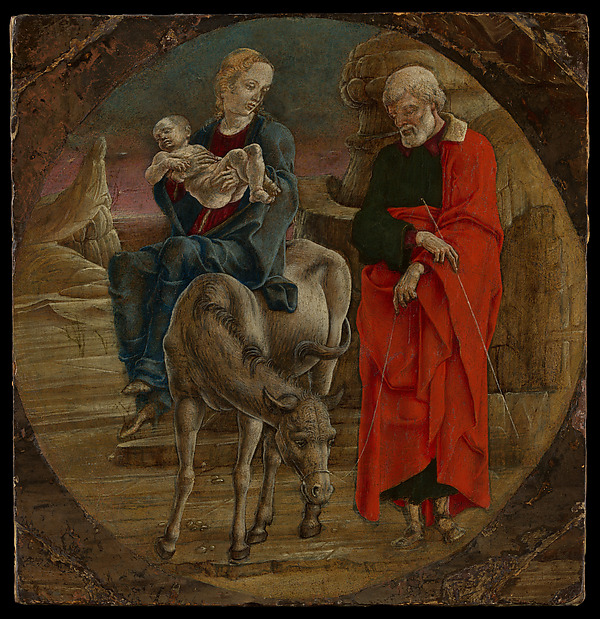
The Flight into Egypt, painted by Cosmè Tura around 1470 in tempera and gold on panel and now in the Metropolitan Museum of Art in New York, is a small predella panel from one of his late Ferrarese altarpiece commissions. The painting depicts the apocryphal subject of the Holy Family fleeing King Herod's persecution as recorded in Matthew 2: the Virgin riding on the small donkey holding the swaddled Christ Child, Joseph leading the donkey on foot through a craggy rocky landscape. Tura stages the scene with characteristic late-Quattrocento Ferrarese compositional intensity — figures in extreme proportional elongation, jewel-bright color (saturated crimson and ultramarine), and the angular dry handling of the rocky terrain that became the unmistakable Tura signature. The panel was almost certainly part of one of Tura's larger Ferrara altarpieces (the dispersed Roverella Altarpiece of 1474 has been suggested) before being separated from its parent structure in the eighteenth or nineteenth century.
Bible scenes Cosmè Tura (Cosimo di Domenico di Bonaventura) painted
Matthew